Lemon Blueberry Cake (Fresh, Moist & Elegant)
🎁 FREE E-BOOK: 12 Sweet Favorites — reader-loved desserts in one beautiful recipe book.
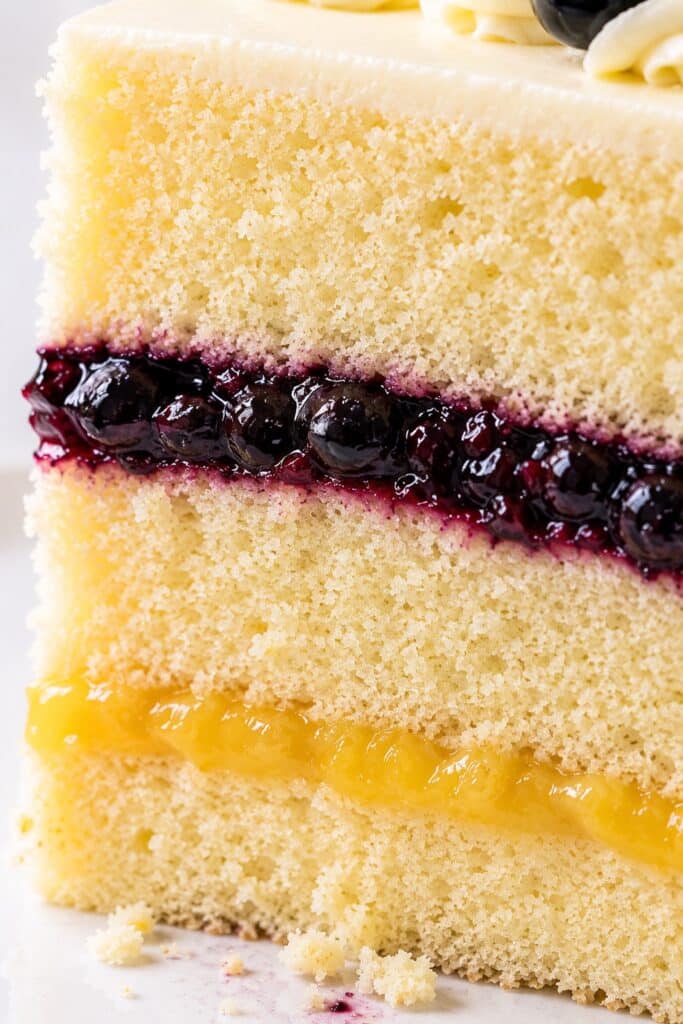
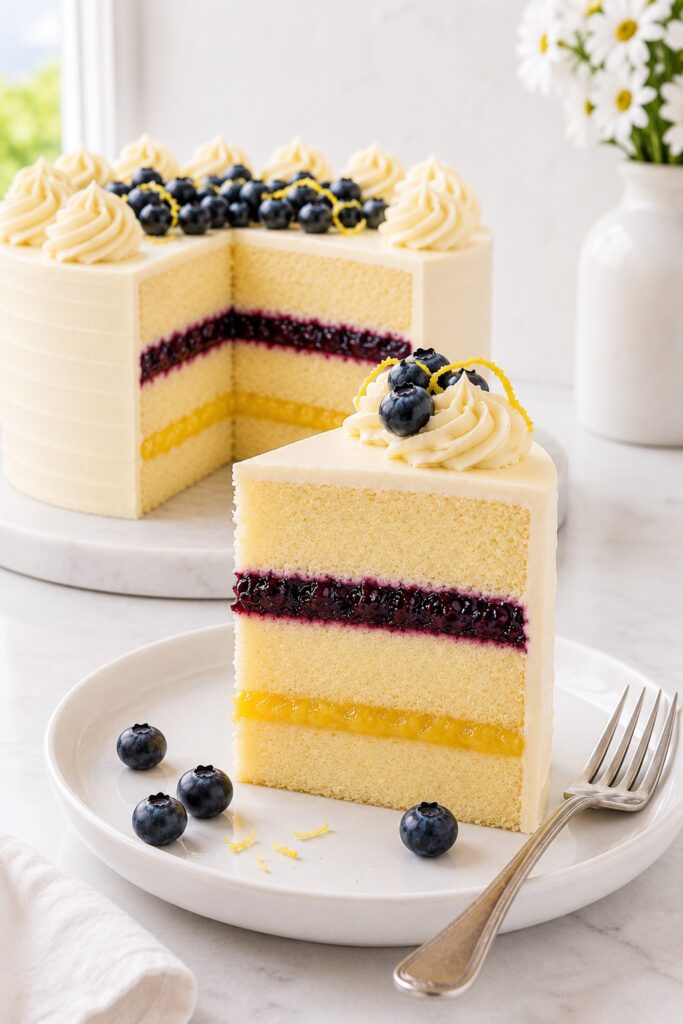
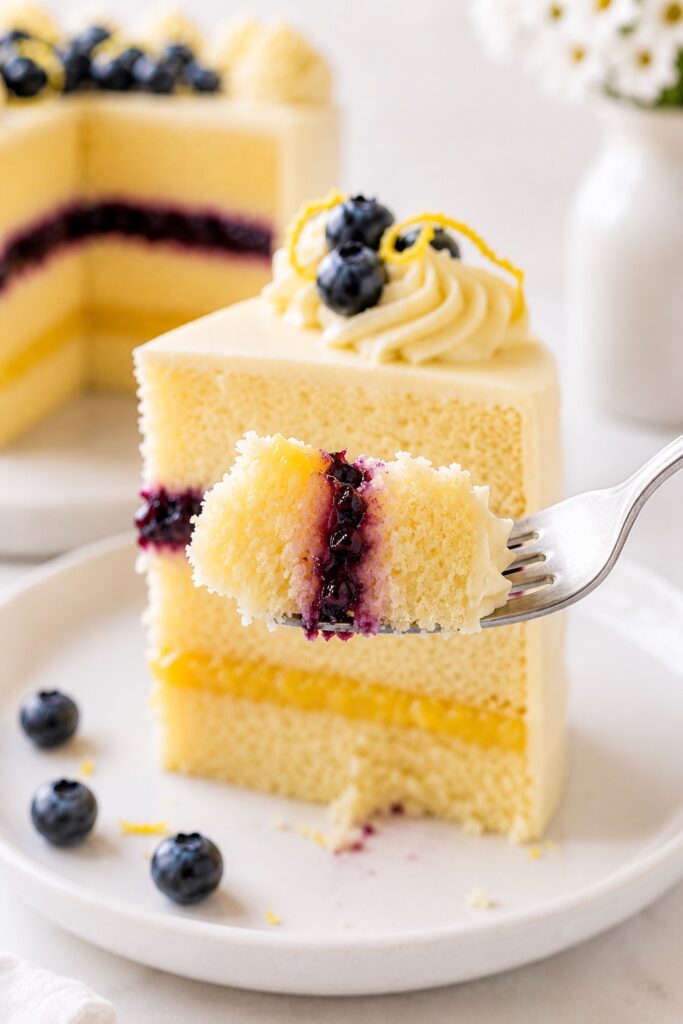
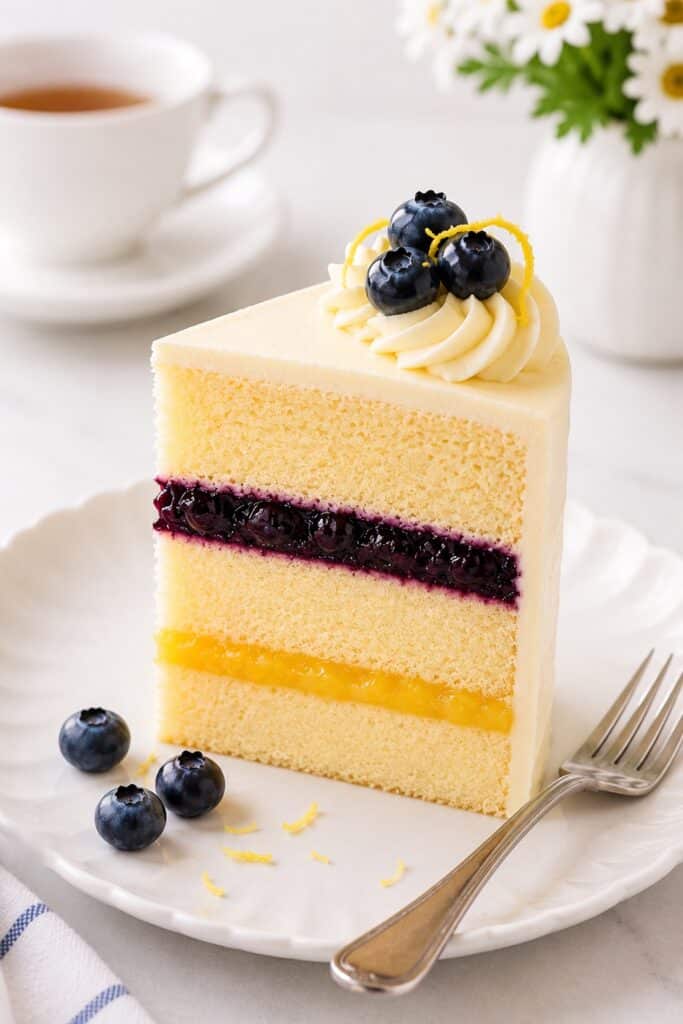
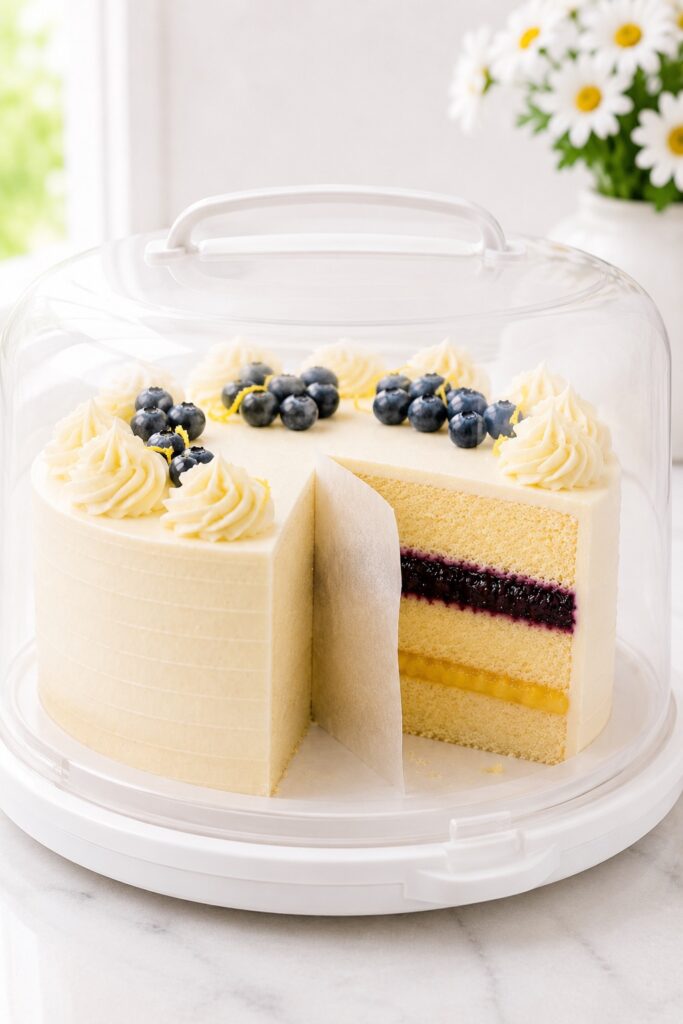
The first slice of this Lemon Blueberry Cake reveals everything that makes it special: three soft lemon layers, a glossy ribbon of lemon curd, a deep violet blueberry filling, and smooth ivory frosting wrapped around the outside. The crumb is fine and plush rather than coarse, the fillings stay clearly defined, and every forkful moves from bright and tangy to sweet, creamy, and buttery.

This is a true celebration cake, but it is not built on appearance alone. The lemon layers are made with butter for flavor, oil for lasting moisture, buttermilk and sour cream for tenderness, and the reverse-creaming method for a soft, even crumb that is still strong enough to stack. Instead of baking blueberries into the batter, this version concentrates them in a thick homemade filling, giving the cake cleaner layers and a more distinct blueberry flavor.
Between the bottom two layers sits silky lemon curd; between the next two, a jammy blueberry compote. A stable lemon cream cheese buttercream forms protective dams around both fillings before covering the cake in a smooth, lightly tangy finish. The contrast is elegant without feeling fussy, making this the kind of cake people remember from birthdays, spring gatherings, Easter tables, summer celebrations, and Mother’s Day.
There are several components, but none needs to be rushed. The curd, blueberry filling, and cake layers can all be prepared ahead, leaving only the frosting and assembly for the following day. The instructions below show not only what to do, but what each mixture should look like, when it is ready, and how to keep a tall filled cake straight and stable from the first layer to the final slice.
What Is Lemon Blueberry Cake?
Lemon Blueberry Cake is a layered celebration cake that combines tender lemon cake with blueberries and a creamy frosting. In this version, three 8-inch lemon cake layers are filled separately with homemade lemon curd and thick blueberry compote, then covered with lemon cream cheese buttercream. Keeping the blueberries in a concentrated filling instead of scattering them through the batter preserves the cake’s soft, fine crumb and creates a vivid blueberry layer that can be tasted in every slice.
Lemon Blueberry Cake at a Glance
Before choosing a baking day, use this snapshot to understand the scale and rhythm of the recipe. The project includes three cake layers, two cooked fillings, one structural frosting, and several necessary chilling periods, but only part of the total time requires active work.
| Category | What to Expect |
|---|---|
| Texture | Moist, fine lemon crumb; silky curd; jammy blueberries; smooth, creamy frosting |
| Flavor | Bright fresh lemon, concentrated blueberry, vanilla, butter, and tangy cream cheese |
| Difficulty | Intermediate, with every stage broken into clear steps |
| Active Time | Approximately 1 hour 45 minutes |
| Total Time | Approximately 6 hours 30 minutes, including cooling and chilling |
| Yield | 14 generous slices or 16 standard slices |
| Pan Size | Three 8 × 2-inch round cake pans |
| Method | Reverse-creamed layer cake with cooked fillings |
| Best For | Birthdays, Easter, Mother’s Day, spring and summer celebrations |
| Make Ahead | Best divided across two days |
In short: this is an elegant three-layer lemon blueberry cake with two distinct fillings and enough structure for clean assembly, while remaining soft and moist when served.
Why This Lemon Blueberry Cake Works
A cake with two moist fillings succeeds only when the crumb, fillings, and frosting are designed as one system. Each decision below controls one of three pressure points—tenderness, excess water, or structural support—so the finished cake can remain soft without becoming unstable.
- Reverse creaming creates a fine, even crumb. Coating the cake flour with butter before adding most of the liquid limits excessive gluten development and helps the layers bake with a delicate, close texture.
- Butter and oil solve two different problems. Butter gives the cake a rich bakery-style flavor, while neutral oil keeps the crumb soft after the assembled cake has been refrigerated.
- Lemon zest supplies concentrated flavor without weakening the batter. Rubbing the zest into the sugar releases its aromatic oils. Fresh juice adds acidity and brightness, but is deliberately limited to ¼ cup so the cake remains balanced.
- The blueberries are cooked separately. Reducing them into a thick filling removes excess water, intensifies their flavor, and prevents wet fruit pockets from interrupting the fine crumb.
- Each filling has its own layer. The curd and compote remain visually and texturally distinct instead of blending into one slippery, overloaded center.
- The frosting is engineered for assembly. The butter and confectioners’ sugar are combined before cold brick-style cream cheese is added. This creates a firmer lemon cream cheese buttercream that can form dams, hold the layers, and support a smooth exterior.
| Common Approach | This Recipe’s Approach | Why It Matters |
|---|---|---|
| Blueberries folded into the batter | Blueberries reduced into a separate filling | Finer crumb, clearer layers, and concentrated berry flavor |
| Filling spread directly on bare cake | Thin buttercream barrier plus a piped dam | Less absorption, leaking, and bulging |
| Soft cream cheese frosting | Butter-first cream cheese buttercream | Better piping and stacking stability |
| Filling measured by eye | Maximum 200–220g per layer | Predictable height and cleaner slices |
Why You’ll Love This Cake
The appeal goes beyond pairing lemon with blueberries. Each forkful moves through four deliberate textures, while the make-ahead components and minimal decoration make the cake as practical for a host as it is memorable for guests.
- Every layer tastes different but connected. The lemon curd is sharp and silky, the blueberries are sweet and jammy, and the cream cheese frosting softens both.
- It looks dramatic without complicated decoration. A smooth ivory finish, restrained frosting swirls, blueberries, and a little lemon zest are enough.
- It slices cleanly. Properly chilled fillings and frosting dams keep the colored layers visible instead of allowing them to run into the crumb.
- Most of the work can happen ahead. Preparing the components on one day makes assembly calm and manageable on the next.
- It feels right for many occasions. The bright flavor suits warm-weather gatherings, but the polished three-layer presentation also makes it birthday-table worthy.
How the Cake Stays Moist, Fine-Crumbed, and Stable
Moisture and stability are not opposites when the fat, liquid, and proteins are balanced deliberately. Four parts of this formula work together to keep the refrigerated crumb tender while giving each layer enough strength to carry the curd, fruit, and frosting.
Reverse creaming controls gluten
Traditional creaming beats butter and sugar together to trap air. Reverse creaming begins by mixing softened butter into the flour, sugar, and leaveners. The butter coats much of the flour before the larger amount of liquid arrives, so fewer strong gluten networks form. The result is a tighter, softer crumb with small, even air pockets rather than a coarse or chewy texture.
The 90-second mixing stage after the buttermilk-oil mixture is added is still essential. It builds enough structure for the layers to rise and support two wet fillings. Skipping that stage can leave the cakes fragile; extending it unnecessarily can make them firmer than intended.
Butter provides flavor; oil protects softness
Butter becomes firm in the refrigerator, which can make an all-butter cake feel dry when cold even if it contains enough moisture. Oil remains fluid at refrigerator temperatures. Using both produces a cake with real butter flavor that regains its plush texture quickly after it is removed from the refrigerator.
Buttermilk and sour cream tenderize without making the batter thin
Buttermilk supplies fluid and acidity, while full-fat sour cream adds moisture, milk solids, and body. Their acidity works with the baking soda, but enough acidity remains to keep the flavor fresh. Because sour cream is thick, it increases tenderness without loosening the batter so much that the finished layers become weak.
Whole eggs and egg whites balance tenderness with support
Three whole eggs add emulsifiers, richness, and structure. Two additional whites reinforce the crumb without adding more yolk fat, helping the cake stay light enough for a delicate bite but strong enough to carry the curd, compote, and frosting. The two leftover yolks move directly into the lemon curd, so all six eggs used by the recipe have a purpose.
What You Need for Bright Lemon Flavor and Clean Layers
The ingredients are grouped by component in the order they are prepared, which makes advance measuring much easier. Read through all four lists before starting: the two yolks left from the cake move into the curd, and several lemon ingredients appear in more than one component.
For the Lemon Cake Layers
- 3 cups (345g) cake flour
- 1¾ cups (350g) granulated sugar
- 2½ teaspoons (10g) baking powder
- ½ teaspoon (2.5g) baking soda
- ¾ teaspoon (4g) fine salt
- 2 tablespoons finely grated lemon zest
- ¾ cup (170g) unsalted butter, softened but still cool
- ⅓ cup (80ml; approximately 73g) neutral oil
- ¾ cup (180ml) full-fat buttermilk, room temperature
- ½ cup (120g) full-fat sour cream, room temperature
- ¼ cup (60ml) fresh lemon juice, room temperature
- 2 teaspoons pure vanilla extract
- 3 large eggs, room temperature
- 2 large egg whites, room temperature; reserve the yolks for the curd
For the Thick Lemon Curd
- 2 large egg yolks, reserved from the cake
- 1 large egg
- ½ cup (100g) granulated sugar
- ⅓ cup (80ml) fresh lemon juice
- 1 tablespoon finely grated lemon zest
- ⅛ teaspoon fine salt
- 4 tablespoons (57g) unsalted butter, cubed
For the Thick Blueberry Filling
- 2 cups (280g) fresh or frozen blueberries
- ¼ cup (50g) granulated sugar
- 1 tablespoon (15ml) fresh lemon juice
- 1 tablespoon (8g) cornstarch
- 1 tablespoon (15ml) cold water
- Pinch of fine salt
For the Stable Lemon Cream Cheese Buttercream
- 2 cups (454g) unsalted butter, cool room temperature
- 6 cups (720g) confectioners’ sugar, sifted
- 1 tablespoon finely grated lemon zest
- 1 tablespoon (15ml) fresh lemon juice
- 2 teaspoons pure vanilla extract
- ½ teaspoon fine salt
- 8 ounces (226g) full-fat brick-style cream cheese, cold and cubed
For Decorating, Optional
- ½ cup fresh blueberries
- Fine lemon zest or narrow lemon twists
- A small amount of reserved lemon curd or blueberry filling
You will need approximately five to six medium lemons for the cake, curd, filling, frosting, and optional decoration. Zest each lemon before cutting and juicing it, taking only the yellow outer layer and leaving the bitter white pith behind.
How the Key Ingredients Build Moisture, Flavor, and Structure
The quantities in this formula are connected rather than independently adjustable. This table shows the main job of each structural ingredient and explains why apparently small changes—especially to the sugar, dairy, citrus juice, or cream cheese—can alter the final crumb or stability.
| Ingredient | Primary Role | What Happens If It Changes |
|---|---|---|
| Cake flour | Creates a soft, fine crumb with lower protein | All-purpose flour produces a firmer, less delicate texture |
| Granulated sugar | Sweetens, retains moisture, and delays protein setting | Reducing it significantly can make the cake drier and more compact |
| Butter | Adds flavor and coats flour during reverse creaming | Butter that is greasy or partially melted cannot coat the dry mixture evenly |
| Neutral oil | Keeps the refrigerated crumb soft | Removing it makes the cake feel firmer when chilled |
| Buttermilk | Adds moisture and acidity | Thin, low-fat substitutes produce less body and richness |
| Sour cream | Adds fat, milk solids, and tenderness | Low-fat sour cream can make the batter looser and the crumb less rich |
| Lemon zest | Supplies concentrated citrus aroma | Adding extra juice instead changes the batter’s liquid and acid balance |
| Eggs and whites | Emulsify the batter and support the layers | Incorrect quantities can cause weak, dense, or rubbery cake |
| Cornstarch | Stabilizes the blueberry filling | Undercooking it leaves the filling loose; too much creates a gummy texture |
| Brick cream cheese | Adds tang while preserving frosting structure | Tub-style or low-fat cream cheese introduces too much water |
Ingredient Substitutions That Actually Work
Use the original ingredients when possible, particularly for the cake flour and brick-style cream cheese. When a replacement is necessary, the options below preserve the formula’s acidity, fat level, liquid volume, or thickening power closely enough to keep the intended structure.
Cake flour
Cake flour gives the most refined texture and is strongly recommended. If it is unavailable, whisk and sift together 300g all-purpose flour and 45g cornstarch twice before using. The substitute will work, but the crumb may be marginally firmer and less cottony than one made with commercial cake flour.
Buttermilk
For an emergency substitute, place 2 teaspoons fresh lemon juice in a measuring cup, then add enough whole milk to reach ¾ cup (180ml). Stir and let it stand for 5 minutes. It will supply acidity but not quite the same thickness or cultured flavor as real full-fat buttermilk.
Sour cream
Replace it gram for gram with full-fat plain Greek yogurt. The layers will remain moist, although the flavor may be slightly tangier and the crumb a little less rich.
Fresh or frozen blueberries
Either works in the cooked filling. Do not thaw frozen blueberries. Begin cooking them directly from frozen and allow approximately 1–2 additional minutes for them to release their juices.
Homemade or store-bought fillings
You may replace the homemade lemon curd with ¾ cup (200–220g) of a thick refrigerated lemon curd. For a quicker blueberry layer, use the same amount of thick blueberry preserves. Avoid pourable dessert sauces because they are not concentrated enough to remain inside the frosting dam.
Cream cheese
There is no reliable direct substitute for the brick-style full-fat cream cheese in this frosting. Whipped, spreadable, and reduced-fat products contain more water and can make the frosting too soft for a tall filled cake.
Do not add more lemon juice to intensify the flavor. Extra liquid can weaken both the cake batter and the frosting. Add more finely grated zest instead, keeping the bitter white pith out.
Equipment That Makes a Tall Layer Cake Easier
Pan dimensions, accurate weights, and temperature control have more influence on this cake than specialized decorating tools. Prioritize the essential items first; the helpful tools improve speed, alignment, and finish but do not replace careful mixing or chilling.
| Equipment | Essential or Helpful | Why It Matters |
|---|---|---|
| Three light-colored 8 × 2-inch round pans | Strongly recommended | Bake all three layers together for the most even height; a research-supported holding method for fewer pans appears in the FAQ |
| Parchment rounds | Essential | Release the tender layers without tearing their bases |
| Stand mixer or strong hand mixer | Essential | Coats the flour evenly and builds the batter’s structure |
| Digital kitchen scale | Strongly recommended | Measures flour accurately and divides approximately 515g batter per pan |
| Small heavy-bottomed saucepan | Essential | Cooks the curd and blueberry filling evenly |
| Instant-read thermometer | Helpful | Checks lemon curd and cake doneness precisely |
| Cooling racks | Essential | Prevent condensation under the cake layers |
| Large offset spatula | Helpful | Spreads barriers, fillings, crumb coat, and final frosting |
| Piping bag with ½-inch round opening | Strongly recommended | Creates even frosting dams around the fillings |
| Cake turntable and scraper | Helpful | Produce a smoother, straighter exterior |
| 8-inch cake board | Helpful | Makes chilling and transporting the assembled cake safer |
Make It Across Two Days: A Calm Production Plan
Chilling is an active part of the method rather than empty waiting time: it thickens the curd and compote, firms the tender cake layers, and stabilizes the completed stack. This schedule places those rest periods between work sessions so no warm component delays assembly.
| When | What to Do |
|---|---|
| Day 1, morning or afternoon | Make the lemon curd and blueberry filling. Cover and refrigerate both until fully cold. |
| Day 1, later | Bake and cool the three cake layers. Wrap each layer tightly once completely cool. |
| Day 2 | Make the lemon cream cheese buttercream, assemble the cake, apply the crumb coat, chill, and finish decorating. |
| At least 1 hour before cutting | Refrigerate the completed cake so the fillings and frosting become stable. |
| 30–45 minutes before serving | Remove the cake from the refrigerator so the crumb and buttercream can soften. |
For a same-day cake, prepare the curd first because it needs at least 4 hours to set. Make the blueberry filling next, then bake the cake while both fillings chill. Do not begin assembly until every component is completely cool.
How to Make Lemon Blueberry Cake
Prepare the lemon curd first, the blueberry filling second, and the cake layers third; assemble only after all three are completely cold. Follow the temperatures and times, but use the visual and texture cues as the final test because pans, mixers, fruit, and stovetops behave differently.
1. Make and chill the lemon curd
In a small heavy-bottomed, nonreactive saucepan, whisk together the 2 egg yolks, 1 whole egg, ½ cup (100g) granulated sugar, ⅓ cup (80ml) lemon juice, 1 tablespoon lemon zest, and ⅛ teaspoon salt. Begin cooking immediately over medium-low heat, whisking continuously and reaching into the corners of the pan.
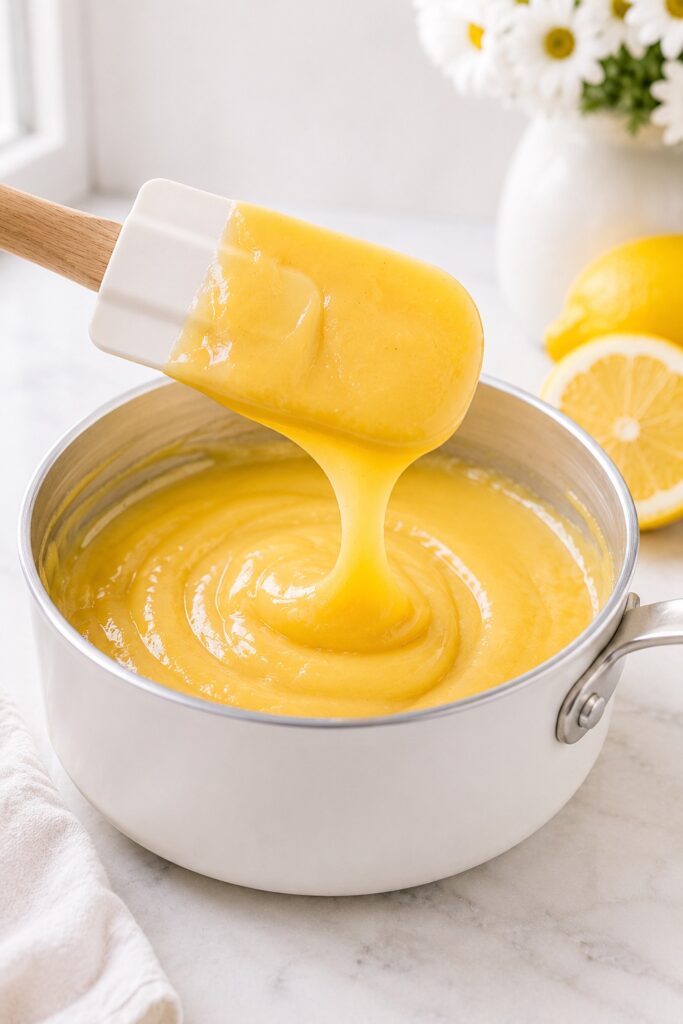
Cook for 7–10 minutes, until the curd reaches 170–175°F (77–80°C). Remove the pan from the heat and whisk in the 4 tablespoons (57g) cubed butter, one piece at a time. Pass the curd through a fine-mesh sieve into a clean bowl, press plastic wrap directly against its surface, and refrigerate for at least 4 hours.
What you should see: the hot curd should coat the back of a spoon or flexible spatula. When you draw a finger through it, the line should remain open instead of immediately flowing back together. It will look softer than the final filling because it thickens substantially as it chills.
Tip: Do not wait for the curd to look refrigerator-thick while it is still on the stove. Continuing to cook after 175°F increases the risk of grainy egg proteins and an overly firm filling.
2. Cook the blueberry filling until it holds its shape
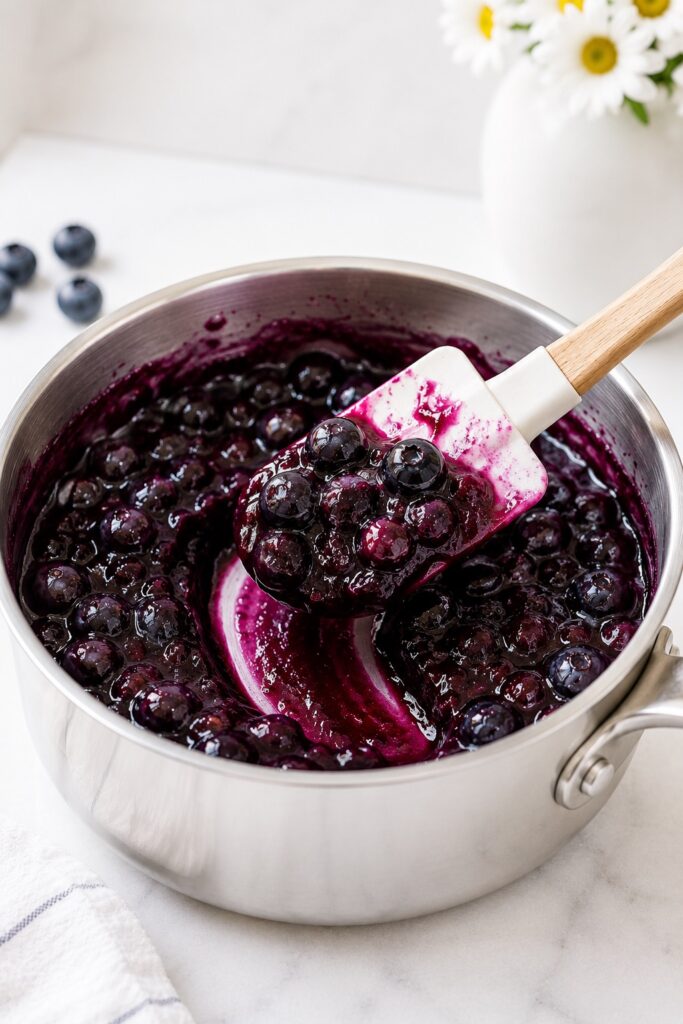
Whisk 1 tablespoon (8g) cornstarch with 1 tablespoon (15ml) cold water until completely smooth. Place the blueberries, ¼ cup (50g) sugar, 1 tablespoon lemon juice, and a pinch of salt in a small saucepan over medium heat.
Cook for 3–4 minutes for fresh blueberries or 5–6 minutes for frozen, stirring regularly, until the fruit releases enough juice to simmer. Press approximately one-third of the berries against the side of the pan, leaving the rest partially whole. Stir the slurry again, pour it into the bubbling berries, and cook for another 60–90 seconds while stirring continuously.
Transfer the filling to a shallow bowl, cool for 20 minutes, cover, and refrigerate for at least 2 hours.
What you should see: the color should change from cloudy purple to glossy deep violet as the cornstarch cooks. The compote should mound on the spoon, and a spatula drawn across the bottom of the pan should leave a path visible for approximately 2 seconds.
Why it matters: Cornstarch thickens fully only after the mixture reaches a real simmer. Removing the filling as soon as it looks warm and juicy can leave it too loose to support the upper cake layer.
3. Prepare the pans and bring the ingredients to temperature
Preheat the oven to 350°F (177°C) with a rack in the center. Lightly grease three light-colored 8 × 2-inch round cake pans. Line the bottoms with parchment rounds, then grease the parchment.
Bring the buttermilk, sour cream, lemon juice, eggs, and egg whites to approximately 68–72°F (20–22°C). The butter should be slightly cooler, approximately 65–68°F (18–20°C): flexible enough to dent when pressed, but matte rather than shiny or greasy.
Tip: Reverse-creamed batter is more forgiving than traditional creamed batter, but ingredient temperature still controls the emulsion. Cold liquid can leave small butter pieces in the batter; overheated butter cannot coat the flour properly.
4. Rub the lemon zest into the sugar
Place the 1¾ cups (350g) granulated sugar in the mixer bowl. Add 2 tablespoons finely grated lemon zest and rub the mixture between your fingertips for 30–45 seconds.
What you should see: the sugar will become faintly yellow, slightly damp, and intensely fragrant. This step distributes the lemon oils more evenly than adding untreated zest at the end of mixing.
5. Prepare the two liquid mixtures
In one measuring jug, whisk together ½ cup (120ml) of the buttermilk and the ⅓ cup (80ml) neutral oil.
In a second jug, whisk the remaining ¼ cup (60ml) buttermilk with the ½ cup (120g) sour cream, ¼ cup (60ml) lemon juice, 2 teaspoons vanilla, 3 whole eggs, and 2 egg whites until no separate streaks of white remain.
What you should see: the second mixture may look lightly curdled because acidic lemon juice is meeting cultured dairy. That appearance is normal and will disappear as the batter emulsifies.
6. Reverse cream the butter into the dry ingredients
Add the 3 cups (345g) cake flour, 2½ teaspoons baking powder, ½ teaspoon baking soda, and ¾ teaspoon salt to the lemon sugar. With the paddle attachment, mix on low for 30 seconds.
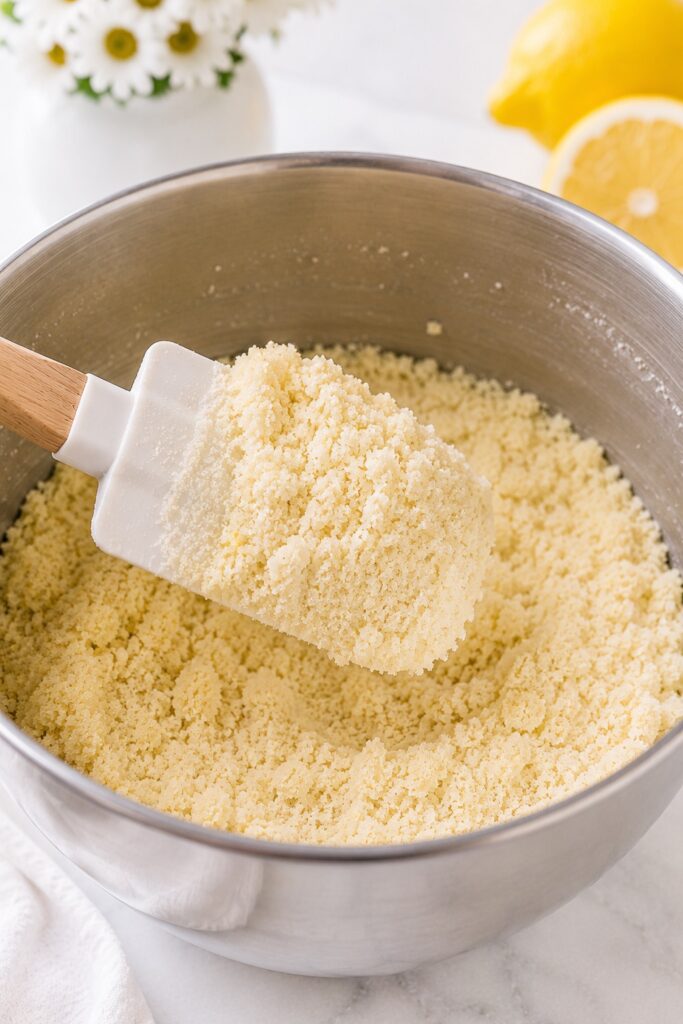
Cut the ¾ cup (170g) softened butter into tablespoon-size pieces. With the mixer running on low, add the butter gradually. Continue mixing for 90–120 seconds, stopping once to scrape the bottom of the bowl.
What you should see: every visible patch of dry flour should disappear. The mixture should resemble fine, damp sand and hold together briefly when squeezed. A few pea-size butter pieces mean it needs another 15–20 seconds.
7. Build the batter’s structure
Pour in the buttermilk-oil mixture. Mix on low for 30 seconds, scrape the bowl thoroughly, then increase to medium speed and beat for exactly 90 seconds.
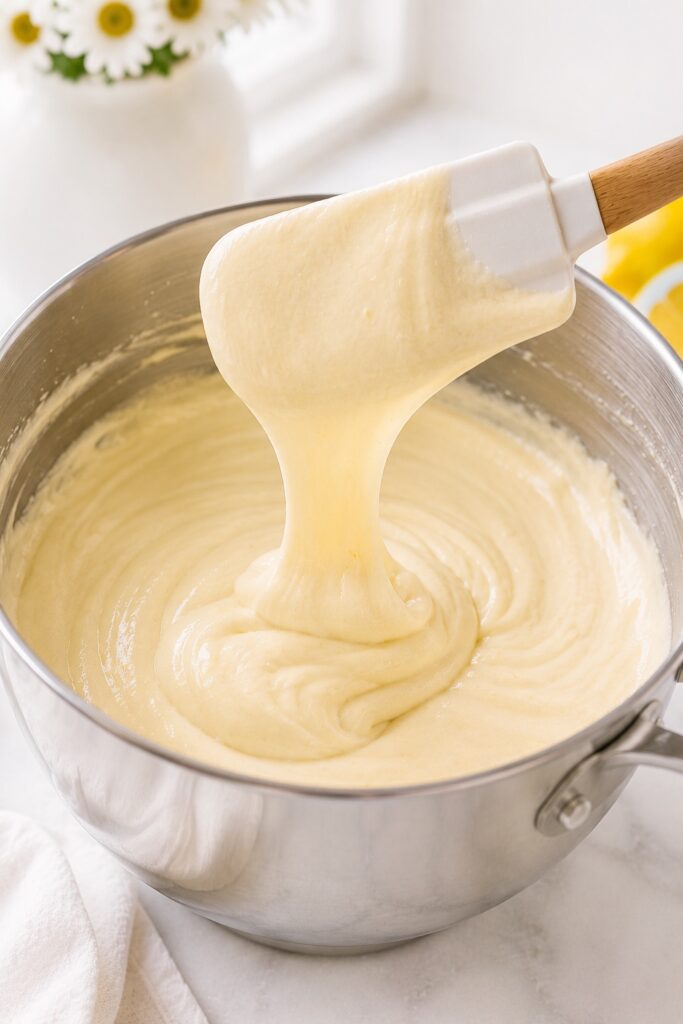
Return the mixer to low. Add the egg-sour cream mixture in three additions, mixing for approximately 15 seconds after each. Scrape the bowl after the second addition. After the final addition, mix only until the batter is uniform, approximately 10–15 additional seconds.
What you should see: before the egg mixture is added, the batter will be thick and pale. After all three additions, it should be smooth, glossy, and thick enough for a ribbon from the spatula to remain visible on the surface for 2–3 seconds.
Why it matters: The full 90-second structural mix is intentional. Once the egg mixture begins going in, however, longer beating adds no benefit and can create excess air or a firmer crumb.
8. Divide and bake the layers
Divide the batter evenly among the prepared pans, using approximately 515g per pan. Smooth each surface with a small offset spatula and tap each pan once against a folded kitchen towel to release any unusually large air pocket.
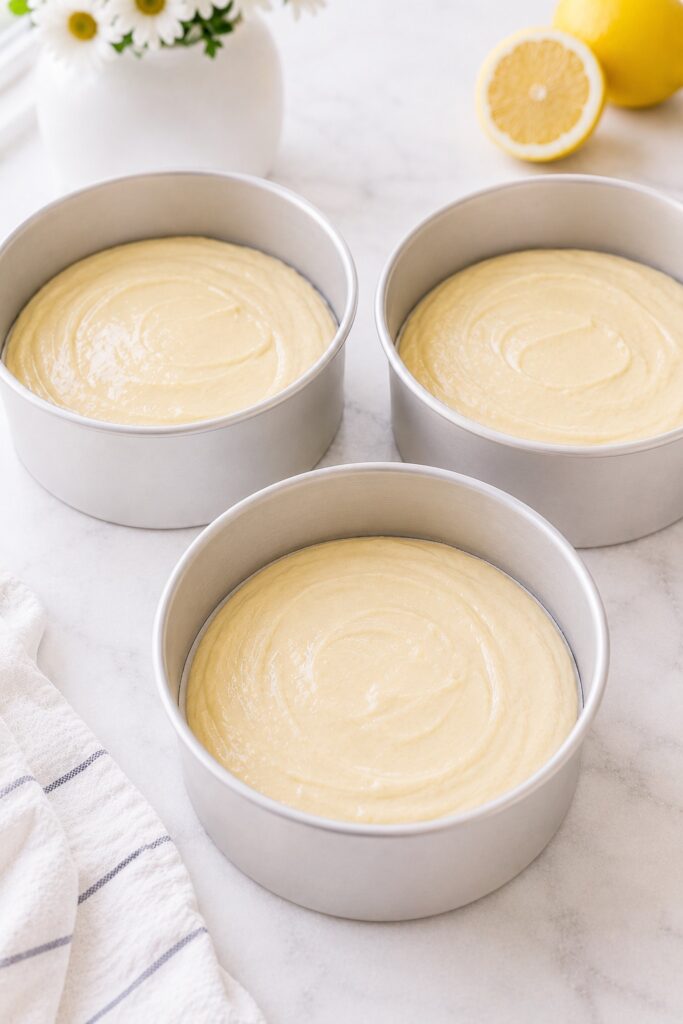
Bake for 23–27 minutes. Keep the oven closed for the first 22 minutes. Begin checking at 23 minutes and remove each layer as soon as it meets the doneness cues below.
What you should see: the tops should be pale yellow-gold and almost level, with faintly golden edges. The centers should spring back slowly when touched, and a tester should show a few moist crumbs but no glossy batter.
9. Cool and chill the cake layers
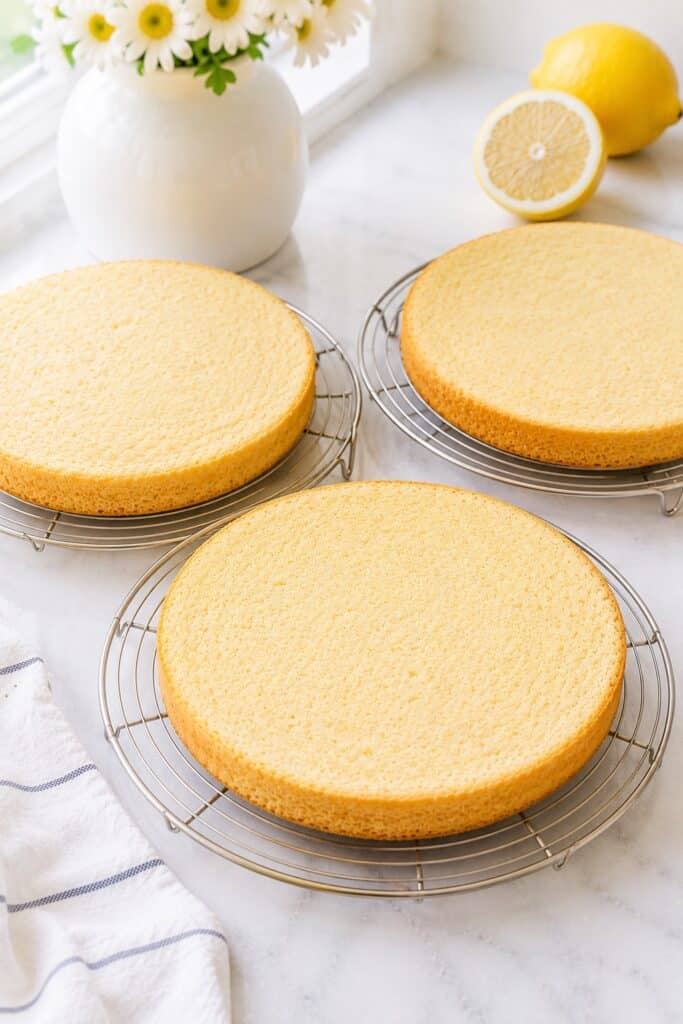
Cool the cakes in their pans for exactly 10 minutes. Run a thin flexible spatula around the edges, invert onto cooling racks, and remove the parchment. Turn the layers right side up and cool completely for approximately 75–90 minutes.
Once cool, wrap each layer tightly and refrigerate for at least 30 minutes before assembling. Level only a dome higher than approximately ⅛ inch; unnecessary trimming removes the softest part of the cake and reduces its final height.
Tip: Do not wrap warm cake. Trapped steam wets the surface, makes the crumb fragile, and can cause the filling barrier to slide.
10. Make the stable lemon cream cheese buttercream
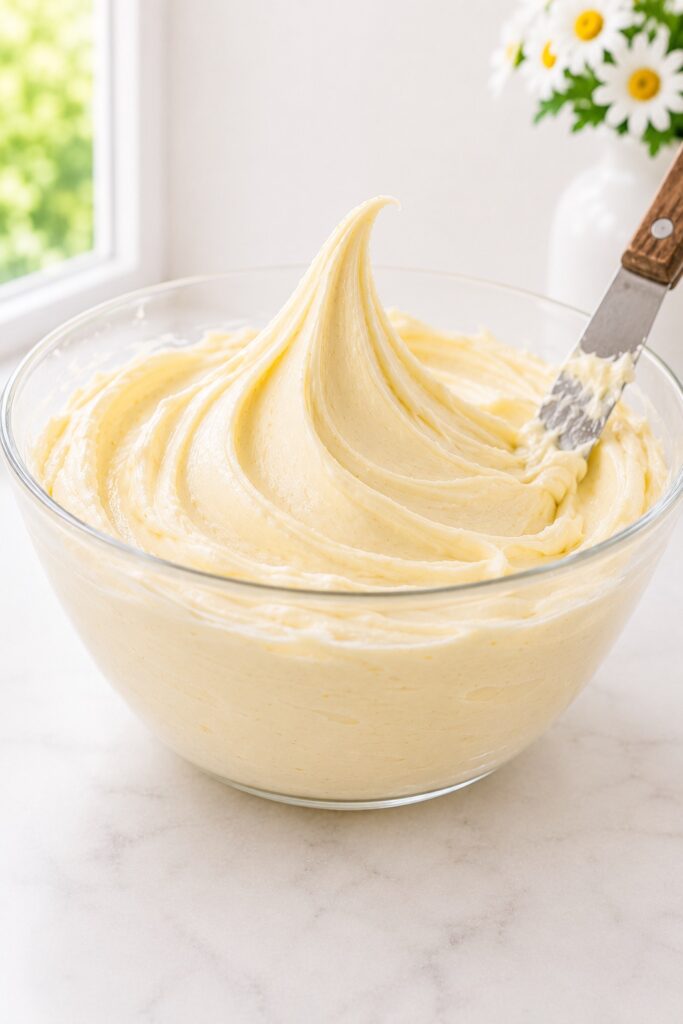
Beat the 2 cups (454g) cool room-temperature butter with the paddle attachment on medium speed for 2 minutes, until smooth and creamy but not aerated into a very fluffy mass.
Add the 6 cups (720g) sifted confectioners’ sugar in four additions, mixing on low for approximately 30 seconds after each. Add the lemon zest, lemon juice, vanilla, and salt. Mix on medium-low for 60 seconds, then scrape the bowl.
With the mixer on low, add the 8 ounces (226g) cold cubed cream cheese one piece at a time. Mix for 45–60 seconds, stopping as soon as no cream cheese streaks remain. Fold the frosting against the side of the bowl several times with a flexible spatula to press out large air pockets.
What you should see: the buttercream should look smooth and hold a firm peak with only a slight curve at the tip. It should pipe a clear ridge without spreading outward. If it is softer, refrigerate it for 15 minutes, then fold it gently by hand before using.
Tip: Cream cheese is added last and mixed briefly because prolonged beating releases more of its water into the sugar. Continuing to whip after the frosting is smooth can turn a stable buttercream progressively softer.
11. Create the frosting barrier and lemon curd layer
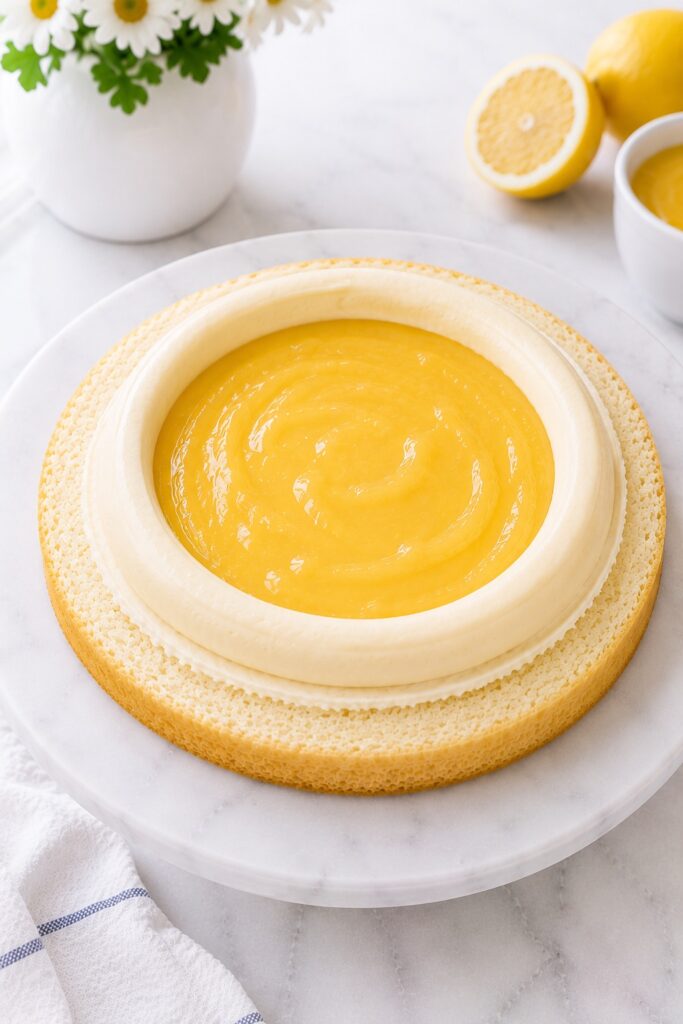
Place the first chilled cake layer on an 8-inch cake board or serving plate. Spread approximately 2 tablespoons of buttercream over the top in a very thin, continuous layer. This is a moisture barrier, not a full frosting layer.
Pipe a buttercream dam approximately ½ inch high and ¾ inch wide just inside the outer edge. If the frosting is very firm, one thick ring is sufficient; if the opening is smaller, pipe two rings directly beside each other.
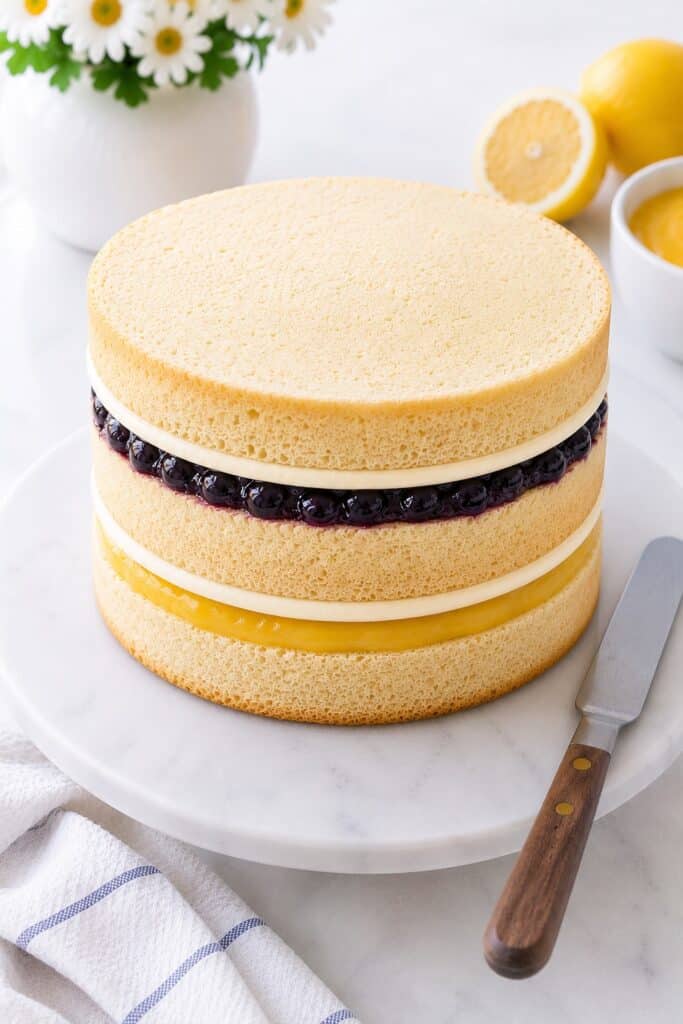
Stir the chilled curd just enough to make it spreadable. Weigh 200–220g into the center and spread it evenly, stopping before it reaches the top of the dam.
What you should see: viewed from the side, the curd should sit completely inside the buttercream boundary. No yellow filling should touch or rise above the outer edge.
12. Add the blueberry filling layer
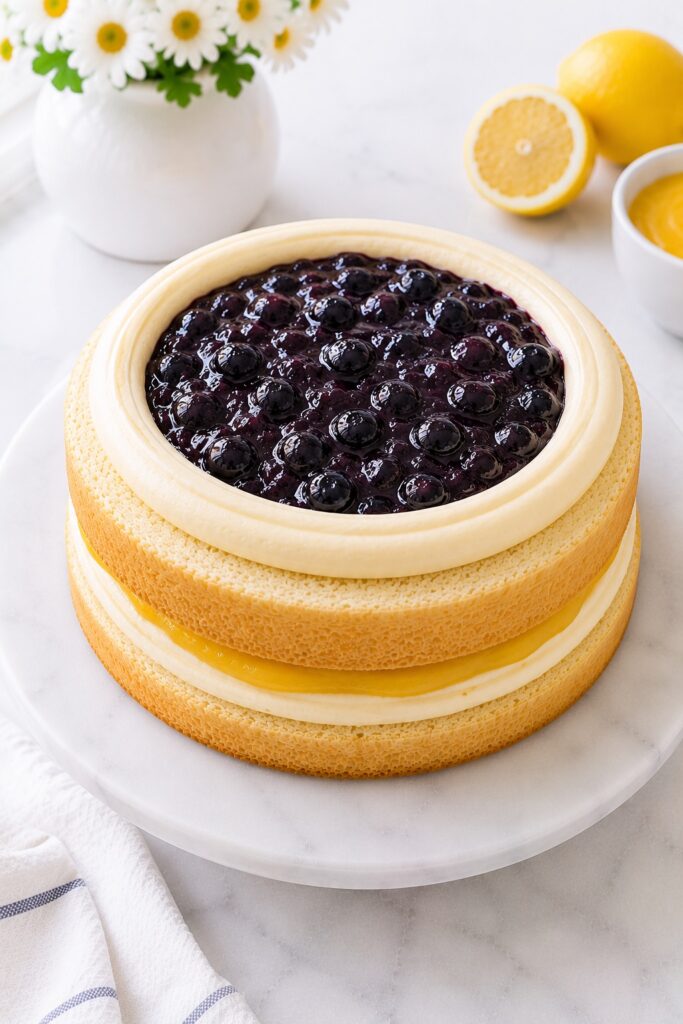
Center the second chilled cake layer over the first and lower it straight down without pressing firmly. Repeat the thin buttercream barrier and piped dam.
Stir the blueberry filling to loosen it evenly, then add 200–220g inside the dam. Spread it into a level layer while preserving some of the visible berry texture. Keep the filling below the top of the frosting boundary.
Tip: If either filling pushes above the dam, remove the excess rather than adding more frosting over it. An overfilled center is much more likely to bulge after the cake warms.
13. Stack and stabilize the cake
Place the third cake layer upside down so the flat base of the baked layer becomes the top of the cake. Check the cake from eye level and make small alignment corrections before the fillings begin to settle.
Refrigerate the filled cake uncovered for 20 minutes. This short rest firms the dams and allows the layers to settle before the exterior frosting adds more pressure.
What you should see: the stacked cake should remain vertical, with no filling visible at the sides and no gap between the cake and the frosting dams.
14. Crumb coat, finish, and decorate
Apply a thin layer of buttercream over the top and sides, filling the small spaces between the cake layers. Scrape away the excess; a crumb coat should seal crumbs rather than hide the cake completely. Refrigerate for 20–30 minutes, until the surface feels firm and no frosting transfers to a clean fingertip.
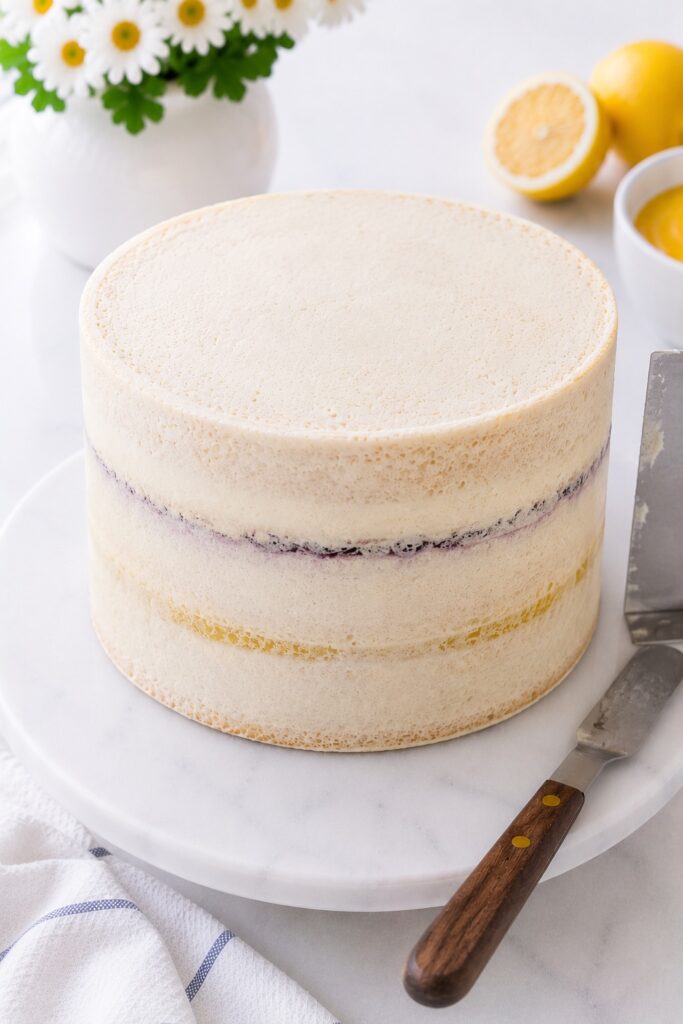
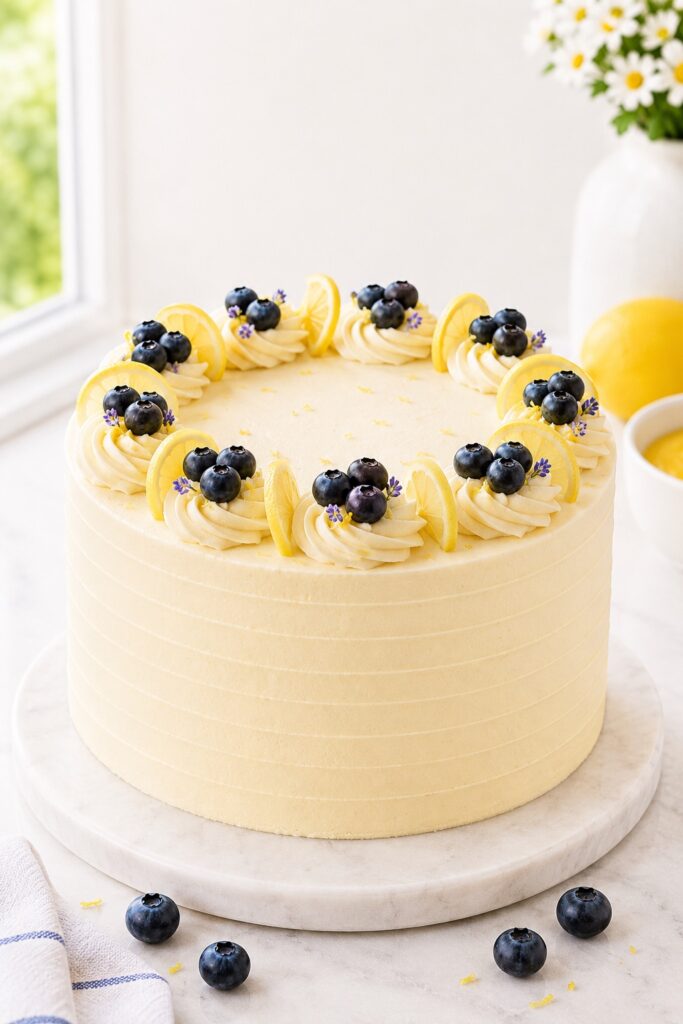
Apply the final frosting layer, approximately ¼ inch thick, and smooth it with a cake scraper or offset spatula. Use the remaining buttercream for six to eight restrained swirls around the top. Add grouped blueberries, fine lemon zest, or narrow lemon twists. If using reserved curd or compote, add only small spoonfuls on top rather than pouring a drip over the sides.
Refrigerate the completed cake for at least 1 hour before cutting.
Tip: Fresh lemon slices begin releasing juice as they sit. Add them within 1–2 hours of serving, or use dry lemon twists and zest for a decoration that can remain on the cake longer.
How to Tell When the Lemon Cake Layers Are Done
Begin checking the layers at 23 minutes. Use several cues together rather than waiting for a tester to emerge completely dry.
| Test | Correct Doneness |
|---|---|
| Surface | Pale yellow-gold, set, and nearly level rather than wet or visibly rippling |
| Edges | Faintly golden and beginning to release from the pan at one or two points |
| Touch | The center springs back slowly and does not retain a deep fingerprint |
| Tester | A few soft, moist crumbs; no streak of glossy batter |
| Internal temperature | Approximately 205–210°F (96–99°C) in the center |
An underbaked layer has a damp, shiny center that sinks after cooling. An overbaked layer pulls noticeably from the entire pan, develops darker edges, and gives a dry tester. The best moment to remove these cakes is while a few moist crumbs still cling to the tester; residual heat continues setting the crumb during the 10-minute pan rest.
How to Keep Lemon Curd and Blueberry Filling from Leaking
Filled cakes usually leak because of temperature, consistency, quantity, or pressure—not because fruit fillings are inherently unsuitable for layer cakes. Control all four and the fillings remain where they belong.
- Chill the fillings completely. Warm curd and compote are thinner and soften the buttercream dam on contact.
- Use chilled, level cake layers. Warm or noticeably domed layers shift under weight.
- Spread a thin frosting barrier first. It limits the amount of filling absorbed directly into the crumb.
- Pipe a real dam. It should be approximately ½ inch high and ¾ inch wide, not a decorative pencil-thin line.
- Limit each filling to 200–220g. The fact that more filling fits inside the ring does not mean the cake can support it cleanly.
- Keep the filling below the dam. The next cake layer must rest on frosting, not directly on slippery curd or fruit.
- Lower layers straight down. Twisting a layer across the filling pushes it toward the edge.
- Chill the filled stack before crumb coating. Twenty minutes is enough to firm the boundaries before exterior pressure is applied.
If a small bulge appears during crumb coating, refrigerate the cake for 20 minutes, remove the softened area, pipe fresh firm buttercream into the gap, and chill again before continuing. Covering an active bulge with more frosting usually hides it only temporarily.
Expert Tips for a Clean, Bakery-Style Finish
Once the formula is correct, the most visible improvement comes from small controls at transition points: how the butter feels, what remains at the bottom of the bowl, how cold the fillings are, and when mixing stops. These details create a more even crumb, straighter stack, and smoother exterior.
- Zest before juicing. A whole firm lemon is much easier to zest evenly than a squeezed half, and the fragrant oils are the main source of natural lemon aroma.
- Judge butter by texture, not time on the counter. It should accept a shallow fingerprint without collapsing around it. A glossy surface means it is already too warm.
- Scrape the lowest curve of the mixer bowl. Reverse-creamed mixtures can hide a dry band beneath the paddle; leaving it there creates floury streaks in the finished cake.
- Complete the 90-second mixing stage. The batter changes from a heavy paste to a lighter, smoother emulsion during this interval. Stopping at 30 seconds can produce tender but fragile layers.
- Weigh the filled pans. A difference of 40–50g is enough to create visibly uneven layers and a leaning stack.
- Do not chase stronger lemon flavor with extra juice. Add finely grated zest to the sugar or frosting instead. Juice changes acidity and water content much faster than it increases baked lemon aroma.
- Cool the blueberry filling in a shallow container. A deep bowl can remain warm in the center long after the outside feels cold.
- Loosen chilled curd by stirring, not warming. Even brief heating can make it fluid enough to press through the dam.
- Keep the frosting cool but flexible. Frosting that cracks as the scraper moves is too cold; frosting that develops rounded ridges and slides downward is too warm.
- Remove air before the final coat. Pressing the frosting against the bowl with a flexible spatula produces a cleaner ivory surface than beating it at high speed.
Common Mistakes and How to Fix Them
Most problems with this cake can be traced to ingredient temperature, incomplete cooking, incorrect mixing, or too much filling. Match the visible symptom to the table before making a correction; adding flour, sugar, or frosting without identifying the cause often creates a second problem.
| Mistake | What Happens | How to Fix It |
|---|---|---|
| Using cold dairy and eggs | The batter emulsifies unevenly and may bake with dense or gummy areas | Bring them to approximately 68–72°F (20–22°C) before mixing |
| Using greasy, overly warm butter | The flour is not coated evenly and the batter may feel oily | Use matte butter at approximately 65–68°F (18–20°C) |
| Stopping reverse creaming too early | Dry flour remains and the crumb becomes patchy | Mix until the entire bowl resembles evenly damp, fine sand |
| Skipping the 90-second structural mix | The layers may be very tender but too fragile to stack | Beat the buttermilk-oil stage on medium for the full 90 seconds |
| Overmixing after adding the egg mixture | Excess air and gluten can produce domes, tunnels, or a firmer crumb | Use low speed and stop as soon as the batter is uniform |
| Dividing batter by eye | The cake layers bake at different rates and the stack leans | Place each pan on a scale and add approximately 515g batter |
| Waiting for a completely dry tester | The cake loses the moisture needed after refrigeration | Remove it when the tester carries a few moist crumbs |
| Undercooking the blueberry slurry | The chilled filling remains cloudy, loose, and prone to leaking | Cook it at a full gentle bubble for 60–90 seconds |
| Assembling with warm fillings | The frosting dam softens and the layers begin sliding | Chill the curd at least 4 hours and the compote at least 2 hours |
| Adding more than 220g filling | The filling bulges from the sides as the cake settles | Remove the excess and keep the surface below the dam |
| Using tub-style cream cheese | The frosting becomes too soft for piping and smooth sides | Use full-fat brick-style cream cheese only |
| Whipping after adding cream cheese | The frosting becomes progressively looser | Mix on low for only 45–60 seconds and stop once smooth |
| Serving directly from the refrigerator | The butter and frosting feel firm, making the cake seem drier than it is | Let the cake stand for 30–45 minutes before serving |
How to Serve It for the Softest Crumb and Cleanest Slices
The cake should be chilled enough for the colored filling bands to remain aligned, but not so cold that the butter firms the crumb and masks the lemon aroma. A short tempering period, the right knife, and deliberate portioning preserve both its texture and presentation.
Bring the cake closer to room temperature
Refrigeration is necessary for stability and food safety, but this cake tastes best after standing at room temperature for 30–45 minutes. During that time, the butter in the crumb and frosting softens, the lemon aroma becomes more noticeable, and the curd regains its silky texture.
In a warm room above 75°F (24°C), begin with 20–30 minutes and check the frosting before waiting longer. The cake should feel cool, not refrigerator-hard, when served.
Cut through all three layers cleanly
Use a long, thin, sharp knife. Dip the blade into hot water, dry it completely, and make one decisive downward cut. Wipe and rewarm the blade before every slice. Sawing repeatedly with a serrated knife can drag blueberry filling into the pale crumb and blur the clean layers.
For 14 generous portions, cut the cake into wedges. For 16 celebration-size servings, cut narrow wedges or use the event-cake method: cut a straight strip approximately 2 inches from one side, divide that strip into portions, then repeat.
Let the cake be the centerpiece
The bright lemon and blueberry flavors pair naturally with coffee, black tea, Earl Grey, or an unsweetened iced tea. Because the cake already contains curd, fruit, and a rich frosting, it does not need ice cream, sauce, or an additional topping on the plate. A few fresh blueberries and a fine curl of lemon zest are enough.
Its clean ivory exterior makes it especially beautiful for spring brunches, Easter, Mother’s Day, garden gatherings, birthdays, bridal showers, and summer dinner parties.
How to Store, Refrigerate, and Freeze the Cake
Each component keeps differently, so the best storage method depends on whether the cake is still in separate parts or already assembled. Protecting it from air and managing condensation are as important as the stated time limits because both directly affect the fine crumb and smooth frosting.
| Component | Storage | Best Quality |
|---|---|---|
| Lemon curd | Airtight in the refrigerator | Up to 5 days |
| Blueberry filling | Airtight in the refrigerator | Up to 5 days |
| Unfrosted cake layers | Wrapped tightly at cool room temperature | Up to 1 day |
| Unfrosted cake layers | Wrapped tightly in the refrigerator | Up to 2 days |
| Unfrosted cake layers | Double-wrapped and frozen | Up to 2 months |
| Prepared buttercream | Airtight in the refrigerator | Up to 2 days |
| Assembled cake | Covered in the refrigerator | Up to 4 days |
| Individual cake slices | Wrapped and frozen | Up to 1 month |
Refrigerating the assembled cake
Place the cake in a tall airtight cake carrier or cover it without touching the frosting. Exposed cut surfaces dry faster than the intact exterior, so press a piece of parchment against each cut side before returning leftovers to the refrigerator.
Because the cake contains cream cheese frosting and egg-based curd, keep it refrigerated and limit its cumulative time at room temperature to 2 hours. In temperatures above 90°F (32°C), reduce that limit to 1 hour. This follows USDA guidance for perishable foods.
Freezing the cake layers
Cool the layers completely, wrap each one twice in plastic, then add a layer of foil or place them in freezer bags. Thaw overnight in the refrigerator while still wrapped so condensation forms on the wrapping instead of the cake. Chilled thawed layers can be filled and frosted directly.
Freezing the finished cake
The unfrosted layers freeze more predictably than the fully assembled cake. Lemon curd and blueberry filling can release a small amount of moisture after thawing, so freezing the whole cake is not the preferred make-ahead method. To preserve leftovers, freeze individual chilled slices on a tray until firm, wrap them tightly, and thaw overnight in the refrigerator.
Variations That Preserve the Cake’s Structure
The safest way to vary this cake is to keep the tested lemon layers and buttercream unchanged while replacing one cooked filling at a time. Every version below maintains the same 200–220g filling limit per layer so a new flavor does not compromise the stack.
Lemon Raspberry Layer Cake
Replace the 280g blueberries with 280g fresh or frozen raspberries. Keep the sugar, lemon juice, cornstarch, water, and salt unchanged. Raspberries break down faster, so cook them for 2–3 minutes before adding the slurry and expect a smoother filling with visible seeds.
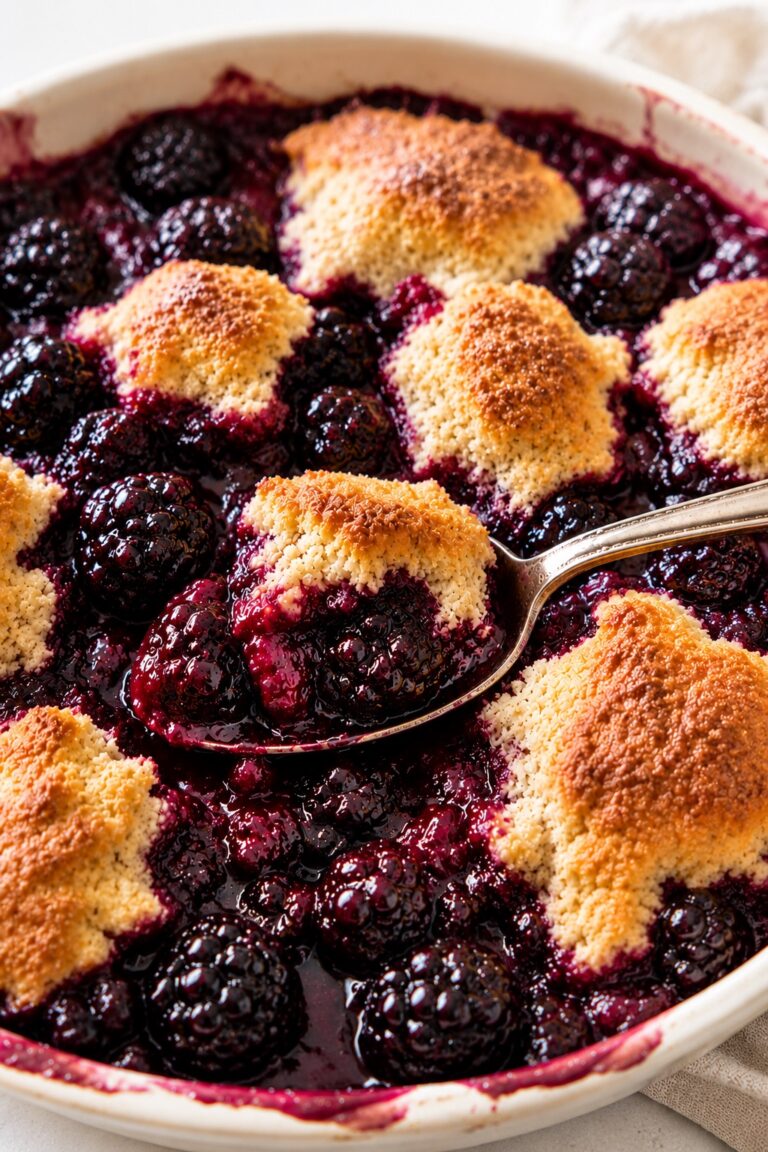
Lemon Blackberry Layer Cake
Use 280g blackberries in the filling and keep all other compote ingredients the same. Mash approximately half of the berries because their larger shape makes an even cake layer harder to spread. Cook until the same glossy, moundable consistency is reached.
Double Lemon Cake
For a cake focused entirely on lemon, double the lemon curd ingredients and use 200–220g curd between both sets of layers. Keep the frosting dams, barriers, chilling times, and cake formula unchanged.
Blueberry-Forward Layer Cake
Double the blueberry filling and use 200–220g between both layers, omitting the lemon curd. The cake and frosting still provide clear lemon flavor, while the two berry layers create a sweeter, more fruit-forward result.
Frequently Asked Questions
Pan changes, delayed baking, alternate formats, and transport all affect this recipe differently because the batter is acid-leavened and the finished cake contains two soft fillings. These answers preserve the original formula’s rise and the assembled cake’s stability wherever possible.
Can I bake this Lemon Blueberry Cake in two 9-inch pans?
Yes. Divide the batter evenly between two greased and parchment-lined 9 × 2-inch pans and bake at 350°F (177°C) for approximately 28–34 minutes. Because two cake layers create only one filling space, choose either the lemon curd or blueberry filling for the center and serve the other alongside. The original three-pan version is required to keep both fillings in separate layers.
What if I own only one or two 8-inch cake pans?
Three pans give the most identical layers, but you can bake in batches. Weigh approximately 515g batter into each available prepared pan, place the remaining portion in a covered bowl, and refrigerate it immediately. After the first layers have cooled in their pans for 10 minutes, release them, cool one pan completely, wash and reline it, then transfer the reserved batter without remixing and bake as directed. Refrigeration slows the loss of leavening power, although the later layer may still be marginally shorter.
Can I make cupcakes with this batter?
Yes. Fill lined standard cupcake wells approximately two-thirds full and bake at 350°F (177°C) for 17–21 minutes. The batter yields approximately 26–30 cupcakes, depending on how heavily the wells are filled. Once cool, remove a small center from each cupcake, add 1–2 teaspoons of either lemon curd or blueberry filling, and pipe the frosting on top. Filling every cupcake with both mixtures can make the centers overly wet.
Can I use a hand mixer for reverse creaming?
Yes, provided the hand mixer is strong and the bowl is large enough to prevent dry ingredients from escaping. Use standard beaters, keep the mixer on its lowest speed while adding butter and liquids, and follow the same visual cues and mixing times. Scrape the bowl more frequently because hand-mixer beaters cover less of its base.
Can I put both fillings in the same layer?
Do not stack full layers of curd and compote inside one dam. Together they create too much slippery filling and increase the chance of bulging. If making a two-layer cake, choose one as the center filling and serve the second with individual slices.
Can I use wild blueberries for the filling?
Yes. Use the same 280g weight. Their smaller size creates a smoother, more evenly spread filling, and their flavor is often more concentrated. If frozen, cook them directly from the freezer without thawing.
How do I transport a filled three-layer cake safely?
Refrigerate the completed cake for at least 2 hours before moving it. Place the cake board inside a fitted box or carrier on a nonslip mat, then set it on the flat floor of an air-conditioned vehicle rather than on a sloped seat. Keep the cake out of direct sunlight. For a longer warm-weather trip, place the closed carrier inside a larger insulated container with cold packs positioned around it, never directly against the cake.
Continue Your Lemon and Blueberry Baking Journey
If the contrast of bright lemon, jammy berries, and tangy cream cheese made this cake memorable, choose your next bake by the part you want to enjoy again. Stay with the lemon-blueberry flavor family, take that freshness into a different dessert format, or turn your attention to another celebration-worthy layer cake.
Stay with Bright Lemon and Blueberry Flavors
These recipes keep lemon, blueberries, or both at the center, while offering a simpler shape or a new balance of fruit, cake, and cream cheese.
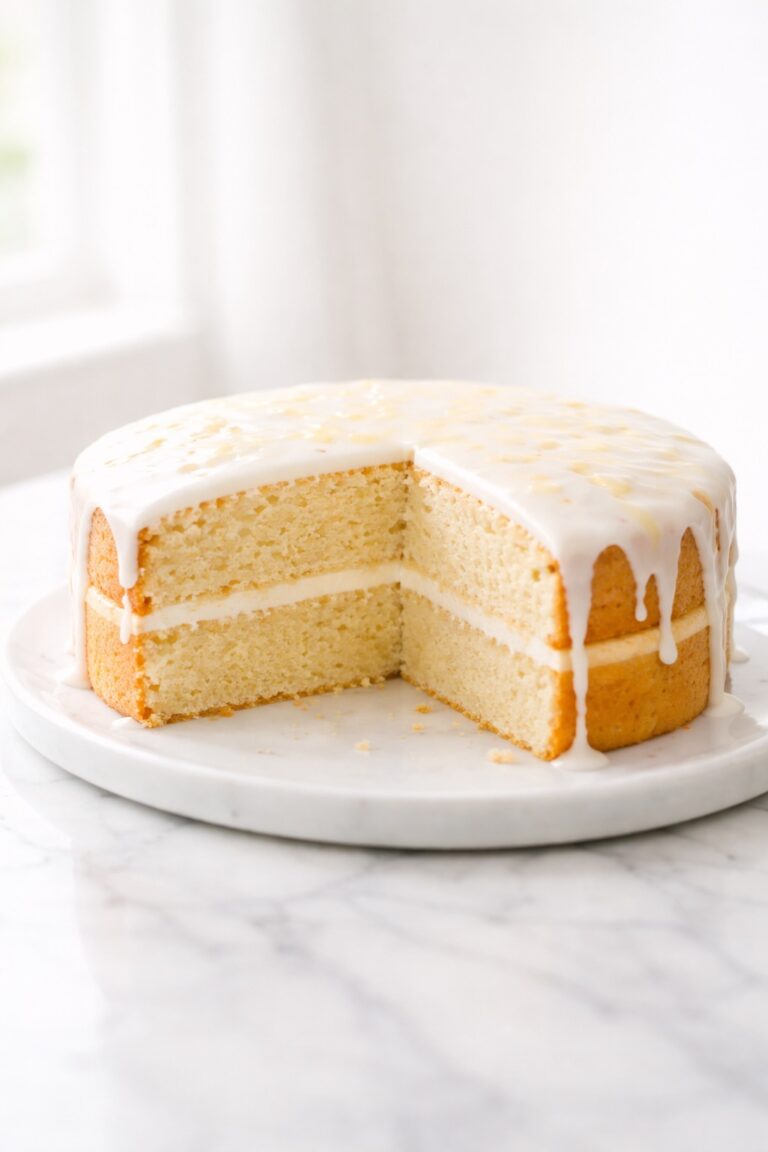
- Lemon Blueberry Muffins — choose these when you want the same lemon-blueberry pairing in soft individual bakes with a crumbly streusel finish.
- Lemon Cake Recipe — this moist glazed cake lets the citrus side of the original recipe take center stage in a more streamlined bake.
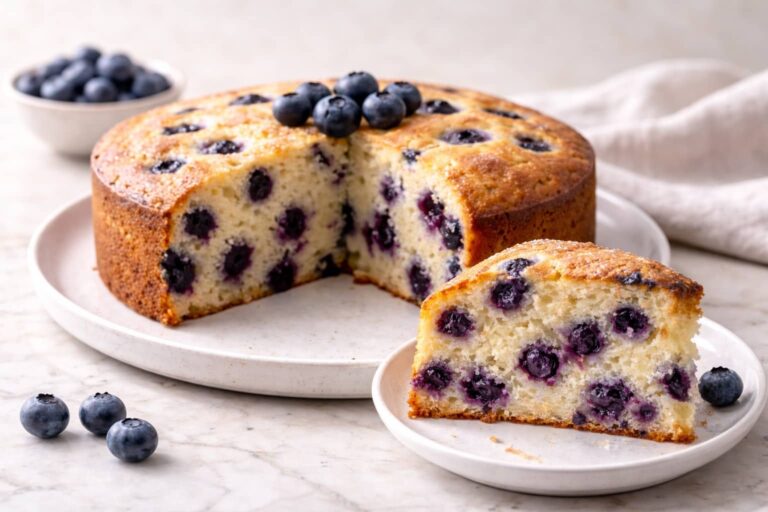
- Blueberry Cake — follow this recipe when you want tender cake with the berries in the leading role and fewer components to assemble.
- Blueberry Cream Cheese Bars Recipe — the buttery base, tangy cream cheese, and blueberry layer echo this cake’s best contrasts in an easy-to-slice bar.
Try the Same Brightness in a Different Dessert
Follow this path when you still want lively fruit or citrus, but would rather bake a bar, cheesecake, shortcake, or chilled pie than another layer cake.
- Lemon Bars — the crisp shortbread base and concentrated lemon filling deliver a sharper citrus hit in a compact, shareable dessert.
- Blueberry Cheesecake — choose this richer chilled direction for an ultra-creamy base finished with a vivid blueberry topping.
- Strawberry Shortcake Recipe — fresh berries, lightly sweetened cream, and tender shortcakes create a lighter way to continue the fruit-and-cream theme.
- Key Lime Pie — its tangy citrus filling and crumbly crust preserve the bright flavor profile while changing every element of the texture.
Bake Another Celebration-Worthy Layer Cake
When you are ready for another centerpiece, these layer cakes offer distinct flavors and textures while keeping the polished, special-occasion experience.
- Strawberry Cake — this fruit-forward layer cake is the closest celebration alternative when you want berries to shape both the flavor and presentation.
- Hummingbird Cake — choose it for a richer, cozier fruit-and-spice profile that still feels generous enough for a gathering.
- Coconut Cake — its soft coconut layers and creamy finish make an elegant next project with a gentle tropical shift.
- Red Velvet Cake — the dramatic layers, mild cocoa flavor, and tangy cream cheese frosting make it a natural choice for your next centerpiece cake.

Lemon Blueberry Cake
Three tender reverse-creamed lemon layers are filled separately with silky lemon curd and thick blueberry compote, then finished with stable lemon cream cheese buttercream. The result is a moist celebration cake with a fine crumb, bright citrus flavor, and clean, distinct filling bands.
Ingredients
Lemon Cake Layers
- 3 cups (345g) cake flour
- 1 3/4 cups (350g) granulated sugar
- 2 1/2 teaspoons (10g) baking powder
- 1/2 teaspoon (2.5g) baking soda
- 3/4 teaspoon (4g) fine salt
- 2 tablespoons finely grated lemon zest
- 3/4 cup (170g) unsalted butter, softened but still cool
- 1/3 cup (80ml; approximately 73g) neutral oil
- 3/4 cup (180ml) full-fat buttermilk, room temperature
- 1/2 cup (120g) full-fat sour cream, room temperature
- 1/4 cup (60ml) fresh lemon juice, room temperature
- 2 teaspoons pure vanilla extract
- 3 large eggs, room temperature
- 2 large egg whites, room temperature; reserve the yolks for the curd
Thick Lemon Curd
- 2 large egg yolks, reserved from the cake
- 1 large egg
- 1/2 cup (100g) granulated sugar
- 1/3 cup (80ml) fresh lemon juice
- 1 tablespoon finely grated lemon zest
- 1/8 teaspoon fine salt
- 4 tablespoons (57g) unsalted butter, cubed
Thick Blueberry Filling
- 2 cups (280g) fresh or frozen blueberries
- 1/4 cup (50g) granulated sugar
- 1 tablespoon (15ml) fresh lemon juice
- 1 tablespoon (8g) cornstarch
- 1 tablespoon (15ml) cold water
- Pinch of fine salt
Stable Lemon Cream Cheese Buttercream
- 2 cups (454g) unsalted butter, cool room temperature
- 6 cups (720g) confectioners’ sugar, sifted
- 1 tablespoon finely grated lemon zest
- 1 tablespoon (15ml) fresh lemon juice
- 2 teaspoons pure vanilla extract
- 1/2 teaspoon fine salt
- 8 ounces (226g) full-fat brick-style cream cheese, cold and cubed
Optional Decoration
- 1/2 cup fresh blueberries
- Fine lemon zest or narrow lemon twists
- A small amount of reserved lemon curd or blueberry filling
Instructions
1. Make and chill the lemon curd
Whisk the 2 egg yolks, 1 whole egg, ½ cup (100g) sugar, ⅓ cup (80ml) lemon juice, 1 tablespoon zest, and ⅛ teaspoon salt in a small heavy-bottomed nonreactive saucepan. Cook immediately over medium-low heat for 7–10 minutes, whisking continuously, until the curd reaches 170–175°F (77–80°C) and coats the back of a spoon. Remove from the heat and whisk in the 4 tablespoons (57g) butter one piece at a time. Strain into a clean bowl, press plastic wrap directly against the surface, and refrigerate for at least 4 hours.
2. Make and chill the blueberry filling
Whisk the cornstarch with the cold water until smooth. Cook the blueberries, ¼ cup (50g) sugar, lemon juice, and salt over medium heat for 3–4 minutes if fresh or 5–6 minutes if frozen, until the fruit releases enough juice to simmer. Mash approximately one-third of the berries. Re-stir and add the slurry, then cook at a real simmer for 60–90 seconds, stirring constantly, until the filling is glossy and a spatula trail remains visible for about 2 seconds. Cool for 20 minutes, cover, and refrigerate for at least 2 hours.
3. Prepare the oven, pans, and ingredients
Heat the oven to 350°F (177°C) with a rack in the center. Lightly grease three light-colored 8 × 2-inch round pans, line the bottoms with parchment, and grease the parchment. Bring the buttermilk, sour cream, lemon juice, eggs, and whites to 68–72°F (20–22°C). The butter should be flexible but matte at approximately 65–68°F (18–20°C).
4. Release the lemon oils
Place the sugar and 2 tablespoons lemon zest in the mixer bowl. Rub them together for 30–45 seconds, until the sugar looks faintly yellow, slightly damp, and fragrant.
5. Prepare the liquid mixtures
In one jug, whisk ½ cup (120ml) buttermilk with the neutral oil. In a second jug, whisk the remaining ¼ cup (60ml) buttermilk with the sour cream, lemon juice, vanilla, 3 whole eggs, and 2 egg whites until no separate white streaks remain.
6. Reverse cream the butter and dry ingredients
Add the cake flour, baking powder, baking soda, and salt to the lemon sugar. Mix with the paddle on low for 30 seconds. Add the softened butter gradually and continue mixing on low for 90–120 seconds, scraping once, until every dry patch disappears and the mixture resembles evenly damp, fine sand.
7. Finish the batter
Add the buttermilk-oil mixture. Mix on low for 30 seconds, scrape thoroughly, then beat on medium for exactly 90 seconds. Return to low speed and add the egg-sour cream mixture in three additions, mixing for about 15 seconds after each and scraping after the second. After the final addition, mix only 10–15 seconds, until the batter is smooth, glossy, and uniform.
8. Divide and bake
Divide the batter among the pans, approximately 515g per pan. Smooth the tops and tap each pan once against a folded towel. Bake for 23–27 minutes, keeping the oven closed for the first 22 minutes. The layers are ready when the tops are pale yellow-gold, the centers spring back slowly, and a tester shows a few moist crumbs but no glossy batter. The center should register approximately 205–210°F (96–99°C).
9. Cool and chill the layers
Cool in the pans for 10 minutes. Release the edges, invert onto racks, remove the parchment, and turn right side up. Cool completely for 75–90 minutes. Wrap the cool layers tightly and refrigerate for at least 30 minutes. Level only a dome higher than approximately ⅛ inch.
10. Make the stable buttercream
Beat the butter with the paddle on medium for 2 minutes, until smooth but not highly aerated. Add the confectioners’ sugar in four additions on low. Add the zest, lemon juice, vanilla, and salt; mix on medium-low for 60 seconds. With the mixer on low, add the cold cream cheese one cube at a time and mix for only 45–60 seconds, stopping as soon as no streaks remain. Fold against the bowl to remove large air pockets. The frosting should hold a firm peak; chill for 15 minutes if it is too soft.
11. Add the lemon curd layer
Place the first chilled layer on a cake board. Spread approximately 2 tablespoons buttercream over it as a thin moisture barrier. Pipe a dam approximately ½ inch high and ¾ inch wide just inside the edge. Stir the cold curd only until spreadable, weigh 200–220g into the center, and keep it below the top of the dam.
12. Add the blueberry layer
Lower the second chilled layer straight down. Repeat the thin buttercream barrier and dam. Stir the blueberry filling, weigh 200–220g into the center, and spread it evenly below the frosting boundary.
13. Stack and stabilize
Place the third layer upside down to create a flat top. Align the stack at eye level, then refrigerate uncovered for 20 minutes so the dams firm and the layers settle.
14. Crumb coat, finish, and chill
Apply a thin crumb coat and refrigerate for 20–30 minutes, until firm. Add a final buttercream layer approximately ¼ inch thick and smooth it. Pipe six to eight restrained swirls and decorate with fresh blueberries, fine lemon zest, or narrow lemon twists. Use only small spoonfuls of reserved filling on top. Refrigerate the finished cake for at least 1 hour before cutting, then temper it for 30–45 minutes before serving.
Notes
- Use fresh lemon juice and zest; zest the lemons before juicing them. Five to six medium lemons cover the cake, curd, filling, frosting, and optional decoration.
- Do not exceed 200–220g filling per layer, and keep both fillings completely cold before assembly.
- Use full-fat brick-style cream cheese. Tub-style, whipped, or reduced-fat cream cheese can make the frosting too soft.
- If using frozen blueberries, cook them without thawing and allow 1–2 extra minutes before adding the slurry.
- Three pans produce the most even layers. If baking in batches, refrigerate the reserved 515g batter in a covered bowl and transfer it to a fully cooled, relined pan without remixing.
- Keep the assembled cake refrigerated. Limit cumulative room-temperature exposure to 2 hours, or 1 hour above 90°F (32°C).
- Store covered in the refrigerator for up to 4 days. Freeze well-wrapped individual slices for up to 1 month.
- Assembling the cake does not restart the storage clock. Count the cake’s refrigerated shelf life from the day the oldest filling or frosting component was made.
Nutrition Information:
Yield: 16 servings Serving Size: 1 sliceAmount Per Serving: Calories: 820Total Fat: 47gSaturated Fat: 26gCarbohydrates: 94gFiber: 1gSugar: 75gProtein: 6g
Nutrition information is provided as an estimate only and may vary based on specific ingredients, brands, and portion sizes used. This information should not be considered medical or nutritional advice.
12 Sweet Favorites — Yours, Free 🍰
Tiramisù, no-bake cheesecake, the perfect chocolate chip cookie & 9 more reader-loved desserts — gathered into one beautiful free recipe book. From my kitchen to yours.
No spam, just sweet things. Unsubscribe anytime.