Crème Brûlée French Toast
🎁 FREE E-BOOK: 12 Sweet Favorites — reader-loved desserts in one beautiful recipe book.
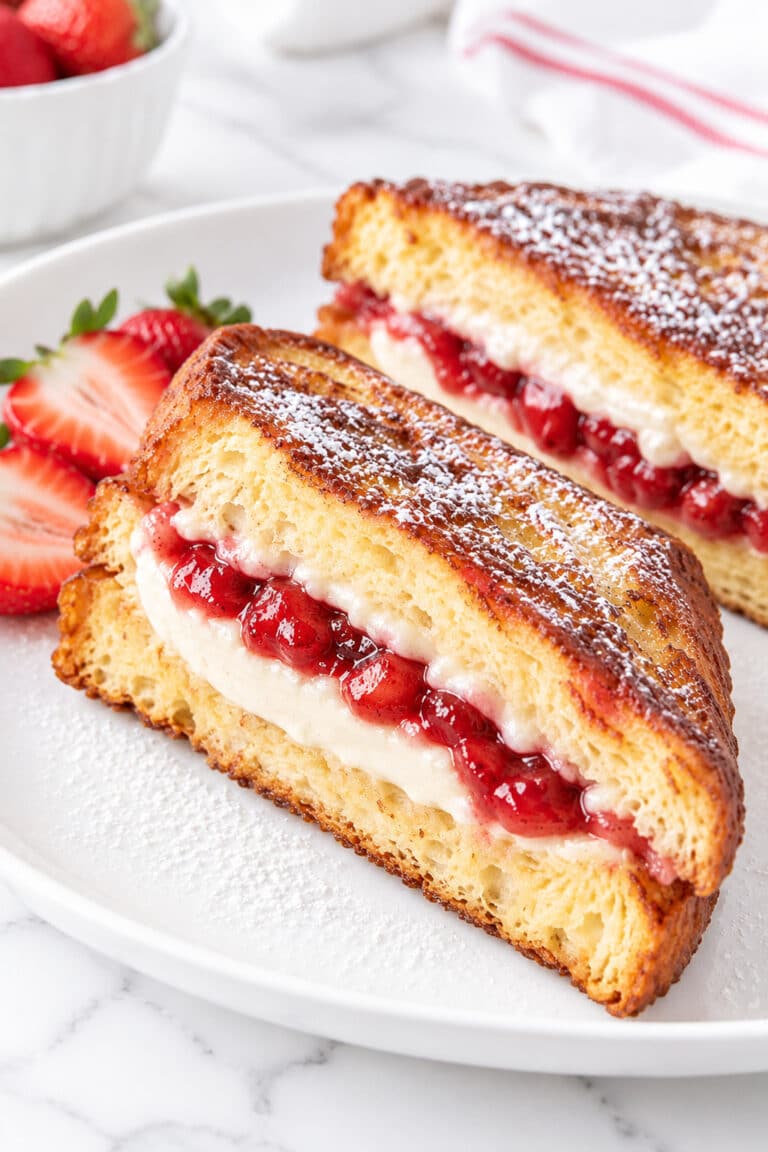
This creme brulee french toast turns thick slices of brioche into a deeply comforting brunch centerpiece, with golden edges, a soft custardy center, and a glossy layer of buttery brown sugar caramel on top.

It has the familiar warmth of French toast, but the overnight rest makes the morning feel unusually calm: the pan is assembled the night before, then baked while coffee is brewing and the table is coming together.
For the most reliable texture, use 12 ounces (340 g) of surface-dried brioche, bake the center to 160–165°F (71–74°C), and invert the slices after a five-minute rest. These three checkpoints keep the center soft and set while helping the warm caramel release cleanly.
Crème Brûlée French Toast at a Glance
This is a make-ahead baked French toast made with six whole brioche slices, a vanilla half-and-half custard, and a caramel base that becomes the topping when each slice is turned out.
| Flavor | Buttery caramel, vanilla, and lightly toasted brioche |
|---|---|
| Texture | Golden at the edges, soft and custardy in the center, with a glossy soft-set caramel top |
| Method | Assemble overnight, bake in one 9×13-inch dish, then invert the slices individually |
| Timing | 20 minutes prep, 8–12 hours chilling, 35–45 minutes baking, 5 minutes resting |
| Yield | 6 generous servings |
| Best for | Holiday mornings, weekend brunch, and make-ahead entertaining |
This version produces thick, custardy whole slices with a glossy caramel topping; it is not the skillet-style version finished with a brittle, torched sugar shell. If you want a spoonable bake made with cubes of bread, this French Toast Casserole is the closer format.
Why This Crème Brûlée French Toast Works
The recipe works because the bread quantity, center temperature, and caramel-release timing are all measured instead of relying on soak time and surface color alone.
- 340 g of surface-dried brioche: This gives the five-egg custard enough bread structure to absorb into without leaving the finished center wet or collapsed.
- A 160–165°F center: The eggs are fully set while the enriched bread remains tender rather than turning firm and rubbery.
- A five-minute inversion window: The caramel has time to settle after baking but remains warm enough to release from the pan and coat the slices.
Weighing the brioche prevents excess custard, checking the center temperature prevents an underbaked middle, and inverting after five minutes helps the caramel stay on the toast instead of sticking to the dish.
Why You’ll Love This Crème Brûlée French Toast
This recipe gives you the drama of a caramel-topped brunch dish without requiring a kitchen torch or keeping six separate slices warm on the stove.
- The morning work is light. Most of the measuring and assembly happens the night before.
- Everyone can eat together. All six servings finish in the same pan at the same time.
- The reveal feels special. Turning each slice caramel-side up creates a beautiful finish with very little last-minute decoration.
- The flavor stays familiar. Brioche, vanilla, butter, and brown sugar make it indulgent without introducing unusual flavors.
- It fits more than one occasion. The same pan works for a relaxed weekend breakfast or a holiday brunch table.
The Food Science Behind Custardy, Not Soggy, French Toast
Good baked French toast depends on controlled absorption and a fully set egg custard: the bread should hold the liquid within its crumb, not sit in a loose pool around it.
Why Slightly Dry Brioche Absorbs Custard Better
Slightly stale brioche has lost enough surface moisture to take in custard while its enriched crumb still has the strength to remain a slice. Fresh, very soft bread already contains more water and is easier to compress, which narrows the line between tender and soggy.

How the Custard Sets Without Becoming Dry
As the center heats, the egg proteins form a delicate network around the dairy absorbed by the bread. One distinction that changed the way I judge baked French toast is that custardy should mean soft and completely set—not wet in the center. For comparison, a bread pudding is intentionally spoonable, while these whole slices need enough structure to lift and invert cleanly.
The Caramel Stays Beneath the Custard While Baking
The butter, brown sugar, and corn syrup begin as a distinct layer under the brioche. That separation lets the custard set inside the bread while the caramel remains concentrated at the bottom, ready to become the topping rather than dissolving throughout the dish.
Ingredients for Crème Brûlée French Toast
The ingredient list is short, but the bread weight and dairy ratio matter because they determine whether the center becomes properly custardy or merely wet.
Ingredient List
Measure the ingredients in this order so the caramel base is ready before the bread and custard are assembled.
- ½ cup (113 g) unsalted butter
- 1 packed cup (213 g) light brown sugar
- 2 tablespoons (42 g) light corn syrup
- 12 ounces (340 g) slightly stale unsliced brioche, cut into 6 slices about 1¼ inches thick
- 5 large eggs (250 g without shells)
- 1½ cups (360 ml) half-and-half
- 2 teaspoons (10 ml) pure vanilla extract
- ½ teaspoon (3 g) fine sea salt
- Fresh berries, optional, for serving
- Powdered sugar, optional, for serving

Ingredient Notes That Matter
A few ingredient choices have a noticeable effect on how the brioche absorbs the custard and how smoothly the caramel releases.
- Brioche: Choose an unsliced rectangular loaf so you can cut six substantial, similarly sized pieces. Weigh the usable slices after trimming or cutting rather than relying on the package weight.
- Light corn syrup: This helps the brown sugar caramel remain smooth and fluid enough to release. It is not used to make the recipe sweeter than a traditional brown sugar base.
- Half-and-half: Its balance of milk and cream gives the custard richness without making it excessively heavy. If needed, replace it with 1 cup whole milk plus ½ cup heavy cream.
- Vanilla and salt: Vanilla rounds out the egg custard, while salt keeps the butter and brown sugar layer from tasting flatly sweet.

Kitchen Tools Needed
A correctly sized baking dish and a thermometer do the most important work here; the remaining tools keep the slices even and the caramel easy to handle.
- Baking dish: One 9×13×2-inch light-colored metal or ceramic baking dish that holds six slices in a single 2×3 layer.
- Bread-prep tools: A serrated knife for even 1¼-inch slices, plus a rimmed sheet pan and wire rack if fresh brioche needs drying.
- Caramel tools: A small heavy-bottomed saucepan and a heatproof silicone spatula for a smooth brown sugar mixture.
- Custard tools: A large mixing bowl, whisk, liquid measuring cup, measuring spoons, and kitchen scale.
- Doneness and serving tools: An instant-read thermometer and a thin flexible spatula for checking the center and turning out each slice.
Before You Begin
Four quick checks before assembly help the overnight preparation go smoothly and keep the custard-to-bread ratio properly balanced.
- Confirm that the six cut brioche slices weigh approximately 12 ounces (340 g) in total.
- Make sure the 9×13-inch dish holds them in one layer without overlap.
- Allow space in a refrigerator maintained at 40°F (4°C) or below for the covered pan.
- Reserve 8–12 hours for chilling and about 75 minutes from refrigerator to table the next morning.

Overnight Timeline for a Relaxed Brunch
Work backward from the serving time so the bread receives a full chill without forcing the baked slices to wait in the caramel.
| When | Plan |
|---|---|
| The previous evening | Allow about 20 minutes to make the caramel and custard and assemble the pan; add 12–15 minutes plus cooling time if the brioche is fresh. |
| 8–12 hours before baking | Place the covered dish in the refrigerator for the ideal soaking window. |
| 75 minutes before serving | Remove the dish from the refrigerator and begin preheating the oven. |
| 45 minutes before serving | Begin checking a metal dish at 35 minutes; a ceramic dish may need closer to 45 minutes. |
| 5 minutes before serving | Let the baked French toast settle briefly before turning out the slices. |
| At serving time | Invert each slice caramel-side up and bring it to the table while the topping is glossy and warm. |
What to Expect from Crème Brûlée French Toast
This French toast changes from thoroughly soaked bread to a puffed, softly set bake, and several normal signs can look unusual if you are expecting skillet French toast.
- After chilling, the brioche should look saturated and heavier, with little or no large pool of loose custard around it.
- In the oven, the slices may puff unevenly and then settle slightly during the short rest; that movement is normal for an egg custard.
- The baked center should remain soft even though it is fully set, rather than becoming dry like toast.
- The caramel topping will be glossy and spoon-soft, not a hard sheet of crackling brûléed sugar.

How to Make Crème Brûlée French Toast
Build the recipe from the bottom up—caramel first, then brioche and custard—so the finished slices can be inverted with their topping already in place.
1. Dry and Slice the Brioche
Cut the brioche into six slices about 1¼ inches thick and confirm that they weigh about 12 ounces (340 g). If the loaf is very fresh and soft, arrange the slices on a wire rack set over a sheet pan and dry them in a 275°F (135°C) oven for 12–15 minutes, turning once halfway through; cool before assembling.
What you should see: The surfaces feel dry and slightly firm, but the centers remain pale and soft rather than toasted through.
2. Make the Caramel Base
Melt the butter in a small heavy-bottomed saucepan over medium-low heat. Add the brown sugar and corn syrup and stir continuously for 2–3 minutes, just until the mixture is smooth. Pour it into the baking dish and spread it evenly across the bottom.
What you should see: A glossy, unified caramel that flows from the spatula without dry sugar pockets, scorched specks, or oily separation.

3. Arrange the Brioche
Set the six cooled brioche slices over the caramel in a single 2×3 layer. Keep them flat and avoid overlapping their edges, which would create thick areas that absorb and bake at a different rate.
What you should see: Six evenly thick slices resting directly on the caramel, with each slice occupying its own space in the dish.

4. Mix and Add the Custard
Whisk the eggs in a large bowl until no separate streaks of white remain. Whisk in the half-and-half, vanilla, and salt until uniform. Pour the custard slowly over the bread in two passes, pausing briefly between them so each slice receives a similar amount.
What you should see: The bread surfaces are evenly moistened, and the liquid around the slices is smooth and pale with no visible ropes of egg white.

5. Chill Overnight
Cover the dish tightly and refrigerate it for 8–12 hours. The assembled pan can remain refrigerated for up to 24 hours, but the shorter window gives the custard enough time to soak through the brioche without softening it more than necessary.
What you should see: The slices look plump and saturated, and most of the custard has been absorbed without a large pool of liquid surrounding them.

6. Temper and Bake
Remove the covered dish from the refrigerator and let it stand for 30 minutes while the oven preheats to 350°F (175°C). Uncover and bake for 35–45 minutes, beginning the temperature check at 35 minutes. Probe through the side of a center slice; remove the dish when the center reaches 160–165°F (71–74°C).
What you should see: Golden upper edges, gently puffed slices, no liquid custard rippling in the center, and a thermometer reading within the target range.

7. Rest and Invert
Let the dish rest for five minutes. Run a thin flexible spatula around the sides of one slice, lift it, and turn it caramel-side up onto a plate. Repeat with the remaining slices and spoon any caramel left in the dish over the tops.
What you should see: Each slice releases in one piece with a glossy amber-brown topping that slowly settles over its surface.
I have learned not to leave caramel-based French toast sitting in the pan for long after baking: once the caramel cools and thickens, more of that beautiful topping begins to stay behind on the bottom.

How to Tell When Crème Brûlée French Toast Is Done
Check the center slice for doneness: it should reach 160–165°F (71–74°C), look set rather than liquid, and remain tender when gently pressed.
| Stage | Temperature and appearance | What to do |
|---|---|---|
| Underdone | Below 160°F; wet custard is visible or the center ripples when the pan moves | Continue baking in 3–5 minute intervals and check the same center area again. |
| Perfectly baked | 160–165°F; softly set, lightly puffed, and golden at the upper edges | Remove the dish and begin the five-minute rest. |
| Overbaked | Very firm center, strongly contracted edges, or a dry, rubbery bite | Serve promptly; next time begin checking earlier, especially in a metal dish. |
The FDA’s egg-safety guidance sets 160°F as the cooking temperature for casseroles and other egg-containing dishes. The upper end of this recipe’s 160–165°F window adds a practical margin without deliberately baking the brioche dry.

Expert Tips for Crème Brûlée French Toast
These details improve consistency and presentation without repeating the main method.
- Weigh the usable slices. Brioche packages include end pieces and loaves vary in size, so weighing the six actual slices protects the custard ratio and reduces the risk of a wet center.
- Choose a rectangular unsliced loaf. Similar cross-sections create a more even 2×3 arrangement, which gives the custard a more consistent depth from slice to slice.
- Adjust the first check to the pan. Light metal usually transfers heat faster than ceramic, so checking metal at 35 minutes and expecting ceramic closer to 45 minutes avoids treating one bake time as universal.
- Probe through the side. A horizontal thermometer entry reaches the center of the middle slice without leaving a visible hole across the caramel-covered top.
- Warm the serving plates. Briefly warmed plates slow the cooling of the caramel, helping it stay glossy while the remaining slices are turned out.
Crème Brûlée French Toast Mistakes to Avoid
Most failures come from changing the bread-to-custard balance, creating uneven slice thickness, or missing the narrow window between a set custard and caramel that has cooled in the pan.
| Mistake | What Happens | Why It Happens | How to Prevent or Fix It |
|---|---|---|---|
| Using very fresh bread without drying it | The center feels wet or compressed | Soft fresh crumb brings more moisture and less absorption room | Dry only the surfaces at 275°F, then cool completely before assembly. |
| Using less than 340 g of brioche | Loose custard remains around the slices | There is not enough bread to absorb the measured custard | Weigh the six usable slices and add bread until they reach 340 g in total. |
| Overlapping the slices | Some areas stay wet while exposed edges dry | The stacked sections have a different thickness and heat path | Use the specified 9×13-inch dish and keep all six pieces in one layer. |
| Boiling the caramel aggressively | The base may scorch, separate, or become too thick | High heat drives off water rapidly and overheats the sugar | Use medium-low heat and stop as soon as the mixture is smooth. |
| Judging doneness only by color | The top looks ready while the center remains under-set | Brioche browns before the deepest custard necessarily reaches a safe set | Check the center slice with an instant-read thermometer. |
| Waiting too long to invert | More caramel stays stuck to the dish | The topping thickens as it cools | Rest for five minutes, then invert the slices individually while the caramel is still warm. |

Beautiful Ways to Serve Crème Brûlée French Toast
Serve the slices warm and caramel-side up, using fresh, bright accompaniments to frame the rich topping instead of competing with it.
Let the Caramel Be the Finish
Place each slice on a warm white plate and spoon over only the caramel that remains in the dish. Maple syrup is unnecessary here and can hide the buttery brown sugar finish that defines the recipe.
Add a Bright Berry Contrast
Arrange a small handful of raspberries, blueberries, or sliced strawberries beside the toast, leaving most of the caramel visible. Their color and acidity keep the plate from feeling too heavy.
Build a Holiday Brunch Table
For Christmas morning or Easter brunch, bring the baked dish to the table and turn out the slices onto individual plates as guests sit down. A restrained dusting of powdered sugar is enough if you want a festive finish.
Balance the Brunch
Pair the sweet, rich toast with black coffee, unsweetened tea, a citrus salad, or simply seasoned eggs. For a faster, less sweet alternative on another morning, make this classic French Toast Recipe on the stovetop.

How to Store, Make Ahead, Freeze, and Reheat Crème Brûlée French Toast
The unbaked dish is best treated as an overnight make-ahead breakfast, while leftovers should be cooled promptly, stored as individual slices, and reheated only until hot.
Make It Ahead
Assemble and refrigerate the covered dish for 8–12 hours for the best texture. It may remain refrigerated for up to 24 hours, but do not leave the raw egg custard at room temperature while planning the schedule.
Refrigerate Leftovers
Transfer cooled slices to a shallow airtight container and refrigerate within two hours. They are best within two days for texture, although the FDA advises using refrigerated cooked egg dishes within 3–4 days.
Freeze Baked Slices
Freeze only fully baked, cooled slices, wrapping them individually before placing them in an airtight freezer container. FoodSafety.gov lists 2–3 months for baked egg casseroles, but one month is the better quality limit for this brioche-and-caramel texture. Thaw overnight in the refrigerator; freezing the unbaked custard-soaked bread is not recommended.
Reheat Without Drying
For several slices, cover loosely and reheat in a 325°F (165°C) oven until the centers reach 165°F (74°C), usually about 10–15 minutes from the refrigerator. For one slice, microwave at 50% power in 30-second intervals until hot. The FDA recommends reheating cooked egg dishes to 165°F before serving.

Substitutions, Variations, and Scaling for Crème Brûlée French Toast
Keep substitutions close to the original bread weight, dairy richness, and syrup consistency. More extensive dietary changes affect how the custard sets and require different ratios.
Use Challah Instead of Brioche
Replace brioche with 12 ounces (340 g) of slightly stale challah cut to the same thickness. It absorbs the custard in a similar way, although its flavor may be a little less buttery.
Replace the Half-and-Half
Use 1 cup (240 ml) whole milk plus ½ cup (120 ml) heavy cream. This preserves the total dairy volume and a similar balance of water and fat.
Change the Vanilla
Vanilla bean paste may replace vanilla extract 1:1. Expect visible vanilla specks but no meaningful change to the custard structure.
Replace the Corn Syrup
Glucose syrup may replace light corn syrup 1:1. Golden syrup also works 1:1, but it creates a darker caramel with a more pronounced toffee flavor.
Scale the Recipe
For 12 servings, prepare two complete 9×13-inch dishes and bake each one under the same conditions as the original recipe, checking the center of each dish independently. Do not force a doubled batch into one deeper pan because the greater custard depth would change the baking time.
Dairy-free, gluten-free, and egg-free substitutions change both the custard and bread structure, so they cannot be swapped directly into this recipe. Ordinary sandwich bread and freezing the assembled dish before baking are also not recommended.
Crème Brûlée French Toast Questions
These answers cover the most common questions about preparing, baking, and serving this overnight French toast.
Do I Need a Kitchen Torch?
No. This recipe creates its glossy caramel topping by baking the brioche over a brown sugar base and inverting each slice; it is intentionally different from French toast with a brittle torched sugar crust.
Can I Make Crème Brûlée French Toast the Night Before?
Yes. Assemble it 8–12 hours before baking for the best texture, keep it covered at 40°F (4°C) or below, and bake it within 24 hours.
Why Did My French Toast Turn Out Soggy?
The most likely causes are fresh, very soft bread, less than 340 g of usable brioche, overlapping slices, or a center removed below 160°F. Check those four details before changing the egg or dairy quantities.
Why Is Corn Syrup in the Caramel?
The small amount of light corn syrup helps the butter-and-brown-sugar caramel stay smooth and fluid enough to release from the pan. Glucose syrup is the closest 1:1 substitute.
How Do I Know the Center Is Fully Cooked?
Insert an instant-read thermometer horizontally into a center slice. The French toast is ready at 160–165°F (71–74°C), when the center is softly set and no loose custard ripples around it.
Keep the Brunch Baking Going
Choose another French toast for a similar breakfast, a special brunch favorite for a different centerpiece, or a cozy bake to share with family and friends.
More Ways to Make French Toast
These recipes keep the familiar bread-and-custard character while changing the shape, timing, or flavor of the finished breakfast.
- French Toast Casserole — choose it when you want a cubed, scoopable format that is easy to portion.
- French Toast Recipe — make it when you want classic slices quickly from a skillet.
- Sourdough French Toast — its gentle tang gives the rich custard a more pronounced contrast.
- French Toast Sticks — this hand-held shape suits casual breakfasts and dipping.
More Special Brunch Favorites
For a different centerpiece, these familiar brunch recipes offer crisp, fluffy, delicate, or dramatically puffed textures.
- Belgian Waffle Recipe — ideal when you want crisp pockets and a light, airy center.
- Buttermilk Pancake Recipe — a soft, familiar stack for a more traditional breakfast table.
- Crepe Recipe — choose thin, delicate crepes when everyone wants to customize their own filling.
- German Pancakes — one oven-baked pancake creates a dramatic puff with little stovetop work.
More Cozy Bakes to Share
Choose one of these when you want a warm bake that can be shared at brunch or served as dessert.
- Homemade Cinnamon Rolls — make them when you want soft iced spirals for a holiday brunch.
- Monkey Bread — caramelized pull-apart pieces invite everyone to share from the same bake.
- Bread Pudding Recipe — a spoonable custard bake moves the bread-and-dairy idea closer to dessert.
- Sourdough Discard Cinnamon Rolls — turn sourdough discard into soft rolls with a gentle tang.
Why This Crème Brûlée French Toast Belongs in Your Recipe Box
This recipe is worth keeping because it combines overnight convenience with a soft custardy center and a caramel topping that looks special on the table.
- Custardy, Not Wet: Clear temperature and visual cues help you keep the center soft while ensuring the egg custard is fully set.
- Easy Overnight Prep: Most of the work is finished the evening before, leaving only tempering, baking, and serving for the morning.
- Classic Brunch Flavor: Brioche, vanilla, butter, and brown sugar create a familiar French toast flavor with a rich caramel topping.
- Made for Sharing: All six slices bake together, making the recipe practical for a family breakfast or holiday brunch.
- Reliable Doneness Cues: The center temperature and appearance make it easier to know exactly when the toast is ready.
- Caramel-Topped Finish: Turning out each slice reveals a glossy topping without needing a kitchen torch.
A Final Note on Crème Brûlée French Toast
With its soft vanilla-soaked center and warm caramel topping, crème brûlée French toast makes an impressive brunch without a complicated morning preparation.
Assemble it the night before, bake until the center reaches 160–165°F, and turn out the slices after their five-minute rest.
Serve it warm with fresh berries and let the glossy brown sugar caramel be the finishing touch.

Crème Brûlée French Toast
Thick brioche slices soak overnight in a vanilla half-and-half custard, bake over a buttery brown sugar caramel, and are inverted individually for a glossy caramel-topped finish. The centers stay soft and custardy but fully set, and no kitchen torch is required.
Ingredients
For the Caramel Base
- 1/2 cup (113 g) unsalted butter
- 1 packed cup (213 g) light brown sugar
- 2 tablespoons (42 g) light corn syrup
For the French Toast
- 12 ounces (340 g) slightly stale unsliced brioche, cut into 6 slices about 1 1/4 inches thick
- 5 large eggs (250 g without shells)
- 1 1/2 cups (360 ml) half-and-half
- 2 teaspoons (10 ml) pure vanilla extract
- 1/2 teaspoon (3 g) fine sea salt
Optional for Serving
- Fresh berries
- Powdered sugar
Instructions
- Dry and slice the brioche. Cut the loaf into 6 slices about 1 1/4 inches thick and confirm that the slices weigh about 12 ounces (340 g). If the brioche is very fresh, arrange it on a wire rack over a rimmed sheet pan and dry at 275°F (135°C) for 12–15 minutes, turning once; cool completely before assembling. The surfaces should feel dry and slightly firm while the centers remain soft.
- Make the caramel base. Melt the butter in a small heavy-bottomed saucepan over medium-low heat. Add the brown sugar and corn syrup and stir continuously for 2–3 minutes, just until smooth and glossy. Pour the caramel into a 9×13×2-inch light-colored metal or ceramic baking dish and spread it evenly.
- Arrange the brioche. Place the 6 cooled slices over the caramel in one flat 2×3 layer. Do not overlap the slices; each piece should rest directly on the caramel.
- Mix and add the custard. Whisk the eggs until no separate streaks of white remain. Whisk in the half-and-half, vanilla, and salt until uniform. Pour the custard slowly over the brioche in two passes so every slice is evenly moistened.
- Chill overnight. Cover the dish tightly and refrigerate for 8–12 hours; the assembled dish may remain refrigerated for up to 24 hours. After the ideal soak, the slices should look plump and saturated with little or no large pool of loose custard.
- Temper the dish. Remove the covered dish from the refrigerator and let it stand at room temperature for 30 minutes while the oven preheats to 350°F (175°C).
- Bake until softly set. Uncover and bake for 35–45 minutes, beginning the doneness check at 35 minutes. Insert an instant-read thermometer horizontally through the side of a center slice. Remove the dish when the center reaches 160–165°F (71–74°C), the upper edges are golden, and no liquid custard ripples in the middle.
- Rest and invert. Let the dish rest for 5 minutes. Loosen one slice with a thin flexible spatula, lift it, and turn it caramel-side up onto a plate. Repeat with the remaining slices and spoon any caramel left in the dish over the tops.
- Serve. Add fresh berries or a light dusting of powdered sugar, if desired, and serve while the caramel is warm and glossy.
Notes
Bread weight: Weigh the 6 usable slices after cutting. The 12-ounce (340 g) bread target maintains the correct bread-to-custard ratio.
Best chilling window: Refrigerate for 8–12 hours for the best texture; do not exceed 24 hours.
Doneness: The center slice should reach 160–165°F (71–74°C). Custardy means soft and fully set, not wet.
Caramel release: Rest for 5 minutes, then invert the slices individually while the caramel is still warm.
Substitutions: Use challah at the same 340 g weight. Replace the half-and-half with 1 cup whole milk plus 1/2 cup heavy cream. Vanilla bean paste may replace vanilla extract 1:1. Replace light corn syrup with glucose syrup 1:1, or use golden syrup 1:1 for a darker toffee flavor.
Storage: Refrigerate baked leftovers promptly. They are best within 2 days and may be refrigerated for up to 3–4 days. Reheat to 165°F (74°C).
Freezing: Freeze only fully baked and cooled slices, ideally for up to 1 month. Thaw overnight in the refrigerator. Do not freeze the unbaked custard-soaked bread.
Scaling: For 12 servings, prepare two separate 9×13-inch dishes. Do not double the recipe in one deeper pan.
Nutrition Information:
Yield: 6 Serving Size: 1 sliceAmount Per Serving: Calories: 620Total Fat: 33gSaturated Fat: 19gCholesterol: 220mgSodium: 490mgCarbohydrates: 72gFiber: 1gSugar: 46gProtein: 13g
Nutrition information is provided as an estimate only and may vary based on specific ingredients, brands, and portion sizes used. This information should not be considered medical or nutritional advice.
12 Sweet Favorites — Yours, Free 🍰
Tiramisù, no-bake cheesecake, the perfect chocolate chip cookie & 9 more reader-loved desserts — gathered into one beautiful free recipe book. From my kitchen to yours.
No spam, just sweet things. Unsubscribe anytime.