German Chocolate Cake with Rich Coconut-Pecan Filling
German Chocolate Cake brings together three tender chocolate layers, a buttery coconut-pecan filling, and a thin coat of chocolate buttercream. Sweet baking chocolate gives the crumb a gentle cocoa flavor, while toasted pecans and soft coconut make each slice richly textured. The same golden filling covers the top, framed by a modest chocolate border.

German Chocolate Cake is the kind of celebration cake that invites a proper pause at the table. A tall slice, a little coconut on the fork, and the contrast of soft cake with toasted nuts give it a generous, old-fashioned charm without needing elaborate decoration.
12 Sweet Favorites — Yours, Free 🍰
Tiramisù, no-bake cheesecake, the perfect chocolate chip cookie & 9 more reader-loved desserts — gathered into one beautiful free recipe book. From my kitchen to yours.
No spam, just sweet things. Unsubscribe anytime.Keep this German Chocolate Cake recipe for the occasions when you want to make something special and can give it time to cool. The preparation order takes you from the cooked filling to the delicate layers, with clear cues for the moment each component is ready to come together.
German Chocolate Cake at a Glance
Plan on three components and a generous cooling window for this German Chocolate Cake. Its light-brown, tender crumb has a mild chocolate flavor, rather than the dark, dense character of a fudge cake; coconut and pecans remain the defining flavors.
| Detail | What to Know |
|---|---|
| Preparation | Baked chocolate layer cake with cooked coconut-pecan filling and chocolate buttercream |
| Yield | One three-layer, 9-inch cake; 16 slices |
| Difficulty | Intermediate: separated eggs, cooked filling, and layered assembly |
| Prep Time | 75 minutes |
| Cook Time | 50 minutes, including the filling and cake baking allowance |
| Additional Time | 150 minutes for cooling and the final chill |
| Total Time | About 4 hours 35 minutes; allow longer if the layers or filling are still warm |
| Pans | Three light-metal 9-inch round cake pans, each at least 2 inches deep |
| Oven | 350°F / 175°C, conventional |
| Texture | Tender cake, softly set coconut filling, chopped toasted pecans, and a thin chocolate finish |
| Make Ahead | Prepare the layers and filling the day before, or assemble and refrigerate the cake overnight |
| Storage | Keep refrigerated; count the storage window from the day the filling is made |
Why Is It Called German Chocolate Cake?
German Chocolate Cake takes its name from the sweet baking chocolate associated with Samuel German, rather than from Germany. The coconut-pecan filling distinguishes it from many other American chocolate layer cakes.
If you enjoy coconut and pecans with a vanilla cake and cream cheese frosting, Italian Cream Cake offers a different way to enjoy that combination.
Why This German Chocolate Cake Works
The balance in this German Chocolate Cake comes from giving each component a clear role: a tender chocolate foundation, a generous coconut-pecan filling, and just enough buttercream to finish the sides and edges.
- Sweet baking chocolate lets the filling lead. Using a measured bar in the cake keeps its flavor gentle enough for the coconut and toasted pecans to remain noticeable in each bite.
- The filling reaches all three surfaces. Dividing the cooked mixture into thirds provides two interior layers and a matching top, without leaving the final layer short.
- The chocolate finish stays restrained. Narrow buttercream rings and thinly frosted sides support a tidy presentation while leaving the coconut-pecan topping visible.
Why You’ll Love This German Chocolate Cake
This German Chocolate Cake suits a celebration where you want a generous centerpiece and can prepare ahead. It is especially appealing if you enjoy coconut, toasted nuts, and a cake that offers more than one texture in every slice.
- A cake for a full table. Sixteen slices make it practical for a birthday meal or a family dessert spread.
- Work you can divide across two days. The layers and filling can be prepared the day before, leaving the finishing work for later.
- A simple decorating approach. The filling supplies most of the visual interest, so a thin side coat and small border are enough.
- Different textures in every slice. Tender sweet-chocolate layers, soft coconut, and toasted pecans give German Chocolate Cake plenty of contrast beneath its thin chocolate finish.
Choose German Chocolate Cake when you have room for three pans, refrigerator space, and time for the components to cool. If you want a simpler single-pan bake, Chocolate Sheet Cake is an easier fit for that kind of day.
The Science Behind Tender Layers and Coconut-Pecan Filling
The tender layers and stable filling in German Chocolate Cake depend on two different kinds of structure: air held in the batter and a cooked mixture that thickens further as it cools. Understanding those changes helps you judge the cake beyond the clock.
Air needs gentle handling. Creaming butter and sugar introduces air, and the beaten egg whites add more. Folding preserves that lightness; vigorous stirring after the whites go in can leave the baked layers noticeably denser. Glossy, firm peaks blend more readily than dry clumps.
Cooking and cooling do different jobs in the filling for German Chocolate Cake. Heat thickens the egg-yolk mixture, while cooling makes the finished coconut-pecan filling more suitable for spreading and stacking. A safe cooking temperature alone does not prove that it is thick enough, and a hot mixture cannot show you its final consistency.
Warmth works against assembly. Warm cake or filling can soften the buttercream and allow the layers to move. A narrow ring helps contain a properly thick filling, but it cannot turn a flowing mixture into a stable one.
Ingredients for the Cake, Coconut-Pecan Filling, and Buttercream
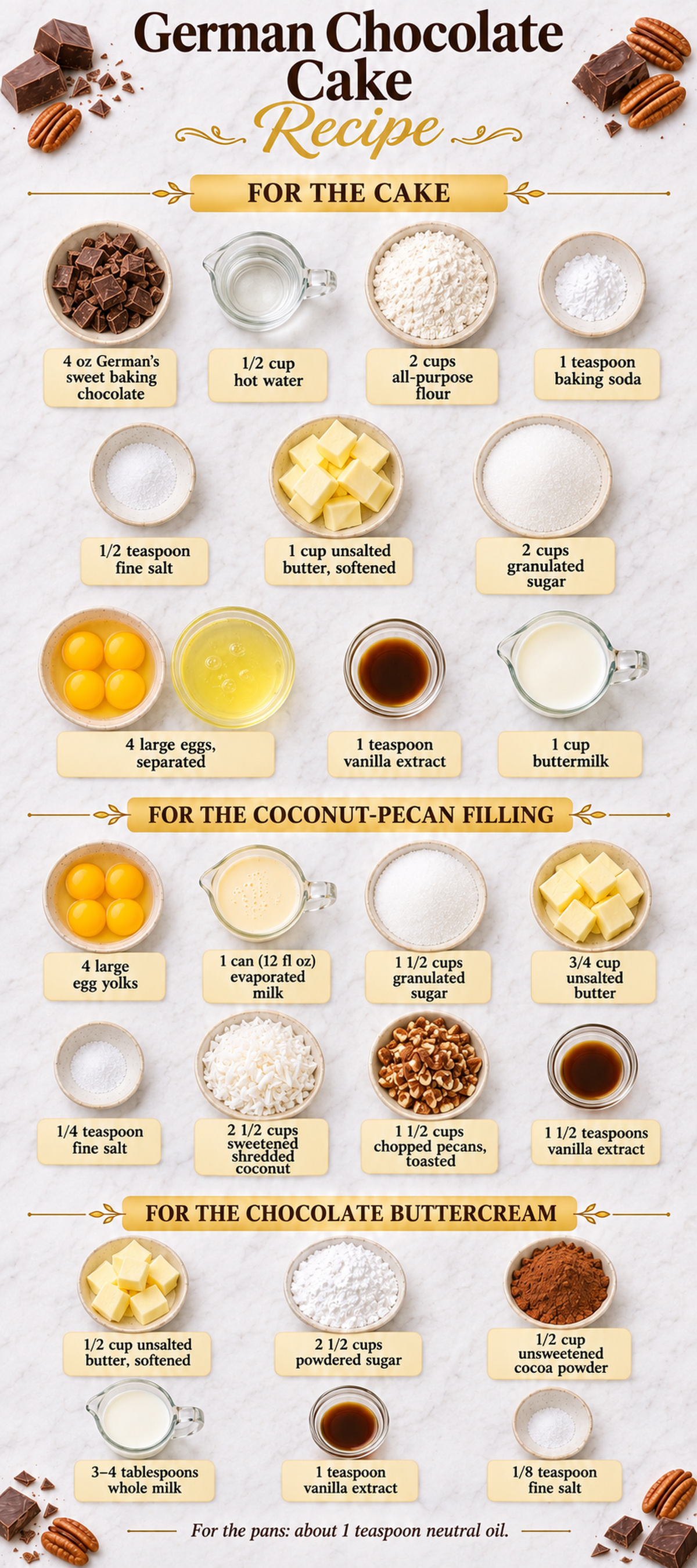
The ingredients for German Chocolate Cake are divided into the chocolate layers, coconut-pecan filling, buttercream, and a little oil for the pans. Keep the cake eggs separate from the extra yolks used in the filling.

Ingredient List
Measure each component of German Chocolate Cake before beginning. US measurements are listed first, with metric amounts alongside them; a kitchen scale is particularly helpful for the flour, chocolate, coconut, and powdered sugar.
Cake layers
- 4 oz (113 g) German’s sweet baking chocolate, approximately 48% cacao, finely chopped
- 1/2 cup (120 ml) hot water
- 2 cups (240 g) all-purpose flour, spooned and leveled
- 1 teaspoon (5 g) baking soda
- 1/2 teaspoon (3 g) fine table salt
- 1 cup (227 g) unsalted butter, softened but still structured
- 2 cups (400 g) granulated sugar
- 4 large eggs (approximately 200 g without shells), separated
- 1 teaspoon (5 ml) pure vanilla extract
- 1 cup (240 ml) cultured buttermilk, brought toward room temperature
Coconut-pecan filling and topping
- 4 large egg yolks (approximately 65–70 g)
- One 12-fl-oz can (354 ml) evaporated milk, not sweetened condensed milk
- 1 1/2 cups (300 g) granulated sugar
- 3/4 cup (170 g) unsalted butter, cut into small pieces
- 1/4 teaspoon (1.5 g) fine table salt
- 2 1/2 cups (213 g) sweetened shredded coconut
- 1 1/2 cups (170 g) chopped pecans, toasted and cooled
- 1 1/2 teaspoons (7.5 ml) pure vanilla extract
Chocolate buttercream
- 1/2 cup (113 g) unsalted butter, softened but still structured
- 2 1/2 cups (283 g) powdered sugar, measured before sifting
- 1/2 cup (42 g) unsweetened natural cocoa powder, sifted
- 3–4 tablespoons (45–60 ml) whole milk, divided: start with 3 tablespoons; use the remaining tablespoon only as needed
- 1 teaspoon (5 ml) pure vanilla extract
- 1/8 teaspoon fine table salt
Pan preparation
- Approximately 1 teaspoon neutral oil, divided between the three pans, applied as a thin film
For the German Chocolate Cake layers, separate four large eggs and use both their yolks and whites. The filling needs four additional yolks; reserve those extra whites for another recipe. Measure the evaporated milk by its stated can volume, not by assuming milliliters and grams are interchangeable.
Choosing the Chocolate, Coconut, and Milk
The right products matter in German Chocolate Cake because changing their sweetness or moisture changes more than the flavor. Check the chocolate label and choose sweetened shredded coconut and evaporated milk before you start.
German’s sweet baking chocolate: use the specified 4-ounce bar, approximately 48% cacao, for the layers. Dark chocolate and cocoa powder bring different proportions of cocoa, sugar, and fat, so they are not direct replacements here.
Sweetened shredded coconut: its soft shreds and sweetness belong in this filling. Dry, finely desiccated coconut or unsweetened flakes can produce a different texture, and simply removing the coconut leaves a very different mixture.
Evaporated milk: use the full 12-fluid-ounce can, 354 ml. Sweetened condensed milk contains added sugar and has a different consistency; it is not interchangeable in this filling.
Butter and cocoa: softened butter should give under light pressure while still holding its shape. The natural cocoa powder is for the buttercream only. Keep the cake’s chocolate mixture barely warm so it does not melt the creamed butter.
This German Chocolate Cake recipe is written for three 9-inch pans with the coconut and pecans included. For another pan size or an ingredient omission, choose a recipe designed for that change rather than carrying over these quantities and bake times.
Kitchen Tools for Three Tender Cake Layers
Have all three cake pans ready before mixing German Chocolate Cake batter, and keep a clean bowl and beaters aside for the whites. The cooked filling also needs a shallow dish and refrigerator space so it can cool while the cake bakes.
- Pans, parchment, and oven space: three light-metal 9-inch round cake pans, at least 2 inches deep; parchment circles; a baking tray for the pecans; and a conventional oven with room for all three pans and air gaps around them.
- Mixing tools: a mixer with paddle or beaters, clean whisk or beaters for the whites, a large mixing bowl, a separate grease-free egg-white bowl, and a flexible spatula.
- Filling tools: a heavy 3-quart saucepan, whisk, instant-read thermometer, and shallow heat-safe cooling dish.
- Measuring and cooling: a kitchen scale, US measuring cups and spoons, and three wire racks.
- Assembly and slicing: an offset spatula, level cake plate, serrated or sharp knife, and a piping bag with a medium round or open-star tip. A turntable is helpful but optional.
A Workback Plan for Baking and Assembling the Cake
Allow about 4 hours 35 minutes to make German Chocolate Cake in one session. This schedule includes the initial pan rest, full cake cooling, assembly, and a final chill; use the readiness cues even if your kitchen needs more time.
| Elapsed Time | Task | What Must Happen Next |
|---|---|---|
| 00:00–00:15 | Prepare pans and toast pecans | Confirm pan space and let the toasted pecans cool |
| 00:15–00:30 | Cook the filling | Finish the mixture and refrigerate promptly in a shallow dish |
| 00:30–01:00 | Mix the cake batter | Fold in the whites and divide the batter without delay |
| 01:00–01:35 | Bake the layers | Check individual pans from 28 minutes |
| 01:35–03:35 | Cool the cakes | Allow 15 minutes in the pans, then cool completely on racks |
| 03:35–04:05 | Make buttercream and assemble | Stack only when all components have the right temperature and consistency |
| 04:05–04:35 | Chill the assembled cake | Let the layers settle before slicing |
The German Chocolate Cake filling stays refrigerated while the layers are mixed, baked, and cooled. For a two-day plan, use the make-ahead guidance below; assembling later does not restart the filling’s storage clock.
Before You Begin: Pan Space and Cool Components
Before mixing German Chocolate Cake, settle the two things that are difficult to fix halfway through: space for all three pans and a place to cool the filling promptly. Once the whites are folded in, the batter should go into its pans and into the oven.
- Confirm that the pans fit with air gaps; do not place one directly beneath another or leave aerated batter waiting through a first baking batch.
- Clear refrigerator space for the shallow filling dish and, later, the assembled cake.
- Set aside clean, grease-free tools for the egg whites.
- Plan to handle cooled layers with flat support rather than lifting them by their edges.
What to Expect from the Batter, Layers, and Filling
German Chocolate Cake batter is airy and spreadable after the whites are folded in. The baked layers are tender, and the coconut-pecan filling becomes thicker as it chills, with the shreds and chopped nuts remaining clearly visible.
- Batter: a softly aerated mixture that may need gentle spreading to reach the edges of each pan.
- Layers: a delicate crumb that needs support during release and assembly.
- Filling: a textured mixture that is softer while warm and softly moundable when ready to stack.
How to Make German Chocolate Cake
Make German Chocolate Cake in this order: prepare the pans, cook and chill the filling, bake and cool the layers, then make the buttercream and assemble. The pause for cooling is essential to a cake that stays neatly stacked.
1. Prepare the Pans and Toast the Pecans
Prepare the pans and pecans before mixing the German Chocolate Cake batter. Preheat a conventional oven to 350°F / 175°C, lightly oil the three pans, and line their bases with parchment circles.
Spread the chopped pecans on a baking tray and toast for about 6–8 minutes, checking early, until fragrant and slightly deeper in color. Let them cool. Separate the four cake eggs into clean bowls, and measure the four additional yolks for the filling. Let the cake ingredients temper only while you complete the preparation.
What you should see: evenly lined pans and pecans with a toasted aroma, without dark or scorched edges.

2. Cook and Chill the Coconut-Pecan Filling
Cook the filling for German Chocolate Cake first so it has time to thicken and cool before assembly. Whisk the filling yolks with the evaporated milk in the saucepan, then add the sugar, butter, and salt.
Stir continuously over medium-low to medium heat, scraping the bottom and corners, for approximately 10–15 minutes. The mixture must reach at least 160°F / 71°C and visibly thicken enough to coat a spatula, with a trail that lingers briefly. Keep stirring beyond the temperature minimum if the mixture is still thin; avoid a violent boil or browned bits.

Remove the pan from the heat and fold in the coconut, cooled pecans, and vanilla. Transfer the filling to a shallow heat-safe dish and refrigerate promptly, loosely covered at first and fully covered once chilled. Do not leave it on the counter through the entire cake-cooling period.
What you should see: a thickened base before the coconut goes in, followed by a textured filling that holds a soft mound once cooled. A hot, flowing mixture is not ready for the cake.

3. Mix the Chocolate Batter and Fold in the Whites
Build the German Chocolate Cake batter in two stages: a creamed chocolate mixture, then the gently folded whites. Stir the hot water into the chopped sweet chocolate until smooth and let it cool until barely warm.

Whisk together the flour, baking soda, and salt. In a separate large bowl, cream the softened butter and sugar for about 3–5 minutes, until visibly paler and aerated. Beat in the four cake yolks one at a time, scraping the bowl, then mix in the cooled chocolate and vanilla.

At low speed, add the dry ingredients in three additions, alternating with the buttermilk in two additions. Begin and end with the dry mixture, and stop once the last flour disappears.
Using clean, grease-free tools, beat the four cake whites to glossy, firm peaks. Fold about one third into the batter to loosen it, then gently fold in the remaining whites until no conspicuous white streaks remain. Avoid beating or stirring hard at this stage.

Weigh the completed German Chocolate Cake batter if possible and divide it evenly among the three pans. Gently spread the tops level and move directly to baking.

What you should see: pale, aerated creamed butter; glossy whites that hold a peak; and a softly expanded chocolate batter with no obvious pockets of white.

4. Bake and Cool the Three Layers
Bake the German Chocolate Cake layers for approximately 28–35 minutes, beginning your checks at 28 minutes. Each pan may finish at a slightly different time, so judge the centers individually.
The center should spring back lightly, and a skewer should show a few small crumbs or come out clean, with no wet batter. Do not extend baking just to deepen the chocolate color.

Let the German Chocolate Cake layers rest in their pans for 15 minutes. Loosen the edges carefully, turn out each layer with flat support, remove the parchment, and cool completely on wire racks. Allow about two hours from oven exit in your schedule, but wait longer if the center of any layer still feels warm.
What you should see: set centers and supported, intact layers that are fully cool before frosting. The cakes remain tender, so avoid lifting them by their edges.

5. Make the Chocolate Buttercream
The buttercream for German Chocolate Cake should spread thinly yet hold a narrow piped ring. Beat the softened butter until smooth, then gradually incorporate the powdered sugar and cocoa on low speed.
Add the vanilla, salt, and 3 tablespoons of milk, then beat until spreadable. Add the remaining tablespoon in small increments only if needed. Stop adding milk once the frosting spreads comfortably and holds its shape.
What you should see: smooth buttercream with enough body to retain a small piped ridge rather than relaxing into a puddle.

6. Fill, Frost, and Chill the Cake
Before stacking German Chocolate Cake, check all three components together. The layers should be completely cool, the filling should hold a soft mound, and the buttercream should hold a narrow ring; if any one is not ready, pause before assembly.
Weigh the cooled German Chocolate Cake filling and divide it into three equal portions. Reserve about 100 g of buttercream for two narrow containment rings and a modest upper border, leaving the rest for a thin side coat.
Place the first layer on a level cake plate. Pipe a narrow ring around its edge and spread one portion of filling inside. Add the second layer and repeat with another ring and the second filling portion. Set the third layer on top without pressing hard enough to squeeze out the filling.

Spread a thin layer of buttercream around the sides, pipe a restrained upper border, and distribute the last filling portion across the exposed top. Keep the coconut-pecan surface visible; this amount of frosting is intended for a light finish, not thick rosettes.
Refrigerate the assembled German Chocolate Cake for about 30 minutes before slicing. Use a sharp knife and wipe it between cuts. For cake stored ahead, individual slices can temper for about 20–30 minutes while staying within the room-temperature limits in the storage section.
What you should see: three cake layers with two even interior filling seams, a coconut-pecan top, and thin chocolate sides. The layers should remain aligned when cut.

Doneness Cues for the Cake Layers and Coconut-Pecan Filling
Use a different cue for each part of German Chocolate Cake: the layers need set centers, the filling needs both cooking and cooling, and the buttercream needs enough body for the finish. Times guide your checks; the visible result tells you when to move on.
| Component | Ready Cue | What the Cue Tells You |
|---|---|---|
| Cake layers | Light spring-back; skewer without wet batter | The center has baked through without waiting for a darker color |
| Cooked filling base | At least 160°F / 71°C, coating the spatula with a briefly lingering trail | Both the cooking minimum and actual thickening have been reached |
| Cooled filling | A soft mound that stays where spread | The mixture has enough body for a filling layer |
| Buttercream | A narrow piped ring holds its shape | The frosting can support the planned restrained finish |

Expert Tips for Handling Tender Cake Layers
Careful support and even distribution matter more than elaborate decoration when assembling German Chocolate Cake. Small adjustments to how you lift, portion, and settle the components can prevent damage that extra frosting will not hide.
I’ve learned to be patient with tender cakes before lifting them out of the pan. Give each layer its initial rest, then support its full surface as you release it rather than pulling up one edge.
- Weigh the filling you actually have. Cooking changes its weight through evaporation, so divide the cooled batch into thirds instead of relying on an assumed finished cup measure; the top will receive its share.
- Keep the filling level before adding the next layer. Spread it evenly rather than leaving a thick mound in the middle, so the next cake layer sits flat without pressure.
- Lift with support, then set down gently. A broad, flat support spreads the weight of the tender layer, reducing the chance of an edge crack during transfer.
- Reserve the border frosting before coating the sides. Setting that portion aside helps keep the side finish thin and leaves enough for the narrow rings and upper edge.
Common Mistakes with Coconut-Pecan Filling and Cake Layers
Troubleshoot German Chocolate Cake by identifying whether the problem began in the batter, the cooked filling, or the assembly. Some issues can be corrected before stacking; a dense baked crumb or badly compressed layer cannot be restored by adding frosting.
| Problem | Likely Cause | Prevention or Next Action | Recovery Limit |
|---|---|---|---|
| Dense layers | Lost aeration or excessive mixing | Cream properly, keep whites glossy, and fold gently | A baked dense crumb cannot be aerated afterward |
| Broken layer | Release while too fragile or lift by an edge | Use parchment, the pan rest, and full support | A small crack may be supported inside; a crumbled layer will not carry weight evenly |
| Curdled or scorched filling | Excessive heat or poor stirring | Use moderate heat and scrape the base continuously | Remake significantly curdled or scorched filling |
| Loose filling | Insufficient cooking or cooling | Assess both thickening during cooking and consistency after chilling | Do not stack a fluid filling or expect a buttercream ring to repair it |
| Sliding layers | Warm components, uneven filling, or excess pressure | Cool completely, divide evenly, and assemble on a level plate | Chill and realign slight movement; compressed layers will not spring back |
| Dry cake | Baking beyond the center’s endpoint | Check each pan early and stop at the doneness cues | Extra frosting cannot restore moisture inside an overbaked layer |
Beautiful Ways to Serve German Chocolate Cake
Serve German Chocolate Cake so the coconut-pecan topping and the two filling seams are easy to see. A simple cake plate or uncluttered dessert plate gives the contrasting textures enough room to speak for themselves.
A Celebration Cake with the Coconut-Pecan Top on Show
Present German Chocolate Cake on a simple plate with its exposed topping facing upward and its thin chocolate sides visible. The golden coconut and pecans already provide color and texture, so the small border is enough to frame the cake.
A Generous Slice on a Simple White Plate
Serve each slice of German Chocolate Cake with its cut face visible so the tender layers and both filling seams can be seen. If the cake has been refrigerated, let individual slices stand for about 20–30 minutes before serving to soften the buttercream, while keeping within the cumulative room-temperature limit in the storage section. A simple white plate leaves the coconut and toasted pecans at the center of the presentation.

Neat Portions for a Dessert Table
Cut the chilled German Chocolate Cake into 16 slices, wiping the knife between portions for clearer filling seams. Bring out a small group of slices at a time and leave the remainder refrigerated, especially when dessert will be served over an extended period.
How to Store and Make Ahead German Chocolate Cake
German Chocolate Cake belongs in the refrigerator because of its cooked egg-yolk filling. Count its keeping time from the day that filling is prepared, even when you bake the layers or assemble the cake on a different day.
Refrigerating the Filled Cake
Keep German Chocolate Cake covered at or below 40°F / 4°C for up to 3–4 days from making the filling; aim to enjoy it in the first 2–3 days for best eating quality. Refrigerating the cake after assembly does not restart that window.
Keep German Chocolate Cake out of the refrigerator for no more than two hours in total, or one hour when the temperature is above 90°F / 32°C. That includes handling the perishable filling, assembly, and serving. These conservative limits follow FDA guidance for cooked egg dishes. Return leftovers promptly to the refrigerator.

Preparing the Components a Day Ahead
To make German Chocolate Cake ahead, bake and fully cool the layers the day before, then wrap them well. Prepare the filling, refrigerate it promptly in a shallow container, and keep it covered once chilled.
To finish German Chocolate Cake, make the buttercream with softened butter when you are ready to assemble. You can also complete the cake the previous day and refrigerate it covered. In either case, keep the filling’s original preparation date in mind when planning leftovers.
Freezing the Unfilled Cake Layers
Freeze the cooled, unfilled layers of German Chocolate Cake well wrapped for up to two months as a quality target. Thaw them wrapped before use, and wait until they are ready for gentle handling before assembling.
To prepare German Chocolate Cake further ahead, freeze the bare layers and make the filling separately. Coconut-pecan filling can change consistency after freezing and thawing, so the same quality should not be assumed for a fully assembled frozen cake. No reheating is needed.
German Chocolate Cake Questions, Answered
The most useful German Chocolate Cake questions concern filling consistency, storage, and changes to its defining ingredients. These answers help with those decisions while keeping the cake’s proportions and handling needs in view.
Why is the filling in my German Chocolate Cake runny?
It may not have thickened enough during cooking, or it may still be warm. The cooked base should coat a spatula and leave a brief trail, then the finished filling should hold a soft mound after prompt chilling. Do not fill the cake while the mixture flows freely.
Does German Chocolate Cake need to be refrigerated?
Yes. Keep this German Chocolate Cake covered at 40°F / 4°C or below because it contains a cooked egg-yolk filling. Use it within 3–4 days of making the filling, with a cumulative two-hour room-temperature limit, or one hour above 90°F / 32°C.
Can I make German Chocolate Cake the day before?
Yes. Prepare the German Chocolate Cake layers and filling ahead, or assemble the cake and refrigerate it covered overnight. Cool and wrap the layers before storing them, chill the filling promptly, and count leftover storage time from the day the filling was made.
Can I use dark chocolate in German Chocolate Cake?
Use the specified sweet baking chocolate for this recipe. Dark chocolate changes the balance of cocoa, sugar, and fat, so an equal-weight swap will not give the same batter. A cake written for dark chocolate is a better starting point for that flavor.
Can I make German Chocolate Cake without coconut or pecans?
Coconut and pecans give this filling much of its texture and bulk. Leaving either out changes both the filling and the cake’s identity. For an allergy or a strong preference, choose a cake and filling designed around the ingredients you can use.
Can I bake this German Chocolate Cake in a 9×13-inch pan?
This German Chocolate Cake recipe is written for three 9-inch round pans. A single rectangular pan changes the depth of the batter and its baking time, so these layer-cake instructions should not be transferred unchanged. Use a sheet-cake recipe for that format.
More Cakes, Pecan Desserts, and Chocolate Favorites
After German Chocolate Cake, you might want another layered centerpiece, a different way to bake with pecans, or a new chocolate texture. These three groups give you a useful direction for the next dessert.
More Layer Cakes for the Celebration
For another celebration, choose a layer cake with its own defining fruit, spice, or frosting. These recipes offer familiar cake-making pleasures with a different flavor at the center.
- Coconut Cake: Keep coconut at the center with a vanilla-based cake and creamy frosting.
- Hummingbird Cake: Try banana, pineapple and pecans beneath cream cheese frosting.
- Carrot Cake Recipe: Move to a spiced carrot cake with a tangy cream cheese finish.
- Red Velvet Cake: Explore subtle cocoa flavor paired with cream cheese frosting.
Keep the Pecans, Change the Dessert
Keep the toasted-nut appeal and change the format to a pie, bar, or cookie. Each offers a different balance of buttery base and pecan-rich filling or dough.
- Classic Pecan Pie Recipe (Rich & Gooey): Choose a gooey pecan filling in a pastry shell.
- Chocolate Pecan Pie: Keep the chocolate-and-pecan pairing in pie form.
- Pecan Pie Bars: Try pecan filling over a shortbread-style base in sliceable bars.
- Butter Pecan Cookies: Bring buttery pecan flavor to individual cookies.
Explore Another Chocolate Texture
Move from a tender layered crumb to a richer cake, a filled cupcake, or a smooth chocolate pie. Let the texture you want guide the next bake.
- Matilda Cake: Explore a deeper chocolate layer cake with a generous frosting finish.
- Chocolate Cupcake Recipe: Bake individual chocolate cupcakes with a ganache center.
- Chocolate Cream Pie: Switch to silky chocolate custard in a pastry crust.
- Flourless Chocolate Cake: Try a dense, truffle-like chocolate texture.
Why This German Chocolate Cake Belongs in Your Recipe Box
Keep this German Chocolate Cake recipe as a reference for celebrations that deserve a carefully layered dessert. Its lasting value is in the small judgments that become easier to recognize each time you bake.
- A Celebration Reference: This three-layer German Chocolate Cake gives you 16 slices, with coconut-pecan filling between the layers and across the top.
- A Filling Worth Understanding: The distinction between cooking to thickness and cooling for assembly helps you recognize what the filling needs before it meets the cake.
- Confidence with Tender Layers: Parchment-lined pans, a 15-minute pan rest, and full support help you release and move the delicate cake layers.
- An Advance-Preparation Routine: The day-before option turns a long baking project into manageable stages without losing track of the filling’s keeping time.
- A Clear Finishing Plan: The divided filling and reserved buttercream make it easier to finish the top neatly instead of running short at the last layer.
- A Cake to Revisit: Come back to the combination of gentle chocolate, buttery coconut, and toasted pecans when a familiar celebration cake feels right.
A Final Note on German Chocolate Cake
German Chocolate Cake has a generous character: soft layers, a textured coconut-pecan filling, and just enough chocolate frosting to draw everything together. It is a cake with something distinct to offer in every forkful.
Bring German Chocolate Cake back for the birthdays, family meals, and long-awaited gatherings where a layered cake feels right. It does not need a new decoration each time; the cut slice and its golden filling already give it a recognizable place on the table.
There is pleasure in a cake that asks you to slow down a little. Letting each part become ready, then bringing them together with a gentle hand, makes the finished dessert feel as thoughtful as the occasion.

German Chocolate Cake
Three tender sweet-chocolate layers with coconut-pecan filling between the layers and across the top, finished with thin chocolate buttercream sides and a small piped border.
Ingredients
Cake layers
- 4 oz (113 g) German's sweet baking chocolate, approximately 48% cacao, finely chopped
- 1/2 cup (120 ml) hot water
- 2 cups (240 g) all-purpose flour, spooned and leveled
- 1 teaspoon (5 g) baking soda
- 1/2 teaspoon (3 g) fine table salt
- 1 cup (227 g) unsalted butter, softened but still structured
- 2 cups (400 g) granulated sugar
- 4 large eggs (approximately 200 g without shells), separated
- 1 teaspoon (5 ml) pure vanilla extract
- 1 cup (240 ml) cultured buttermilk, brought toward room temperature
Coconut-pecan filling and topping
- 4 large egg yolks (approximately 65–70 g)
- One 12-fl-oz can (354 ml) evaporated milk, not sweetened condensed milk
- 1 1/2 cups (300 g) granulated sugar
- 3/4 cup (170 g) unsalted butter, cut into small pieces
- 1/4 teaspoon (1.5 g) fine table salt
- 2 1/2 cups (213 g) sweetened shredded coconut
- 1 1/2 cups (170 g) chopped pecans, toasted and cooled
- 1 1/2 teaspoons (7.5 ml) pure vanilla extract
Chocolate buttercream
- 1/2 cup (113 g) unsalted butter, softened but still structured
- 2 1/2 cups (283 g) powdered sugar, measured before sifting
- 1/2 cup (42 g) unsweetened natural cocoa powder, sifted
- 3–4 tablespoons (45–60 ml) whole milk, divided: start with 3 tablespoons; use the remaining tablespoon only as needed
- 1 teaspoon (5 ml) pure vanilla extract
- 1/8 teaspoon fine table salt
Pan preparation
- Approximately 1 teaspoon neutral oil, divided between the three pans, applied as a thin film
Instructions
- Prepare the pans and pecans. Preheat a conventional oven to 350°F / 175°C. Use three light-metal 9-inch round pans, each at least 2 inches deep, with space and air gaps for all three in the oven. Divide the pan oil into a thin film in each pan and line the bases with parchment. Toast the chopped pecans on a baking tray for 6–8 minutes, checking early, until fragrant and slightly deeper in color. Let cool.
- Separate the eggs. Separate the four cake eggs into clean bowls. Measure the four additional yolks for the filling; keep their whites for another use. Let the cake ingredients temper only while completing preparation. Use the four cake whites later in the batter.
- Cook the coconut-pecan filling. In a heavy 3-quart saucepan, whisk the four filling yolks with the evaporated milk. Add the filling sugar, butter, and salt. Stir continuously over medium-low to medium heat, scraping the base and corners, for about 10–15 minutes. The mixture must reach at least 160°F / 71°C and thicken enough to coat a spatula, leaving a trail that lingers briefly. Continue stirring if it is still thin at that temperature. Avoid a violent boil or browned bits. Remove from the heat and fold in the coconut, cooled pecans, and filling vanilla.
- Chill the filling. Transfer the filling to a shallow heat-safe dish and refrigerate promptly, loosely covered at first and fully covered once chilled. Keep it refrigerated while making and cooling the cakes. Before assembly, it must hold a soft mound on a spoon and stay where spread; a hot or flowing filling is not ready.
- Melt the chocolate. Stir the hot water into the finely chopped sweet baking chocolate until smooth. Let cool until barely warm so it will not melt the creamed butter.
- Mix the cake batter. For the cake, whisk together the all-purpose flour, baking soda, and salt. In a large bowl, cream the cake butter and sugar for about 3–5 minutes, until visibly paler and aerated. Beat in the four cake yolks one at a time, scraping the bowl. Mix in the barely warm chocolate and cake vanilla. On low speed, add the dry mixture in three additions, alternating with the buttermilk in two additions, beginning and ending with dry ingredients. Stop when the last flour disappears.
- Fold in the whites and portion. With clean, grease-free tools, beat the four cake whites to glossy, firm peaks, not dry clumps. Fold one third into the batter to loosen it, then gently fold in the rest until no conspicuous white streaks remain. Weigh the completed batter if possible and divide it equally among the three pans. Spread the tops level and bake promptly.
- Bake the layers. Bake at 350°F / 175°C for about 28–35 minutes, beginning checks at 28 minutes. Check each pan separately. The center should spring back lightly, and a skewer should come out with a few small crumbs or clean, with no wet batter. Do not keep baking merely to darken the chocolate color.
- Cool completely. Rest the cakes in their pans for 15 minutes. Loosen the edges carefully, turn out with flat support, remove the parchment, and cool fully on wire racks. Allow about two hours from oven exit, including the pan rest, and longer if any center remains warm. Support the whole layer when moving it; do not lift by an edge.
- Make the buttercream. Beat the buttercream butter until smooth. Gradually add the powdered sugar and cocoa on low speed. Add the buttercream vanilla, salt, and 3 tablespoons (45 ml) whole milk, then beat until spreadable. Add up to the remaining tablespoon (15 ml) in small increments only if needed. Stop adding milk when the buttercream spreads easily and holds a narrow piped ring without slumping.
- Portion the filling and frosting. Check that the cake layers are fully cool, the filling holds a soft mound, and the buttercream holds its shape. Weigh the cooled filling and divide it into three equal portions. Reserve about 100 g of buttercream for two narrow containment rings and a modest upper border; use the remaining buttercream for a thin side coat.
- Stack and finish. Place the first cake layer on a level cake plate. Pipe a narrow buttercream ring around the edge and spread one filling portion evenly inside. Add the second cake layer and repeat with a narrow ring and the second filling portion. Set the third layer on top without pressing hard enough to squeeze out filling. Coat the sides thinly with buttercream, pipe a restrained upper border, and spread the final filling portion across the exposed top. Keep the coconut-pecan topping visible.
- Chill and slice. Refrigerate the assembled cake for about 30 minutes before cutting into 16 slices. Use a sharp knife and wipe it between cuts. For cake made ahead, individual slices can temper for about 20–30 minutes, while remaining within the cumulative room-temperature limit below. Return leftovers promptly to the refrigerator.
Notes
Equipment
- Pans, parchment, and oven space: Three light-metal 9-inch round pans, at least 2 inches deep; Parchment circles; Conventional oven at 350°F / 175°C with space and air gaps for all three pans; Baking tray for toasting the pecans.
- Mixing and egg-white tools: Mixer with paddle/beaters and clean whisk/beaters; Large mixing bowl; Separate clean, grease-free egg-white bowl; Flexible spatula.
- Filling and temperature tools: Heavy 3-quart saucepan; Whisk; Instant-read thermometer; Shallow heat-safe cooling dish.
- Measuring and cooling tools: Kitchen scale and US measuring cups/spoons; Three wire racks.
- Assembly and slicing tools: Offset spatula; Level cake plate; Serrated/sharp knife; Piping bag with medium round or open-star tip; Optional turntable.
- Ingredient choices. Use German's sweet baking chocolate, approximately 48% cacao, and sweetened shredded coconut. Evaporated milk is not sweetened condensed milk. Dark chocolate, unsweetened coconut, or omitted pecans change the balance and texture; use a recipe designed for those ingredients instead of swapping them directly.
- Measurements and pans. Use the listed gram weights where provided. Measure the powdered sugar before sifting and spoon and level the flour if using cups. This recipe uses three 9-inch round pans; other pan sizes need different instructions and baking times.
- Timing. The 4-hour-35-minute schedule includes 75 minutes of preparation, 50 minutes for filling and cake cooking, and 150 minutes for cooling and the final chill. Pecan toasting fits within preparation. Cooling includes the initial pan rest. Allow more time if the layers or filling are not ready for assembly.
- Filling and finish. The filling belongs in two interior seams and on top. Buttercream is for thin sides, narrow rings, and a small border. A buttercream ring cannot support a hot or loose filling. Remake filling that is significantly curdled or scorched.
- Make ahead. Prepare the layers and filling the day before. Wrap the fully cooled layers well and keep the filling refrigerated in a covered shallow container. Make the buttercream when ready to assemble, or assemble the cake the day before and refrigerate it covered.
- Storage. Keep the cake covered at or below 40°F / 4°C for up to 3–4 days from making the filling, with best eating quality in the first 2–3 days. Assembly does not restart that window. Keep cumulative time outside refrigeration within two hours, or one hour above 90°F / 32°C, including filling handling, assembly, and serving.
- Freezing. Freeze fully cooled, unfilled layers well wrapped for up to two months for best quality. Thaw wrapped before using. For the most predictable texture, freeze the bare layers and make the filling separately. No reheating is needed.
- Allergens. Contains wheat, eggs, milk, and pecans. Check chocolate and other packaged ingredients for soy and cross-contact.
- Nutrition. Estimated per slice when the complete cake is divided into 16 equal slices, including all filling, buttercream, pan oil, and the full 4 tablespoons of milk. Actual values vary with ingredients and portion size.
Nutrition Information:
Yield: 16 Serving Size: 1 sliceAmount Per Serving: Calories: 780Total Fat: 45gSaturated Fat: 25gCholesterol: 170mgSodium: 320mgCarbohydrates: 90gFiber: 3gSugar: 74gProtein: 9g
Nutrition information is provided as an estimate only and may vary based on specific ingredients, brands, and portion sizes used. This information should not be considered medical or nutritional advice.
12 Sweet Favorites — Yours, Free 🍰
Tiramisù, no-bake cheesecake, the perfect chocolate chip cookie & 9 more reader-loved desserts — gathered into one beautiful free recipe book. From my kitchen to yours.
No spam, just sweet things. Unsubscribe anytime.