Pumpkin Roll Recipe
🎁 FREE E-BOOK: 12 Sweet Favorites — reader-loved desserts in one beautiful recipe book.
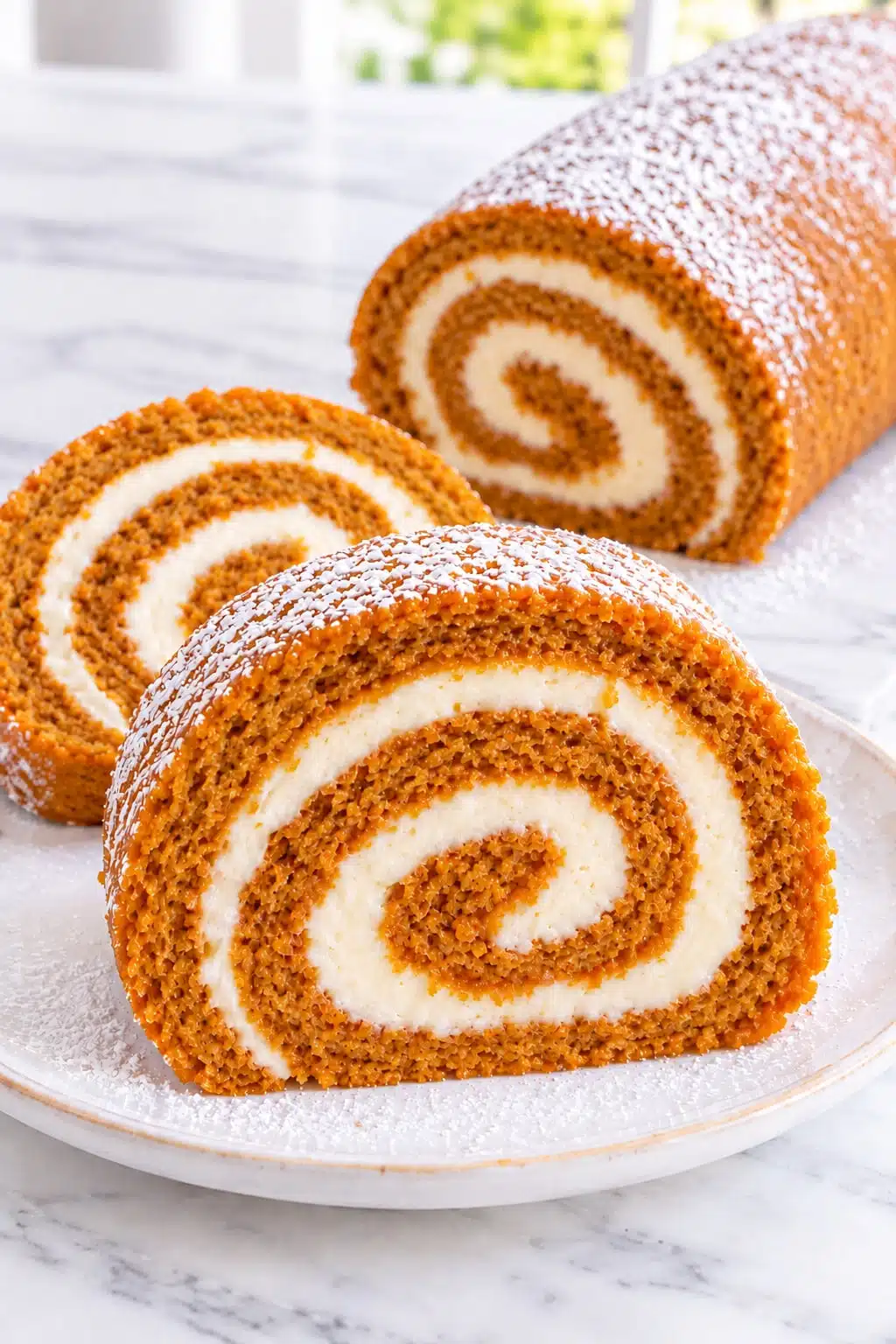
This pumpkin roll recipe wraps a soft, warmly spiced pumpkin sponge around a smooth vanilla cream cheese filling, creating a clear orange-and-cream spiral beneath a light dusting of confectioners’ sugar.
It has the familiar flavors of a fall baking table, but its shape makes it feel especially inviting for Thanksgiving, a holiday dessert spread, or an afternoon slice with coffee.
Save this recipe for the detailed control points: the two-second egg ribbon, the 15 x 10-inch pan, the one-minute rolling window, the thin filling layer, and the final chill all have a clear job in protecting the spiral.
A Quick Pumpkin Roll Overview
This is an intermediate rolled cake with about 45 minutes of active preparation, a 12 to 15 minute bake, complete cooling, and at least one hour of chilling before slicing.
| Texture | Soft, flexible pumpkin sponge with a smooth, firm cream cheese filling |
|---|---|
| Flavor | Pumpkin, cinnamon, ginger, nutmeg, gentle clove, vanilla, and tangy cream cheese |
| Difficulty | Intermediate |
| Time | 2 hours 45 minutes minimum, including cooling and chilling |
| Servings | 10 slices |
| Method | Thin sponge baked in a jelly-roll pan, rolled warm, cooled, filled, rerolled, and chilled |
| Best For | Fall gatherings, Thanksgiving, holiday dessert tables, and make-ahead serving |
In short: This recipe produces a thin pumpkin sponge rolled around vanilla cream cheese filling, not a yeast-raised pumpkin cinnamon roll or a thick frosted cake. If you want pumpkin flavor without the rolling step, this pumpkin cake is the better format.
Why This Pumpkin Roll Recipe Works
The formula and method support a flexible sponge, a balanced filling layer, and a spiral that becomes easier to slice once cold.
- Controlled cake thickness: About 600 g of batter spreads across a light-colored 15 x 10-inch pan, giving the sponge enough surface area to stay thin and roll into several turns.
- Layered lift: A well-developed whole-egg foam provides the main aeration, while baking powder and baking soda add resilience without replacing careful mixing.
- A trained curve: Rolling the sponge while hot sets its first curve before the cake cools and becomes less flexible.
- Balanced filling: A thin layer of cool cream cheese filling adds richness without becoming an exterior frosting or forcing the spiral apart.
- A firm finish: Chilling sets the filling so the roll holds a rounded shape and cuts into cleaner slices.
Why You’ll Love This Pumpkin Roll
This recipe suits a baker who wants a classic fall dessert with a polished spiral, familiar ingredients, and a practical make-ahead window.
- Classic fall flavor: Pumpkin and four warm spices stay clear beneath the tangy vanilla filling.
- Ten generous slices: One approximately 10-inch roll portions neatly for a family meal or holiday table.
- Useful make-ahead timing: The completed roll can be refrigerated up to two days before serving.
- No nuts required: The classic profile stays focused on pumpkin, spice, and cream cheese.
- Simple finish: A light dusting of confectioners’ sugar leaves the spiral as the main visual feature.
The Science Behind a Flexible Pumpkin Sponge
Four mechanisms control whether this thin cake rises evenly, bends while warm, and keeps a defined filling layer after chilling.
Egg Foam Builds Flexible Lift
Beating whole eggs with sugar traps fine air bubbles and builds a pale, thick foam. The practical checkpoint is a ribbon that rests on the surface for about two seconds: stop too early and the cake may be dense; mix harshly after adding flour and that captured volume can collapse.

Pan Depth Controls the Spiral
The specified pan spreads the batter into a thin, even layer that can make several spiral turns without becoming dry. A smaller pan creates a thicker cake that needs different baking and rolling decisions, while a much larger pan increases the risk of brittle edges.
Warm Rolling Sets the Curve
A freshly baked sponge is most pliable before its structure cools and sets. The first towel-assisted roll trains that curve without filling, so the cooled cake can follow the same path during the final roll instead of being forced into a new shape.
Cool Filling Protects Definition
Cool room-temperature butter and brick cream cheese form a thick filling that holds a soft ridge. A warm cake or overheated filling softens that structure, making the layer more likely to squeeze from the ends and blur the spiral.
Ingredients for Pumpkin Roll and Cream Cheese Filling
The ingredient states matter as much as the quantities: room-temperature eggs support aeration, plain pumpkin controls moisture, and cool dairy keeps the filling thick.
Ingredient List
Measure the flour and pumpkin by weight when possible, and keep the towel sugar separate from the filling sugar so every portion goes to the correct stage.
Towel and Finish
- 1/4 cup (28 g) confectioners’ sugar, unsifted, for the towel, with excess expected to remain
- 1 tablespoon (7 g) confectioners’ sugar, sifted over the chilled roll just before serving, optional
Pumpkin Sponge
- 3 large eggs (150 g without shells), room temperature, approximately 68 to 72°F
- 1 cup (198 g) granulated sugar, standard white granulated sugar
- 2/3 cup (151 g) pumpkin puree, plain 100 percent pumpkin, not pumpkin pie filling, at room temperature
- 3/4 cup (90 g) all-purpose flour, spoon-and-level volume; weight controls
- 1/2 teaspoon (2 g) baking powder, fresh and double-acting
- 1/2 teaspoon (3 g) baking soda, fresh and lump-free
- 1 teaspoon (2.5 g) ground cinnamon, freshly aromatic
- 1/2 teaspoon (1 g) ground ginger
- 1/4 teaspoon (0.5 g) ground nutmeg
- 1/8 teaspoon (0.25 g) ground cloves; do not increase casually
- 1/4 teaspoon (1.5 g) fine sea salt, not coarse
Vanilla Cream Cheese Filling
- 8 ounces (226 g) full-fat brick-style cream cheese, cool room temperature, approximately 65 to 68°F; no tub, whipped, or reduced-fat product
- 6 tablespoons (85 g) unsalted butter, cool room temperature, approximately 65 to 68°F
- 1 cup (113 g) confectioners’ sugar, sifted after measuring by weight
- 1 teaspoon (5 ml) vanilla extract, pure vanilla extract
- 1/8 teaspoon (0.75 g) fine sea salt

Ingredient Notes for the Sponge and Filling
Plain canned pumpkin gives the sponge a predictable moisture level; pumpkin pie filling already contains sweeteners and spices, and fresh puree can vary enough to change the texture. Weigh the flour because even a small excess matters in a cake this thin.
Use full-fat brick cream cheese rather than a tub or whipped product. Its lower free-moisture level helps the filling keep its body. If you want a deeper explanation of dairy temperature and consistency, this guide to how to make cream cheese frosting explains the same cream cheese and butter relationship in a different application.
No direct ingredient substitution is recommended for this version. In particular, do not replace the pumpkin puree, brick cream cheese, butter, pan size, or conventional oven setting and expect the same thickness or rolling behavior.

Kitchen Tools for an Even Pumpkin Roll and Clean Spiral
Five equipment groups cover the tools that materially affect cake thickness, aeration, release, cooling, filling, and clean slicing.
- Pan and release setup: A fully preheated conventional oven with the rack in the center, one light-colored 15 x 10 x 1-inch metal jelly-roll pan, and parchment fitted to the pan.
- Mixing and aeration: A stand mixer with whisk and paddle attachments, or a hand mixer, plus one large mixer bowl, one medium bowl, and a fine-mesh sieve.
- Folding and spreading: A broad flexible spatula for protecting the egg foam and a small or medium offset spatula for leveling the batter and filling.
- Rolling and cooling: A thin, smooth cotton tea towel, not terry cloth or microfiber, and a wire rack large enough for the rolled cake.
- Wrapping and slicing: Food-safe plastic wrap and a thin serrated or sharp slicing knife.
Before You Begin Your Pumpkin Roll
Complete these checks before mixing because the batter cannot wait and the baked sponge has a short warm-rolling window.
- Confirm that the pan is light-colored metal and measures 15 x 10 x 1 inches.
- Fit and lightly grease the parchment, then prepare a smooth cotton towel with a continuous layer of the 1/4 cup confectioners’ sugar.
- Bring the eggs and pumpkin to room temperature, but keep the butter and cream cheese at a cooler 65 to 68°F.
- Clear a heat-safe space beside the oven for inverting and rolling the cake immediately.
- Make room for the towel-wrapped cake on a wire rack and for the finished roll in the refrigerator.
- Allow 45 to 60 minutes for cooling and at least 1 hour for the final chill before serving.
One lesson I keep coming back to with cake rolls is that the most important minute happens before the cake cools: the towel needs to be ready, the cake needs to turn out cleanly, and the first roll needs to happen while the sponge is still flexible. I have learned to treat that minute as part of the setup, not as a last-second task.
What to Expect From This Pumpkin Roll
A few normal characteristics can look surprising if this is your first rolled sponge.
- The batter is light and ribbon-like rather than thick like pumpkin bread batter.
- The baked cake is thin and springy, with edges that only begin to release instead of becoming deeply browned.
- Fine surface lines can appear during the warm roll without becoming a structural split through the sponge.
- The cooled cake keeps a curve and may not lie completely flat when unrolled.
- The filling firms noticeably during the final chill, which helps the spiral stay defined when cut.
How to Make Pumpkin Roll
The method moves through seven phases, with the egg ribbon, bake endpoint, immediate first roll, complete cooling, and final chill acting as the main stopping points.
1. Prepare the Pan, Towel, and Dry Ingredients
Set a rack in the center and preheat the conventional oven to 375°F. Lightly grease the 15 x 10 x 1-inch pan, fit it with parchment, and lightly grease the parchment. Dust the thin cotton towel evenly with 1/4 cup confectioners’ sugar and leave it flat beside the oven.
In the medium bowl, whisk the flour, baking powder, baking soda, cinnamon, ginger, nutmeg, cloves, and 1/4 teaspoon salt. Sift once so the leaveners and spices are evenly dispersed.
What you should see: The parchment lies flat without large wrinkles, the towel has no bare center, and the dry mixture is even in color with no white or brown streaks.
2. Build the Pumpkin Batter
Beat the room-temperature eggs and granulated sugar with the whisk on medium-high to high speed for 4 to 5 minutes, until pale, thick, and about tripled in volume. The ribbon from the raised whisk should rest on the surface for about 2 seconds before sinking back.
Add the room-temperature pumpkin and mix on low for 15 to 20 seconds, only until the color is even. Sift half the dry mixture over the foam and fold with a broad spatula while turning the bowl. Repeat with the remaining dry mixture and stop as soon as no dry pockets remain.
What you should see: The batter is evenly orange, remains visibly aerated, and falls from the spatula in a broad ribbon rather than running like liquid.
3. Spread and Bake the Sponge
Transfer the batter to the prepared pan and spread it gently into the corners in an even layer. Bake for 12 to 15 minutes, beginning the doneness check at 12 minutes.

What you should see: The surface is matte, the center springs back after a light fingertip touch, and the edges have only begun to pull away. A wet depression means it needs more time; dark, crisp edges mean it has baked too far.

4. Roll the Hot Sponge
Within 1 minute of removing the pan from the oven, loosen any exposed edges and invert the cake onto the sugared towel. Lift off the pan, peel the parchment away slowly at a shallow angle, and roll the cake and towel together from one short end. Make the first curl snug, then continue with gentle, even tension. Set the roll seam-side down on the wire rack.
What you should see: The towel-wrapped cake forms one even log without a flattened center. Fine surface lines are acceptable; a split opening through the sponge points to overbaking, delay, or excessive tension.

5. Cool the Roll and Make the Filling
Cool the towel-wrapped roll seam-side down for 45 to 60 minutes, until the center no longer feels warm. Do not refrigerate the hot roll. While it finishes cooling, beat the cool room-temperature butter on medium for 45 to 60 seconds until smooth. Add the cream cheese and mix on medium-low for 30 to 45 seconds, only until uniform.
Add the sifted confectioners’ sugar in two additions on low speed. Mix in the vanilla and 1/8 teaspoon salt, scrape the bowl, and mix on low for another 15 to 20 seconds. Stop as soon as the filling is smooth.

What you should see: No warmth or steam remains in the roll, and the filling is thick, smooth, and able to hold a soft ridge from the spatula without looking shiny or loose.

6. Fill and Reroll
Unroll the cooled cake slowly without forcing the tight center completely flat. Spread the filling in a thin, even layer, leaving a 1/2-inch border along both long sides and the starting short edge, plus a 1-inch border at the far short edge. Reroll from the same short end without the towel, following the trained curve instead of pulling tightly.
What you should see: The filling reaches the inner spiral without forming a heavy ridge at the leading edge, and little or no filling presses from the sides.

7. Chill, Finish, and Slice
Place the roll seam-side down, wrap it securely without flattening it, and refrigerate for at least 1 hour. Unwrap the chilled roll, trim very thin end pieces only if you want a presentation-ready spiral, and dust with the optional tablespoon of confectioners’ sugar. Wipe a thin serrated or sharp knife between cuts and divide the roll into 10 slices.
What you should see: The chilled log stays rounded, the filling no longer shifts when moved, and the slices show defined pumpkin-and-cream spirals with minimal filling drag.

Pumpkin Roll Doneness and Texture Guide
The sponge is ready when the surface, touch, center, and edges agree; color alone is not a reliable stopping point for this thin cake.
| State | What You See | What It Means | Best Decision |
|---|---|---|---|
| Too early | Glossy center or a wet fingertip depression | The center structure has not set | Bake briefly longer and check again |
| Ready | Matte surface, spring-back center, edges just beginning to release | The cake is set but still flexible | Remove it and begin the warm roll immediately |
| Too far | Dark, dry edges or a brittle surface | Moisture loss has reduced flexibility | Roll promptly, but expect a greater crack risk |
| Properly chilled | Rounded log and filling that stays in place | The filling has firmed enough for slicing | Dust and cut while cold |
A toothpick can provide a secondary check, but it should not replace the spring-back, matte surface, and edge-release cues. The finished sponge should feel soft and moist, not sticky, gummy, crisp, or breadlike.
Expert Tips for a Smooth Pumpkin Roll
These details refine the points where a small judgment call has an outsized effect on the finished spiral.
- Level the corners first: Batter tends to collect in the center, so guide it into the corners before smoothing the middle. Even depth gives the edges and center a better chance of finishing together.
- Peel low, not upward: Pull parchment back close to the cake rather than lifting it vertically. The shallow angle reduces stress on the thin sponge surface.
- Protect the tight center: The innermost curve has already learned its shape and does not need to be pressed flat. Leaving that curl relaxed reduces unnecessary tension during rerolling.
- Keep filling below sponge height: A restrained layer makes room for multiple turns and helps prevent a thick leading ridge from pushing filling outward.
- Use temperature as a texture tool: If the filling loses its soft ridge, chill it briefly before spreading rather than compensating with extra sugar, which would change both sweetness and body.
Pumpkin Roll Mistakes and How to Fix Them
Use this control guide to trace a visible symptom back to the stage that most likely caused it and choose a realistic prevention or recovery.
| Mistake | What Happens | Why It Happens | How to Prevent or Fix It |
|---|---|---|---|
| Underbeating the eggs and sugar | The sponge is low and dense | The foam never captured enough fine air | Beat until pale, about tripled, and able to hold a two-second ribbon |
| Overfolding the batter | The batter becomes runny and the cake bakes thin | Repeated stirring collapses the egg foam | Fold in two additions and stop as soon as dry pockets disappear |
| Using the wrong pan | The cake is too thick, too thin, or unevenly baked | Pan area, depth, or dark metal changes heat and batter thickness | Use a light-colored 15 x 10 x 1-inch metal jelly-roll pan |
| Overbaking or rolling late | A large crack opens through the outer curve | The surface set too firmly or cooled before it was trained | Check at 12 minutes and roll within 1 minute; a finished structural split cannot be fully repaired |
| Leaving a bare patch on the towel | The cake sticks and tears during unrolling | Warm cake contacts damp fabric without a sugar barrier | Cover the towel continuously with sugar before the cake leaves the oven |
| Filling a warm cake | The filling loosens and smears | Residual heat softens the dairy mixture | Wait until no warmth remains; chill a loose filling briefly before spreading |
| Spreading filling to every edge | Thick bands squeeze from the ends | The filling has nowhere to move as the spiral tightens | Keep the specified side and end borders and reroll with gentle tension |
| Slicing before the final chill | The filling drags across the spiral | The filling has not firmed enough to resist the knife | Chill at least 1 hour and wipe the knife between cuts |
Beautiful Ways to Serve Pumpkin Roll
Serve the roll cold enough to hold its spiral, then use simple presentation choices that keep the pumpkin color and cream cheese center visible.
A Clean Slice With Coffee or Black Tea
Place one chilled slice on a white dessert plate and let it sit for about 10 to 15 minutes before eating. Coffee or unsweetened black tea balances the sweet filling while the short tempering time softens its texture without making the spiral unstable.

A Thanksgiving Dessert Platter
Arrange thick slices in a slightly overlapping row so each spiral remains visible. Add only a light fresh dusting of sugar before the platter goes out, since a heavy coating can hide the warm pumpkin color.

An Apple Cider Dessert Moment
Pair a cold slice with warm unsweetened apple cider for a contrast of temperature and complementary fall spice. Keep the cider on the side rather than pouring it over the cake, which would soften the sponge and blur the clean presentation.
A Simple Powdered-Sugar Finish
For the most classic look, leave the roll whole until serving, trim only the thinnest end pieces, and sift the final tablespoon of confectioners’ sugar over the top. The pale finish emphasizes the rounded log without competing with the spiral.

How to Decorate Pumpkin Roll for Halloween
Turn the chilled pumpkin roll into a jack-o’-lantern centerpiece with ridged orange buttercream, narrow black stripes, and a playful face. Keep both cut ends uncovered so the pumpkin sponge and cream cheese spiral remain visible.
This decoration uses an additional batch of vanilla buttercream for the outside. Prepare the sponge and cream cheese filling as directed, but skip the final powdered-sugar dusting.

Ingredients and Tools for the Halloween Decoration
The quantities below provide enough frosting and decorations for one approximately 10-inch pumpkin roll, with a little extra for practice piping.
Vanilla Buttercream
- 3/4 cup (170 g) unsalted butter, softened but still cool, approximately 65 to 68°F (18 to 20°C)
- 3 cups (340 g) confectioners’ sugar, sifted
- 1 tablespoon (15 ml) heavy cream, plus up to 2 teaspoons (10 ml) more as needed
- 1 teaspoon (5 ml) vanilla extract
- 1/8 teaspoon fine salt
- Concentrated orange gel food coloring, starting with approximately 1/8 teaspoon and adjusting to the strength of your brand
Black Buttercream Stripes
- 120 g of the prepared vanilla buttercream, reserved before adding orange coloring
- 1 tablespoon (6 g) black cocoa powder, sifted
- Up to 1 teaspoon (5 ml) heavy cream, only if needed
- Concentrated black gel food coloring, starting with a small toothpick-sized addition
Jack-o’-Lantern Face and Bats
- About 2 1/2 ounces (70 g) ready-colored black fondant
- About 1/2 ounce (15 g) white fondant
- A little confectioners’ sugar for rolling
- Optional: a small amount of food-grade confectioner’s glaze suitable for fondant, for a shinier black finish
Use two piping bags, a medium open-star tip such as Wilton #32, a round tip with an approximately 1/4-inch opening, a small offset spatula, parchment paper, a small rolling pin, and a sharp craft-style knife reserved for food. A small bat cutter is helpful but optional.
Make the Frosting and Decorate the Roll
1. Prepare the Face and Bats
Roll the black fondant approximately 1/16 to 1/8 inch (2 to 3 mm) thick on a lightly dusted surface.
Cut two triangular eye bases approximately 1 inch (2.5 cm) tall, one smaller triangular nose, and a curved mouth approximately 4 inches (10 cm) wide. Give the mouth pointed corners and an uneven zigzag upper edge to create the jack-o’-lantern expression.
Cut two small bats approximately 1 1/2 to 2 inches (4 to 5 cm) across. For hand-cut bats, draw a paper template with a small central body, pointed ears, and scalloped wings, then cut around it.
Roll the white fondant slightly thinner. Cut two smaller triangles and attach them over the black eye bases with the tiniest dab of water, leaving a black border visible.
Let the pieces rest flat on parchment until firm enough to lift without stretching. Make them the day before if you want the bats to hold a slightly raised position. Keep them in a dry, covered container at room temperature.
2. Make a Smooth, Pipeable Buttercream
Beat the butter on medium speed for about 2 minutes, until smooth and slightly lighter. Add the confectioners’ sugar in three additions on low speed, scraping the bowl between additions.
Add the vanilla, salt, and 1 tablespoon cream. Beat on medium-low until creamy, then mix on low for another minute to reduce large air pockets.
The buttercream should pipe without requiring excessive pressure, while keeping clearly defined ridges. If it is too stiff, add the additional cream 1/2 teaspoon at a time. If it looks shiny or slumps, refrigerate briefly and stir before testing again.
3. Divide and Color the Frosting
Reserve 120 g buttercream in a separate bowl for the black stripes.
Tint the remaining buttercream bright pumpkin-orange with concentrated gel coloring. Add the color gradually and mix thoroughly before deciding whether it needs more.
Mix the black cocoa into the reserved buttercream. Add a little black gel coloring, then enough of the extra teaspoon of cream to restore its original piping consistency, if necessary.
Cover the black frosting and allow the color to develop for 1 to 2 hours before adding more coloring. Refrigerate during a longer wait, then bring it back to a pipeable consistency and stir before using.
What you should see: Orange frosting with crisp star-tip ridges and black frosting that forms a smooth rope without spreading into a puddle.
4. Prepare the Chilled Roll
Place the fully chilled, undusted roll seam-side down on its serving board. Trim a thin piece from each end with a sharp knife if needed to expose a clean spiral.
Gently brush away loose surface sugar left from the rolling towel. If condensation has formed, let the surface dry briefly in the refrigerator before applying frosting.
Keep the two spiral ends bare. The decoration belongs on the rounded upper surface and upper sides.
5. Pipe the Orange Bands
Fit the orange piping bag with the open-star tip. Position the roll with one spiral end facing you.
Pipe a ridged line across the curved top, from one side of the roll to the other, rather than along its length. Add a second touching line beside it to make one broad orange band.
Repeat to create approximately eight or nine orange bands, leaving narrow gaps for the black stripes. Follow the rounded surface without pressing the piping tip into the sponge.
Stop approximately 1/2 inch (1 cm) before each cut end so the frosting does not cover the spiral.
What you should see: Broad, textured orange bands wrapping over the top like ribbons, with the cake’s rounded shape still visible.
6. Add the Black Stripes
Fit the black piping bag with the round tip. Pipe one continuous black rope into each gap between the orange bands, following the same curve.
Keep the black stripes narrower than the orange bands. Use steady pressure and release pressure before lifting the tip to avoid long tails.
The buttercream stripes will have a soft satin finish. Use the optional edible glaze on the fondant pieces if you want the face and bats to look shinier.
7. Arrange the Face and Bats
Place the two triangular eyes on the upper-middle portion of the decorated top, with their points facing toward the far end of the roll.
Position the nose below them and the wide zigzag mouth closer to the front spiral end. Press each piece only enough to anchor it in the buttercream.
Arrange the two bats near the far end. Lay them slightly overlapping, or support a firm bat at a gentle angle with a small buttercream mound underneath.
Leave a little space between the face elements so the orange-and-black striped background remains visible.
8. Chill Before Slicing
Refrigerate the decorated roll for approximately 20 to 30 minutes, until the buttercream feels firm enough to resist light contact.
For the presentation shown, cut one generous slice from the front and place it slightly forward on the board. Use a sharp knife and wipe it clean between cuts to limit black frosting streaks across the orange sponge and ivory filling.
Make-Ahead, Storage, and Serving Tips
For the neatest presentation, fill and chill the roll ahead, prepare the fondant decorations separately, and decorate on the day of serving. Add the face and bats shortly before presenting the cake, since refrigerator moisture can soften fondant and encourage dark colors to bleed.
Store the decorated roll in a covered cake container without letting plastic wrap touch the piping. Keep it refrigerated at 40°F (4°C) or below and follow the storage window for the filled roll; decorating does not restart that clock.
Count decorating and serving time together toward the two-hour room-temperature limit, or one hour when the temperature exceeds 90°F (32°C).
Candy corn and miniature pumpkins can complete the Halloween setting around the platter. Keep synthetic cobwebs and plastic spiders away from the cake, utensils, and surfaces that will touch the slices.
Decoration note: This optional buttercream-and-fondant finish adds preparation time, sugar, and calories beyond the classic powdered-sugar version.
Plan Your Pumpkin Roll From Oven to Serving
Start at least 2 hours 45 minutes before serving, or complete the roll a day ahead, because cooling and chilling cannot be compressed without changing the filling and spiral.
| Moment | What to Prepare | Readiness Dependency | Hold or Storage |
|---|---|---|---|
| About 2 hours 45 minutes before serving | Preheat, prepare the pan and towel, mix, and bake | The pan and towel must be ready before the batter and warm cake | None |
| About 2 hours 15 minutes before serving | Make the warm training roll | The sponge must be hot and pliable | Cool seam-side down on a rack |
| About 1 hour 15 minutes before serving | Make the filling, fill, and reroll | The center of the cake must have no remaining warmth | Wrap seam-side down |
| At least 1 hour before serving | Chill the completed roll | The filling needs time to firm for clean slices | Refrigerate at 40°F or below |
| 10 to 15 minutes before eating | Dust and portion | The roll should remain cold while slicing | Return unused slices to the refrigerator |
Store, Freeze, and Make Pumpkin Roll Ahead
The filled roll stores well when tightly wrapped and kept cold, but food-safety limits and best-texture windows are not the same thing.
Refrigerate the Filled Roll
Wrap the roll securely and refrigerate it for up to 4 days. The softest sponge and cleanest filling are expected during the first 2 to 3 days. Add the finishing sugar shortly before serving because refrigerator moisture can dissolve it.
Make It Ahead
Complete the filled roll up to 2 days before serving and keep it tightly wrapped in the refrigerator. Making the filled roll ahead protects the sponge better than storing the unfilled cake, which is more exposed to drying and repeated handling.

Freeze and Thaw
Freeze the completed, undusted roll tightly wrapped for up to 2 months for best quality. Thaw it overnight in the refrigerator while still wrapped, then unwrap, dust, and slice it cold.
Keep the Cream Cheese Filling Cold
Keep the filled roll at 40°F or below. The FDA safe food handling guidance supports returning perishable food to refrigeration within 2 hours, or within 1 hour when the temperature is above 90°F, and thawing frozen food in the refrigerator rather than on the counter.
Pumpkin Roll Questions Home Bakers Ask
These focused answers cover the choices that most often determine whether a pumpkin roll bends cleanly, keeps its shape, and stays safe to serve.
Why Did My Pumpkin Roll Crack?
A pumpkin roll usually cracks because the sponge baked too long, cooled before its first roll, or was rolled without enough powdered sugar on the towel. Check it at 12 minutes and roll it from the short end within 1 minute of leaving the oven.
Can I Use Parchment Instead of a Towel?
Use the sugared lint-free towel for this method. It supports the hot sponge, limits sticking, and lets steam escape; parchment can trap condensation and does not provide the same protective sugar layer during cooling.
Can I Use Fresh Pumpkin Puree?
Use plain canned pumpkin for this formula. Fresh puree varies in moisture and thickness, so it is not an equivalent direct swap; measure 151 g of plain 100 percent pumpkin, not pumpkin pie filling.
Can I Use a Different Pan?
Do not change the pan for this formula. A light-colored 15 x 10 x 1-inch metal jelly-roll pan gives the intended batter depth; a smaller pan makes the cake too thick, while a larger or dark pan changes the bake rate and flexibility.
Does Pumpkin Roll Need to Be Refrigerated?
Yes. Once filled with cream cheese, keep the roll at 40°F or below and return it to the refrigerator within 2 hours of serving, or within 1 hour when the temperature is above 90°F.
Keep the Fall Baking Going
After a chilled pumpkin roll gives you soft cake, warm spice, and creamy filling in one slice, choose the next bake by whether you want more pumpkin, a different format, or another holiday showpiece.
More Classic Pumpkin Bakes
These recipes stay close to the same pumpkin-spice craving while changing the shape and serving style.
- Pumpkin Cake gives you pumpkin-and-cream-cheese comfort in a simpler sliceable cake.
- Pumpkin Cupcakes turn the creamy pumpkin profile into individual celebration portions.
- Pumpkin Bread Recipe is a cozy loaf when you want pumpkin spice without filling or rolling.
- Pumpkin Muffins offer an everyday tender pumpkin bake that is easy to portion.
Try Pumpkin in a Different Form
Each option keeps pumpkin at the center but changes the texture, technique, or level of richness.
- Pumpkin Cheesecake Bars deliver a denser pumpkin-and-cream-cheese dessert in clean handheld portions.
- Pumpkin Cinnamon Rolls take the yeast-raised route for a soft breakfast roll with pumpkin and cinnamon.
- Pumpkin Coffee Cake adds a crumb topping for brunch or a relaxed fall snack.
- Pumpkin Snickerdoodle Cookies turn the pumpkin-spice craving into chewy cookies.
Take On Another Holiday Showpiece
Move from the pumpkin spiral to another bake that rewards careful assembly or presentation.
- Yule Log Cake Recipe is the natural next cake-roll project when you want a decorated chocolate centerpiece.
- Carrot Cake Recipe pairs another warmly spiced cake with cream cheese frosting.
- Gingerbread Cake keeps the cozy holiday spice profile while moving to a deep molasses cake.
- Pecan Pie Cheesecake is a richer centerpiece with a creamy finish and nutty topping.
Why This Pumpkin Roll Belongs in Your Recipe Box
This is a recipe worth keeping because its most important decisions remain easy to find each time you return to it.
- A Repeatable Roll Map: The sequence connects each waiting period to the state the cake or filling must reach next.
- Built-In Visual Checks: Specific batter, cake, filling, and slice cues make the written recipe useful beyond the timer.
- A True Make-Ahead Plan: The finished dessert can be completed before a gathering without leaving the most delicate work for the last hour.
- Ten Presentation-Ready Slices: The yield creates substantial portions with a visible spiral rather than fragile slivers.
- Clear Storage Limits: Separate safety and quality guidance makes leftovers and advance preparation easier to manage.
- A Classic No-Nut Profile: Pumpkin, warm spice, vanilla, and cream cheese stay at the center of the dessert.
A Final Note on This Classic Pumpkin Roll
This pumpkin roll earns its place by turning a delicate-looking dessert into a series of visible, manageable states while keeping the classic flavor and powdered finish intact.
It is the kind of bake to return to when a familiar fall dessert should still feel special on the table, whether it is served whole for the reveal or already cut into generous spiraled slices.
Careful baking rewards attention to the right moment: when the ribbon holds, when the sponge springs back, and when the chilled roll is ready to become a clean slice.

Pumpkin Roll
A softly spiced pumpkin sponge rolled while warm, cooled, and filled with smooth vanilla cream cheese filling. The 15 x 10-inch pan, two-second egg ribbon, immediate first roll, and final chill protect the flexible cake and clean spiral.
Ingredients
Towel and Finish
- 1/4 cup (28 g) confectioners' sugar, unsifted, for the towel; excess will remain
- 1 tablespoon (7 g) confectioners' sugar, sifted over the chilled roll just before serving, optional
Pumpkin Sponge
- 3 large eggs (150 g without shells), room temperature, approximately 68–72°F
- 1 cup (198 g) granulated sugar, standard white granulated sugar
- 2/3 cup (151 g) pumpkin puree, plain 100 percent pumpkin, not pumpkin pie filling, at room temperature
- 3/4 cup (90 g) all-purpose flour, spoon-and-level volume; weight controls
- 1/2 teaspoon (2 g) baking powder, fresh and double-acting
- 1/2 teaspoon (3 g) baking soda, fresh and lump-free
- 1 teaspoon (2.5 g) ground cinnamon, freshly aromatic
- 1/2 teaspoon (1 g) ground ginger
- 1/4 teaspoon (0.5 g) ground nutmeg
- 1/8 teaspoon (0.25 g) ground cloves; do not increase casually
- 1/4 teaspoon (1.5 g) fine sea salt, not coarse
Vanilla Cream Cheese Filling
- 8 ounces (226 g) full-fat brick-style cream cheese, cool room temperature, approximately 65–68°F; do not use tub, whipped, or reduced-fat cream cheese
- 6 tablespoons (85 g) unsalted butter, cool room temperature, approximately 65–68°F
- 1 cup (113 g) confectioners' sugar, sifted after measuring by weight
- 1 teaspoon (5 ml) pure vanilla extract
- 1/8 teaspoon (0.75 g) fine sea salt
Instructions
- Prepare the oven, pan, and towel. Set a rack in the center and preheat a conventional oven to 375°F / 190°C. Lightly grease a light-colored 15 x 10 x 1-inch metal jelly-roll pan, fit it with parchment, and lightly grease the parchment. Dust a thin, smooth cotton towel evenly with the 1/4 cup confectioners' sugar and leave it flat beside the oven. The parchment should lie flat, and the towel should have no bare area in the center.
- Combine the dry ingredients. Whisk the flour, baking powder, baking soda, cinnamon, ginger, nutmeg, cloves, and 1/4 teaspoon salt in a medium bowl. Sift once. The mixture should look uniform, with no visible leavener or spice streaks.
- Build the egg foam. Beat the room-temperature eggs and granulated sugar with the whisk on medium-high to high speed for 4 to 5 minutes, until pale, thick, and about tripled in volume. The ribbon from the raised whisk should rest on the surface for about 2 seconds before sinking back.
- Add the pumpkin. Add the room-temperature pumpkin puree. Mix on low for 15 to 20 seconds, only until evenly orange, then scrape the bowl once. The mixture should still look aerated, not flat or watery.
- Fold in the dry mixture. Sift half of the dry mixture over the foam and fold gently with a broad spatula while turning the bowl. Repeat with the remaining dry mixture and stop as soon as no dry pockets remain. The batter should fall in a light, broad ribbon rather than look runny or deflated.
- Spread and bake. Spread the batter gently into the prepared pan in an even layer. Bake for 12 to 15 minutes, checking at 12 minutes. The top should be matte, the center should spring back from a light touch without a wet depression, and the edges should only begin to release.
- Turn out and make the warm roll. Within 1 minute of removing the pan from the oven, loosen the exposed edges and invert the cake onto the sugared towel. Lift off the pan, peel away the parchment at a shallow angle, and roll the cake and towel together from one short end. Make the first curl snug, continue with gentle tension, and place the roll seam-side down on a wire rack.
- Cool completely. Cool the towel-wrapped roll seam-side down for 45 to 60 minutes, until no warmth remains at the center. Do not refrigerate the hot roll.
- Make the filling. Beat the cool room-temperature butter on medium for 45 to 60 seconds, until smooth. Add the cream cheese and mix on medium-low for 30 to 45 seconds, only until uniform. Add the sifted confectioners' sugar in two additions on low. Add the vanilla and 1/8 teaspoon salt, scrape the bowl, and mix on low for 15 to 20 seconds. Stop when the filling is thick, smooth, and able to hold a soft ridge.
- Fill and reroll. Unroll the cooled cake slowly without forcing the tight center flat. Spread the filling in a thin layer, leaving a 1/2-inch border along both long sides and the starting short edge, plus a 1-inch border at the far short edge. Reroll from the same short end without the towel, following the trained curve without pulling tightly.
- Wrap and chill. Place the roll seam-side down, wrap it securely without flattening it, and refrigerate for at least 1 hour. The chilled log should stay rounded, and the filling should not shift when moved.
- Finish and slice. Unwrap the chilled roll. If desired, trim only very thin end pieces. Dust with the optional 1 tablespoon confectioners' sugar, wipe a thin serrated or sharp knife between cuts, and divide the roll into 10 slices.
Notes
- Weigh the flour and pumpkin when possible because small measurement differences matter in a thin rolled sponge.
- Use a light-colored 15 x 10 x 1-inch metal jelly-roll pan and a conventional oven. A dark pan, a 9 x 13-inch pan, a half-sheet pan, or convection changes the cake thickness or bake rate.
- Use plain canned 100 percent pumpkin. Pumpkin pie filling and fresh pumpkin puree are not equivalent direct swaps.
- Keep the butter and full-fat brick-style cream cheese at the same cool room temperature so the filling stays smooth and thick.
- Roll the cake from a short end within 1 minute of baking, then fill it only after the center has no remaining warmth.
- Do not double the batter in one pan. Make separate batches in separate prepared pans if two rolls are needed.
- Keep the filled roll refrigerated and return it to the refrigerator within 2 hours, or within 1 hour when the temperature is above 90°F.
STORAGE
- Keep the filled roll tightly wrapped and refrigerated at 40°F or below for up to 4 days. For best texture, serve within 2 to 3 days. Freeze the completed undusted roll at 0°F or below for up to 2 months and thaw it overnight in the refrigerator.
ALLERGENS: Contains wheat, eggs, and milk.
Nutrition Information:
Yield: 10 Serving Size: 1 sliceAmount Per Serving: Calories: 328Total Fat: 16gSaturated Fat: 9gCholesterol: 97mgSodium: 285mgCarbohydrates: 42gFiber: 1gSugar: 34gProtein: 4g
Nutrition information is provided as an estimate only and may vary based on specific ingredients, brands, and portion sizes used. This information should not be considered medical or nutritional advice.
12 Sweet Favorites — Yours, Free 🍰
Tiramisù, no-bake cheesecake, the perfect chocolate chip cookie & 9 more reader-loved desserts — gathered into one beautiful free recipe book. From my kitchen to yours.
No spam, just sweet things. Unsubscribe anytime.