Strawberry Sheet Cake (Moist, Soft & Packed with Real Strawberry Flavor)
🎁 FREE E-BOOK: 12 Sweet Favorites — reader-loved desserts in one beautiful recipe book.
There is something instantly joyful about a strawberry sheet cake: the soft pink crumb, the creamy swirls of frosting and the unmistakable flavor of ripe summer berries. This homemade strawberry sheet cake turns that familiar favorite into a cake that tastes as beautiful as it looks.
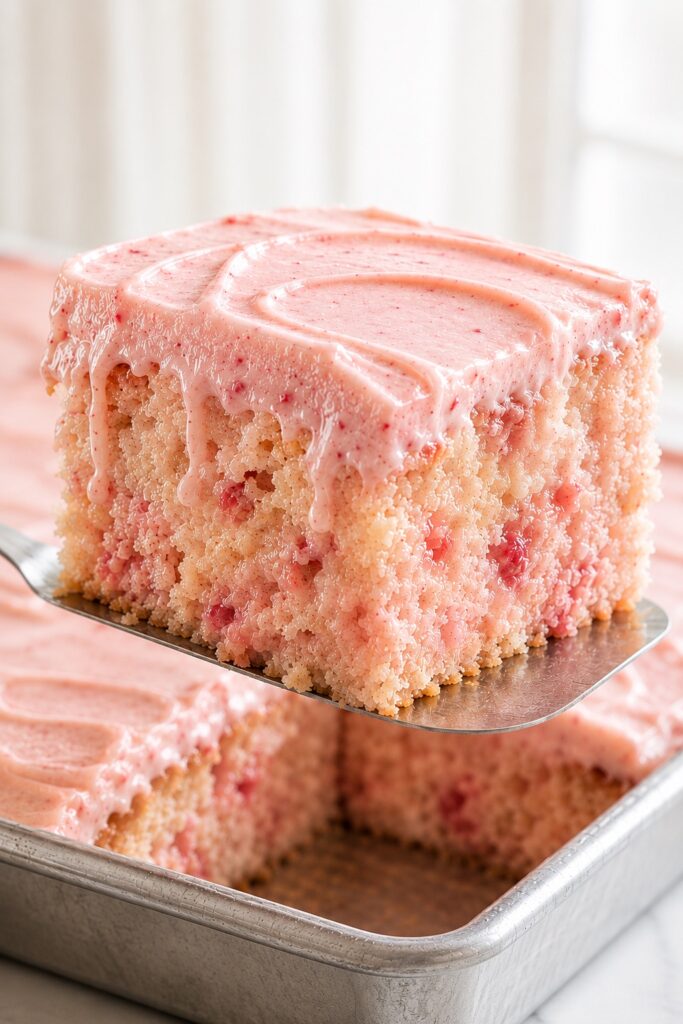
The cake is made from scratch with a concentrated fresh strawberry reduction, allowing real berry flavor to come through without making the crumb heavy or wet. Finely diced strawberries create small, juicy bursts throughout each slice, while egg whites keep the color delicate and the texture soft and tender.
A generous layer of strawberry cream cheese frosting finishes the cake. Freeze-dried strawberries give the frosting concentrated flavor and its naturally pretty pink color without adding excess moisture, while cream cheese brings enough tang to balance the sweetness.
This is the kind of dependable 9×13-inch cake people save for birthdays, spring celebrations, summer gatherings and any occasion that calls for something cheerful but uncomplicated. It is easy to transport, beautiful enough for a celebration and generous enough to serve a crowd—yet every slice still feels special.
Strawberry Sheet Cake at a Glance
This recipe creates a tall, single-layer strawberry cake with a soft, moist crumb and clear berry flavor from the first bite to the last. Here is what to know before you begin:
- Flavor: Fresh, concentrated strawberry flavor with gentle vanilla notes and tangy strawberry cream cheese frosting
- Texture: Soft, tender and moist, with small pieces of real strawberry throughout
- Pan: Light-colored aluminum 9×13×2-inch baking pan
- Yield: 16 generous squares
- Active preparation: Approximately 45 minutes
- Strawberry reduction: Approximately 25–35 minutes, plus cooling
- Bake time: Approximately 40–46 minutes
- Cooling and finishing: Approximately 2 hours, plus an optional 20–30-minute chill before slicing
- Make-ahead friendly: The reduction and unfrosted cake can both be prepared in advance
- Best for: Birthdays, showers, Easter, Mother’s Day, summer gatherings and family celebrations
Why This Strawberry Sheet Cake Earns a Place at the Celebration
This is not simply a vanilla cake tinted pink. Every element has been designed to preserve and intensify the flavor of real strawberries while keeping the cake structurally reliable.
- It tastes unmistakably like strawberries. A full 1/2 cup of concentrated strawberry reduction flavors the cake, while freeze-dried strawberries give the frosting a bright, berry-forward finish.
- The crumb stays soft without becoming wet or gummy. The reduction provides concentrated flavor with less water, and the finely diced berries are carefully dried and evenly distributed.
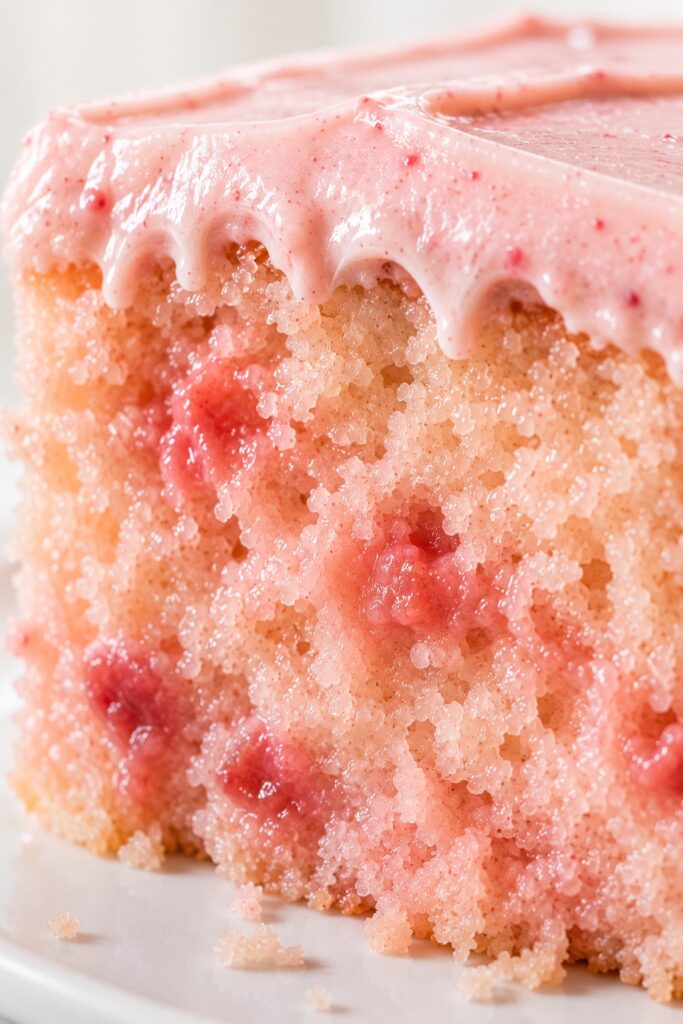
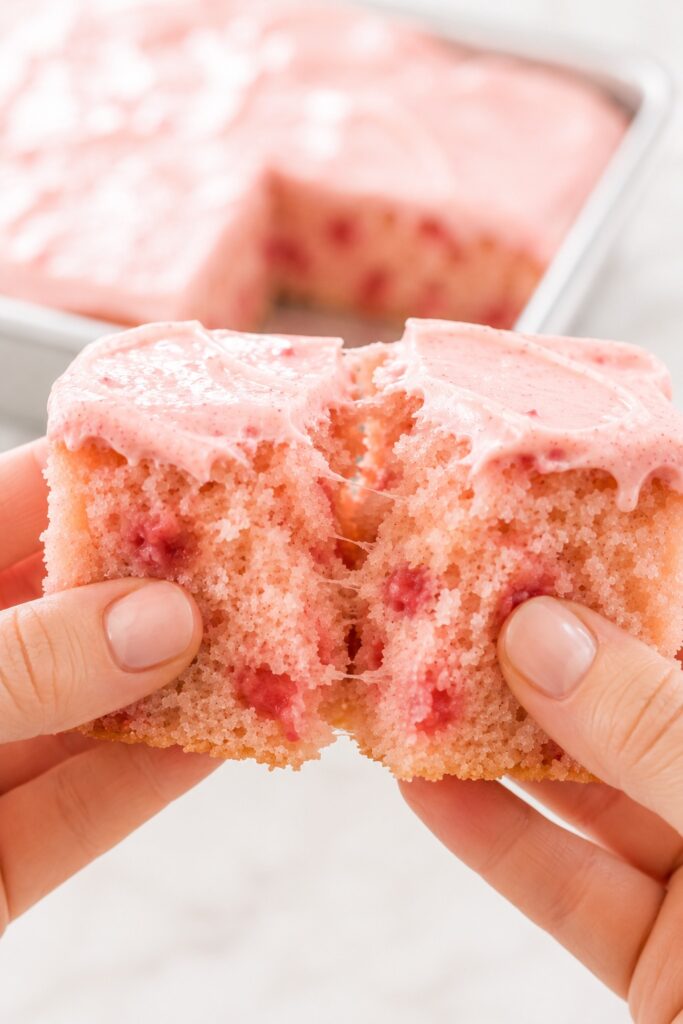
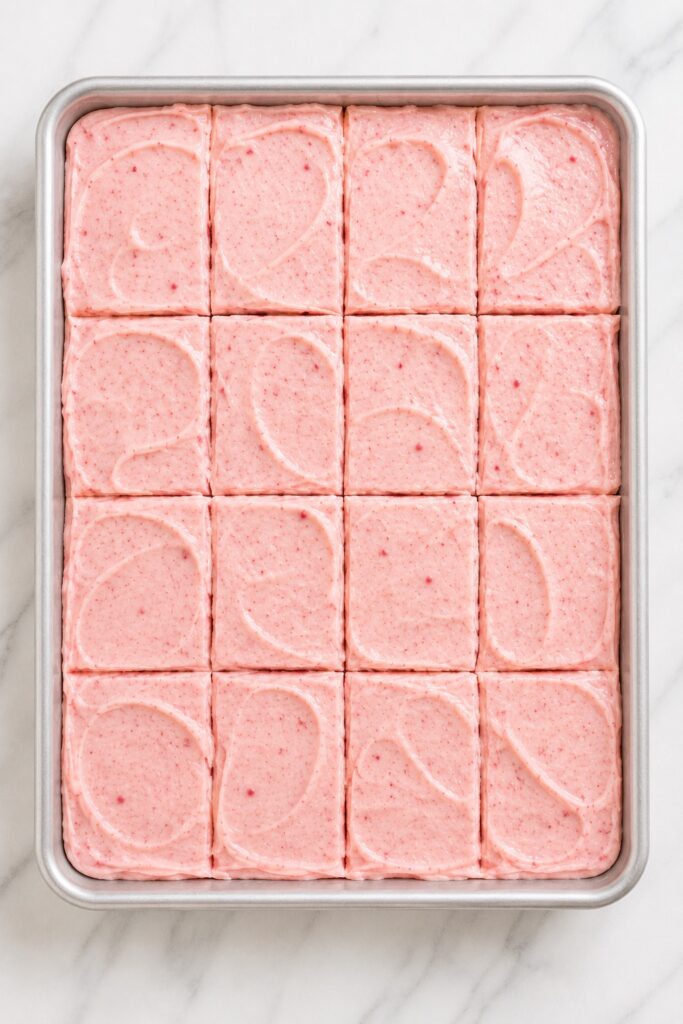
- Real strawberry pieces appear in every slice. The small pieces create the beautiful strawberry-speckled crumb shown in the Hero Master and add occasional juicy bursts of fruit.
- The frosting is balanced rather than overwhelmingly sweet. Full-fat cream cheese adds tang, and the powdered sugar has been carefully limited so it does not bury the strawberry flavor.
- The natural color is beautifully understated. The cake and frosting are softly pink rather than artificially bright. A tiny amount of pink gel coloring remains optional.
- A single pan makes serving simple. There are no layers to level, fill or stack, making this an elegant but practical cake for feeding a crowd.
- It can be prepared in stages. The reduction may be made ahead, and the baked cake can cool overnight before frosting.
What to Expect from a Real-Strawberry Cake
This strawberry sheet cake has a soft, close and tender crumb rather than the extremely airy texture of a sponge cake. Butter gives it richness, neutral oil helps it remain moist after refrigeration and egg whites create a lighter structure and cleaner strawberry color.
The strawberry flavor is natural and concentrated, not candy-like. The reduction supplies the foundation of the flavor, while the small fresh strawberry pieces provide visible fruit and occasional brighter bursts. Because the cake uses real berries, its precise shade may vary from pale blush to soft strawberry pink.
The frosting is thick, creamy and capable of holding broad spatula swoops. It tastes distinctly of strawberries, followed by the gentle tang of cream cheese. It should remain creamy rather than forming the firm sugar crust associated with traditional American buttercream.
This is intentionally a tall 9×13-inch celebration cake, not a thin Texas-style sheet cake. Expect generous slices with enough structure to lift cleanly from the pan once the cake has cooled and the frosting has briefly chilled.
Ingredients You’ll Need for a Strawberry-Forward Cake
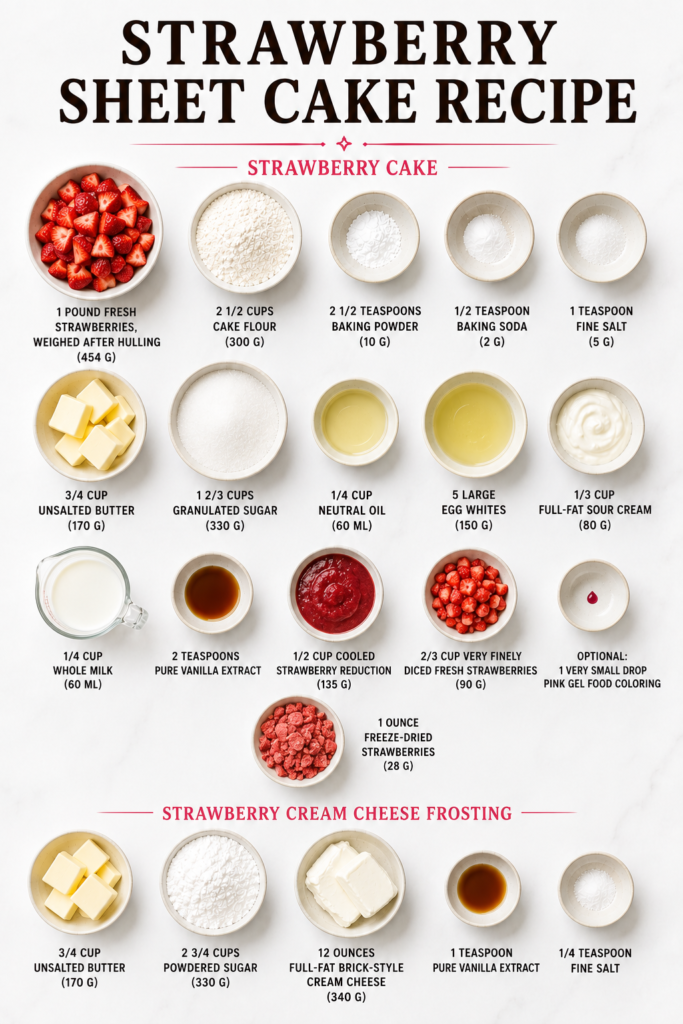
This cake builds strawberry flavor in three distinct ways: concentrated strawberry reduction flavors the batter, small pieces of fresh fruit create juicy pockets throughout the crumb and freeze-dried strawberries intensify the frosting without making it loose. For the most consistent result, measure the flour, reduction and fruit by weight.
For the Strawberry Reduction
- 1 pound fresh strawberries, weighed after hulling (454 g)
For the Strawberry Cake
- 2 1/2 cups cake flour (300 g), divided
- 2 1/2 teaspoons baking powder (10 g)
- 1/2 teaspoon baking soda (2 g)
- 1 teaspoon fine salt (5 g)
- 3/4 cup unsalted butter (170 g), softened to approximately 65°F (18°C)
- 1 2/3 cups granulated sugar (330 g)
- 1/4 cup neutral oil (60 ml or approximately 55 g)
- 5 large egg whites (approximately 150 g), at room temperature
- 1/3 cup full-fat sour cream (80 g), at room temperature
- 1/4 cup whole milk (60 ml), at room temperature
- 2 teaspoons pure vanilla extract
- 1/2 cup cooled strawberry reduction (135 g)
- 2/3 cup very finely diced fresh strawberries (90 g), well dried
- Optional: 1 very small drop pink gel food coloring
For the Strawberry Cream Cheese Frosting
- 1 ounce freeze-dried strawberries (28 g)
- 3/4 cup unsalted butter (170 g), softened to approximately 65°F (18°C)
- 2 3/4 cups powdered sugar (330 g), sifted
- 12 ounces full-fat brick-style cream cheese (340 g), cool but pliable
- 1 teaspoon pure vanilla extract
- 1/4 teaspoon fine salt
Ingredient Notes That Define the Final Texture
Each ingredient has a specific role in creating a cake that is moist and strawberry-forward without becoming heavy. These are the details that make the difference between a dependable cake and one with a gummy crumb or unstable frosting.
Fresh Strawberries
Fresh strawberries are used twice, but differently. The berries for the reduction may be very ripe because their flavor will become concentrated during cooking. The berries folded into the batter should be firmer, finely diced and thoroughly blotted so they do not release excess water into the crumb.
Weigh both quantities after removing the hulls.
Strawberry Reduction
Reducing the purée removes enough water to intensify its flavor without flooding the batter with additional liquid. The finished reduction must weigh exactly 135 g and should be completely cool before it is mixed with the dairy ingredients.
Do not reduce it into a sticky jam. It should remain smooth and spoonable, similar to a thick tomato sauce.
Cake Flour
Cake flour has a lower protein content than all-purpose flour, producing a finer and more tender crumb. Spoon it lightly into the measuring cup and level it if you are not using a scale.
One tablespoon is reserved from the measured quantity and used to coat the diced strawberries. Do not add an extra tablespoon of flour.
Butter and Neutral Oil
Butter gives the cake richness and structure, while neutral oil helps the crumb remain soft after refrigeration. The butter should be pliable but not shiny, greasy or partially melted.
Use an oil with little or no noticeable flavor, such as canola, grapeseed or regular vegetable oil.
Egg Whites
Using egg whites instead of whole eggs keeps the crumb lighter and prevents the yolks from muting the cake’s delicate strawberry color. Add them gradually so they emulsify properly with the creamed butter mixture.
Carton egg whites may behave differently depending on the product. Fresh egg whites are preferred for the most reliable cake structure.
Sour Cream and Whole Milk
Full-fat sour cream adds moisture, tenderness and enough acidity to support the baking soda. Whole milk loosens the strawberry reduction to the right consistency for even incorporation.
Both should be at room temperature so the batter remains smooth rather than curdled.
Freeze-Dried Strawberries
Freeze-dried strawberries provide concentrated flavor and natural color without introducing moisture into the cream cheese frosting. Grind them into a very fine powder so the frosting remains creamy while retaining the delicate strawberry specks visible in the Hero Master.
Do not use chewy dried strawberries. They contain more moisture and will not produce the same powder or flavor concentration.
Brick-Style Cream Cheese
Use full-fat cream cheese sold in solid bricks, not whipped cream cheese and not the spreadable product sold in tubs. Tub-style cream cheese contains more water and can make the frosting loose.
The cream cheese should remain cool but be pliable enough to blend smoothly into the butter mixture.
How to Choose Strawberries for Concentrated Flavor
The quality of the berries matters most when a cake relies on real fruit rather than extract or flavored gelatin. Strawberries should smell distinctly fragrant before you cut them; color alone is not always a reliable indication of flavor.
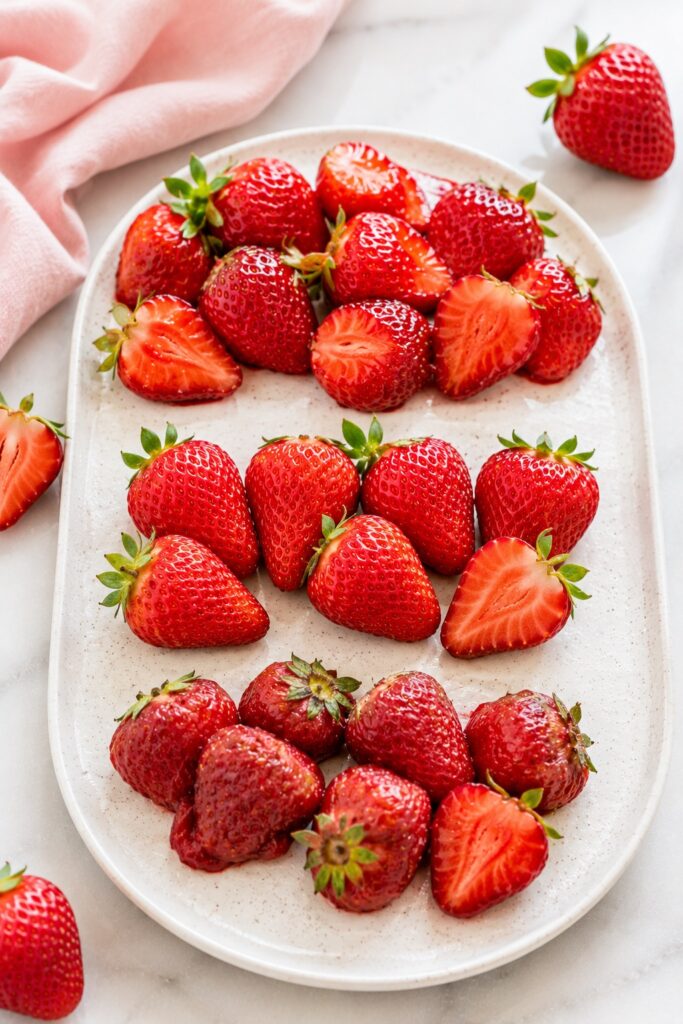
For the strongest natural strawberry character:
- Choose berries that are fragrant, evenly red and free from mold or bruised, watery areas.
- Use the softest, ripest berries for the reduction, where appearance no longer matters.
- Reserve firmer berries for dicing into the cake so the pieces retain some definition.
- Avoid oversized berries with white, flavorless centers when smaller, fragrant berries are available.
- Hull the berries before weighing them.
- Taste one berry before beginning. If the fruit tastes watery or bland, the reduction will improve it, but it cannot create the full flavor of naturally ripe strawberries.
Frozen strawberries may be used for the reduction. Thaw them completely and include all the released juices when puréeing. Because frozen fruit often contains more accessible moisture, the reduction may require additional cooking time.
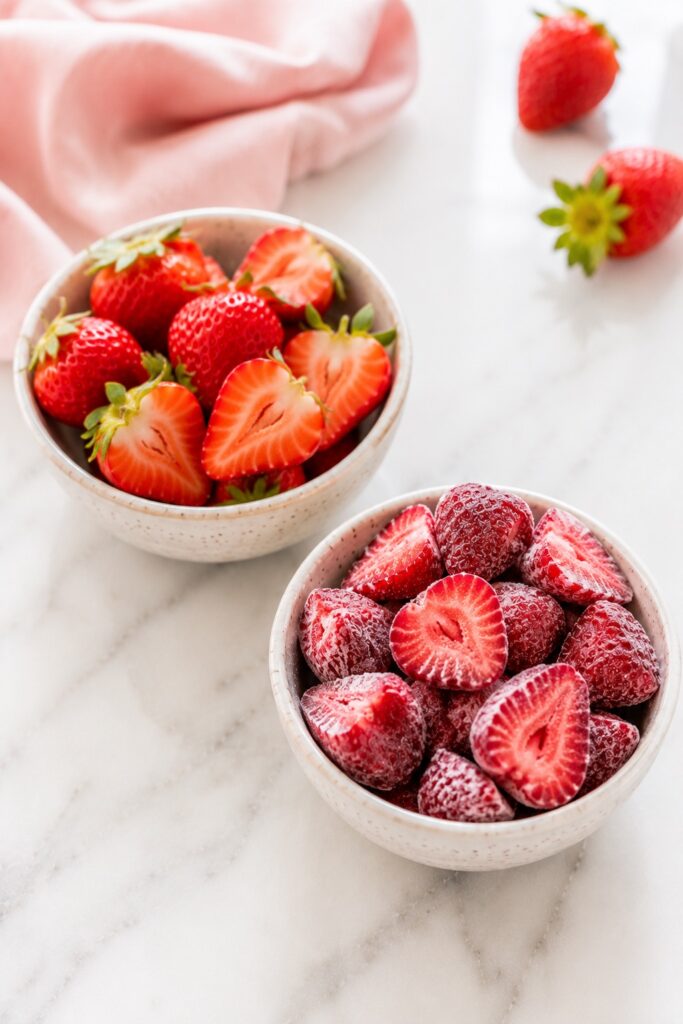
Use fresh strawberries—not frozen—for the diced fruit folded into the batter. Thawed pieces are too soft and wet and can create gummy pockets around the fruit.
Substitutions That Preserve the Cake’s Identity
A few practical substitutions are possible, but the three-part strawberry system should remain intact. Replacing the reduction or freeze-dried powder changes both the flavor and structure of the finished cake.
- Cake flour: In a pinch, measure 2 1/2 cups all-purpose flour, remove 5 tablespoons and replace them with 5 tablespoons cornstarch. Sift the mixture thoroughly several times. The crumb may be slightly less delicate than when made with commercial cake flour.
- Full-fat sour cream: The same amount of thick, full-fat plain Greek yogurt may be used. Avoid low-fat or nonfat yogurt, which can produce a less rich and slightly firmer crumb.
- Neutral oil: Canola, grapeseed or plain vegetable oil may be used interchangeably. Avoid strongly flavored olive oil or coconut oil.
- Fresh strawberries for the reduction: Frozen strawberries are suitable after thawing, and all of their juices should be included.
- Fresh strawberries folded into the cake: Do not replace these with frozen berries. If necessary, they may be omitted, but the finished slices will not have the fruit pieces shown in the Hero Master.
- Freeze-dried strawberries: Do not replace them with fresh purée, jam, strawberry gelatin, chewy dried strawberries or additional extract. Those ingredients alter the frosting’s moisture, sweetness or flavor identity.
- Cream cheese: Use only full-fat brick-style cream cheese. Mascarpone, whipped cream cheese and tub-style spread will not provide the same tang or stability.
- Pink gel color: This is completely optional and affects only appearance. Use no more than one tiny drop; liquid food coloring can thin the batter and create an artificial shade.
Strawberry jam is not an appropriate substitute for the reduction. Its added sugar, pectin and variable concentration would change both the sweetness and the moisture balance of the cake.
Essential Tools for a Consistent Strawberry Sheet Cake
This recipe does not require specialized decorating equipment, but the correct pan and an accurate way to measure the reduction are especially important.
- Digital kitchen scale: Essential for reducing the strawberry purée to exactly 135 g and useful for measuring the flour and diced fruit accurately.
- Blender or food processor: Creates a completely smooth strawberry purée and grinds the freeze-dried berries into fine powder.
- Wide, heavy-bottomed saucepan: Encourages efficient evaporation and reduces the purée evenly without scorching.
- Light-colored aluminum 9×13×2-inch baking pan: Produces the most even bake and the tall, single-layer shape shown in the Hero Master.
- Parchment paper: Prevents sticking and protects the tender bottom crumb.
- Stand mixer or electric hand mixer: Properly aerates the butter and sugar and helps emulsify the egg whites gradually.
- Medium mixing bowls: Keep the dry ingredients and strawberry mixture prepared separately before combining.
- Flexible silicone spatula: Folds in the diced strawberries gently and reaches the bottom of the mixing bowl.
- Fine-mesh sieve: Removes lumps from the powdered sugar and can be used to refine the strawberry powder if necessary.
- Instant-read thermometer: Optional but helpful for confirming that the center reaches approximately 205–210°F (96–99°C).
- Wire cooling rack: Allows air to circulate beneath the pan so the cake cools evenly.
- Large offset spatula: Creates the thick layer and relaxed frosting swoops established by the Hero Master.
How to Make Strawberry Sheet Cake from Scratch
The most important part of this recipe happens before the batter is mixed: the fresh strawberry purée must be reduced to a precise weight and cooled completely. Once that concentrated base is ready, the cake comes together much like a classic butter cake.
1. Make a Concentrated Strawberry Reduction
Purée 1 pound (454 g) of hulled strawberries until completely smooth, leaving the seeds in place. Pour the purée into a wide, heavy-bottomed saucepan and cook it uncovered over medium-low heat.
Stir frequently, scraping the bottom and sides, until the purée has reduced to exactly 1/2 cup (135 g). Depending on the berries and the width of the pan, this generally takes 25–35 minutes.
The reduction should be thick and spoonable but not sticky or jam-like. When a spatula is drawn across the bottom of the pan, the trail should remain visible for 1–2 seconds before slowly closing.
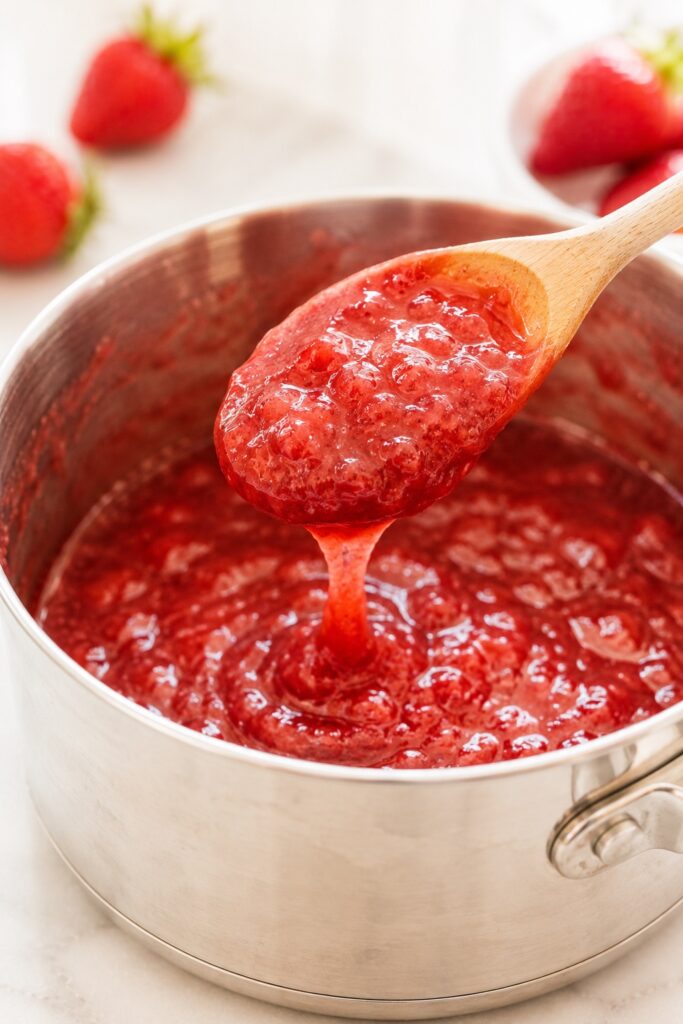
Transfer the reduction to a shallow bowl and cool it completely before adding it to the batter.
What you should see: The finished reduction should be darker and more concentrated than the original purée, with a consistency similar to thick tomato sauce.
BDV Tip: Use a digital scale to confirm the final weight. If the reduction weighs more than 135 g, continue cooking it. If it has reduced below 135 g, do not dilute it with water; begin again for the most reliable batter balance.
2. Prepare the Oven, Pan and Fresh Berries
Preheat the oven to 350°F (177°C) with a rack positioned in the center. Lightly grease a light-colored aluminum 9×13×2-inch pan, line the bottom with parchment paper and lightly grease the parchment.
Cut the strawberries for the batter into pieces no larger than 1/4 inch (6 mm). Spread them over paper towels and blot them thoroughly.
Reserve 1 tablespoon from the already measured cake flour and gently toss it with the diced strawberries. This light coating helps distribute the pieces and absorbs a small amount of surface moisture.
What you should see: The strawberry pieces should look dry on the outside, remain distinct and carry only a fine dusting of flour—not a thick white coating.
3. Combine the Dry and Strawberry Mixtures
Whisk the remaining cake flour with the baking powder, baking soda and salt until evenly combined.
In a separate bowl or measuring jug, whisk together the completely cooled strawberry reduction, sour cream, whole milk and vanilla. Add the optional tiny drop of pink gel coloring here if you want a more consistent blush-pink crumb.
Mix until the strawberry base is smooth and uniform, without streaks of sour cream.
4. Cream the Butter and Sugar Properly
Beat the softened butter and granulated sugar on medium-high speed for 3–4 minutes, scraping the bowl at least once. The mixture should become visibly lighter, fluffier and increased in volume.
With the mixer running on medium speed, slowly drizzle in the neutral oil. Continue mixing for approximately 30 seconds, until the oil is fully incorporated.
What you should see: The mixture should be pale, aerated and creamy. It should not appear greasy, melted or separated.
5. Add the Egg Whites Gradually
Add the room-temperature egg whites in four additions, mixing for 20–30 seconds after each one. Scrape the bottom and sides of the bowl whenever necessary.
Gradual addition gives the fat enough time to emulsify with the egg whites. Adding them all at once can cause the butter mixture to curdle or separate.
A slightly curdled appearance after the final addition is usually recoverable once the dry ingredients are added, but the mixture should not contain liquid pooling at the bottom.
6. Alternate the Dry and Strawberry Mixtures
Set the mixer to low speed and add:
- One-third of the dry ingredients
- Half of the strawberry mixture
- Another one-third of the dry ingredients
- The remaining strawberry mixture
- The remaining dry ingredients
Mix each addition only until it is almost incorporated. Stop the mixer, scrape the bowl and finish combining the batter gently by hand.
Alternating the ingredients helps preserve the emulsion and distributes the strawberry reduction evenly without overworking the flour.
7. Fold in the Fresh Strawberries
Add the flour-coated strawberry pieces and fold them into the batter with a flexible spatula. Reach along the bottom of the bowl so no dense or unmixed batter remains underneath.
Stop folding as soon as the pieces are evenly distributed.
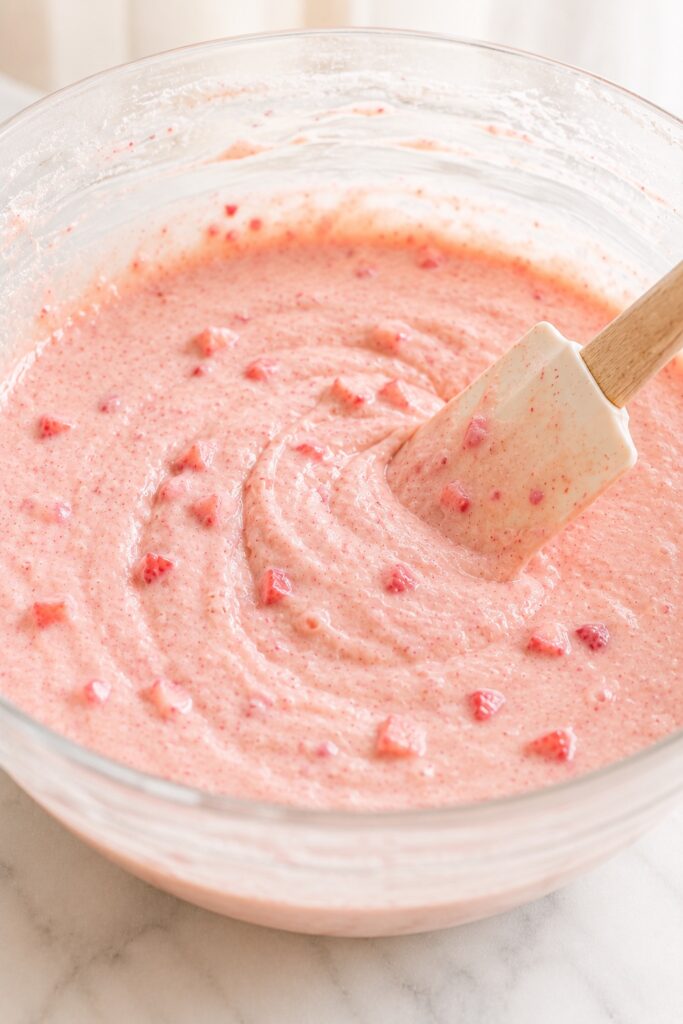
What you should see: The finished batter should be thick, smooth and pale strawberry pink, with small pieces of fruit suspended throughout. It should fall slowly from the spatula rather than pour like a thin liquid.
8. Fill the Pan and Bake
Transfer the batter to the prepared pan and spread it evenly into the corners. Smooth the top gently without pressing out the air created during creaming.
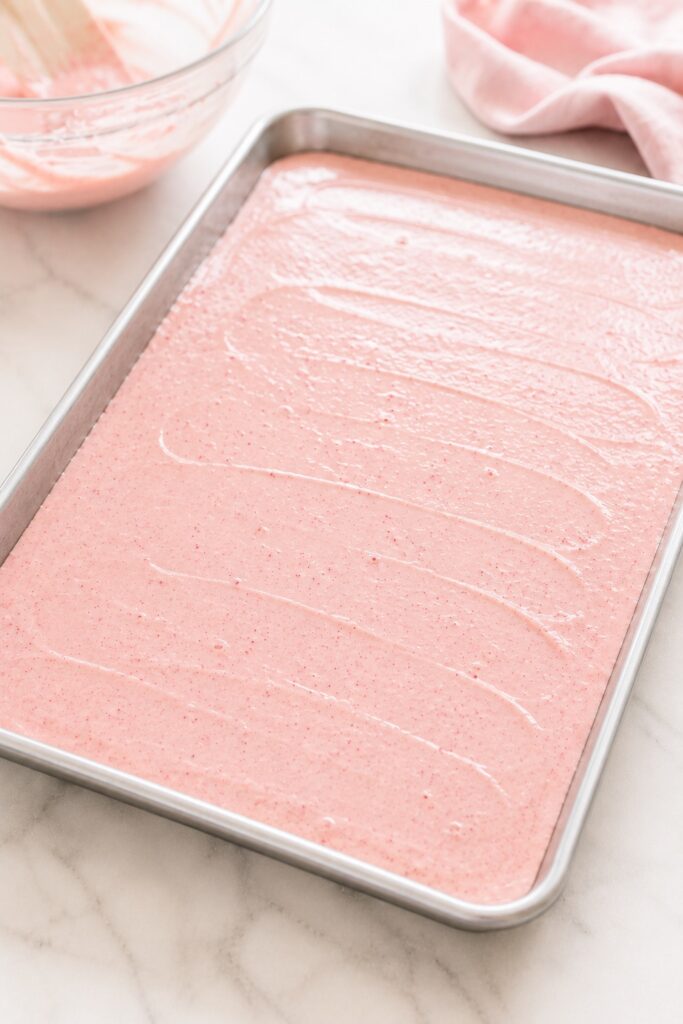
Bake on the center rack for approximately 40–46 minutes. Begin checking at 38 minutes, but avoid opening the oven during the first 30 minutes.
The cake is finished when the center springs back slowly, a toothpick comes out without wet batter and the internal temperature reaches approximately 205–210°F (96–99°C).
9. Cool the Cake Completely
Place the pan on a wire rack and allow the cake to cool completely in the pan, approximately 1 1/2–2 hours.
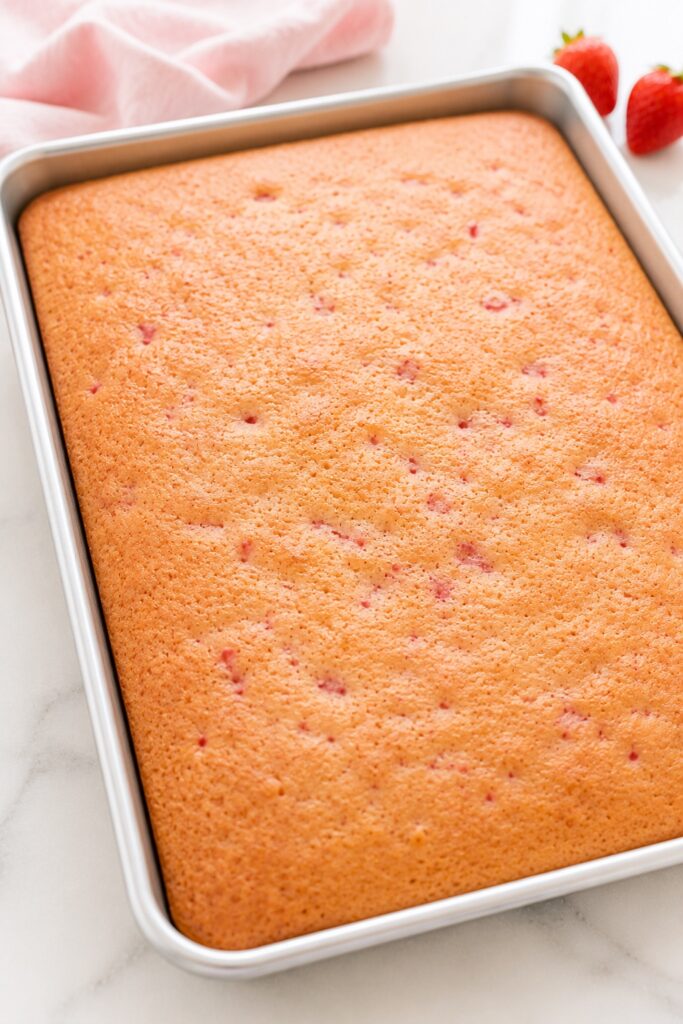
The cake must be cool through the center before frosting. Even residual warmth can soften the cream cheese frosting and cause it to slide or become glossy.
10. Make the Strawberry Cream Cheese Frosting
Process the freeze-dried strawberries into a very fine powder using a completely dry blender or food processor.
Beat the softened butter for approximately 2 minutes, until smooth and creamy. On low speed, gradually add the sifted powdered sugar, strawberry powder and salt. Increase the speed to medium and beat for another 1–2 minutes.
Cut the cool, pliable cream cheese into several pieces. Add it in four additions, mixing on low speed only until each addition disappears into the butter mixture. Add the vanilla and stop mixing as soon as the frosting is smooth.
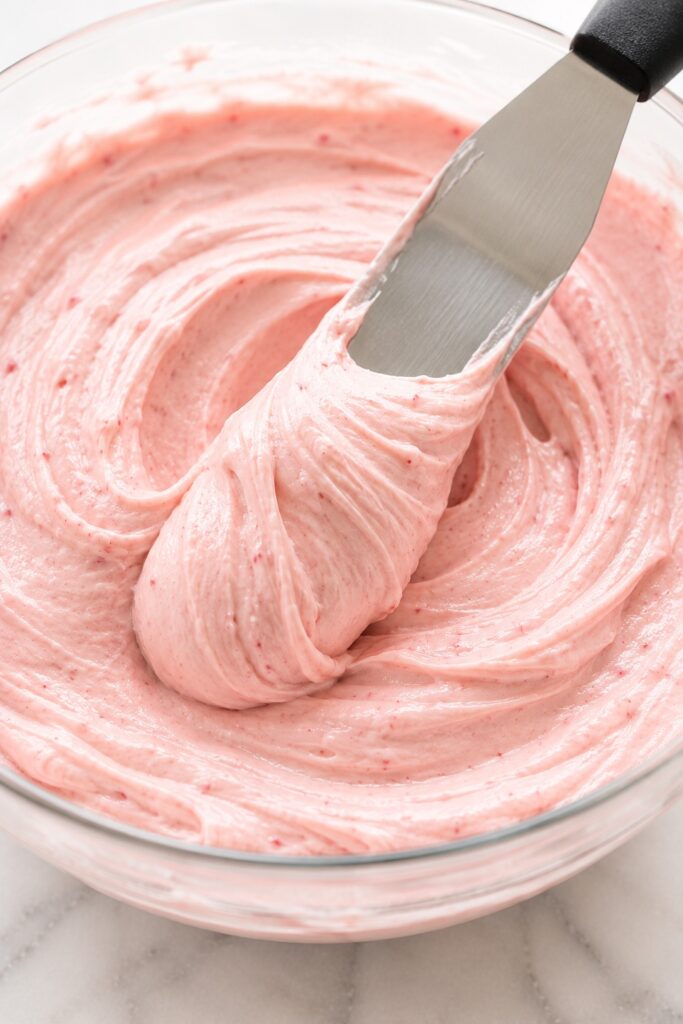
What you should see: The frosting should be naturally pink, visibly flecked with strawberry and thick enough to retain broad spatula swoops.
BDV Tip: Once the cream cheese has been added, more mixing does not make this frosting fluffier—it can make it softer. If it becomes difficult to spread, refrigerate it for 15–20 minutes and then stir it gently by hand.
11. Frost, Set and Slice
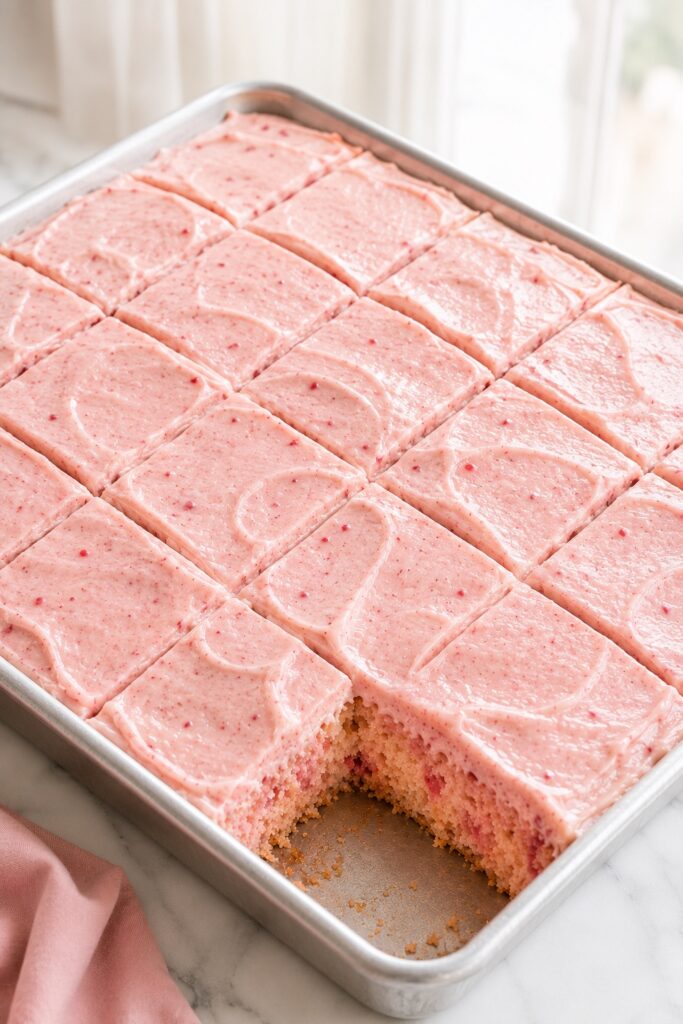
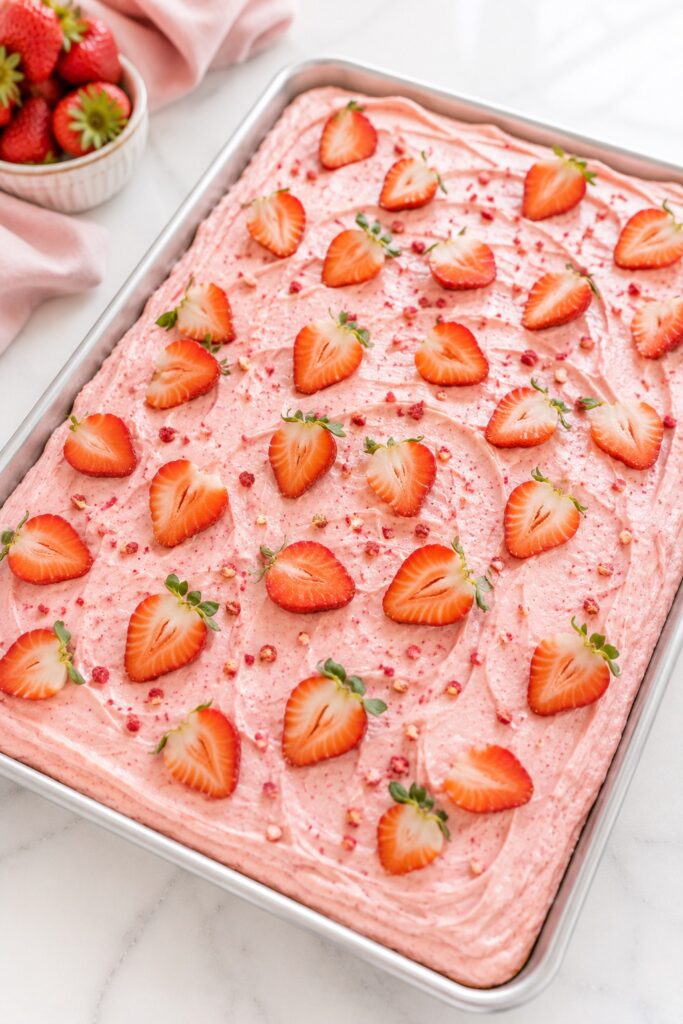
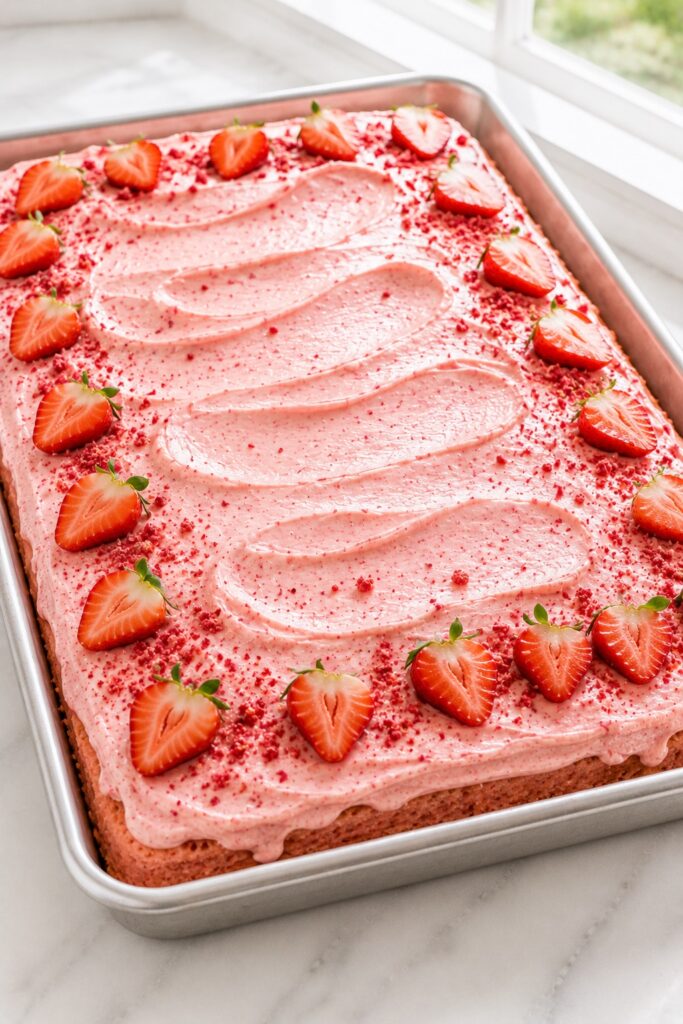
Spread the frosting over the completely cooled cake with a large offset spatula. Create broad, relaxed swoops, taking a small amount of frosting to the edges for the softly draped finish shown in the Hero Master.
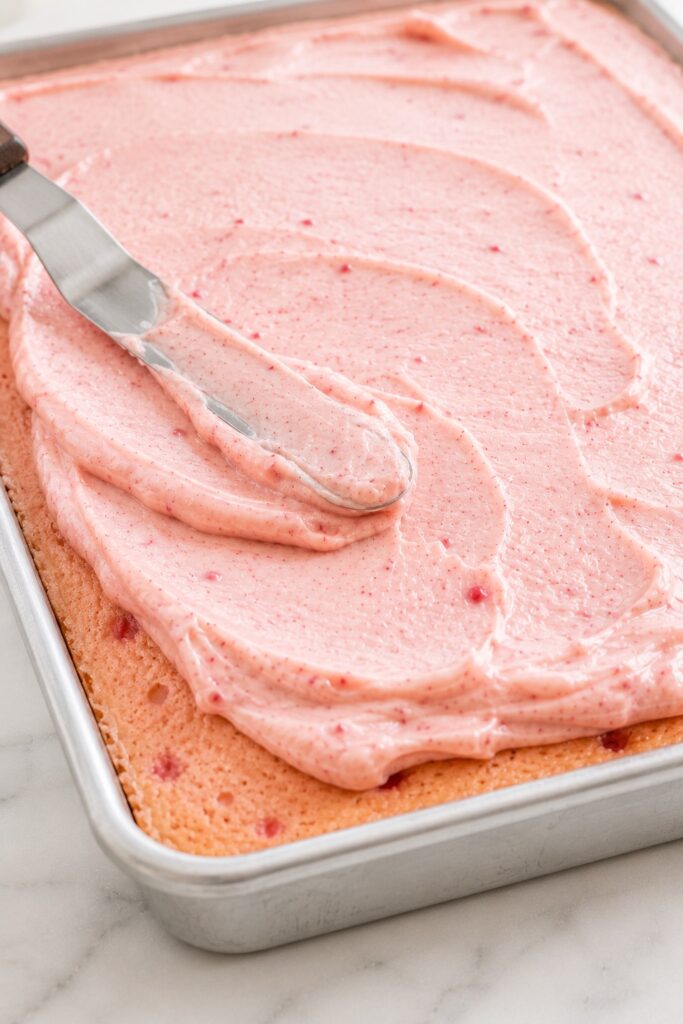
For cleaner slices, refrigerate the frosted cake for 20–30 minutes. Cut it with a long, sharp knife, wiping the blade clean between cuts.
Allow refrigerated slices to stand briefly at room temperature before serving so the crumb and frosting regain their soft, creamy textures.
The Baking Science Behind Real Strawberry Flavor
Fresh strawberries contain a large amount of water, which makes them challenging to use in cake batter. Adding enough raw purée to create powerful flavor would also add enough liquid to weaken the cake’s structure and potentially produce a wet or gummy crumb.
Reducing the purée solves both problems. Evaporation removes excess water while concentrating the fruit’s natural flavor, color, sugar and acidity. The finished 135 g reduction delivers substantially more strawberry character than the same weight of untreated purée.
The finely diced strawberries play a different role. They create visible pieces and brighter pockets of fruit, but their quantity is deliberately limited. Blotting them and keeping the pieces no larger than 1/4 inch prevents them from releasing enough localized moisture to form heavy, underbaked areas.
Butter and oil are used together because they contribute different qualities. Creamed butter traps air and helps establish the cake’s structure, while oil remains liquid when chilled and helps the crumb stay soft after refrigeration.
Egg whites support the cake without introducing the richer flavor or yellow color of yolks. This keeps the strawberry flavor clearer and allows the crumb to retain its delicate blush tone.
The frosting uses freeze-dried strawberries because their water has already been removed. Once ground, they provide intense berry flavor and natural color without loosening the butter-and-cream-cheese emulsion. Fresh purée cannot deliver the same stability.
How to Know the Cake Is Perfectly Baked
A strawberry cake can look finished around the edges while remaining underbaked beneath the center. Use several doneness indicators together instead of relying on color or time alone.
The cake is ready when:
- The center no longer looks wet, shiny or visibly sunken.
- A gentle touch in the center leaves a slight impression that slowly springs back.
- A toothpick inserted in the center comes out with a few moist crumbs but no liquid batter.
- The edges are just beginning to pull away from the pan.
- The internal temperature at the deepest part of the center is approximately 205–210°F (96–99°C).
The top may remain relatively pale because the cake contains egg whites and real fruit. Do not wait for a deeply browned surface, as the edges may become dry before that happens.
If the center is not ready but the top is browning more quickly than expected, place a loose sheet of aluminum foil over the pan and continue baking.
Expert Techniques for a Soft, Even Strawberry Crumb
Small technical choices have a noticeable effect on this cake because the batter contains both concentrated fruit and fresh strawberry pieces.
- Cool the reduction completely. Warm reduction can soften the butter, collapse the aeration and cause a greasy or uneven batter.
- Use ingredients at the specified temperatures. Butter at approximately 65°F (18°C) should yield to gentle pressure without looking shiny. The egg whites, milk, sour cream and reduction should be at room temperature.
- Do not rush the creaming stage. Properly aerated butter and sugar provide much of the cake’s lift and help create a lighter crumb.
- Add the egg whites in stages. Gradual incorporation protects the emulsion and reduces the risk of separation.
- Dry and dice the strawberries carefully. Large or wet pieces are more likely to sink and create gummy pockets.
- Mix minimally after adding flour. Excessive mixing develops gluten and can turn a tender cake into a firm, slightly rubbery one.
- Spread the batter evenly into the corners. An uneven layer creates inconsistent baking and can leave the center deeper than the edges.
- Use the correct pan. A light-colored aluminum pan provides gentler, more even heat than dark metal, glass or ceramic.
- Allow the cake to cool in the pan. Its fruit-rich crumb is especially delicate while warm and becomes easier to slice as it sets.
- Briefly chill before cutting—not before serving. A short chill firms the frosting for neat slices, while a few minutes at room temperature restores the best eating texture.
Common Strawberry Sheet Cake Mistakes—and How to Avoid Them
Even a well-balanced fruit cake can change when the reduction, fresh berries or frosting are handled differently. These are the most likely causes when the result does not match the expected crumb, flavor or finish.
The Cake Tastes More Like Vanilla Than Strawberry
This usually happens when the purée has not been reduced sufficiently or when a smaller quantity is used. Cook it to exactly 135 g and use the entire amount in the batter.
Do not replace the reduction with untreated purée, jam or strawberry extract. Each would alter the cake’s intended flavor or moisture balance.
The Crumb Has Wet or Gummy Pockets
The fresh strawberries may have been too large, too wet or unevenly distributed. Keep the pieces at or below 1/4 inch (6 mm), blot them thoroughly and coat them with the reserved flour.
Underbaking can produce a similar texture, especially through the center. Confirm doneness with both a toothpick and the physical cues above.
The Cake Is Dense or Heavy
Dense texture can result from butter that was too warm, insufficient creaming, cold ingredients, overmixing after the flour was added or expired leavening.
Measure flour by weight whenever possible. Too much flour can make the cake heavy even when every mixing step is correct.
The Cake Sinks in the Center
The oven may have been opened too early, the cake may have been removed before its structure had set or the strawberry reduction may have contained too much water.
Avoid opening the oven during the first 30 minutes and confirm the center is fully baked before removing the pan.
The Strawberry Pieces Sink
Pieces that are too large or wet are difficult for the batter to suspend. Dice them finely, blot away surface moisture and use only the reserved tablespoon of flour to coat them.
Some natural variation is expected, but the fruit should remain distributed throughout the crumb rather than forming a wet layer at the bottom.
The Frosting Is Loose
The cake may still have been warm, the cream cheese may have been tub-style or overly softened, or the frosting may have been beaten too long after adding the cream cheese.
Use cool, full-fat brick-style cream cheese and mix it only until incorporated. If necessary, refrigerate the frosting for 15–20 minutes before spreading.
The Frosting Is Grainy
The powdered sugar may not have been sifted, or the freeze-dried strawberries may not have been ground finely enough. Process the berries into a fine powder and sift the powdered sugar before mixing.
The Cake Is Too Brown at the Edges
Dark metal and glass pans transfer heat differently from light-colored aluminum. They can set or darken the edges before the fruit-rich center is fully baked.
For the result established by this recipe, use a light-colored aluminum 9×13×2-inch pan and bake on the center rack.
Beautiful Ways to Finish and Serve This Strawberry Cake
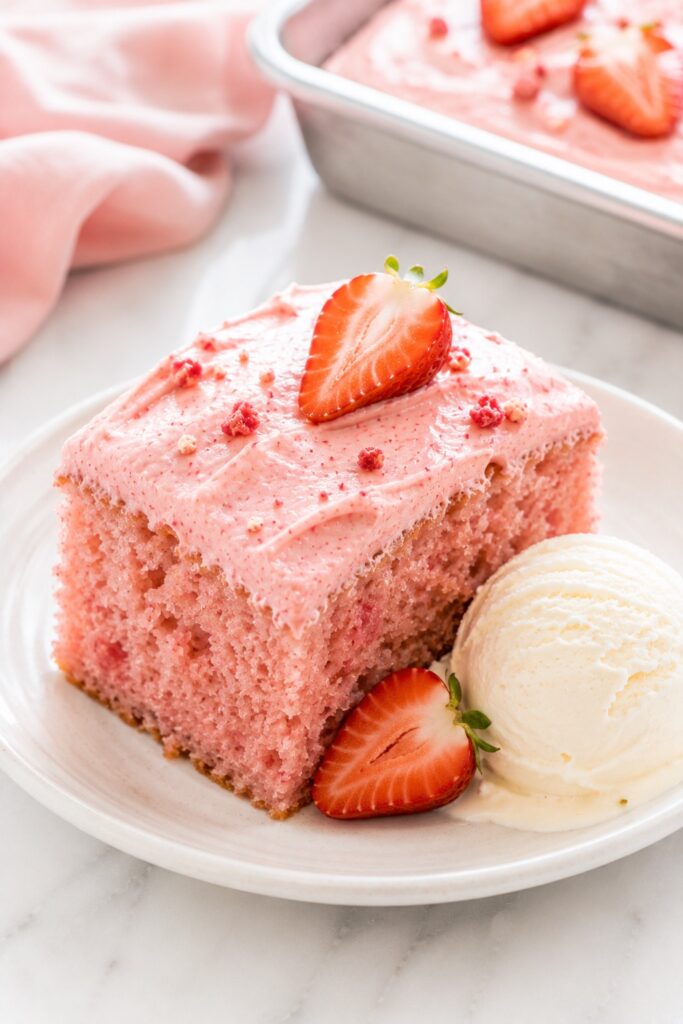
The cake already has a naturally celebratory appearance, so it does not need elaborate decoration. Broad frosting swoops and a few visible strawberry flecks create the most elegant finish while keeping the soft pink surface established by the Hero Master.
For a polished presentation:
- Leave the frosting in relaxed, generous swoops for a clean bakery-style finish.
- Add a light dusting of finely crushed freeze-dried strawberries immediately before serving.
- Arrange a few completely dry strawberry halves around the outer edge rather than covering the entire surface.
- Garnish individual slices instead of the whole cake if it will be stored overnight; fresh berries can release moisture onto the frosting.
- Cut the cake into 16 generous squares, following a clean 4×4 grid for even portions and a polished presentation.
The cake is especially lovely for birthdays, bridal or baby showers, Easter, Mother’s Day and summer gatherings. For a larger dessert table, pair it with colorful Cake Pops or chilled Fruit Pizza Bites.
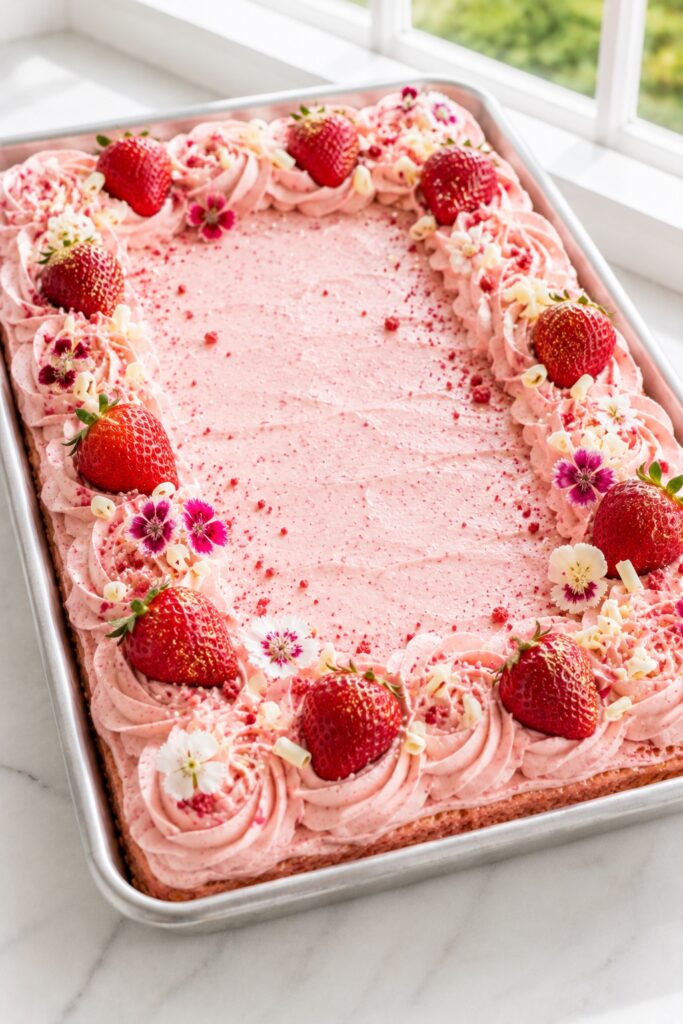
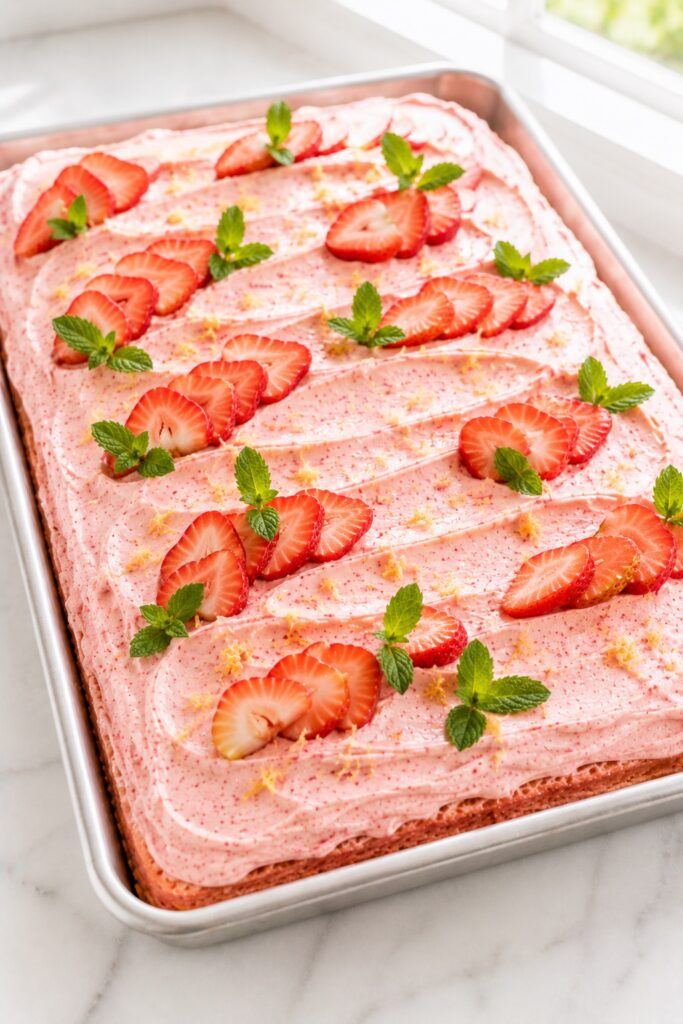
Serve the cake cool, but not refrigerator-cold. Allow individual slices to stand at room temperature for approximately 20–30 minutes so the crumb softens and the strawberry cream cheese frosting becomes silky again.
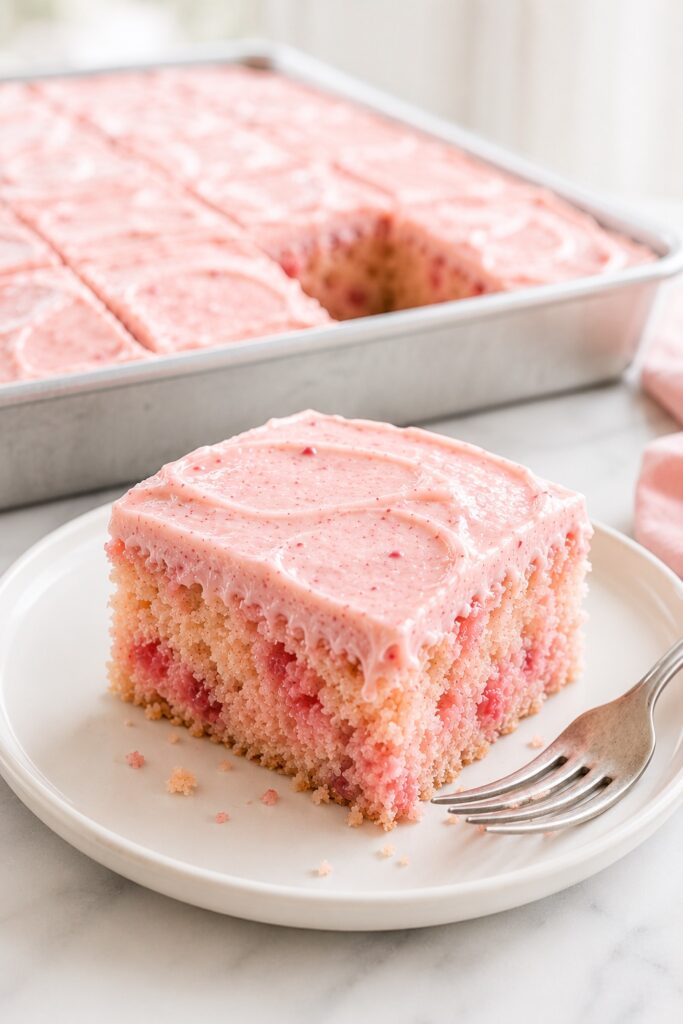
A Calm Make-Ahead Plan for Effortless Serving
This cake is easier to prepare when the reduction, baking and decorating are divided into manageable stages. The following schedule allows every component enough time to cool and set without rushing.
The Best Two-Day Plan
Day One
- Prepare the strawberry reduction and cool it completely.
- Cover and refrigerate the reduction.
- Bake the cake later the same day.
- Cool the cake completely in the pan.
- Cover the pan tightly and refrigerate overnight.
Day Two
- Prepare the strawberry cream cheese frosting.
- Frost the cold cake and create the final swoops.
- Refrigerate for 20–30 minutes if clean slices are important.
- Allow the cake or individual slices to soften briefly at room temperature before serving.
- Add fresh strawberry garnishes only shortly before presentation.
Same-Day Workback Plan
Allow approximately six hours from the beginning of the reduction to serving.
| Time before serving | Task |
|---|---|
| 6 hours | Purée and begin reducing the strawberries |
| 5 hours 20 minutes | Transfer the finished reduction to a shallow bowl and cool |
| 4 hours 25 minutes | Prepare the pan, berries and remaining ingredients |
| 3 hours 55 minutes | Mix the batter and place the cake in the oven |
| 3 hours 10 minutes | Begin cooling the baked cake completely |
| 1 hour 10 minutes | Prepare the frosting |
| 50 minutes | Frost the cake |
| 30 minutes | Briefly chill for cleaner slices |
| 15–20 minutes | Allow the cake to soften slightly before serving |
Do not shorten the cooling period by frosting a warm cake. A cold or fully room-temperature cake is far easier to finish neatly and will not soften the cream cheese frosting.
How to Store, Freeze and Restore the Best Texture
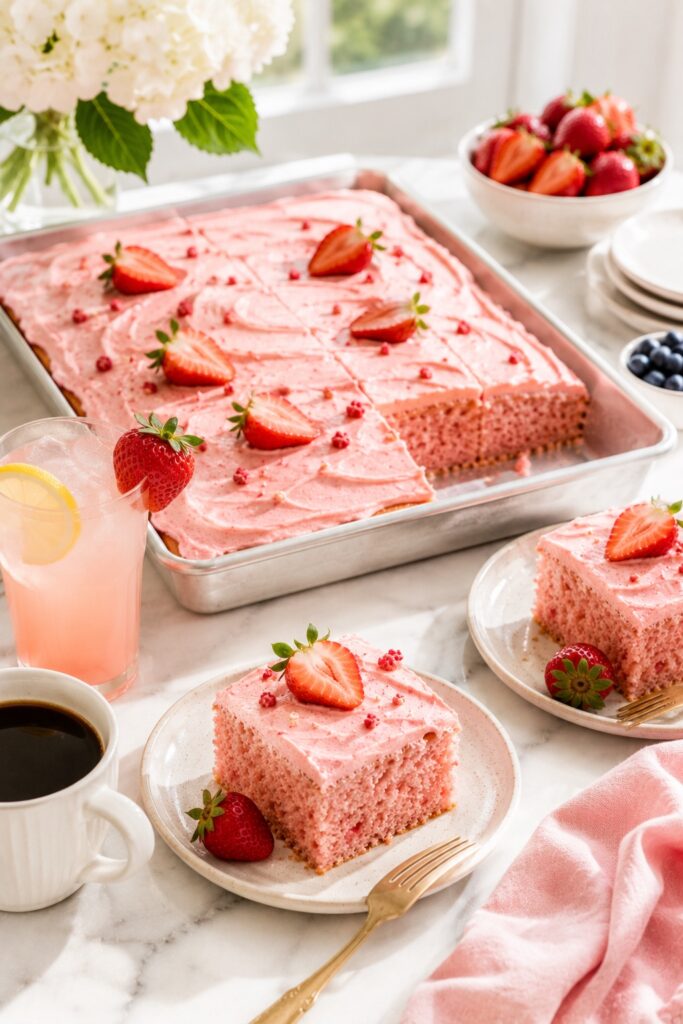
Because the frosting contains cream cheese, the finished cake should be refrigerated. Store it in a tightly covered pan or airtight container so the exposed edges do not dry out or absorb refrigerator odors.
Refrigerator Storage
Refrigerate the frosted cake for up to four days. Its strawberry flavor and soft crumb are at their best during the first two to three days.
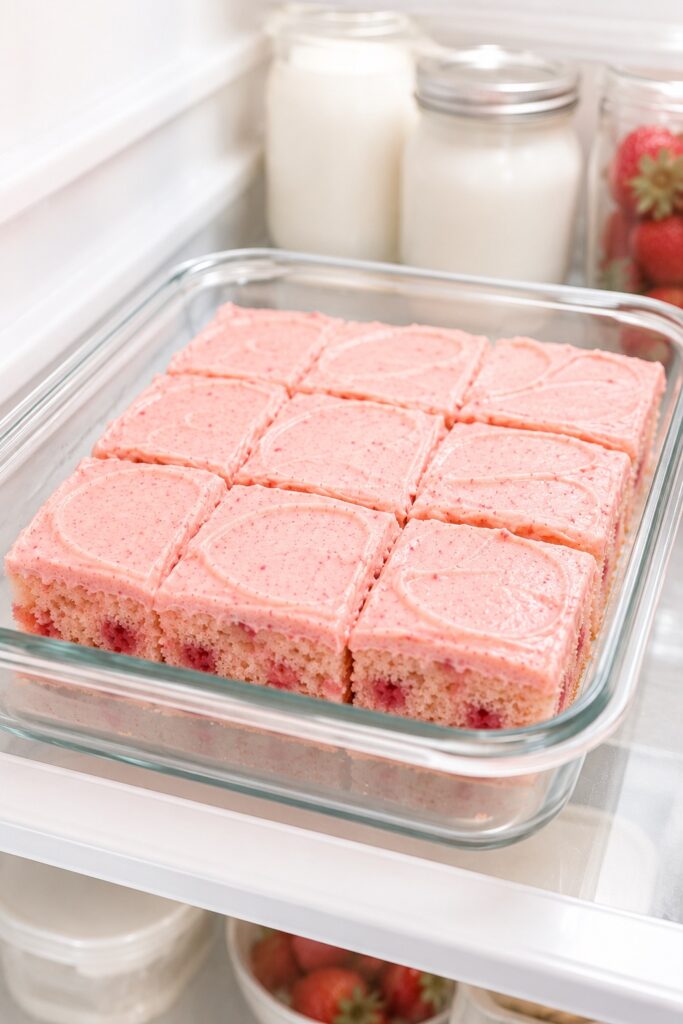
Remove only the number of slices you plan to serve and allow them to stand at room temperature for approximately 20–30 minutes. Avoid microwaving frosted slices, as the cream cheese frosting can melt before the cake warms evenly.
Freezing the Unfrosted Cake
The unfrosted cake freezes more successfully than the fully decorated cake.
Cool it completely, then wrap it tightly in two layers of plastic wrap followed by aluminum foil. Freeze the whole cake or individual portions for up to two months.
Thaw it overnight in the refrigerator while still wrapped. Once thawed, bring it to a cool room temperature before frosting.
Freezing Frosted Slices
Individual frosted slices may be frozen for up to one month. Place them uncovered in the freezer until the frosting is firm, then wrap each slice securely and transfer it to an airtight container.
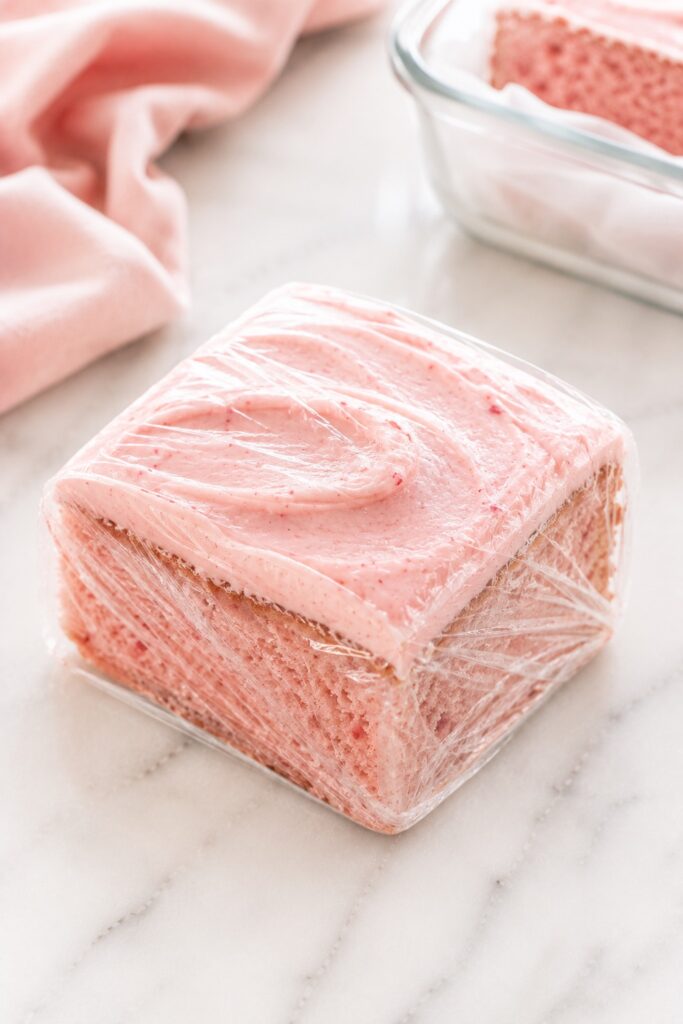
Thaw overnight in the refrigerator. Unwrap the slices before allowing them to soften briefly at room temperature.
Storing the Strawberry Reduction
The finished reduction may be refrigerated in an airtight container for up to three days or frozen for up to two months. Thaw it in the refrigerator and bring it completely to room temperature before mixing the batter.
Do not use the reduction if water has been stirred into it after cooking or if its measured weight has changed.
An Important Food-Safety Note
Do not leave the cream cheese-frosted cake at room temperature for more than two hours—or more than one hour when the surrounding temperature exceeds 90°F (32°C). Keep the refrigerator at or below 40°F (4°C), following the official guidance from the USDA Food Safety and Inspection Service and the FDA.
Questions Bakers Ask About Strawberry Sheet Cake
These answers address the adjustments that most often affect the cake’s strawberry flavor, structure and appearance.
Can I Make the Strawberry Reduction Ahead of Time?
Yes. Prepare it up to three days in advance and refrigerate it in an airtight container. Bring the measured 135 g portion completely to room temperature before adding it to the batter.
Can I Use Frozen Strawberries?
Frozen strawberries work well for the reduction. Thaw them completely and include all the juices when puréeing.
Do not use thawed frozen berries for the diced fruit in the batter. They are too soft and wet to create the distinct pieces shown in the finished cake.
Can I Skip the Fresh Strawberry Pieces?
Yes, but the cake will no longer contain the small fruit pieces and juicy strawberry bursts established by this recipe’s identity. Do not replace them with additional reduction, as that would disturb the batter’s liquid balance.
Can I Make the Frosting Without Freeze-Dried Strawberries?
The freeze-dried strawberries are essential to the frosting’s flavor, color and stability. Fresh purée, jam and chewy dried strawberries cannot be substituted without changing its moisture and texture.
If freeze-dried strawberries are unavailable, it is better to use a separate vanilla cream cheese frosting than to add fresh fruit to this formula—but the cake will no longer have strawberry flavor in both components.
Does the Cake Need Pink Food Coloring?
No. The cake will naturally range from pale blush to soft pink depending on the berries.
If you want a shade closer to the Hero Master, add one very small drop of pink gel coloring to the strawberry-and-dairy mixture. Avoid liquid coloring and deeply saturated pink shades.
Can I Use a Glass Baking Dish?
The formula and baking time are designed for a light-colored aluminum 9×13×2-inch pan. Glass retains and transfers heat differently, which can produce darker edges while the center remains underbaked.
For the most predictable result, use the specified metal pan rather than changing the temperature or timing to accommodate glass.
Can I Bake This Recipe as Cupcakes or a Layer Cake?
The formula is balanced for the depth and surface area of a 9×13×2-inch pan. Cupcake wells and round layer pans require different baking times and may change how the fresh fruit is distributed.
For that reason, the recipe should not be presented as a direct one-to-one conversion for either format.
Why Is My Cake Not Bright Pink?
Natural strawberry color softens during baking and varies with the fruit. A pale pink crumb with darker strawberry pieces is the expected result.
A bright red or intensely pink cake generally requires more coloring than this recipe is intended to use.
How Do I Transport the Cake?
Chill the frosted cake until the frosting is firm, then keep it inside its covered pan or a fitted cake carrier. Transport it on a flat surface in an air-conditioned vehicle.
For warm-weather gatherings, place the carrier in an insulated cooler with cold packs positioned around—not directly against—the cake pan.
Continue Your Strawberry Baking Journey
If this cake is part of a spring or summer dessert table, these recipes continue the fruit-forward theme while offering different textures and serving styles:
- Strawberry Cheesecake Banana Pudding combines berries, banana pudding and cheesecake richness in a chilled dessert.
- Fruit Pizza Bites offer a colorful, individually portioned option for parties and showers.
- Blueberry Cream Cheese Bars carry the fruit-and-cream-cheese pairing into an easy bar dessert.
- Cake Pops make a playful companion for birthday tables and larger celebrations.
Why This Strawberry Cake Belongs in Your Recipe Box
A dependable celebration cake should feel special without becoming fragile, fussy or difficult to serve. This recipe achieves that balance with a simple single-layer format and a carefully controlled approach to real strawberry flavor.
The reduction gives the cake a concentrated berry foundation. Fresh pieces preserve the experience of biting into real fruit, while freeze-dried strawberries keep the frosting vivid and creamy without adding excess water. Each strawberry component has a separate purpose, and together they create a cake that tastes as intentional as it looks.
It is generous enough for a gathering, elegant enough for a celebration and practical enough to prepare over two days. Most importantly, it delivers genuine strawberry character rather than relying on cake mix, gelatin or artificial extract.
Final Thoughts
This strawberry sheet cake brings together everything a real-strawberry cake should offer: a tall and tender crumb, visible pieces of fruit, naturally delicate color and a thick strawberry cream cheese frosting that balances sweetness with gentle tang.
Take the time to reduce the berries accurately, dry the diced fruit and cool the cake completely. Those three details transform a simple 9×13-inch cake into a polished, dependable dessert worthy of birthdays, summer tables and every strawberry season still to come.

Strawberry Sheet Cake
This homemade Strawberry Sheet Cake combines concentrated strawberry reduction with finely diced fresh berries for a soft, moist crumb and genuine fruit flavor. A thick strawberry cream cheese frosting made with freeze-dried strawberries finishes the tall 9×13-inch cake with natural pink color, creamy texture and balanced tang.
Ingredients
For the Strawberry Reduction
- 1 pound fresh strawberries, weighed after hulling (454 g)
For the Strawberry Sheet Cake
- 2 1/2 cups cake flour (300 g), divided
- 2 1/2 teaspoons baking powder (10 g)
- 1/2 teaspoon baking soda (2 g)
- 1 teaspoon fine salt (5 g)
- 3/4 cup unsalted butter (170 g), softened to approximately 65°F (18°C)
- 1 2/3 cups granulated sugar (330 g)
- 1/4 cup neutral oil (60 ml or approximately 55 g)
- 5 large egg whites (approximately 150 g), at room temperature
- 1/3 cup full-fat sour cream (80 g), at room temperature
- 1/4 cup whole milk (60 ml), at room temperature
- 2 teaspoons pure vanilla extract
- 1/2 cup cooled strawberry reduction (135 g)
- 2/3 cup very finely diced fresh strawberries (90 g), cut no larger than 1/4 inch and thoroughly blotted
- Optional: 1 very small drop pink gel food coloring
For the Strawberry Cream Cheese Frosting
- 1 ounce freeze-dried strawberries (28 g)
- 3/4 cup unsalted butter (170 g), softened to approximately 65°F (18°C)
- 2 3/4 cups powdered sugar (330 g), sifted
- 12 ounces full-fat brick-style cream cheese (340 g), cool but pliable
- 1 teaspoon pure vanilla extract
- 1/4 teaspoon fine salt
Instructions
Make the Strawberry Reduction
- Purée the hulled strawberries in a blender or food processor until completely smooth. Leave the seeds in the purée.
- Pour the purée into a wide, heavy-bottomed saucepan. Cook uncovered over medium-low heat, stirring frequently and scraping the bottom and sides, until reduced to exactly 1/2 cup (135 g), approximately 25–35 minutes.
- Transfer the reduction to a shallow bowl and cool completely. It should be thick and spoonable, similar to a thick tomato sauce, but not sticky or jam-like.
Prepare the Pan and Ingredients
- Preheat the oven to 350°F (177°C) with a rack in the center. Lightly grease a light-colored aluminum 9×13×2-inch pan, line the bottom with parchment paper and lightly grease the parchment.
- Reserve 1 tablespoon from the measured cake flour. Toss it gently with the finely diced, thoroughly blotted strawberries. Set aside.
- Whisk the remaining cake flour with the baking powder, baking soda and salt.
- In a separate bowl or measuring jug, whisk together the cooled strawberry reduction, sour cream, whole milk and vanilla. Add the optional tiny drop of pink gel coloring, if using.
Mix the Strawberry Cake Batter
- Beat the softened butter and granulated sugar on medium-high speed for 3–4 minutes, scraping the bowl at least once, until pale, fluffy and visibly increased in volume.
- With the mixer running on medium speed, slowly drizzle in the neutral oil. Mix for approximately 30 seconds, until fully incorporated.
- Add the egg whites in four additions, mixing for 20–30 seconds after each addition. Scrape the bottom and sides of the bowl as needed.
- Reduce the mixer to low speed. Add one-third of the dry ingredients and mix only until almost incorporated, followed by half of the strawberry mixture. Add another one-third of the dry ingredients, then the remaining strawberry mixture, and finish with the remaining dry ingredients, mixing each addition only until almost incorporated. Stop the mixer, scrape the bottom and sides of the bowl, and finish combining the batter gently by hand. Do not beat the batter after adding the flour.
- Fold in the flour-coated diced strawberries with a flexible spatula. Scrape the bottom of the bowl and stop as soon as the fruit is evenly distributed.
Bake and Cool
- Transfer the batter to the prepared pan and spread it evenly into the corners. Smooth the surface gently without pressing down the batter.
- Bake on the center rack for approximately 40–46 minutes. Begin checking at 38 minutes, but do not open the oven during the first 30 minutes.
- The cake is ready when the center springs back slowly after a gentle touch, a toothpick comes out without wet batter and the internal temperature reaches approximately 205–210°F (96–99°C).
- Place the pan on a wire rack and cool the cake completely in the pan, approximately 1 1/2–2 hours. Do not frost the cake while it is even slightly warm.
Make the Strawberry Cream Cheese Frosting
- Process the freeze-dried strawberries in a completely dry blender or food processor until they form a very fine powder.
- Beat the softened butter on medium-high speed for approximately 2 minutes, until smooth and creamy.
- Reduce the mixer to low and gradually add the sifted powdered sugar, strawberry powder and salt. Once incorporated, increase to medium speed and beat for 1–2 minutes, scraping the bowl as necessary.
- Cut the cool, pliable cream cheese into several pieces. Add it in four additions, mixing on low speed only until each addition is incorporated.
- Add the vanilla and mix on low only until the frosting is smooth, thick and evenly pink. Do not continue whipping after the cream cheese has been incorporated.
Frost and Serve
- Spread the frosting over the completely cooled cake, creating broad, relaxed swoops with an offset spatula.
- Refrigerate the frosted cake for 20–30 minutes before slicing if you want especially clean edges.
- Cut with a long, sharp knife, wiping the blade clean between slices. Allow refrigerated slices to stand at room temperature for approximately 20–30 minutes before serving.
Notes
- Measure the reduction precisely. The finished strawberry reduction must weigh 135 g. Too much remaining water can produce a wet or gummy crumb.
- Do not dilute an over-reduced batch. If the reduction falls below 135 g, begin again rather than adding water.
- Use the flour already measured. Reserve 1 tablespoon from the 300 g cake flour to coat the diced berries; do not add extra flour.
- Keep the fruit pieces small and dry. Cut them no larger than 1/4 inch (6 mm) and blot thoroughly before coating them with flour.
- Frozen strawberries: They may be used for the reduction after thawing, including all released juices. Use only fresh strawberries for the pieces folded into the batter.
- Pan: The timing is designed for a light-colored aluminum 9×13×2-inch pan. Glass, ceramic and dark metal pans can bake the edges differently.
- Frosting consistency: If the frosting becomes too soft, refrigerate it for 15–20 minutes and stir gently by hand. Do not correct it with large quantities of powdered sugar.
- Make ahead: Prepare the reduction up to three days in advance. The unfrosted cake may also be baked one day ahead, covered tightly and refrigerated.
- Storage: Refrigerate the frosted cake in an airtight container for up to four days. The best texture and flavor are within the first two to three days.
- Freezing: Freeze the tightly wrapped unfrosted cake for up to two months or individual frosted slices for up to one month.
Nutrition Information:
Yield: 16 Serving Size: 1 squareAmount Per Serving: Calories: 516Total Fat: 29gSaturated Fat: 16gCholesterol: 70mgSodium: 403mgCarbohydrates: 60gFiber: 2gSugar: 44gProtein: 5g
Nutrition information is provided as an estimate only and may vary based on specific ingredients, brands, and portion sizes used. This information should not be considered medical or nutritional advice.
12 Sweet Favorites — Yours, Free 🍰
Tiramisù, no-bake cheesecake, the perfect chocolate chip cookie & 9 more reader-loved desserts — gathered into one beautiful free recipe book. From my kitchen to yours.
No spam, just sweet things. Unsubscribe anytime.