Sourdough English Muffins Recipe (Naturally Leavened)
🎁 FREE E-BOOK: 12 Sweet Favorites — reader-loved desserts in one beautiful recipe book.
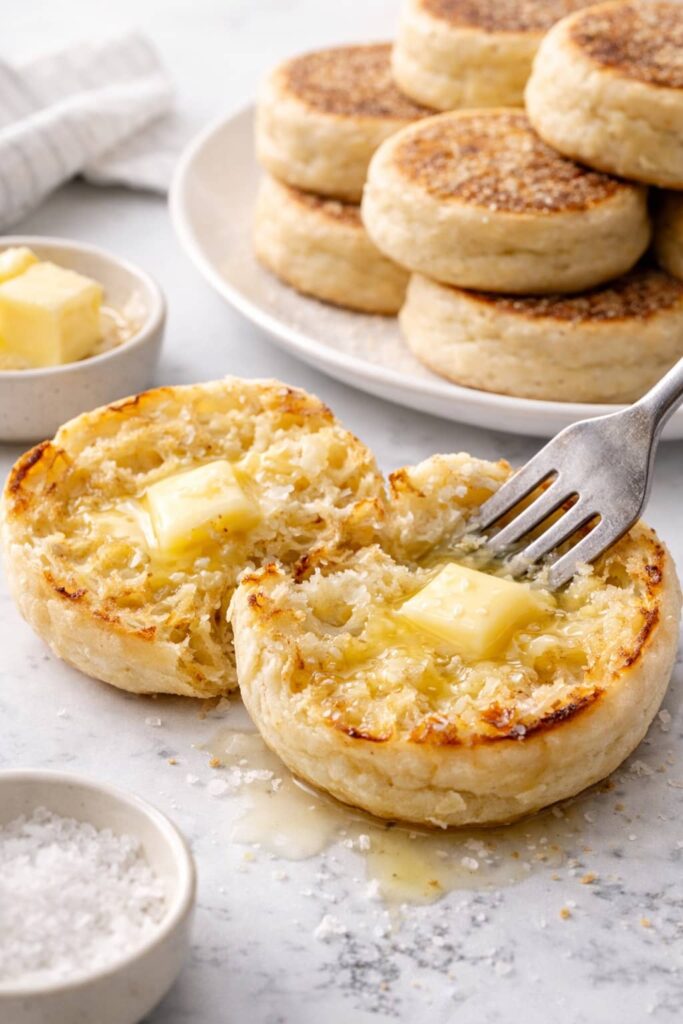
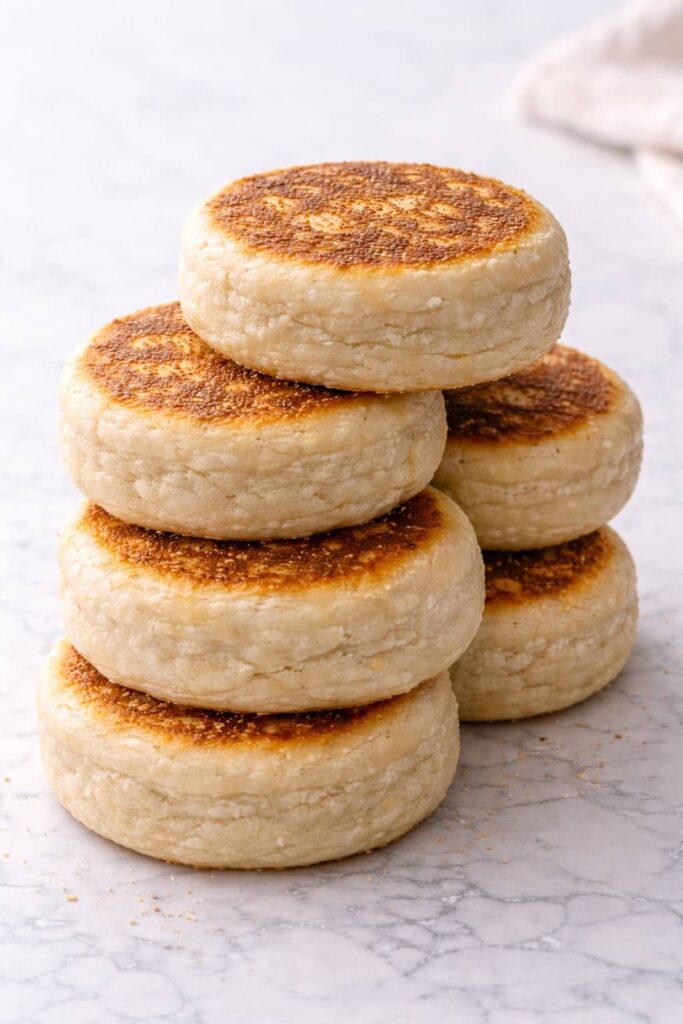
These sourdough English muffins are naturally leavened, skillet-cooked breads with a thin golden crust, a tender-chewy interior, and the irregular nooks and crannies that catch melted butter beautifully.
The dough is enriched with whole milk and butter for softness, while an active sourdough starter provides all the leavening. Two tablespoons of sugar support tenderness, moisture retention, and even griddle browning without making the finished muffins taste sweet.
The standard schedule produces a mild, balanced sourdough flavor. If you prefer a more pronounced tang, the recipe includes a controlled 12–24 hour refrigerated fermentation without changing the texture or adding commercial yeast.
Why You’ll Love This Sourdough English Muffin Recipe
- Naturally leavened: active sourdough starter provides the rise, with no commercial yeast or baking soda.
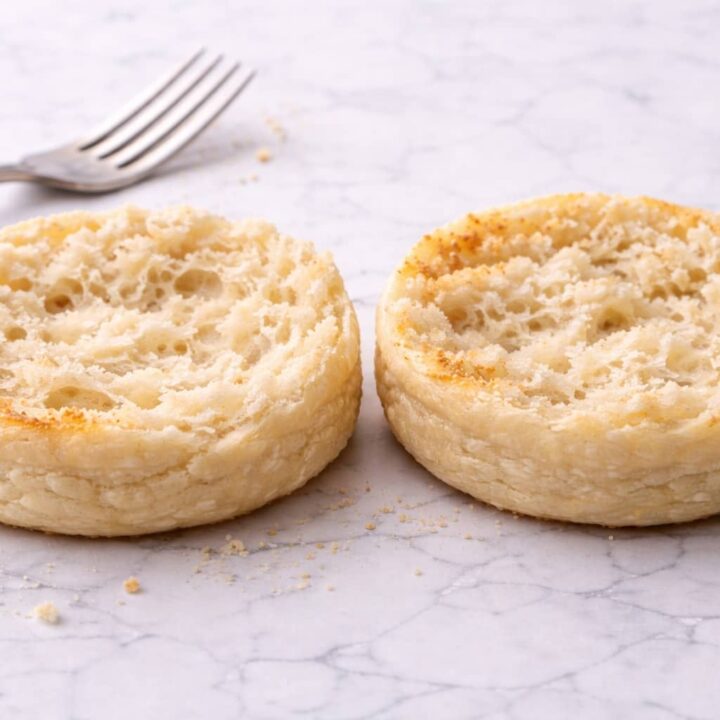
- Classic texture: a tender-chewy crumb holds irregular pockets that become more pronounced when fork-split.
- Balanced flavor: gently fermented and buttery, with an optional cold schedule for more sourdough tang.
- No oven required: the muffins cook slowly on a skillet or griddle, with an optional oven finish only when needed.
- Freezer-friendly: split them before freezing and toast directly from frozen for an easy breakfast.
Recipe Identity and Expectation Boundary
These are soft American-style sourdough English muffins, not sharply sour artisan bread and not sweet breakfast rolls. The standard version has a mild, balanced fermented flavor because the dough contains whole milk, butter, and a modest amount of sugar.
The recipe requires a ripe, active starter at 100% hydration. Unfed discard is not an equal substitute because it may not contain enough active yeast to raise the dough reliably. If your “discard” has recently been fed and reliably doubles after feeding, it is functioning as active starter and can be used.
What to Expect
| Feature | Finished Result |
|---|---|
| Flavor | Mild, balanced sourdough with buttery richness; more tang with the cold-fermentation option |
| Interior | Tender and slightly chewy with irregular air pockets |
| Crust | Thin, dry, and evenly golden from gentle skillet cooking |
| Sweetness | Not noticeably sweet |
| Size | About 3–3 1/4 inches wide and approximately 1 inch tall after cooking |
| Best split | Fork-split after cooling to expose the nooks and crannies |
Sourdough English Muffin Timeline
| Stage | Standard Schedule | More-Tang Schedule |
|---|---|---|
| Mix and knead | About 30 minutes | About 30 minutes |
| Initial room-temperature fermentation | 6–10 hours | 2–3 hours |
| Cold fermentation | None | 12–24 hours |
| Shape | About 15 minutes | About 15 minutes |
| Final proof | 1–2 hours | 1 1/2–3 hours |
| Cook | 25–35 minutes | 25–35 minutes |
Fermentation time is a range, not a deadline. A warm kitchen and highly active starter shorten the rise; a cooler kitchen lengthens it. Use the visual cues in the instructions rather than waiting for the dough to double.
Kitchen Tools
- Digital kitchen scale
- Large mixing bowl or stand mixer
- Dough scraper
- Heavy skillet, cast-iron pan, or electric griddle
- Instant-read thermometer
- Wire cooling rack
Ingredients
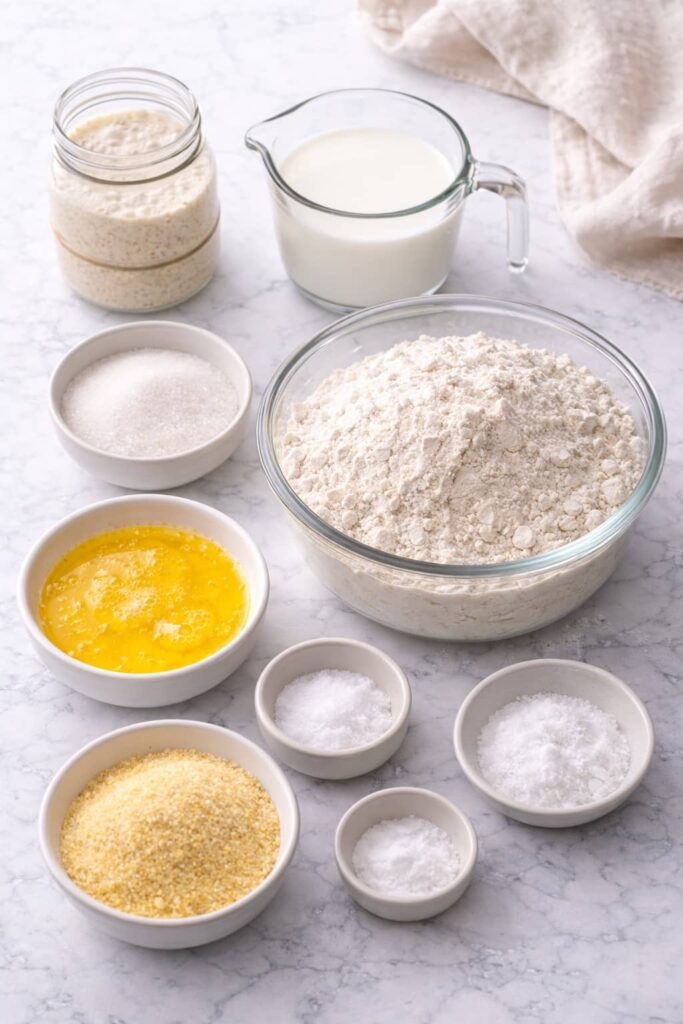
- 1/2 cup active sourdough starter at 100% hydration (113 g)
- 1 cup whole milk, at room temperature (240 ml)
- 2 tablespoons granulated sugar (25 g)
- 3 tablespoons unsalted butter, melted and cooled (42 g)
- 3 cups all-purpose flour (360 g)
- 1 1/2 teaspoons fine sea salt (9 g)
- Cornmeal or semolina, for dusting
For the most repeatable fermentation and dough consistency, use the gram measurements. Starter volume changes depending on how aerated it is, and flour can vary significantly when measured by cups.
Active sourdough starter
Use starter near its peak: it should have doubled after feeding, look bubbly throughout, and have a gently domed top that is just beginning to level. A starter that has already collapsed may still ferment the dough, but the rise will be slower and the result less predictable. King Arthur Baking’s guide to identifying ripe sourdough starter provides additional visual reference.
Whole milk
Whole milk creates a softer crumb and fuller flavor than water. Bring it to approximately 21–24°C (70–75°F); hot milk can weaken the starter, while refrigerator-cold milk slows the beginning of fermentation.
Sugar
Two tablespoons support browning, moisture retention, and a tender bite. The finished muffins should not taste sweet. Removing all the sugar produces paler, slightly leaner muffins but does not automatically create stronger sourdough flavor; starter maturity and fermentation schedule have a greater influence.
All-purpose flour
All-purpose flour gives the muffins enough structure while keeping the crumb tender. Bread flour can make them noticeably chewier and may require a small adjustment in milk, so it is not the preferred flour for the canonical result.

Before You Start
- Feed the starter early enough that it will be at or near peak strength when you mix the dough.
- Choose the standard or refrigerated schedule before mixing so the dough does not over-ferment while you decide.
- Keep the griddle heat gentle. English muffins need enough time for the center to set before the crust becomes too dark.
- Do not plan to cut them while hot. The crumb continues setting during cooling.
How to Make Sourdough English Muffins
1. Mix the dough
In a large bowl, whisk together the active starter, room-temperature milk, sugar, and melted cooled butter. Add the flour and salt. Mix until no dry flour remains and a rough, cohesive dough forms.
Cover and rest for 20 minutes. This short hydration period makes the dough easier to knead without adding extra flour.
What you should see: The dough will look shaggy and feel slightly sticky, but it should hold together rather than pour or spread like batter.
2. Knead until smooth and elastic
Knead with a dough hook on low to medium-low speed for 6–8 minutes, or knead by hand for 8–10 minutes. Stop once the dough is smooth, elastic, and tacky rather than wet.
A small piece should stretch into a thin, translucent membrane before tearing. If the dough clings heavily after several minutes of kneading, add flour only 1 tablespoon at a time; excessive flour creates dense muffins.
What you should see: The dough should pull away from the sides of the bowl while remaining softly attached at the bottom.
3. Bulk ferment until aerated
Transfer the dough to a lightly buttered straight-sided container and cover. Ferment at 21–24°C (70–75°F) for approximately 6–10 hours, until the dough has increased by 50–75%.
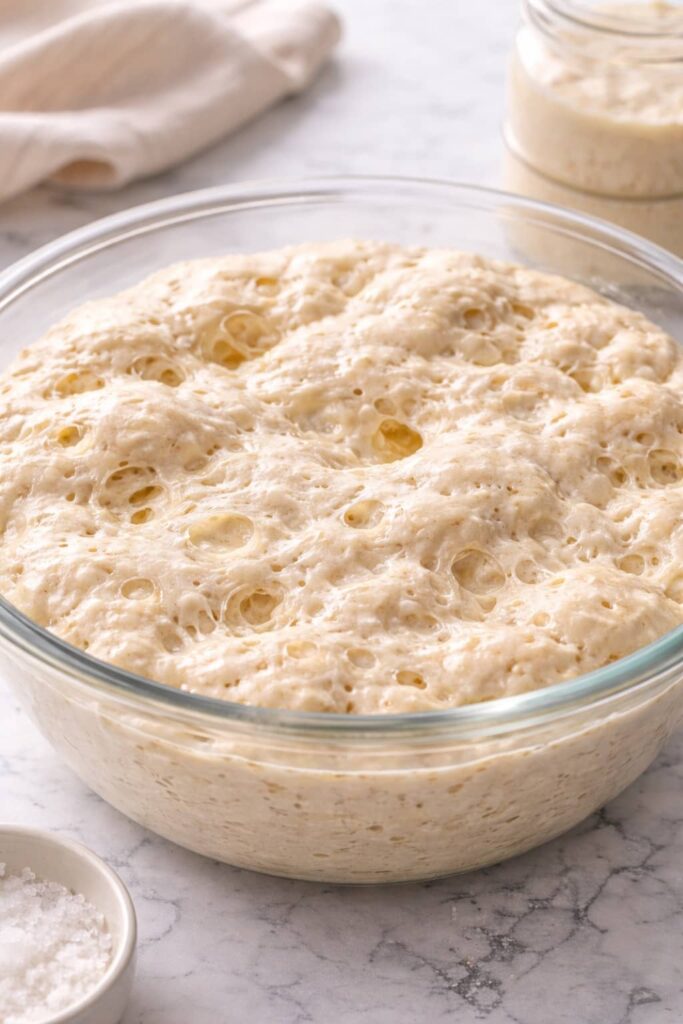
At 24°C (75°F), begin checking around 6 hours. At 21°C (70°F), fermentation may take closer to 9–10 hours. Do not wait automatically for the dough to double; that can push this enriched dough beyond its strongest shaping point.
What you should see: The surface should be slightly domed, small bubbles should be visible around the edges, and the dough should jiggle gently when the container is moved. It should still feel elastic, not loose or collapsed.
4. Divide and shape the muffins
Dust a parchment-lined tray generously with cornmeal or semolina. Turn the dough onto a lightly floured surface and divide it into 10 equal portions, approximately 78–79 g each.
Shape each portion gently into a round by tucking the edges underneath. Rest the rounds for 10 minutes, then press each one to approximately 3–3 1/4 inches wide and 3/4 inch (2 cm) thick. Place them on the prepared tray and dust the tops lightly with more cornmeal.
What you should see: The rounds should be even but naturally handmade, with smooth tops and enough tension to hold their shape. They should not be rolled paper-thin or compressed firmly.
5. Proof until visibly puffy
Cover the shaped muffins and let them proof at room temperature for 60–120 minutes. They are ready when visibly puffed and slightly lighter when the tray is lifted.
Press the side of one round gently with a floured fingertip. The indentation should return slowly and remain faintly visible. A quick spring-back means they need more time; an indentation that does not move can indicate over-proofing.
6. Cook slowly on the skillet
Preheat a heavy skillet or griddle over low to medium-low heat. If using an infrared thermometer, aim for a surface temperature of approximately 150–165°C (300–325°F).
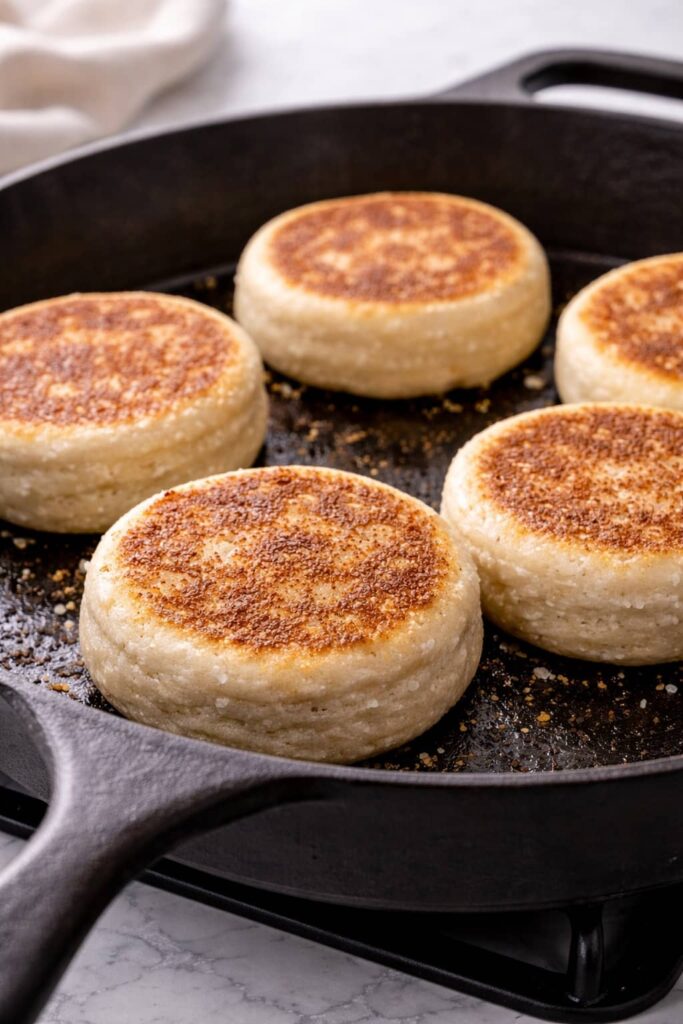
Transfer the muffins carefully to the dry skillet, leaving space between them. Cook for 6–8 minutes on the first side, then turn and cook for another 6–8 minutes. Work in batches if necessary, and do not press them with a spatula.
What you should see: Each side should develop an even golden-brown surface without black patches. The muffins should rise gradually and feel set around the edges.
7. Check the center for doneness
Insert an instant-read thermometer through the side into the center. Fully cooked English muffins should reach 93–96°C (200–205°F).
If the surfaces are sufficiently brown but the centers remain below 93°C (200°F), transfer the muffins to a 180°C (350°F) oven for 5–8 minutes. This finishes the crumb without burning the crust.
8. Cool and split with a fork
Move the cooked muffins to a wire rack and cool for at least 20–30 minutes. Insert the tines of a fork around the circumference, then pull the two halves apart gently.
Fork-splitting exposes the irregular crumb structure; slicing with a knife compresses and smooths the pockets. Toast the split sides until crisp and golden before serving.
Optional Cold Fermentation for More Sourdough Flavor
For a more pronounced sourdough tang, let the kneaded dough ferment at room temperature for 2–3 hours, until it begins to look aerated and has risen approximately 20–30%. Cover tightly and refrigerate at 4°C (40°F) or colder for 12–24 hours.
Divide and shape the dough while it is still cold, then proof the rounds for approximately 1 1/2–3 hours. Cook them when visibly puffy and when a gentle indentation returns slowly. A refrigerator warmer than 4°C (40°F) can allow the dough to ferment faster, so inspect the dough rather than relying only on the clock.
How to Know the Muffins Are Properly Fermented
| Stage | Correct Cue | Warning Sign |
|---|---|---|
| Starter | Doubled, bubbly, gently domed | Flat, inactive, or fully collapsed |
| Bulk fermentation | 50–75% rise with edge bubbles | No rise, or a loose collapsed mass |
| Shaped proof | Puffy; indentation returns slowly | Dense and springy, or fragile and deflating |
| Cooked muffin | Golden exterior; center at 200–205°F | Dark outside with a gummy center |
Doneness Cues
- Both flat sides are evenly golden, not scorched.
- The edges feel set and no longer look raw or shiny.
- The center registers 93–96°C (200–205°F).
- After cooling, the crumb is moist and elastic rather than gummy or doughy.
Expert Tips
- Mark the starting dough level. A piece of tape on a straight-sided container makes a 50–75% rise much easier to judge.
- Use dough temperature to interpret the clock. At 24°C (75°F), check early; at 21°C (70°F), expect the longer end of the range.
- Shape individual portions. Dividing rather than rolling and recutting avoids compressed scraps and preserves more internal gas.
- Keep the skillet dry. Butter burns during the long cooking time. Cornmeal supplies release and the classic exterior texture.
- Use temperature as the final authority. Surface color alone cannot confirm that the center is fully set.
Common Mistakes and How to Fix Them
The muffins taste less sour than expected
The standard formula is intentionally mild. Use a mature starter and the 12–24 hour refrigerated schedule for a clearer tang. Reducing the sugar alone will not produce the same controlled flavor development.
The dough barely rises
The starter was likely underactive, the dough was too cold, or fermentation ended too early. Use starter that reliably doubles after feeding and allow more time when the dough temperature is below 21°C (70°F).
The dough becomes loose and difficult to shape
This usually indicates over-fermentation. Shape at a 50–75% rise rather than waiting for a full doubling, especially in a warm kitchen.
The outsides burn before the centers cook
The skillet is too hot. Reduce the heat and extend the cooking time. If the crust is already brown, finish the muffins in a 180°C (350°F) oven until the centers reach 93–96°C (200–205°F).
The crumb is dense
Common causes include weak starter, insufficient bulk fermentation, adding too much flour, flattening the rounds aggressively, or cooking before the final proof is complete.
The crumb is gummy
The center was undercooked or the muffins were split while hot. Verify the internal temperature and cool them for at least 20–30 minutes before opening.
Beautiful Ways to Serve Sourdough English Muffins
- Toast and finish with salted butter and fruit preserves.
- Build a breakfast sandwich with egg, cheese, and crisp bacon.
- Use as the base for eggs Benedict.
- Spread with cream cheese, honey, or nut butter.
- Serve alongside fresh fruit and coffee for a relaxed brunch.
For another naturally fermented breakfast, try these sourdough discard pancakes. For a faster option without maintaining a starter, use the classic English muffin recipe.
How to Store and Freeze Them
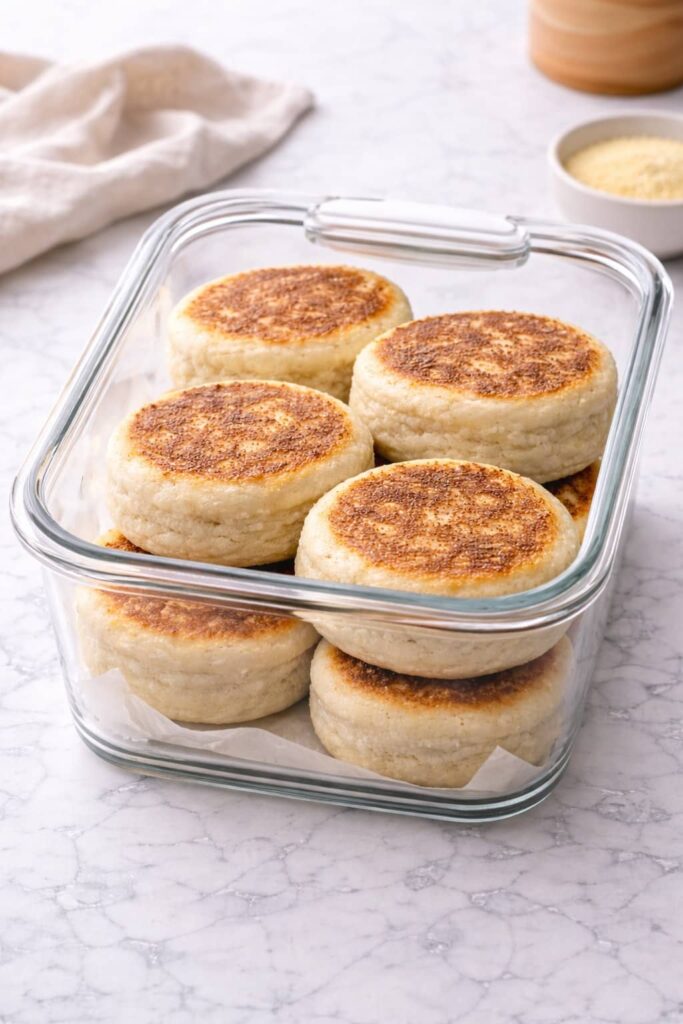
Store fully cooled muffins in an airtight container at room temperature for up to 2 days. Toasting restores the crisp exterior and warms the crumb.
For longer storage, fork-split the cooled muffins and freeze them in an airtight freezer bag for up to 2 months. Place parchment between the halves if needed, then toast directly from frozen.
Frequently Asked Questions
Do sourdough English muffins have to taste very sour?
No. “Sourdough” describes natural fermentation with wild yeast and lactic acid bacteria, but the final acidity varies with the starter, flour, temperature, and fermentation schedule. This standard version is mild; use the refrigerated schedule for more tang.
Do 2 tablespoons of sugar hide the sourdough flavor?
The sugar softens the overall flavor and supports browning, but the muffins should not taste sweet. Fermentation time and starter maturity affect sourdough intensity more directly. For a more pronounced flavor, use the cold-fermentation option rather than simply removing the sugar.
Can I use sourdough discard instead of active starter?
Not as a direct substitution. This naturally leavened recipe depends on active starter for its rise. Discard that has been fed and reliably doubles can be used because it is active again; unfed discard will not provide predictable leavening.
Why is there no baking soda?
Active starter supplies the leavening. Baking soda is unnecessary and would neutralize some of the acidity responsible for sourdough flavor.
Can I leave the dough in the refrigerator longer than 24 hours?
It is not recommended for this formula. A longer retard can weaken the enriched dough and produce a flatter, overly acidic muffin. Shape and cook within the 12–24 hour window.
Can I bake them instead of using a skillet?
You can bake the rounds, but they will resemble small bread rolls rather than classic English muffins. The skillet creates the flat golden surfaces and gradual interior set that define the style.
Why should English muffins be fork-split?
A fork pulls the crumb apart along its natural weak points, exposing irregular pockets and craggy edges. A knife makes a smooth surface and compresses the visual nooks and crannies.
Why This Recipe Belongs in Your Repertoire
This recipe turns a small amount of active starter into a versatile breakfast bread without commercial yeast. The formula is structured enough for predictable shaping, soft enough for a tender crumb, and flexible enough to produce either mild or more pronounced sourdough flavor through timing alone.
If you are building confidence with naturally fermented dough, make these before moving on to a full sourdough bread recipe. If you need a wheat-free alternative, these gluten-free English muffins provide a separate formula designed for that purpose.
Sourdough English Muffins Recipe
Use the recipe card below for the complete measurements, timing, temperature, and optional refrigerated fermentation schedule.
Sourdough English Muffins
Naturally leavened sourdough English muffins with thin golden crusts, tender-chewy centers, and classic nooks and crannies. The standard schedule produces a mild, balanced sourdough flavor, while the optional refrigerated fermentation develops a more pronounced tang without commercial yeast.
Ingredients
- 1/2 cup active sourdough starter at 100% hydration (113 g)
- 1 cup whole milk, at room temperature (240 ml)
- 2 tablespoons granulated sugar (25 g)
- 3 tablespoons unsalted butter, melted and cooled (42 g)
- 3 cups all-purpose flour (360 g)
- 1 1/2 teaspoons fine sea salt (9 g)
- Cornmeal or semolina, for dusting
Instructions
- Mix the dough.
In a large bowl, whisk together the active sourdough starter, room-temperature milk, granulated sugar, and melted cooled butter. Add the all-purpose flour and fine sea salt. Mix until no dry flour remains and a rough, cohesive dough forms. Cover and rest for 20 minutes. - Knead until smooth and elastic.
Knead with a dough hook on low to medium-low speed for 6–8 minutes, or by hand for 8–10 minutes. The finished dough should be smooth, elastic, and tacky rather than wet. A small piece should stretch into a thin membrane before tearing. If the dough still clings heavily after several minutes of kneading, add flour only 1 tablespoon at a time. - Bulk ferment until aerated.
Transfer the dough to a lightly buttered straight-sided container and cover. Ferment at 70–75°F (21–24°C) for approximately 6–10 hours, until the dough has increased by 50–75%. The surface should look slightly domed, small bubbles should be visible around the edges, and the dough should feel aerated but still elastic. Do not wait automatically for it to double. - Divide and shape the muffins.
Line a tray with parchment and dust it generously with cornmeal or semolina. Turn the dough onto a lightly floured surface and divide it into 10 equal portions, approximately 78–79 g each. Shape each portion gently into a round, rest for 10 minutes, then flatten to approximately 3–3 1/4 inches wide and 3/4 inch (2 cm) thick. Place on the prepared tray and dust the tops lightly with more cornmeal. - Proof until visibly puffy.
Cover the shaped muffins and proof at room temperature for 60–120 minutes. They are ready when visibly puffy and a gentle fingertip indentation returns slowly while remaining faintly visible. A quick spring-back means they need more time. - Cook slowly on the skillet.
Preheat a heavy skillet or griddle over low to medium-low heat, ideally to a surface temperature of 300–325°F (150–165°C). Transfer the muffins carefully to the dry skillet, leaving space between them. Cook for 6–8 minutes on the first side, then turn and cook for another 6–8 minutes. Work in batches if necessary and do not press the muffins with a spatula. - Check the center for doneness.
Insert an instant-read thermometer through the side into the center. The muffins are fully cooked at 200–205°F (93–96°C). If the surfaces are sufficiently golden but the centers remain below 200°F (93°C), transfer them to a 350°F (180°C) oven for 5–8 minutes. - Cool and split with a fork.
Transfer the cooked muffins to a wire rack and cool for at least 20–30 minutes. Insert the tines of a fork around the circumference, then pull the halves apart gently. Toast the split sides before serving.
Notes
- Use a ripe starter at or near peak activity. It should have doubled after feeding, look bubbly throughout, and have a gently domed top that is just beginning to level.
- Unfed sourdough discard is not a direct substitute. This recipe relies on active starter for natural leavening and does not use commercial yeast or baking soda.
- For the most repeatable fermentation and dough consistency, use the gram measurements.
- Fermentation time depends on starter strength and dough temperature. At 75°F (24°C), begin checking around 6 hours; at 70°F (21°C), the dough may need 9–10 hours.
- For more sourdough tang: after kneading, ferment the dough at room temperature for 2–3 hours, until it begins to look aerated and has risen approximately 20–30%. Cover tightly and refrigerate at 40°F (4°C) or colder for 12–24 hours. Divide and shape while cold, then proof for approximately 1 1/2–3 hours before cooking.
- The 2 tablespoons of sugar support tenderness, moisture retention, and even browning without making the muffins taste sweet. Fermentation schedule and starter maturity influence sourdough intensity more directly than removing the sugar.
- Keep the skillet dry. Butter can burn during the long cooking time; cornmeal or semolina provides release and the classic exterior texture.
- Store fully cooled muffins in an airtight container at room temperature for up to 2 days. For longer storage, fork-split and freeze in an airtight bag for up to 2 months. Toast directly from frozen.
Nutrition Information:
Yield: 10 muffins Serving Size: 1 muffinAmount Per Serving: Calories: 205Total Fat: 5gSaturated Fat: 3gCholesterol: 12mgSodium: 360mgCarbohydrates: 35gFiber: 1gSugar: 4gProtein: 5g
Nutrition information is provided as an estimate only and may vary based on specific ingredients, brands, and portion sizes used. This information should not be considered medical or nutritional advice.
Final Thought
Good sourdough English muffins are defined by balance: enough fermentation for flavor and lift, enough structure to hold their shape, and gentle heat that cooks the center before the crust becomes too dark. Follow the dough rather than the clock, verify doneness with temperature, and fork-split only after cooling for the best homemade result.
12 Sweet Favorites — Yours, Free 🍰
Tiramisù, no-bake cheesecake, the perfect chocolate chip cookie & 9 more reader-loved desserts — gathered into one beautiful free recipe book. From my kitchen to yours.
No spam, just sweet things. Unsubscribe anytime.

These did not taste like sourdough with 2 Tablespoons of sugar.
Thank you for sharing your experience. These English muffins are designed to have a mild, balanced sourdough flavor, and the 2 tablespoons of sugar help with tenderness, moisture, and browning without making them noticeably sweet. The intensity of the sourdough flavor can vary depending on the maturity of the starter and the fermentation time. I’ve updated the recipe with clearer fermentation guidance and an optional 12–24 hour refrigerated fermentation for a more pronounced tang. I really appreciate you taking the time to share your feedback!