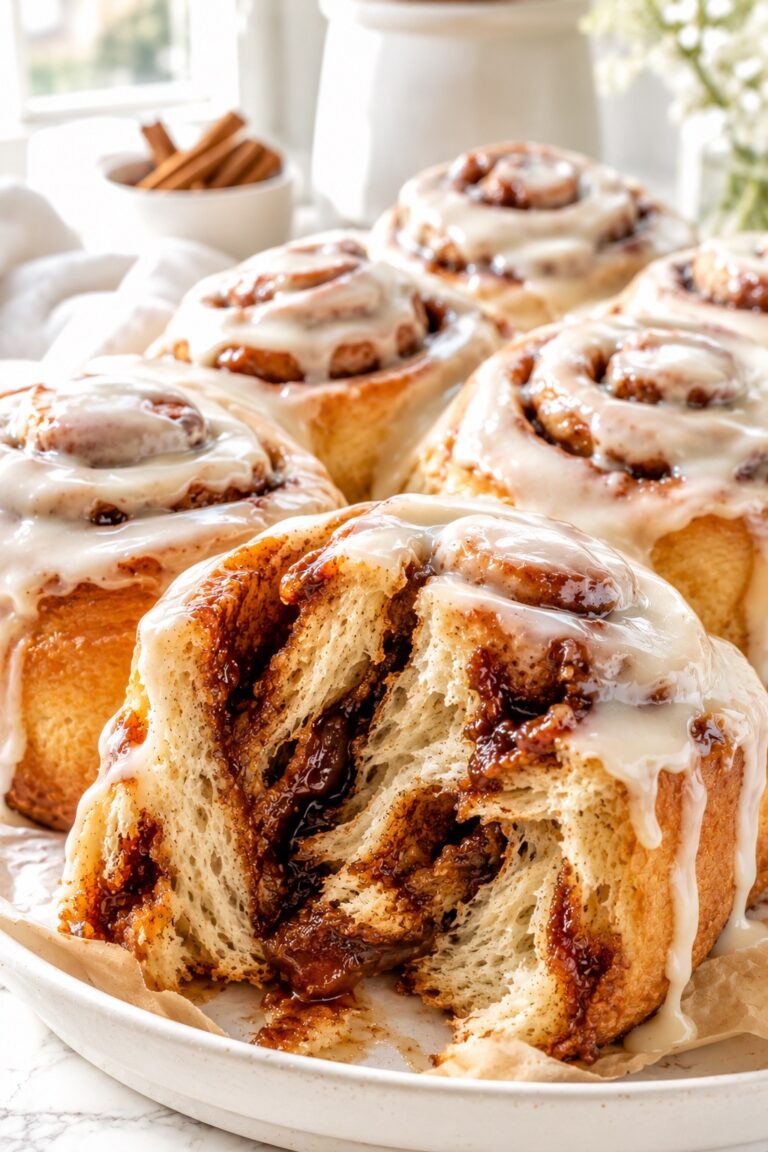
Cranberry Orange Bread with Orange Glaze (Easy, Moist & Fruity)
🎁 FREE E-BOOK: 12 Sweet Favorites — reader-loved desserts in one beautiful recipe book.
Cranberry orange bread is a sweet, hand-mixed quick bread made with fresh cranberries, orange zest and sour cream, then finished with a thin orange glaze. The buttery crumb holds little tart fruit pockets, while the citrus coating brings a gentle sweetness to each slice.

A slice beside a cup of coffee feels especially welcome on a cool morning. The red berries make the loaf lovely for a holiday table, too, with enough color and character that it needs very little dressing up.
Keep this cranberry orange bread recipe close when you want a loaf to share: the berries are measured before chopping, the center checks account for juicy fruit, and the timing leaves room for the bread to cool before its glaze goes on.
Cranberry Orange Bread at a Glance
This cranberry orange bread makes one tender, sliceable loaf raised with baking powder. Allow about 3 hours 35 minutes to 3 hours 50 minutes before serving, including cooling and a short wait for the glaze to settle.
| Detail | What to plan for |
|---|---|
| Texture | Tender, buttery crumb with irregular cranberry pockets and a thin glaze |
| Flavor | Bright orange zest, tart cranberries and a sweet citrus finish |
| Difficulty | Easy hand mixing, with attention to the center and cooling |
| Method | Melted-butter batter, baked in a conventional oven |
| Prep | 20 minutes, including mixing the glaze |
| Bake | 55-70 minutes; begin checking around 50 minutes |
| Cooling and finish | About 2 hours cooling, including 15 minutes in the pan, plus about 20 minutes for the glaze to settle |
| Total | About 3 hours 35 minutes to 3 hours 50 minutes |
| Yield | 1 loaf, cut into 10 equal slices |
| Pan | 9 x 5 x 2 3/4-inch light-colored metal loaf pan, about 23 x 13 x 7 cm |
| Best for | Planned brunch, coffee breaks and a loaf to share |
| Finish | Orange glaze spooned over a fully cooled loaf |
The clock begins with ingredients ready to use. Allow extra time beforehand if the eggs and sour cream are still refrigerator-cold.
Why This Cranberry Orange Loaf Works
This cranberry orange bread brings together a buttery sour-cream crumb, tart fresh fruit and orange in two forms. Each part has a distinct job, so a slice has contrast beneath its delicate glaze.
- A tender base around the berries. Melted butter and full-fat sour cream give cranberry orange bread its richness, while restrained folding keeps the crumb from becoming tough. The chopped cranberries remain distinct, with tart pieces against the soft cake.
- Orange flavor throughout the slice. Finely grated zest goes into the batter, bringing citrus aroma without adding more juice than the formula needs. The orange-juice glaze carries that flavor across the top as well.
- Tart fruit balanced by a sweet finish. Fresh cranberries keep their sharper character in the loaf. The thin confectioners’ sugar glaze adds sweetness at the surface, leaving the berry pockets and browned crust recognizable.
Why You’ll Love Baking This Orange-Cranberry Loaf
Making cranberry orange bread asks for a little measuring and a patient cooling window, but the hands-on work stays simple. These are the details that make the bake pleasant from bowl to serving plate.
- Simple mixing equipment. There is no butter-and-sugar creaming stage: a whisk combines the wet ingredients, then a flexible spatula folds in the flour and fruit. You can make the batter with ordinary bowls and hand tools.
- Useful cues at the uncertain moments. Thick, scoopable batter, a set center and a glaze that falls in a ribbon give you something visible to judge. The recipe also explains how to distinguish red berry moisture from wet batter on a tester.
- A finish that needs no decorating tools. Spoon the orange glaze over the fully cooled loaf and let it settle. Its gentle drips and the red fruit in each slice provide the color without frosting or piping.
- Flexible finishing for the serving day. Bake and cool the cranberry orange bread ahead, then cover it and add the glaze the next day. That keeps the oven work separate from the final presentation while allowing time for the coating to settle.
Who This Cranberry Orange Bread Is Perfect For
Think of this cranberry orange bread when you want a homemade loaf that can be sliced and shared at an unhurried table. It is especially lovely for these readers and occasions.
- Bakers planning a holiday brunch. Ruby cranberry pockets and pale orange glaze bring seasonal color to ten slices. Start early enough for the full 3 hours 35 minutes to 3 hours 50 minutes, or bake the loaf the day before and glaze it before serving.
- Anyone who enjoys tart fruit with coffee. The fresh cranberry pieces give a bright bite alongside the buttery crumb. A slice suits a quiet coffee break when you want citrus and fruit as the main flavors.
- Hosts serving a small afternoon gathering. One loaf gives you ten portions to arrange on a platter, with no individual cakes to finish. Let it cool completely and allow the glaze to settle before cutting and setting out the slices.
- Bakers making a homemade gift. This cranberry orange bread is easy to present whole. Choose a food-safe container that leaves space above the settled glaze, and pack it only after the bread has cooled all the way through.
- Smaller households saving slices for later. Freeze the cooled loaf in unglazed portions so you can thaw only what you plan to serve. Add the glaze after thawing, with the same time to settle before slicing or serving.
The Science Behind a Tender Loaf and a Delicate Glaze
Gentle mixing protects the crumb of cranberry orange bread, and complete cooling protects its delicate finish. These two pauses matter at different stages: one keeps the batter from being overworked, while the other gives the glaze a cool surface to coat.
Why Gentle Mixing Matters
In cranberry orange bread, once flour meets the wet ingredients, stirring begins to develop its gluten structure. Continued beating can make a quick bread tougher, so a smooth-looking batter is not a reason to keep mixing. Fold just until the flour is incorporated, checking the bottom of the bowl for hidden dry pockets.
Why the Glaze Needs a Cool Loaf
A warm loaf makes a simple sugar glaze more fluid, encouraging it to run and soak into the surface. Fully cooled cranberry orange bread gives the glaze a surface it can coat lightly. The consistency in the bowl matters too: it should fall from the spoon in a thick ribbon, rather than pour like juice.
Ingredients for the Loaf and Orange Glaze
The loaf and glaze use separate amounts of orange juice, and the pan needs a little butter of its own. Keeping those portions apart makes cranberry orange bread easier to mix without borrowing juice from the finish or butter from the batter.
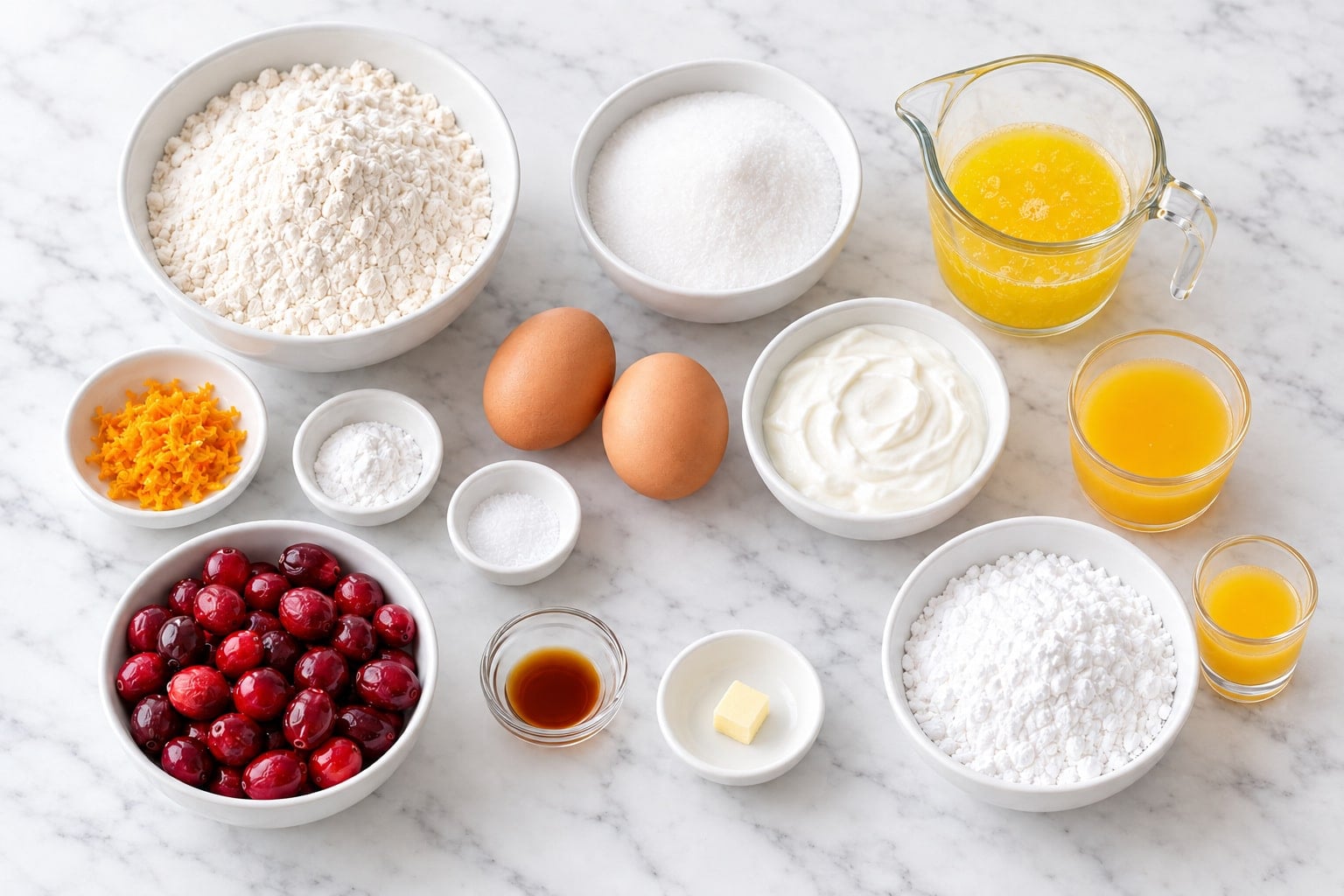
Ingredient List
Measure the cranberries whole before chopping them. Set out the cranberry orange bread ingredients first, then reserve the two glaze ingredients and the additional teaspoon of butter for the pan.
Loaf
- 2 cups all-purpose flour (240 g), spooned and leveled
- 2 teaspoons double-acting baking powder (about 8 g)
- 1/2 teaspoon fine table salt (about 3 g)
- 1 cup granulated sugar (200 g)
- 1 tablespoon finely grated orange zest (about 6 g), orange surface only
- 1/2 cup unsalted butter (113 g), melted and cooled until warm, not hot
- 2 large eggs (about 100 g without shells), room temperature
- 1/2 cup full-fat sour cream (113 g), room temperature
- 1/4 cup orange juice (60 ml)
- 1 teaspoon pure vanilla extract (5 ml)
- 1 1/2 cups fresh cranberries (150 g), measured whole, washed, dried and coarsely chopped
Orange glaze
- 1 cup confectioners’ sugar (113 g), sifted if lumpy
- 1 1/2 to 2 tablespoons orange juice (22.5 to 30 ml), added to consistency
Pan preparation
- 1 teaspoon unsalted butter (5 g), for greasing the pan
Choosing Cranberries and Oranges
Use fresh cranberries for cranberry orange bread, weighing out 150 g while they are whole. Wash and dry them before chopping; visible rinse water should not go into the batter. The cup measure also refers to whole berries, so do not fill the cup with already-chopped fruit.
Grate only the colored orange peel. Measure the zest and juice separately because oranges vary in size and juiciness. You need 60 ml juice for the loaf and another 22.5-30 ml for the glaze; extra juice in the batter changes more than the orange flavor.
Sour Cream, Butter and Baking Powder
Choose full-fat cultured sour cream and unsalted butter. Let the eggs and sour cream lose their refrigerator chill, and cool the melted butter until it is warm rather than hot before combining them.
The leavener is double-acting baking powder. Keep that ingredient and quantity as written; sour cream in the batter does not mean you should add an extra spoonful of baking soda. This cranberry orange bread contains wheat, milk and eggs.
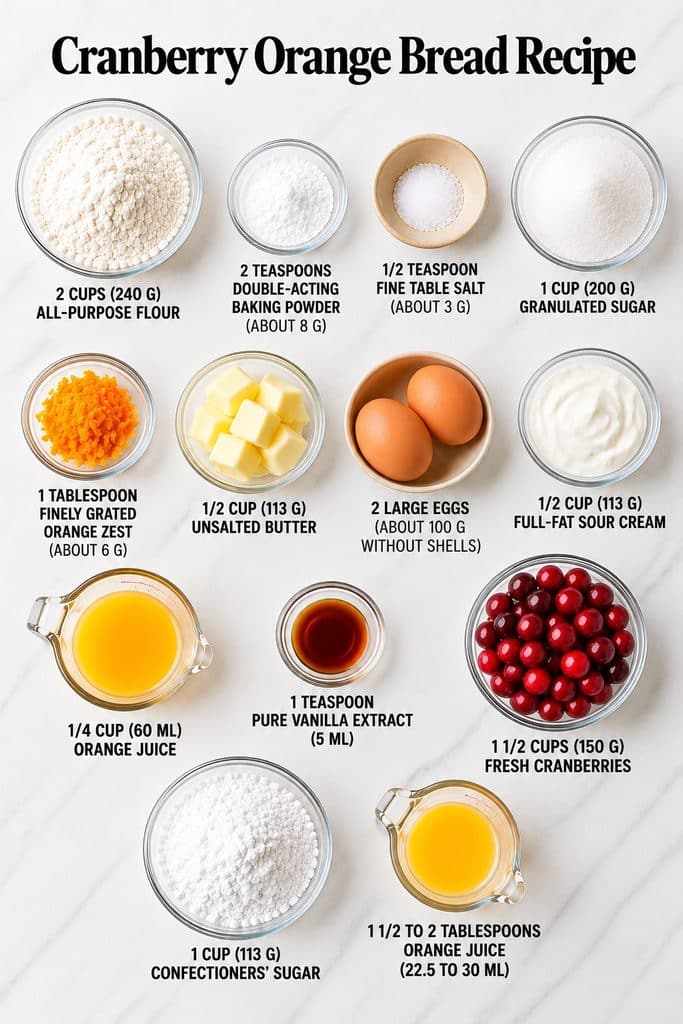
For the pan: Also set aside 1 teaspoon unsalted butter (5 g), in addition to the 1/2 cup (113 g) shown for the batter. This extra pan butter is listed in the written recipe and recipe card but is not pictured in the ingredient chart above.
Tools for a Hand-Mixed Cranberry Loaf
A light-colored metal pan gives this cranberry orange bread room to rise, while a whisk and spatula take care of the mixing. Have the cooling and glazing tools ready as well, so the loaf can come out of its pan at the right stage.
- Pan and lining. One 9 x 5 x 2 3/4-inch light-colored metal loaf pan (about 23 x 13 x 7 cm), parchment sling and the separately listed pan butter.
- Mixing by hand. Large and medium bowls, whisk and flexible spatula; no electric mixer.
- Accurate measuring. Digital scale, dry measuring cups and spoons, plus a liquid measure.
- Preparing the fruit. Fine citrus grater, knife and cutting board; zest before juicing and chop the measured berries.
- Checking and finishing. Cooling rack, cake tester or skewer, foil, and a small glaze bowl with a spoon. Use the knife and board for portioning the cooled loaf.
Before You Mix the Cranberry Batter
Have the fruit, pan and oven ready for cranberry orange bread before the wet and dry mixtures meet. That keeps the mixed batter from sitting while you search for parchment or finish preparing the berries.
- Check the pan dimensions, fit a parchment sling and set aside the additional 1 teaspoon of pan butter.
- Place the oven rack near the center and preheat the conventional oven to 350°F (175°C).
- Weigh the whole cranberries, then wash, dry and coarsely chop them.
- Check that the melted butter is warm, not hot, and the eggs and sour cream are at room temperature.
- Keep the batter juice and glaze juice in separate measured portions.
What the Cranberry Batter and Baked Loaf Look Like
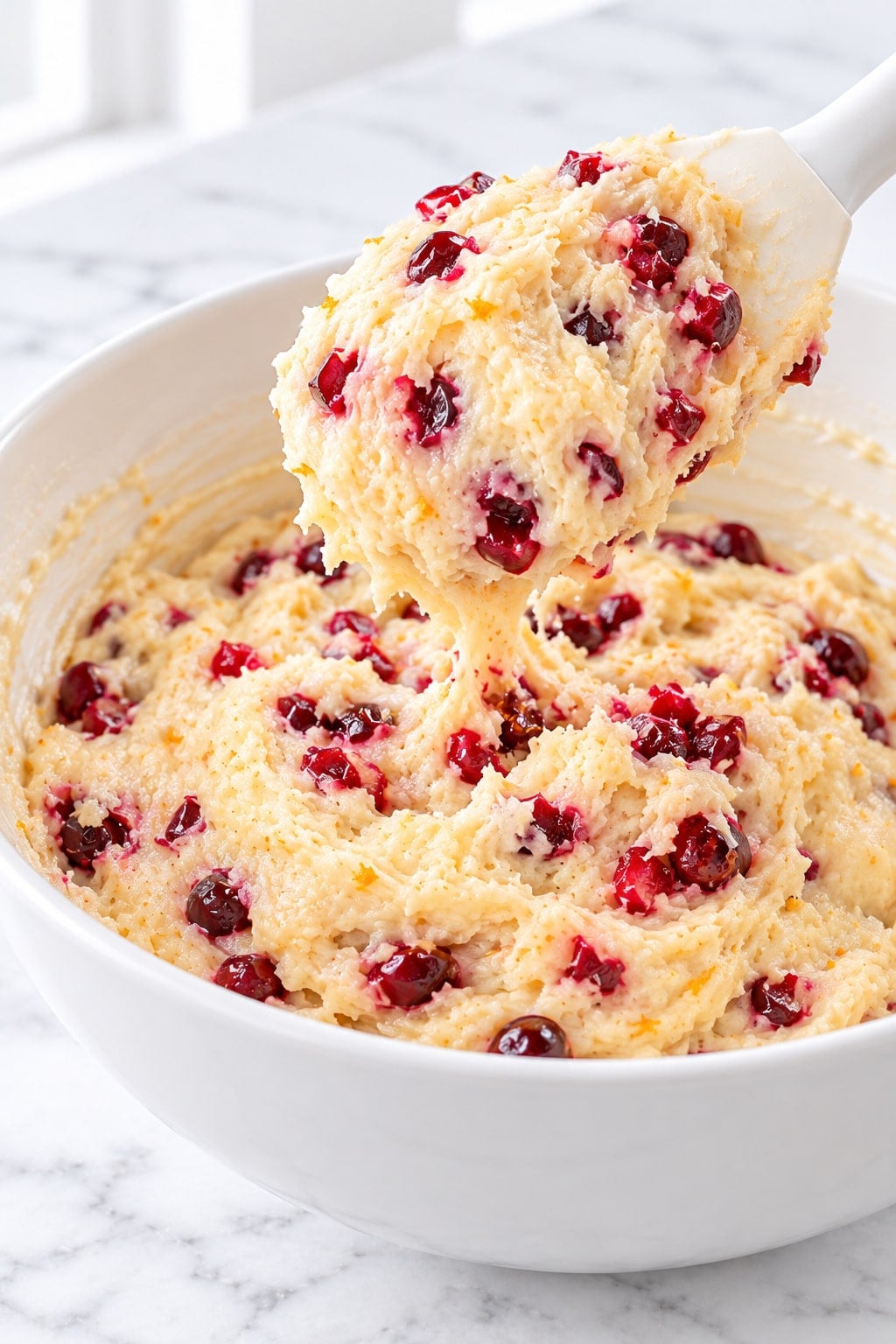
The cranberry orange bread batter is thick enough to scoop, and the finished loaf has a gently raised top. A few uneven berry pockets and a natural crack are part of its homemade appearance.
- The batter holds soft mounds rather than running freely from the bowl.
- The chopped fruit leaves irregular red patches through a pale golden crumb.
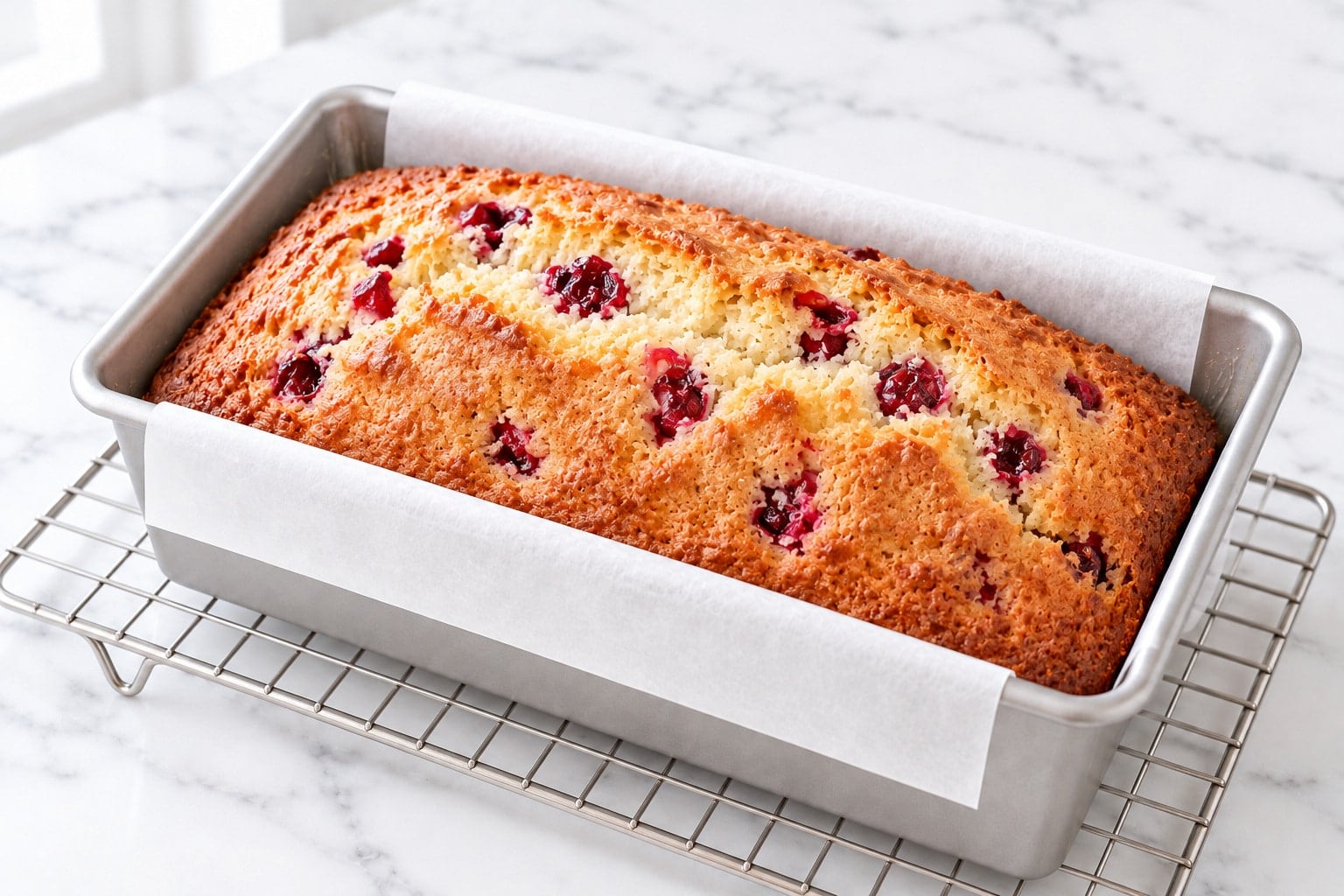
- A central crack can appear as cranberry orange bread rises and the surface sets.
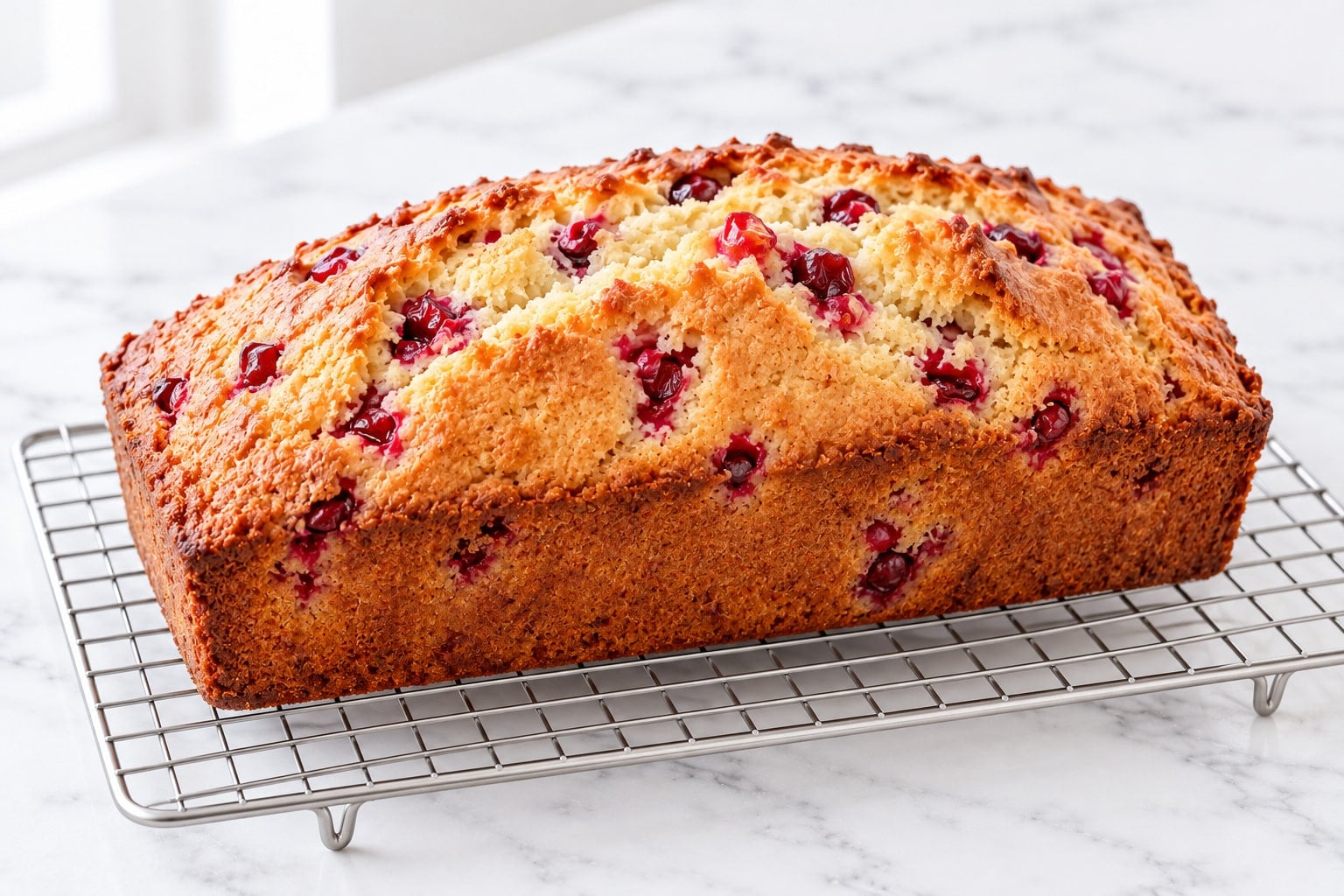
- The orange glaze forms a thin coating with some crust still visible beneath it.
How to Make Cranberry Orange Bread
Make cranberry orange bread in six stages, from preparing the pan to spooning on the glaze. The baking time is a guide; use the center cues to decide when to remove the loaf, then allow it to cool through before finishing.
1. Prepare the Pan and Fruit
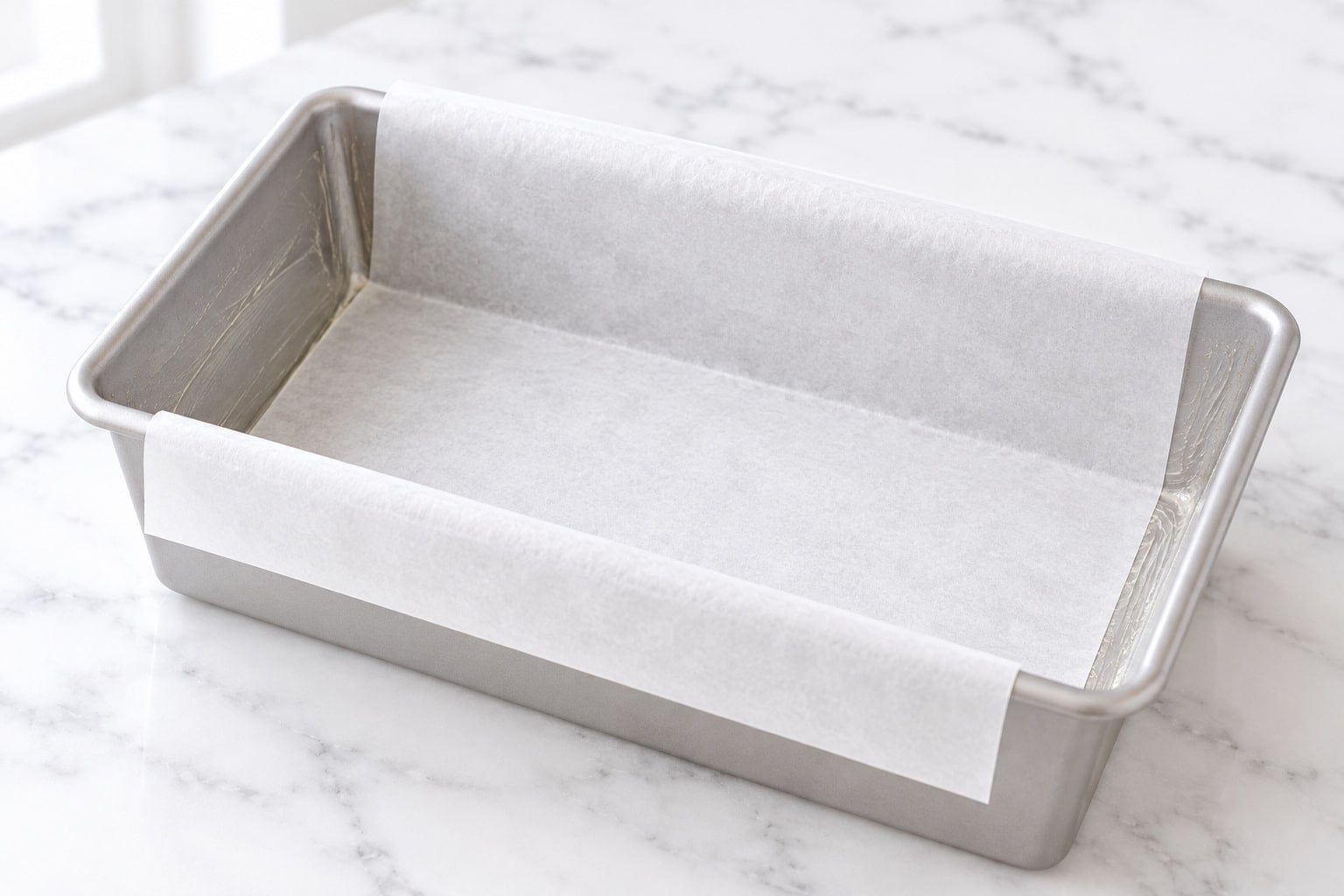
Preheat the oven to 350°F (175°C), with a rack near the center. Grease a 9 x 5 x 2 3/4-inch light-colored metal loaf pan with the additional 1 teaspoon (5 g) butter, then fit a parchment sling with enough overhang to lift the loaf.
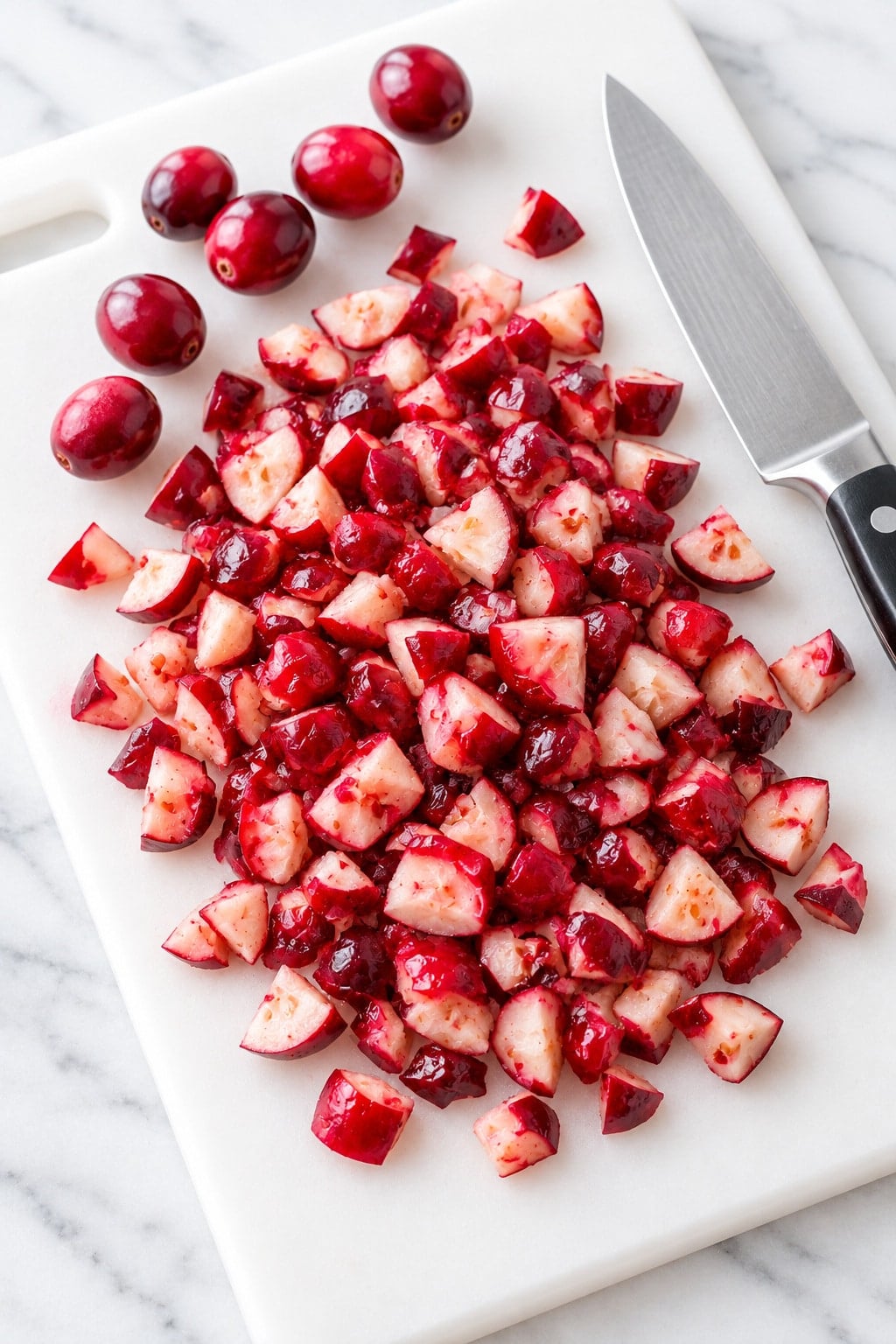
Measure 150 g fresh cranberries while whole. Wash, dry and coarsely chop them. Zest the orange before juicing it, and measure the zest and both juice portions separately.
What you should see: Dry berry surfaces and coarse pieces, a lined pan, and melted butter that is still fluid but no longer hot. The eggs and sour cream should be at room temperature.
2. Whisk the Orange Mixture
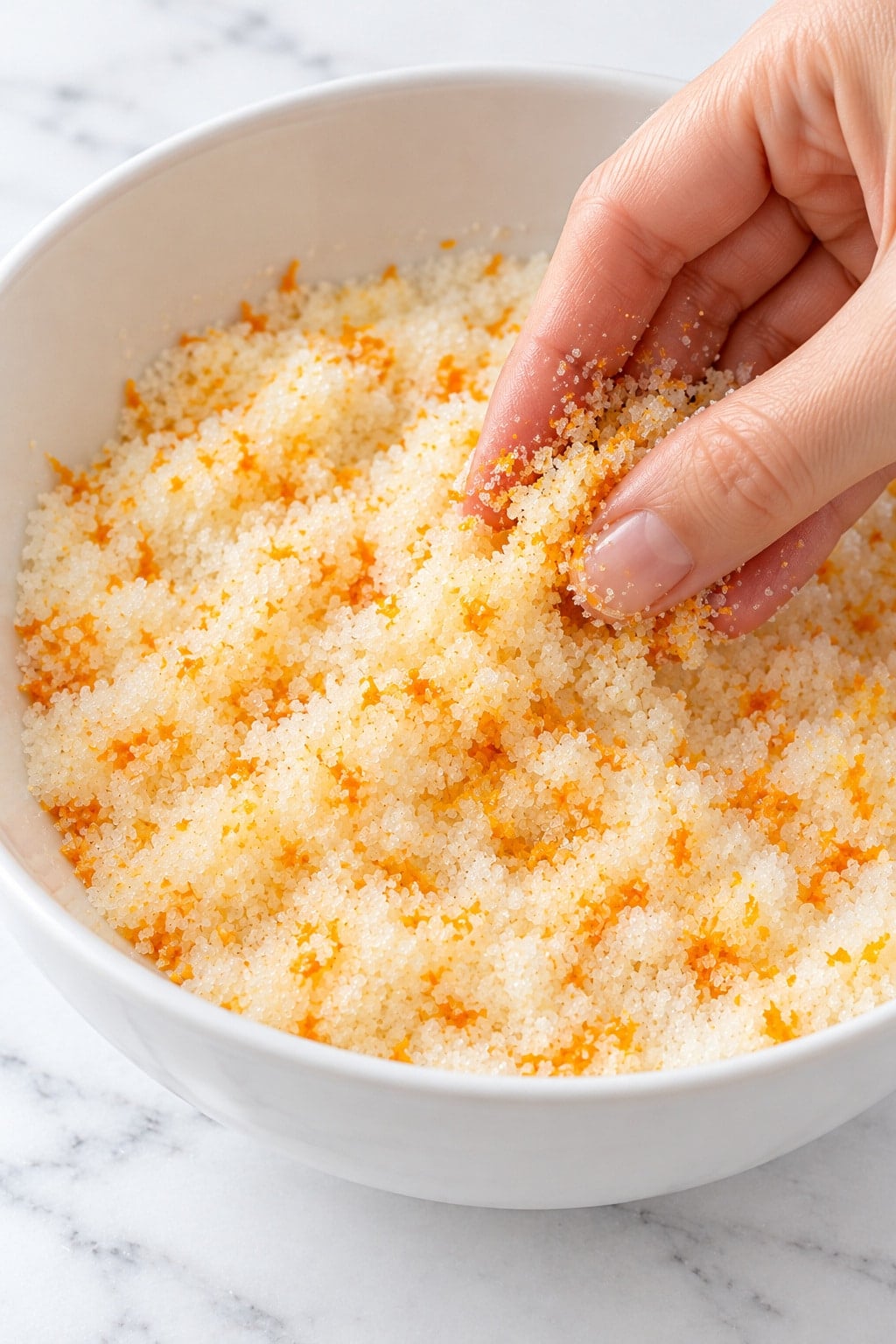
Rub 1 tablespoon orange zest into the 1 cup sugar until the zest is evenly distributed and the sugar smells fragrant.
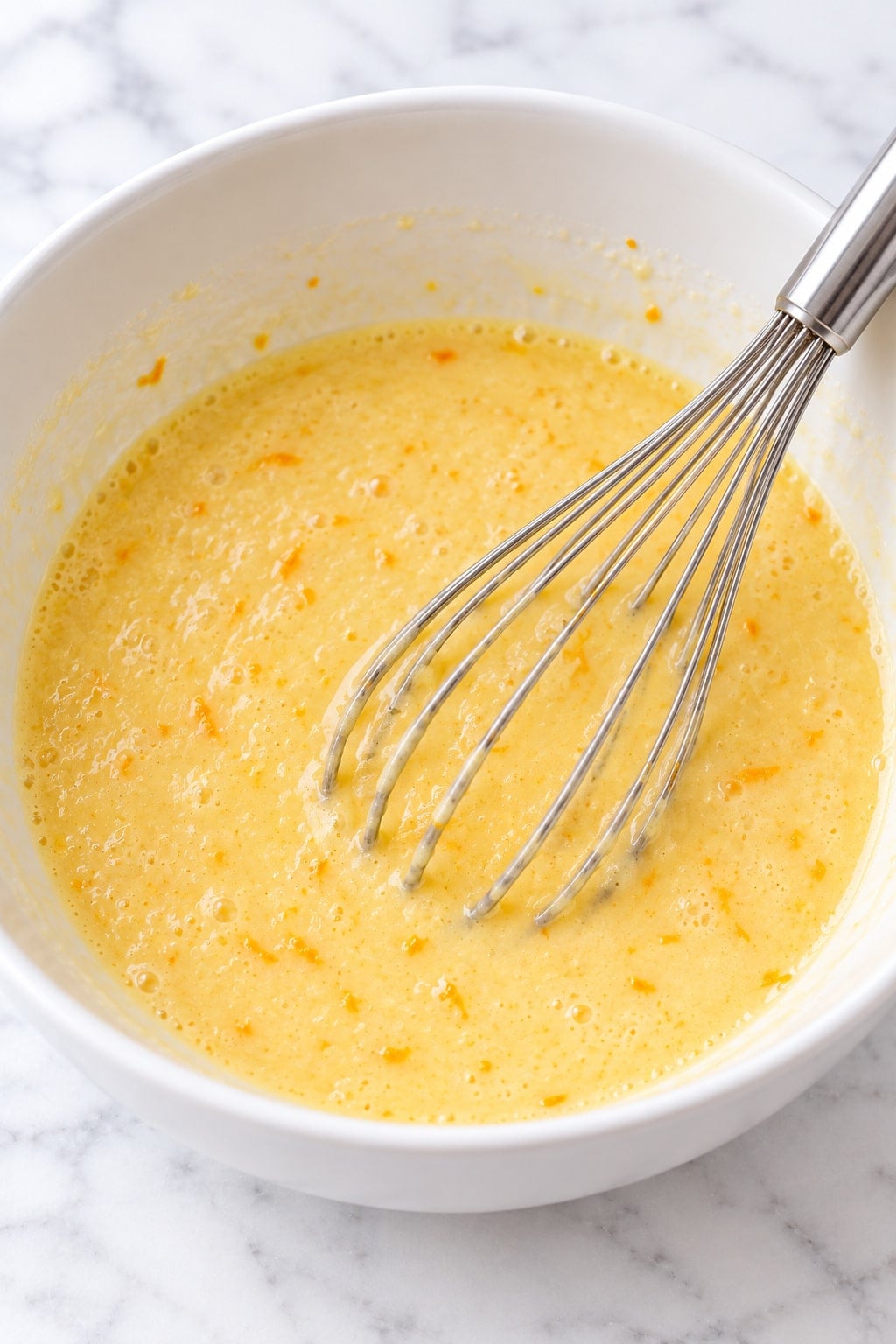
Whisk in the 2 eggs, followed by the 1/2 cup melted butter, 1/2 cup sour cream, 1/4 cup orange juice and 1 teaspoon vanilla. Scrape around the bowl so any sour cream caught along the side joins the mixture.
What you should see: A uniform orange-scented mixture, with no separate oil puddle or visible lump of sour cream. This stage combines the ingredients by hand; there is no creaming step.
3. Fold in the Flour and Cranberries
In a separate bowl, whisk the 2 cups flour, 2 teaspoons baking powder and 1/2 teaspoon salt. Fold them into the orange mixture with a flexible spatula. As the last dry streaks disappear, fold in the chopped cranberries.
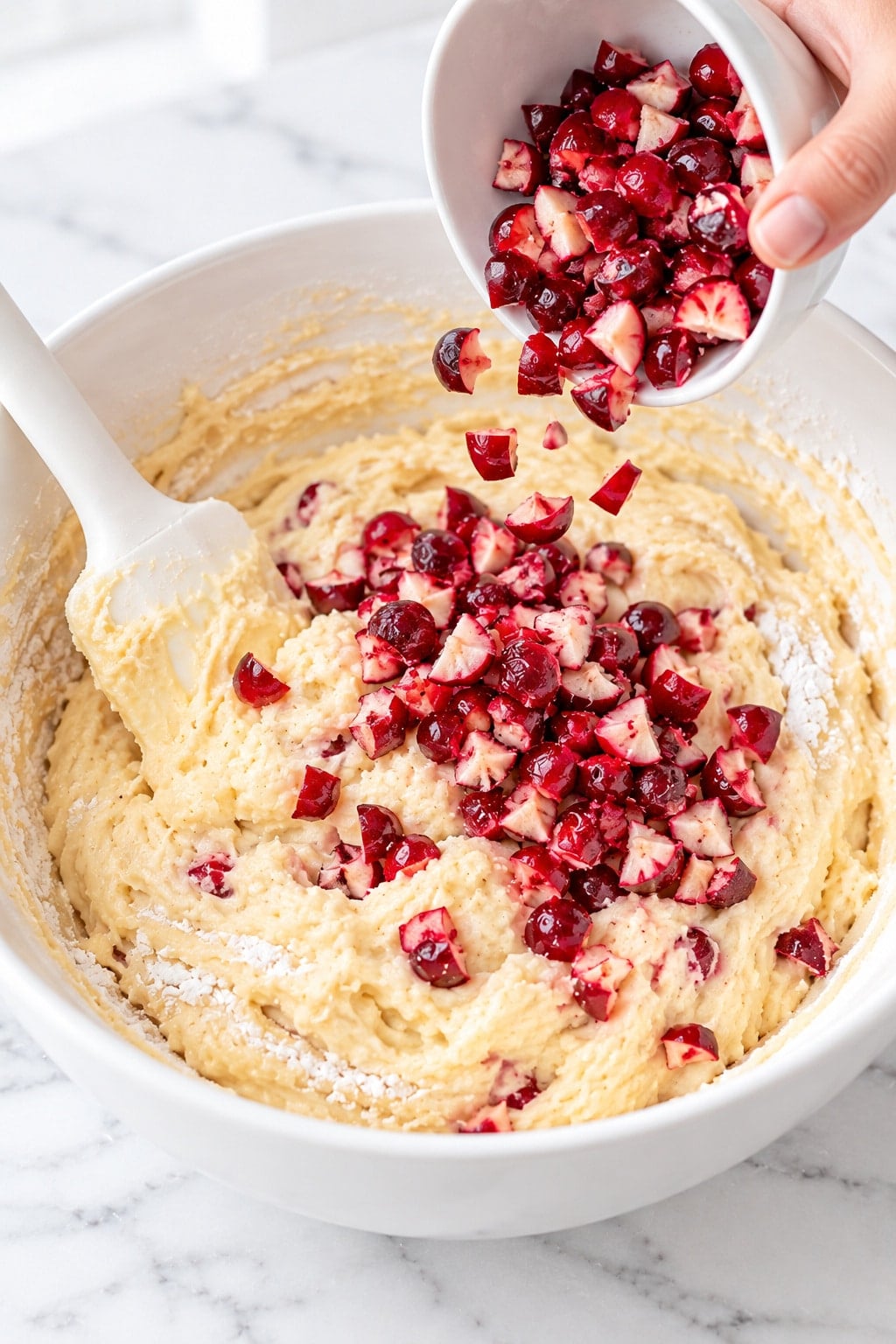
Scrape the bottom of the bowl once more to find any hidden flour, then stop when the fruit is dispersed and no dry pockets remain.
What you should see: Thick, scoopable batter with cranberry pieces distributed through it. Resist extra stirring to make the surface perfectly smooth.
4. Bake Until the Center Is Set
Transfer the full batch to the prepared pan and smooth the surface without packing it down. Leave expansion space; the batter should not rise above about two-thirds of the pan. If it does, check the pan dimensions and ingredient measurements before baking.
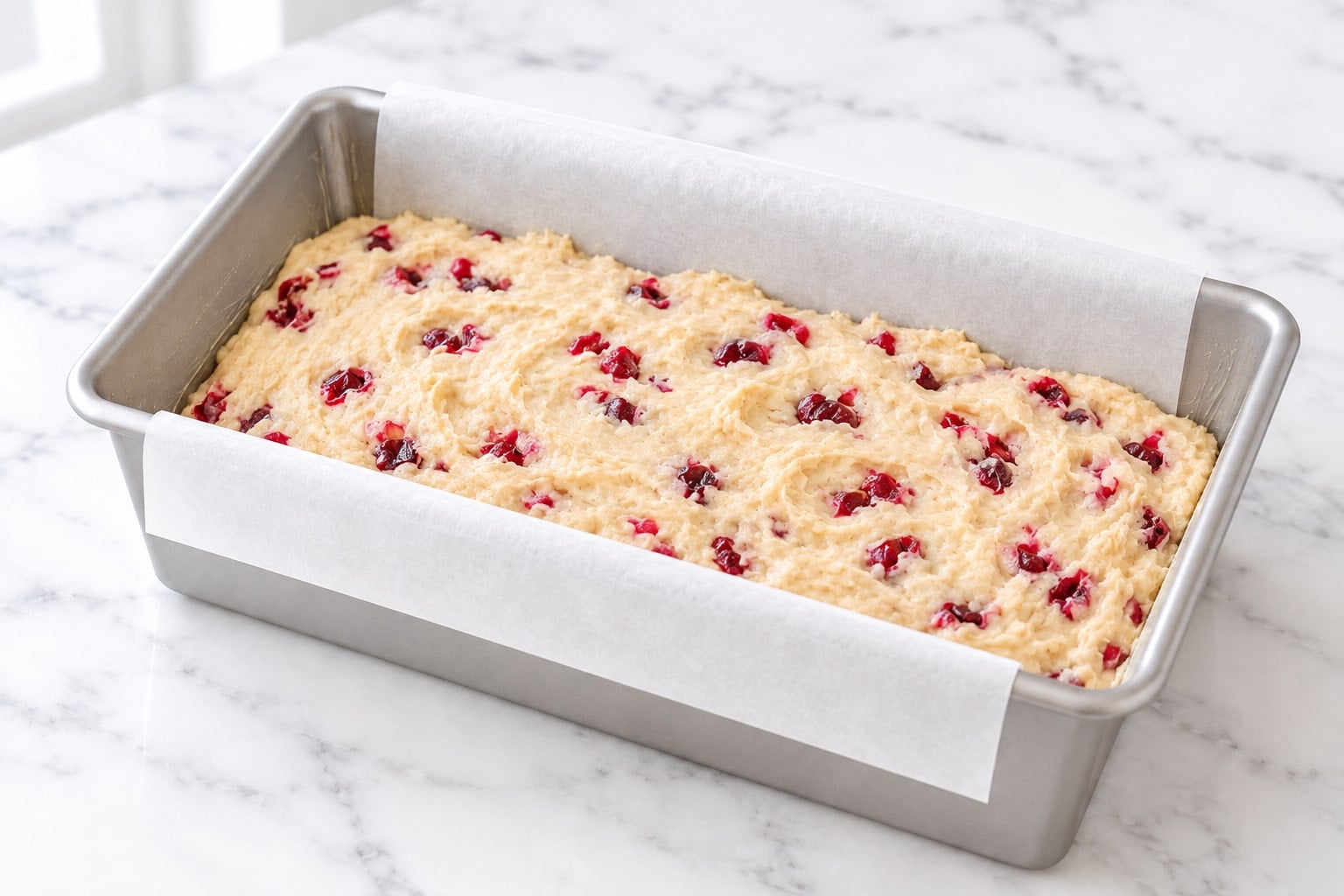
Bake the cranberry orange bread for about 55-70 minutes, beginning the first check around 50 minutes. If the top has browned enough while the center still shows wet batter, cover it loosely with foil and continue baking.
What you should see: A set central crack and a tester from the center with a few crumbs or no batter. If the tester passes through a cranberry, check a second nearby central spot. Red fruit moisture is different from an opaque smear of wet batter; the latter needs more baking time.
5. Cool the Loaf Completely
Let the cranberry orange bread rest in its pan for about 15 minutes. Lift it carefully with the parchment sling and transfer it to a cooling rack. Allow roughly 1 hour 45 minutes more, or until the loaf is fully cool, including the center and base.
What you should see: A loaf that supports its own weight on the rack and no longer feels warm at the base. The two-hour cooling allowance includes the initial pan rest; a warm room or loaf may need longer.
6. Spoon Over the Orange Glaze
Stir the 1 cup confectioners’ sugar with 1 1/2 tablespoons orange juice. Add the remaining juice gradually, only as needed, up to 2 tablespoons total. Mix until smooth.
What you should see: Glaze falling from the spoon in a thick, continuous ribbon. It should coat the cool loaf rather than immediately flood the plate.
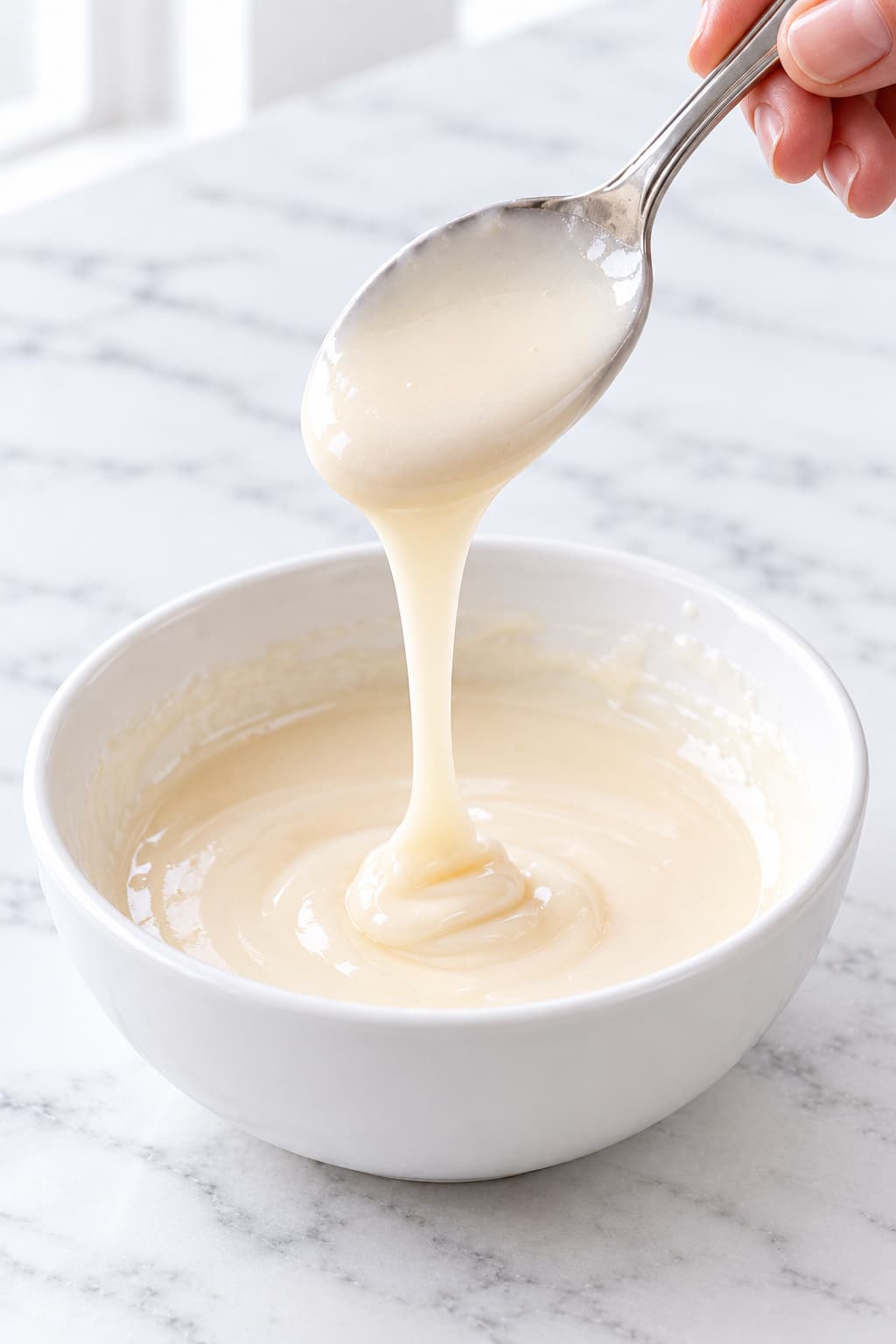
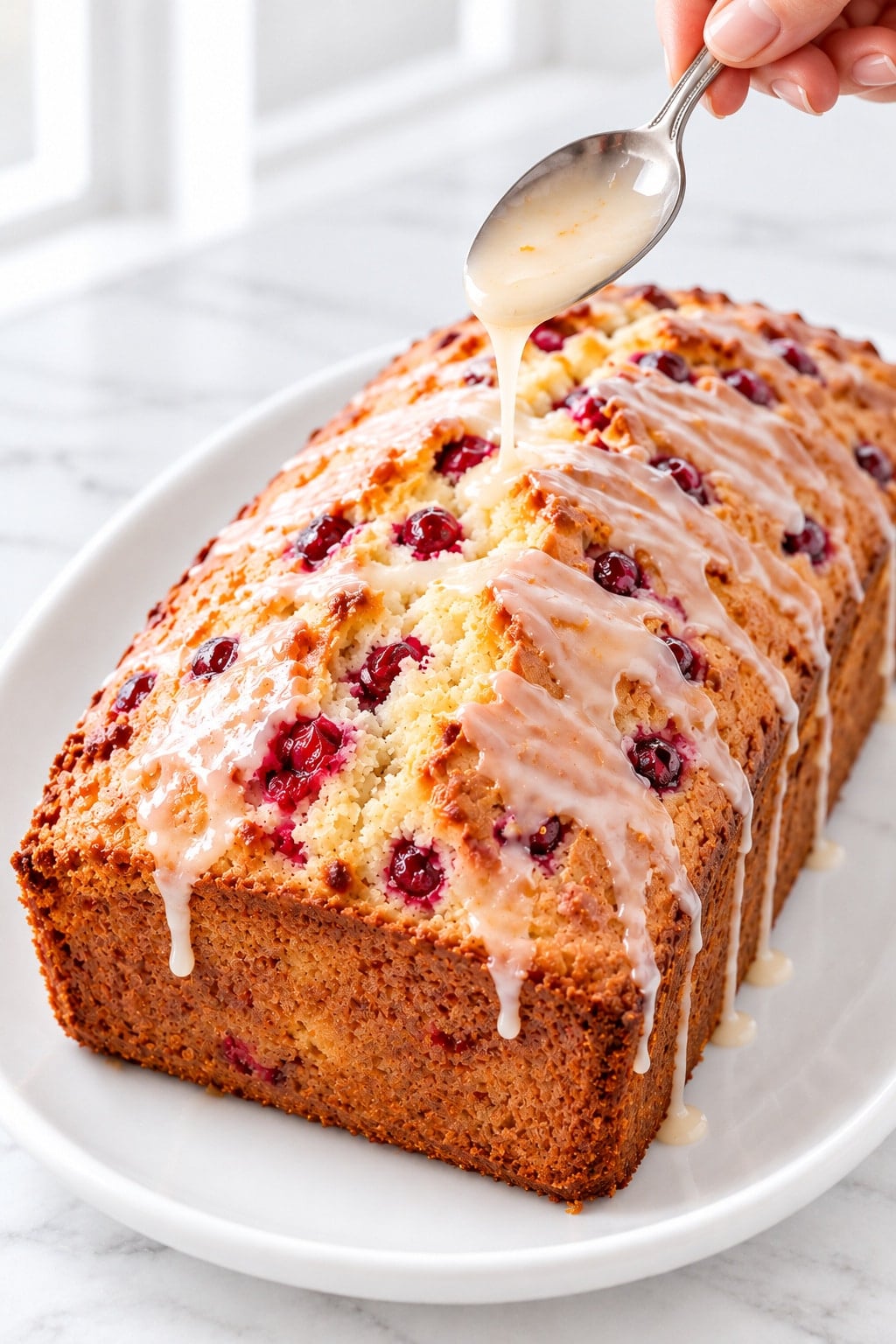
Spoon the glaze over the fully cooled cranberry orange bread. Allow about 20 minutes for the coating to settle before cutting ten equal slices; humidity can change how quickly the surface settles.
I’ve rushed the glaze onto a warm loaf before, only to watch it soak in instead of leaving the delicate coating I wanted. Now I let the bread cool all the way through before spooning it over the top.
How to Tell the Cranberry Loaf Is Baked Through
Cranberry orange bread is ready to leave the oven when the center is set and a tester shows no opaque wet batter. A golden top or one clean test through the edge cannot tell you whether the middle is ready.
| What you notice | What it means | What to do |
|---|---|---|
| Red moisture on the tester | It may be cranberry juice from a fruit pocket. | Test a second nearby spot in the center before deciding. |
| An opaque, sticky smear of batter | The center has not finished baking. | Keep baking; loosely tent with foil if the top has browned enough. |
| A set central crack and a few crumbs, with no wet batter | The center checks agree with a baked loaf. | Remove the pan and begin the cooling sequence. |
| A dry-looking surface or firm edge, but a wet center | The outside is ahead of the middle. | Protect the top and continue checking the center; do not use crust color alone. |
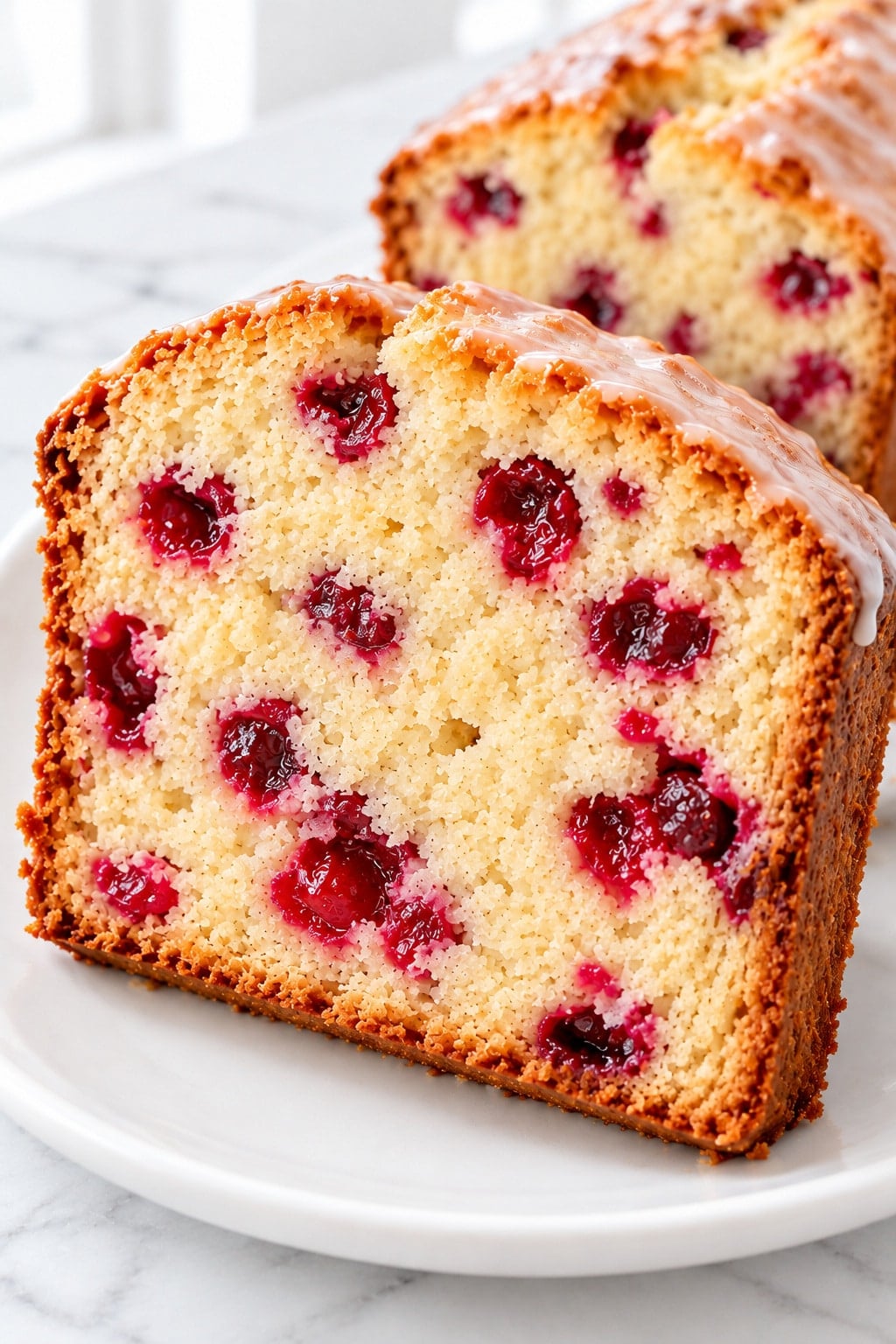
After full cooling, a slice of cranberry orange bread should hold together with a tender crumb and distinct cranberry pockets. A red fruit patch can be moist without being raw batter. A dense, wet band that smears across the knife is different; cutting the loaf while warm also makes the crumb harder to judge and easier to damage.
Small Details for Neater Cranberry Bread Slices
A few practical choices make cranberry orange bread easier to handle, especially when its tender crumb and thin glaze are ready for the serving plate. Keep these details in mind as you finish the loaf.
- Keep the cranberry pieces coarse. After measuring the whole berries, chop them into irregular pieces rather than a fine mash. Scrape the pieces from the board into the bowl so the measured fruit makes it into the batter.
- Leave room beneath a foil tent. If the top needs shielding before the center is baked, arch the foil loosely over it. Pressing foil against the raised surface can mark the crust when you lift it away.
- Support the loaf during the rack transfer. Set the rack close to the pan before lifting with the parchment sling. The loaf is still warm after its pan rest, so keep the sling level and move it gently.
- Add the last glaze juice cautiously. Stir well after each small addition from the measured allowance. Pause to lift the spoon and check the ribbon before adding more; a little juice can change how quickly the glaze runs down the sides.
- Catch drips and cut gently. Put a tray beneath the rack before glazing, then wait for the coating to settle before moving the cranberry orange bread. Mark out ten portions and use a gentle sawing motion with a serrated knife so you do not press the soft crumb flat.
Fixing a Sunken Loaf or a Runny Orange Glaze
If cranberry orange bread sinks in the middle or its glaze disappears into the crust, check the baking, mixing and cooling stages. Use the visible symptom to narrow the problem instead of assuming that every uneven loaf has the same cause.
| Problem | Likely cause or check | What to do now | For the next loaf |
|---|---|---|---|
| Center sinks or stays wet | Underbaking, a pan mismatch or an ingredient change may be involved. | If it is still baking, continue until the central tests show no wet batter. A cooled raw center is not corrected by glaze. | Use the specified pan, measure carefully and test two nearby central spots. |
| Top browns before center is done | The outer crust can brown faster than the center sets. | Tent loosely with foil once the top has enough color and continue baking. | Keep the light-metal pan on the middle rack and start checking around 50 minutes. |
| Crumb feels tough | Excess mixing after adding flour can develop too much gluten; excess flour is another check. | The baked texture cannot be mixed back to tenderness. | Weigh the flour or spoon and level it, and stop folding once dry pockets disappear. |
| Glaze runs off or soaks in | The loaf may still be warm, or too much juice was added. | If the glaze is still in the bowl, pause and check the loaf temperature before applying it. | Begin with the lower juice amount and glaze only a fully cool loaf. |
| Glaze is too stiff to ribbon | It needs more of the measured juice. | Stir in a little more of the reserved glaze juice, staying within the 2-tablespoon total. | Add juice gradually and judge the ribbon before spooning it over the loaf. |
Beautiful Ways to Serve This Cranberry Loaf
Serve cranberry orange bread fully cooled, with the glaze settled and the berry-speckled crumb facing outward. A simple plate leaves its natural color visible, whether you are sharing the whole loaf or setting out one slice.
A Slice Beside Morning Coffee
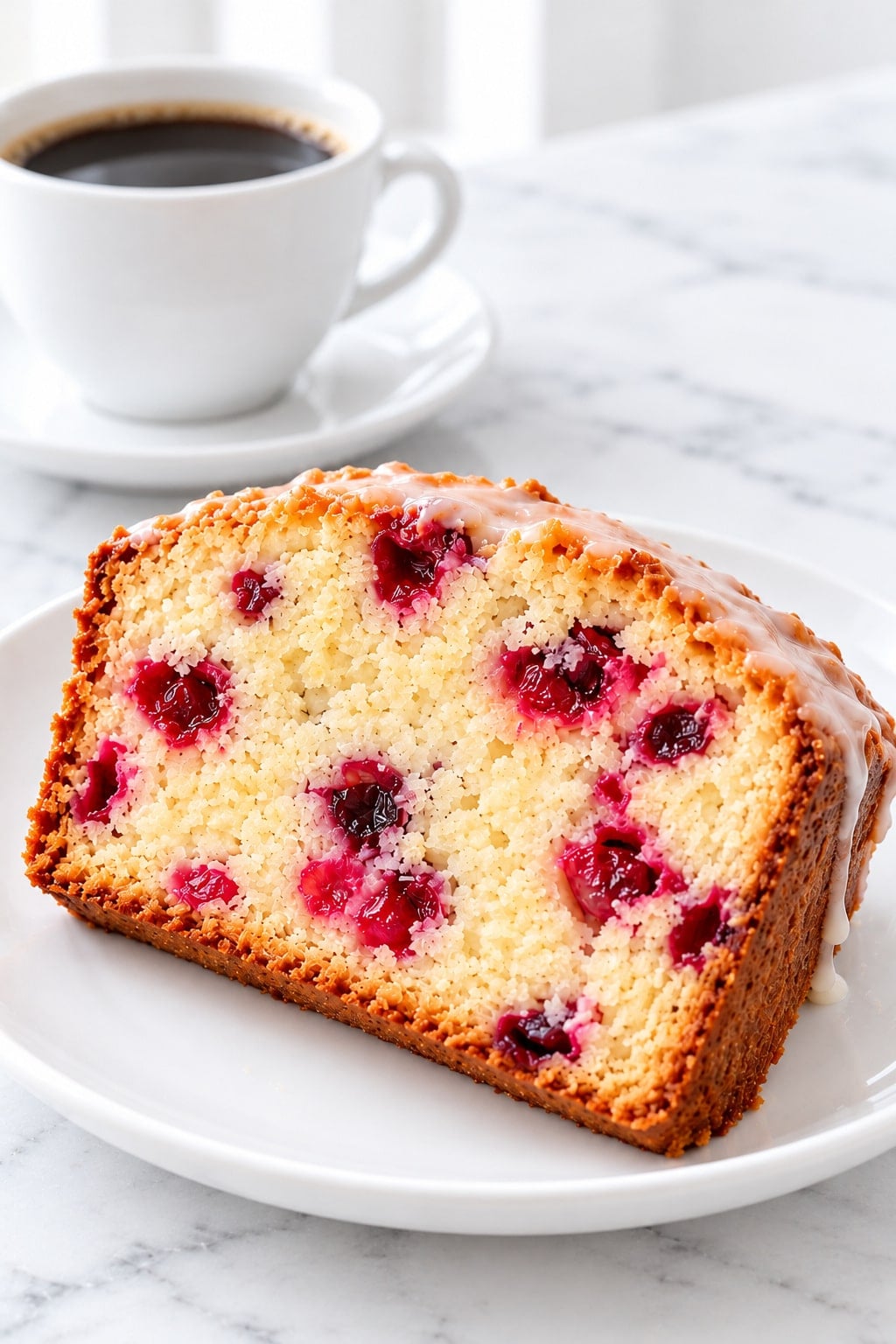
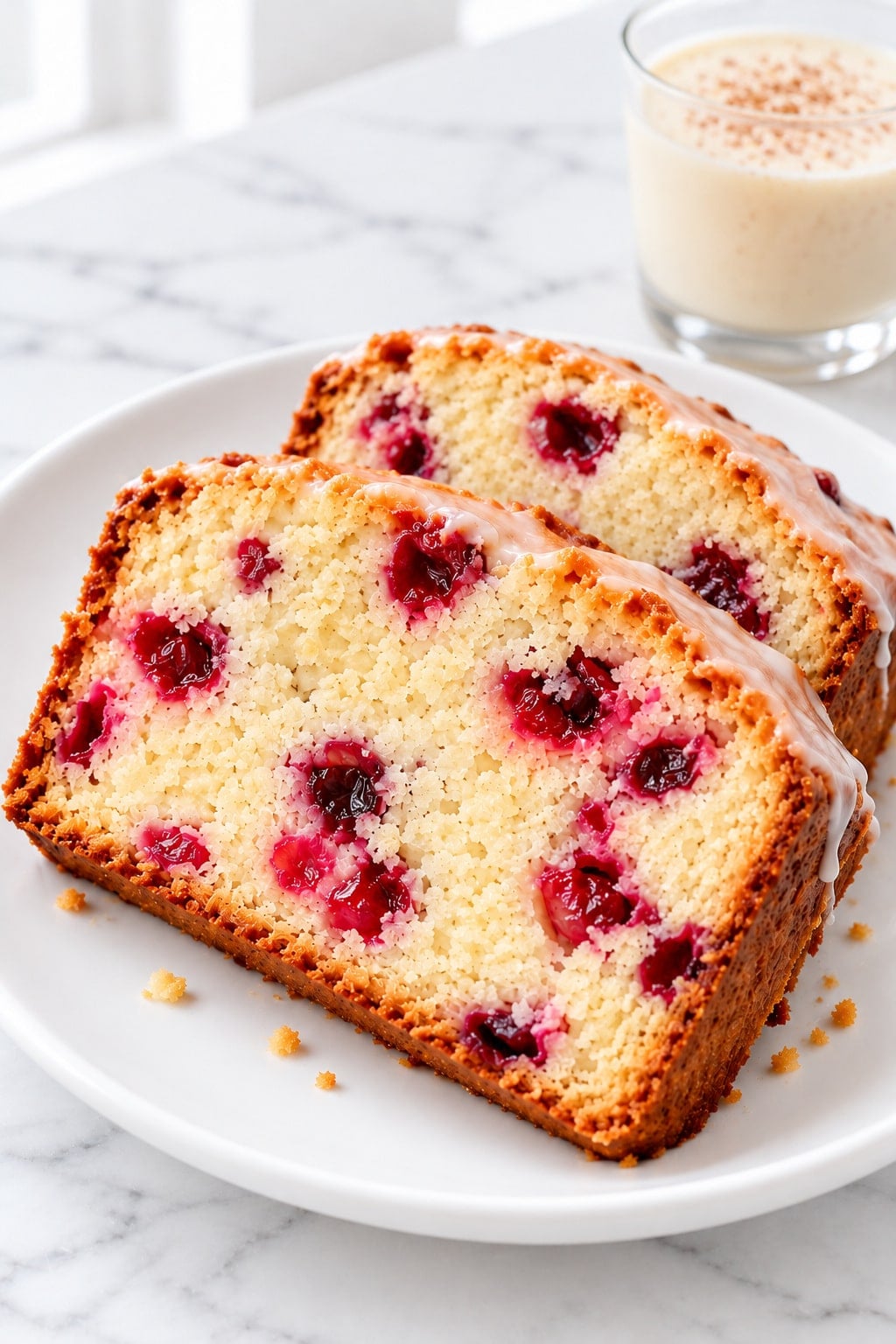
Set a glazed slice of cranberry orange bread on a small white plate beside coffee. The tart fruit gives each bite a bright edge, while the thin glaze keeps the top lightly sweet. Leave the slice plain so the orange fragrance and buttery crumb remain the focus.
A Holiday Brunch Plate
For a holiday brunch, serve a thin slice beside a small glass of chilled homemade eggnog. The creamy drink and sharp fruit make a pleasing contrast; a few neatly spaced slices on a platter keep the serving easy to share.
A Loaf to Wrap and Share
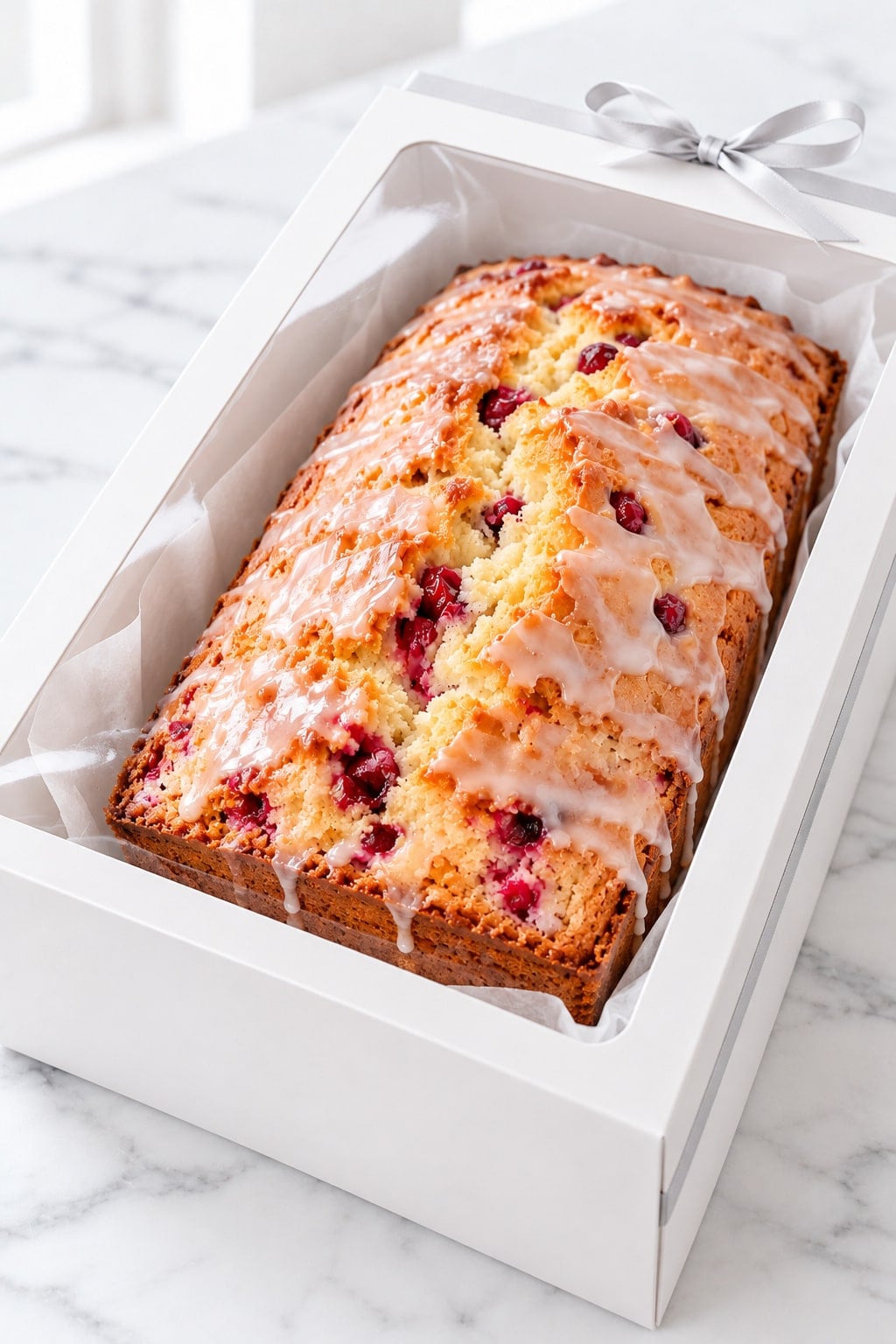
For a local same-day gift, place the completely cooled cranberry orange bread in a food-safe presentation container once its glaze has settled. Leave space above the top so the cover does not pull away the coating, and pass along the short storage guidance with the loaf.
Keeping Cranberry Orange Bread Fresh
Keep cranberry orange bread covered in a cool room for 1-2 days, after it has cooled completely and the glaze has settled. Wrapping a warm loaf traps condensation. For longer keeping, freeze the loaf unglazed and add the finish after thawing.
For the Next Day
You can bake cranberry orange bread the day before serving. Let it cool fully, then cover it; glaze it later if that makes the serving day easier. If you glaze ahead, wait for the coating to settle before covering, and keep the cover clear of the top.
Freezing and Thawing the Unglazed Loaf
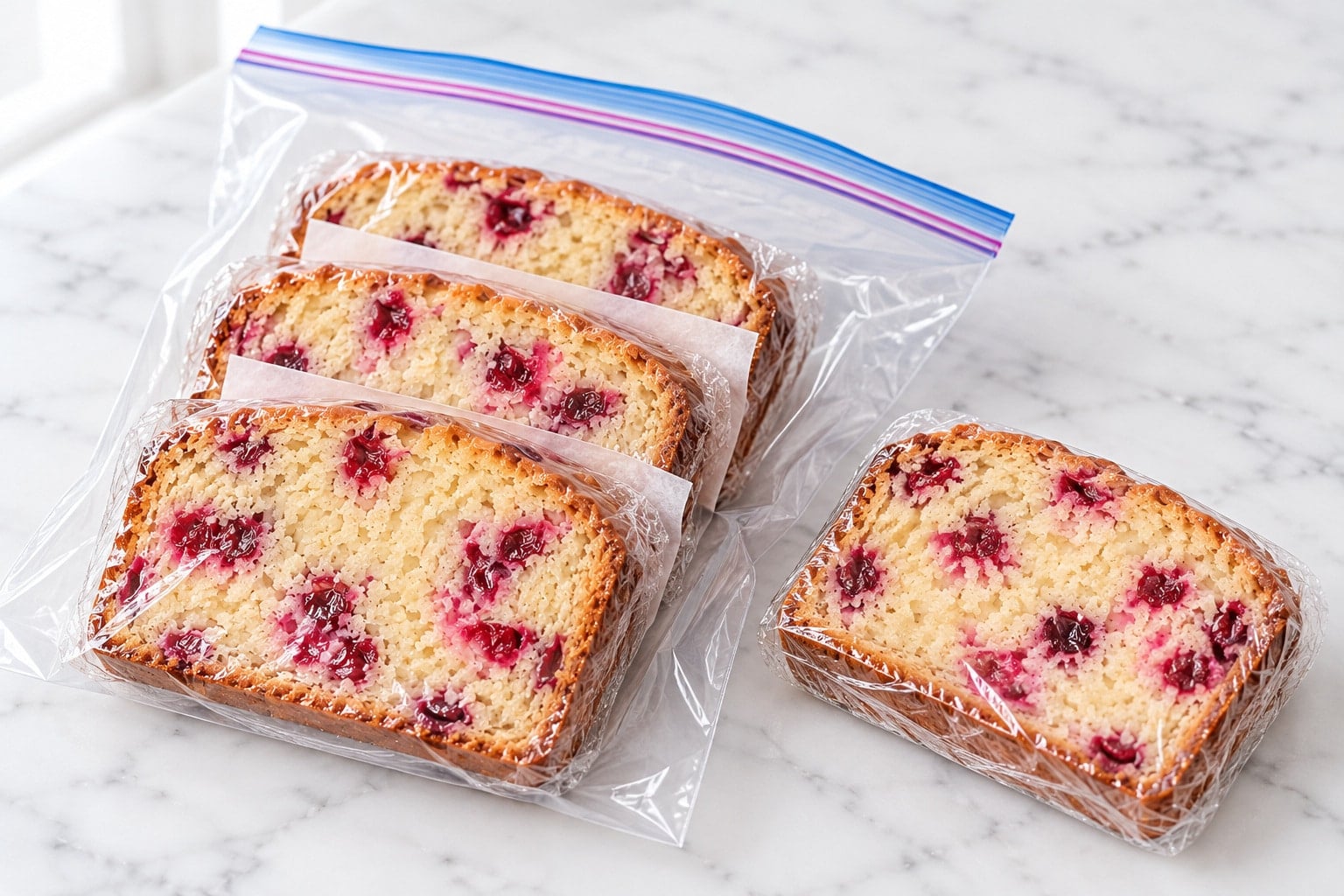
Wrap the cooled, unglazed cranberry orange bread or individual slices well and freeze at 0°F (-18°C) for up to 2 months for best quality. That target is within Illinois Extension’s guidance for baked quick breads, which gives a 2-3 month top-quality window at 0°F.
Thaw cranberry orange bread while wrapped at room temperature, then unwrap and glaze it once thawed. Separating slices before freezing makes it easier to take out only what you need. The freezer time is a quality guide; freezing does not improve bread that was already stale.
Choosing a Different Finish or Muffin Format
You can leave cranberry orange bread unglazed if you prefer a less sweet finish; the loaf still carries orange zest and tart fruit. The appearance and nutrition will differ from the glazed slices described here.
For individual portions with a crumbly topping, use the separate cranberry orange muffins recipe; its pan, batter and baking time are designed for muffins. Use fresh cranberries and full-fat sour cream for this loaf rather than changing several ingredients or guessing at mini-loaf times.
Cranberry Orange Bread Questions
Whole berries are measured before chopping, and a fully cooled loaf can be kept for the next day or frozen without glaze. If you are planning cranberry orange bread around a serving day, the cooling and finishing stages are the details to allow for.
Should I measure the cranberries before or after chopping?
Measure them whole: 150 g, or 1 1/2 cups, before washing, drying and coarsely chopping. This keeps the fruit amount in cranberry orange bread consistent; a cup filled with chopped pieces is a different measure.
Can I make cranberry orange bread the day before?
Yes. Cool it completely, cover it and keep it in a cool room within the 1-2 day storage window. You can add the glaze on the serving day; if you glaze ahead, let the coating settle before covering.
Can I freeze cranberry orange bread?
Yes, freeze fully cooled cranberry orange bread or slices without glaze, well wrapped, for up to 2 months for best quality at 0°F (-18°C). Thaw while wrapped at room temperature, then glaze after thawing.
Can I use dried cranberries in this bread?
Use fresh cranberries for this cranberry orange bread. Dried berries have different moisture and sweetness, so the fresh-fruit quantity is not a straight replacement instruction for dried fruit. Keep the measured 150 g of fresh berries for the loaf described here.
Why did my cranberry orange bread sink in the middle?
A center that is still wet can sink as it cools, but pan size, measurements and ingredient changes also deserve a check. For this cranberry orange bread, test two nearby central spots and look for opaque batter rather than judging by red berry moisture or crust color alone.
Your Next Bake After Cranberry Orange Bread
After cranberry orange bread, you might want another loaf to slice, a brighter citrus bake or something spiced for the coffee table. These three paths keep the next choice tied to the flavor or format you enjoyed.
More Loaves to Slice and Share
Stay with a sliced loaf when you want something that can sit on a board and be portioned as needed. These choices move from fruit-filled quick breads to a close-crumbed vanilla cake.
- Banana Bread: Choose this when ripe banana flavor is the next loaf you want.
- Blueberry Bread: Keep the sliced fruit-loaf format with blueberry pockets.
- Pumpkin Bread: Move toward warm spice and pumpkin in a hand-mixed loaf.
- Pound Cake: Explore a close, buttery vanilla crumb made by creaming.
Bright Citrus Bakes
Follow the citrus flavor into a different shape, from individual muffins to cake and bars. Each gives the fruit a different texture and finish.
- Cranberry Orange Muffins: Keep the cranberry-orange pairing in individual streusel-topped portions.
- Lemon Blueberry Muffins: Try a lemon-and-berry combination with a crumbly topping.
- Lemon Cake: Make citrus the main flavor of a cake for sharing.
- Lemon Bars: Choose a bright lemon filling over a buttery shortbread base.
For the Holiday Coffee Table
For a shared coffee table, add a different fruit, a warm spice or a small cookie. The contrast gives the cranberry loaf company without repeating the same bake.
- Gingerbread Cake: Turn to molasses and warm spice with a creamy topping.
- Apple Cake: Pair fresh apple pieces with a golden cinnamon-sugar top.
- Pumpkin Coffee Cake: Add pumpkin and buttery cinnamon streusel to the coffee table.
- White Chocolate Cranberry Cookies: Keep cranberry flavor in smaller bites with white chocolate.
Why This Cranberry Loaf Belongs in Your Recipe Box
Keep this cranberry orange bread recipe for the next time fresh berries appear in the market or a shared breakfast needs something homemade. The page keeps the small decisions that matter close to the recipe, so you can return to the loaf with a clear plan.
- A dependable place to start measuring. The whole-berry measure, separate glaze juice and additional pan butter are spelled out. You can set out every portion before mixing instead of deciding which part of the recipe an ingredient belongs to.
- Doneness guidance for a fruit-filled center. The two-spot tester check helps when a skewer catches a cranberry. It is a useful reminder to judge the middle of the cranberry orange bread as well as the color of its crust.
- A serving plan that includes cooling. The full timing accounts for the pan rest, rack cooling and glaze settling. That makes it easier to choose between a same-day bake and preparing the loaf the day before.
- A glaze cue you can come back to. The thick ribbon gives you a visible guide within the measured juice range. It helps you aim for the same light coating each time, even when you need slightly less or more of the reserved juice.
- Clear choices for the remaining slices. The short covered-storage window and unglazed freezer option help you decide what to serve now and what to save. You can plan around a whole loaf without needing to finish every slice at once.
- A separate recipe when you want muffins. The linked cranberry orange muffins offer a route designed for individual portions. Keep this page for glazed cranberry orange bread and use that recipe when a muffin tin suits the occasion.
A Little Brightness in a Homemade Loaf
Cranberry orange bread brings a bright note to the kinds of bakes that belong beside a warm cup. The berries stay pleasantly sharp against the buttery crumb, and the orange glaze adds just enough sweetness to soften their edges.
It is a loaf to come back to when a quiet morning calls for a homemade slice, or when a shared table could use something fruity among the richer desserts. Its red-speckled interior gives it a festive feel without needing an elaborate finish.
The pleasure of cranberry orange bread is that the fruit still tastes like fruit: bright, a little tart, and tucked into something soft. A modest coating of citrus glaze leaves that balance intact, with the browned crust and uneven berry pockets still part of every slice.
Cranberry Orange Bread with Orange Glaze
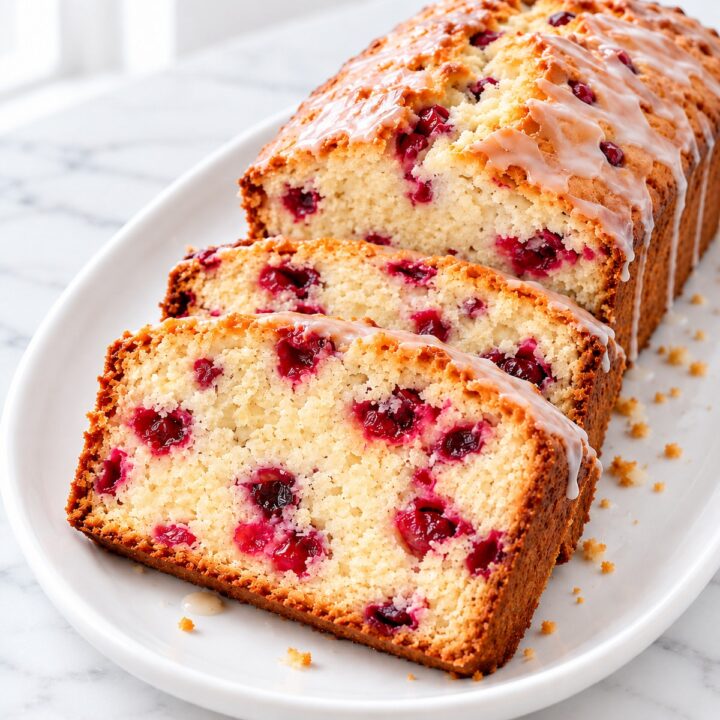
A buttery, hand-mixed cranberry orange bread with fresh cranberry pieces, fragrant orange zest and full-fat sour cream. A thin orange glaze adds a sweet citrus finish to each tender slice.
Ingredients
Loaf
- 2 cups all-purpose flour (240 g), spooned and leveled
- 2 teaspoons double-acting baking powder (about 8 g)
- 1/2 teaspoon fine table salt (about 3 g)
- 1 cup granulated sugar (200 g)
- 1 tablespoon finely grated orange zest (about 6 g), orange surface only
- 1/2 cup unsalted butter (113 g), melted and cooled until warm, not hot
- 2 large eggs (about 100 g without shells), room temperature
- 1/2 cup full-fat sour cream (113 g), room temperature
- 1/4 cup orange juice (60 ml)
- 1 teaspoon pure vanilla extract (5 ml)
- 1 1/2 cups fresh cranberries (150 g), measured whole, washed, dried and coarsely chopped
Orange glaze
- 1 cup confectioners’ sugar (113 g), sifted if lumpy
- 1 1/2 to 2 tablespoons orange juice (22.5 to 30 ml), added to consistency
Pan preparation
- 1 teaspoon unsalted butter (5 g), for greasing the pan
Instructions
Prepare the pan and cranberries. Preheat a conventional oven to 350°F (175°C) with a rack in the center. Grease a 9 x 5 x 2 3/4-inch light-colored metal loaf pan (about 23 x 13 x 7 cm) with the additional 1 teaspoon (5 g) butter and line it with a parchment sling. Measure the cranberries whole, then wash, dry thoroughly and coarsely chop them. Zest the orange before juicing it. Have the eggs and sour cream at room temperature and the melted butter warm, not hot. The berries should have no visible surface water.
Mix the orange-scented wet ingredients. Rub the orange zest into the granulated sugar in a large bowl until evenly distributed and fragrant. Whisk in the eggs, followed by the melted butter, sour cream, 1/4 cup (60 ml) orange juice and vanilla. Whisk until uniform, with no separate oil puddle or lumps of sour cream.
Fold in the flour and fruit. In a medium bowl, whisk together the flour, baking powder and salt. Fold the dry mixture into the wet mixture with a flexible spatula. As the last dry streaks disappear, fold in the cranberries, scraping the bottom of the bowl. Stop when the thick, scoopable batter has evenly dispersed fruit and no pockets of flour.
Fill the pan and bake. Scrape the batter into the prepared pan and gently smooth the top. The pan should be no more than about two-thirds full; if it is fuller, recheck its dimensions and the ingredient measurements before baking. Bake for 55-70 minutes, beginning checks around 50 minutes. If the top is already well browned but the center is still wet, cover loosely with foil and continue baking. The center crack should look set, and a skewer inserted into the center should show a few crumbs or no batter. If it passes through a cranberry, test a second nearby spot: red fruit moisture is different from opaque, sticky batter. Use these cues rather than time alone.
Cool completely. Let the loaf rest in the pan for about 15 minutes, then lift it out with the parchment sling and place it on a cooling rack. Allow about 1 hour 45 minutes more, or until the center and base no longer feel warm. Let it cool completely before glazing, slicing or wrapping so the crumb has time to settle and condensation does not collect.
Glaze and slice. Stir the confectioners’ sugar with 1 1/2 tablespoons (22.5 ml) orange juice in a small bowl. Add more juice a little at a time, up to 2 tablespoons (30 ml) total, only as needed for a thick, continuous ribbon. Spoon over the fully cooled loaf, leaving a thin visible coating. Let the glaze settle for about 20 minutes, then cut into 10 equal slices.
Notes
Equipment
- One 9 x 5 x 2 3/4-inch light-colored metal loaf pan (about 23 x 13 x 7 cm), parchment sling and the separately listed pan butter.
- Large and medium bowls, whisk and flexible spatula; no electric mixer.
- Digital scale, dry measuring cups and spoons, plus a liquid measure.
- Fine citrus grater, knife and cutting board; zest before juicing and chop the measured berries.
- Cooling rack, cake tester or skewer, foil, and a small glaze bowl with a spoon. Use the knife and board to slice the cooled loaf.
- Pan and portions: Use the specified light-colored metal loaf pan. A smaller pan or a glass pan can change the baking time and how the center cooks. The quantities make one loaf; the oven temperature and baking time are for that pan and batch.
- Measuring the cranberries: The 1 1/2 cups (150 g) of fresh cranberries is measured before chopping. Dry them thoroughly after washing. Dried cranberries and cranberry sauce are not direct replacements.
- Flour and mixing: Spoon flour into the measuring cup and level it, or weigh 240 g. Fold only until no dry flour remains; continuing to beat the batter can make the crumb tougher.
- Time to serve: Plan for 3 hours 35 minutes to 3 hours 50 minutes, including 20 minutes of active preparation, 55-70 minutes baking, about 2 hours cooling and about 20 minutes for the glaze to settle. The displayed total uses a 60-minute bake. Allow extra time beforehand if the eggs and sour cream need to come to room temperature.
- Make ahead: Bake and cool the loaf the day before serving, then wrap it well. Glaze on the serving day for a neater finish, allowing about 20 minutes for the glaze to settle.
- Storage: Once completely cool and the glaze has settled, keep the loaf tightly covered in a cool room for 1-2 days.
- Freezing: For longer keeping, wrap the cooled, unglazed loaf or slices well and freeze for up to 2 months for best quality at 0°F (-18°C). Thaw while wrapped at room temperature, then glaze.
- Nutrition: The estimate is for 1 of 10 equal slices and includes the full glaze made with 2 tablespoons of juice and the butter used to grease the pan.
Nutrition Information:
Yield: 10 Serving Size: 1 of 10 equal slicesAmount Per Serving: Calories: 343Total Fat: 13gSaturated Fat: 7.5gCholesterol: 69mgSodium: 222mgCarbohydrates: 53.4gFiber: 1.3gSugar: 33gProtein: 4.3g
Nutrition information is provided as an estimate only and may vary based on specific ingredients, brands, and portion sizes used. This information should not be considered medical or nutritional advice.
12 Sweet Favorites — Yours, Free 🍰
Tiramisù, no-bake cheesecake, the perfect chocolate chip cookie & 9 more reader-loved desserts — gathered into one beautiful free recipe book. From my kitchen to yours.
No spam, just sweet things. Unsubscribe anytime.