Authentic Italian Gelato Recipe (Gelato alla Crema)
🎁 FREE E-BOOK: 12 Sweet Favorites — reader-loved desserts in one beautiful recipe book.
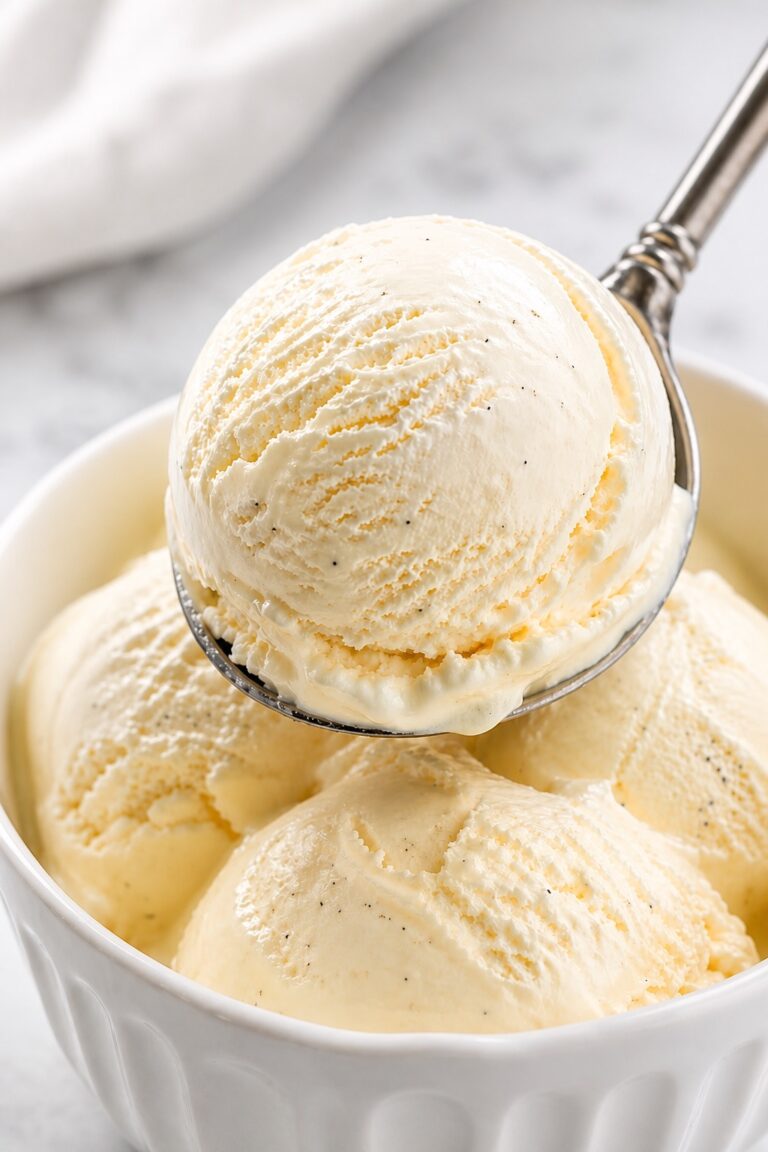
This gelato recipe makes authentic Italian gelato alla crema with a dense, silky body, fine texture, and a gentle elasticity as each scoop begins to soften. Whole milk leads the flavor, while vanilla, egg yolks, and one delicate strip of lemon peel create the quiet custard aroma that defines crema gelato.
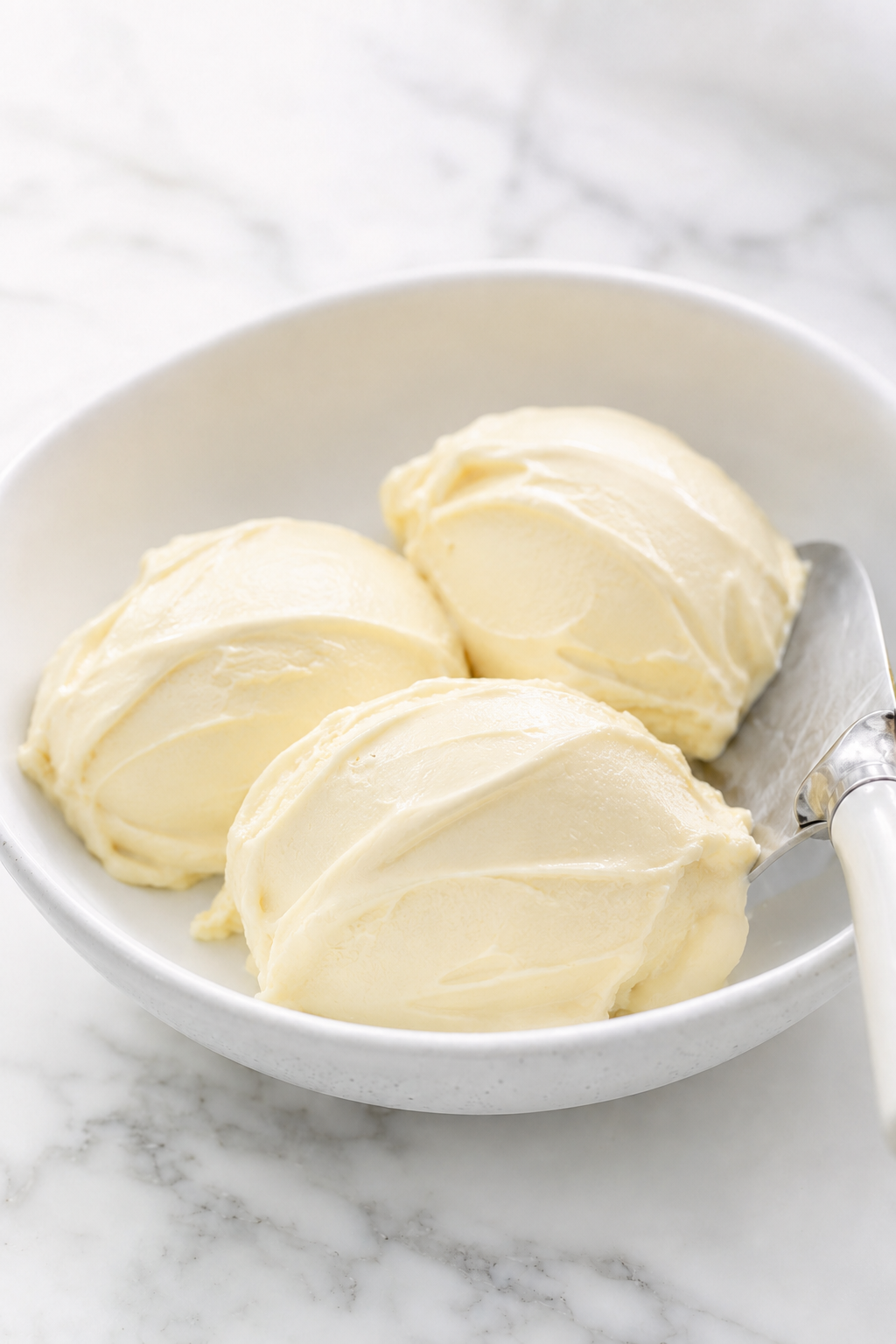
There is something especially comforting about a slowly softening scoop: cool and creamy at first, then increasingly aromatic as the milk, vanilla, and faint citrus note open up. The flavor is familiar and restrained rather than overly rich, which is exactly why this Italian classic feels elegant without feeling complicated.
This is a recipe worth returning to when you want more than a simplified frozen dessert. The professional-style 1,000-gram balance, precise temperature targets, and observable texture cues remove much of the guesswork from making serious gelato with home equipment.
The commitment is real but manageable: you need an ice cream machine, a precise scale, rapid cooling, and 6–12 hours of cold maturation before churning. In return, the method gives every specialized ingredient and every waiting period a clear purpose.
Authentic Italian Gelato at a Glance
This is an authentic home-scale gelato alla crema: a milk-dominant Italian gelato enriched with egg yolks, vanilla, and a delicate lemon accent, then pasteurized, matured, and dynamically frozen with low overrun.
| Method | Cooked dairy-and-yolk base, rapid chilling, 6–12 hour maturation, machine churning |
|---|---|
| Yield | Approximately 4 1/2–5 cups, or 10 servings |
| Machine | Minimum 1.5-quart capacity; halve the formula for a 1-quart machine |
| Plan ahead | 8–14 hours for soft service; 10–18 hours for firmer scoops |
| Defining texture | Dense, smooth, finely crystalline, and lightly elastic rather than fluffy |
This crema-style gelato is not fior di latte, Sicilian cornstarch gelato, American frozen custard, or conventional classic vanilla ice cream. Yolks belong to its specific crema identity, but milk remains dominant and the complete sugar, solids, air, and service-temperature balance keeps the result recognizably Italian.
The Science Behind Dense, Silky Italian Gelato
The formula creates body through balance rather than excess cream, so the finished gelato tastes clear and milky while still churning into dense, smooth folds.
- Milk stays in charge. Whole milk is the primary liquid, while a restrained amount of cream supplies enough fat for body without a heavy finish.
- The solids are deliberately balanced. Sucrose, dextrose, atomized glucose, milk powder, yolks, and locust bean gum manage sweetness, softness, water, and structure as one system.
- Pasteurization is controlled. Bringing the base to 180–183°F emulsifies and hydrates it without reducing it into a thick pastry cream.
- Maturation is structural. Cold resting gives milk proteins and other solids time to hydrate before freezing; maturation and rapid dynamic churning also support a finer frozen texture.
- Extraction is cue-led. Stopping at dense soft-serve folds protects low overrun and prevents the airy or greasy character that comes from unnecessary churning.
Why You’ll Love This Recipe
This recipe is designed for the home cook who wants authentic process and exact guidance, not an easier method that promises a different dessert under the same name.
- Every ingredient is given by authoritative metric weight, including the specialized powders.
- The work can be divided naturally across two days.
- Extraction cues remain useful even when home machines churn at different speeds.
- You can serve it very soft immediately or harden it for more defined scoops.
- Storage and refrigerator-tempering guidance account honestly for a 0°F home freezer.
- Troubleshooting separates recoverable problems from batches that cannot be fully repaired.
Ingredients for Authentic Italian Gelato alla Crema
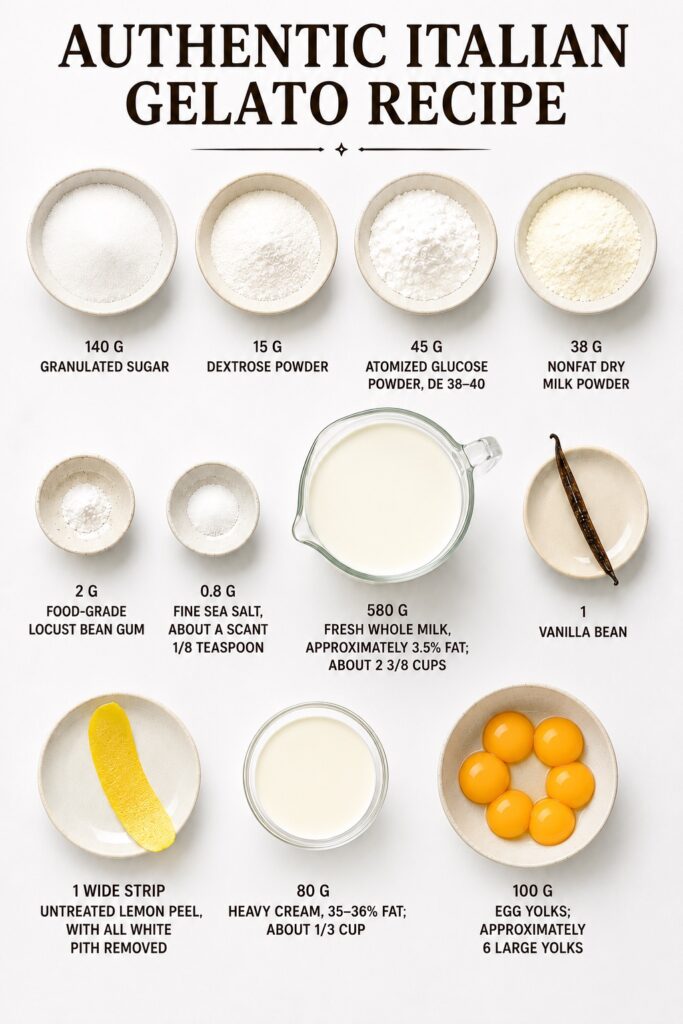
The ingredient list is short in flavor but technically precise in structure. Weigh the complete formula in grams; cup measures are working references only and are not accurate enough for the specialized sugars or stabilizer.
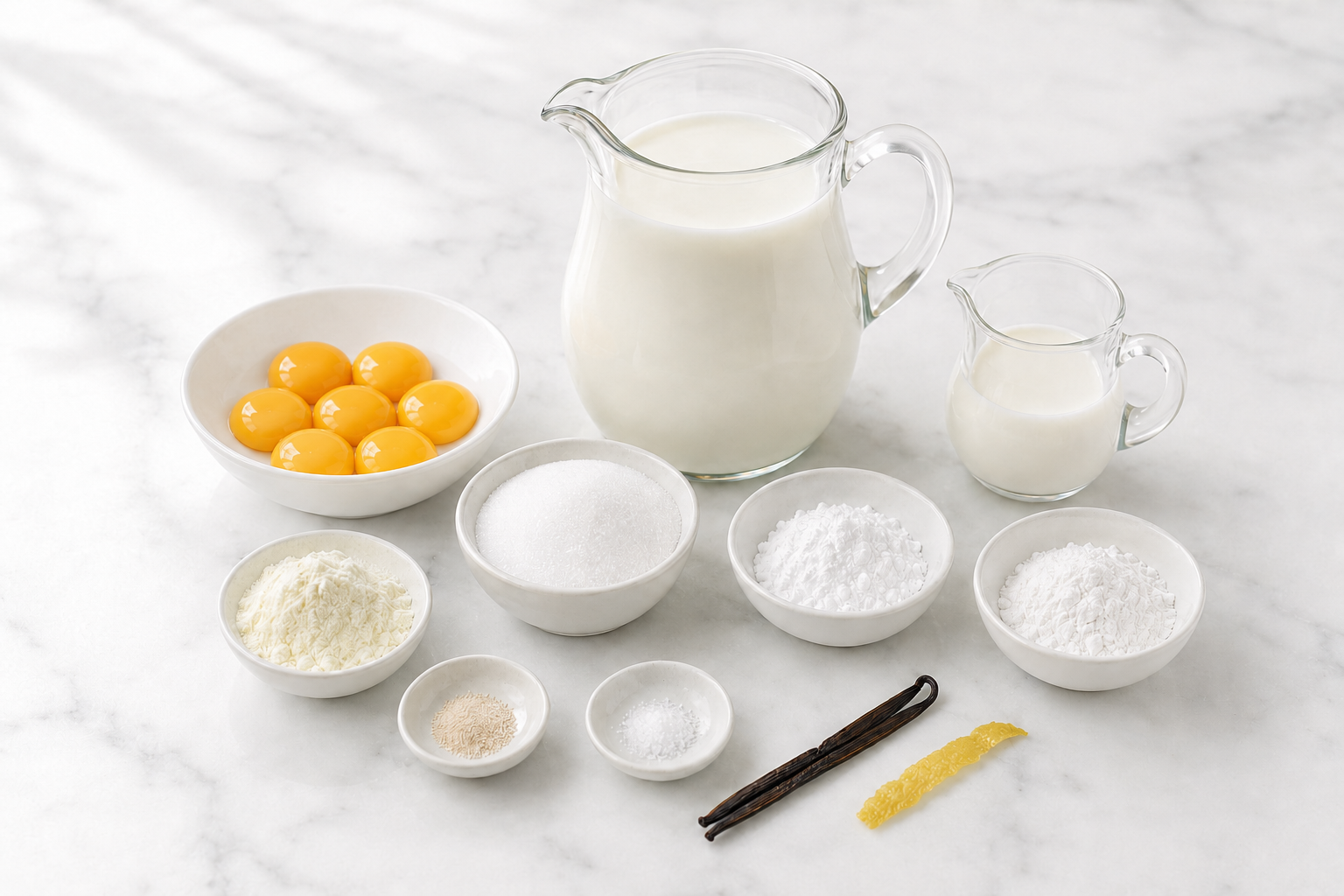
Dry blend
Whisk these dry ingredients together completely before they touch the milk so the locust bean gum disperses evenly.
- 140 g granulated sugar
- 15 g dextrose powder
- 45 g atomized glucose powder, DE 38–40
- 38 g nonfat dry milk powder
- 2 g food-grade locust bean gum
- 0.8 g fine sea salt, about a scant 1/8 teaspoon
Dairy, yolks, and aromatics
These ingredients build the milk-forward crema base and its restrained vanilla-lemon profile.
- 580 g fresh whole milk, approximately 3.5% fat; about 2 3/8 cups
- 1 vanilla bean, split lengthwise and seeds scraped
- 1 wide strip untreated lemon peel, with all white pith removed
- 80 g heavy cream, 35–36% fat; about 1/3 cup
- 100 g egg yolks; approximately 6 large yolks
Dextrose, atomized glucose powder, nonfat dry milk, and locust bean gum must be weighed.
Milk, Cream, and Egg Yolks
Whole milk supplies most of the water, milk proteins, lactose, and fresh dairy flavor. A small amount of heavy cream raises the fat just enough for a rounded mouthfeel, while the yolks define gelato alla crema, emulsify the mixture, and give it a natural pale-yellow color.
- 580 g fresh whole milk, approximately 3.5% fat
- 80 g heavy cream, 35–36% fat
- 100 g egg yolks, approximately 6 large yolks
The Three-Part Sugar System
Sucrose, dextrose, and atomized glucose are not three names for the same ingredient. Each changes sweetness, body, and freezing behavior differently, so the three-part system must remain intact unless the complete formula is professionally rebalanced.
| Ingredient | Amount | Primary role | Texture contribution | Substitution inside this formula |
|---|---|---|---|---|
| Granulated sugar | 140 g | Primary sweetness and solids | Softens the frozen base and supports body | Use as written |
| Dextrose powder | 15 g | Freezing-point control with restrained sweetness | Improves scoopability without making the base excessively sweet | Do not replace atomized glucose with it by equal weight |
| Atomized glucose powder, DE 38–40 | 45 g | Body and controlled freezing | Adds solids and helps manage hardness with lower sweetness impact than sucrose | Do not replace with liquid corn syrup or dextrose by equal weight |
Milk Powder and Locust Bean Gum
Nonfat dry milk increases milk proteins and solids without adding more water or cream. Locust bean gum works at a very low dose to help control free water, ice-crystal growth, and melting, but too much creates an unpleasant gummy stretch.
- 38 g nonfat dry milk powder
- 2 g food-grade locust bean gum, weighed on a 0.1 g scale
Neither ingredient can simply be omitted while preserving the validated texture balance. Locust bean gum is also not replaced by an equal amount of xanthan gum.
Vanilla, Lemon Peel, and Salt
Vanilla provides the central aroma, lemon peel gives crema gelato its delicate traditional lift, and a small amount of salt keeps the dairy and custard notes clearly defined. Remove every trace of white pith from the peel so the infusion never becomes bitter.
- 1 vanilla bean
- 1 wide strip untreated lemon peel, no white pith
- 0.8 g fine sea salt, about a scant 1/8 teaspoon
Essential Equipment for Making Gelato at Home
The machine supplies the rapid dynamic freezing that this formula needs, while the thermometer and precision scale protect the two smallest tolerances: pasteurization temperature and stabilizer weight.
- Ice cream machine with at least 1.5-quart capacity
- Digital kitchen scale plus a 0.1 g precision scale
- Calibrated instant-read thermometer
- Heavy-bottomed saucepan
- Whisk and heatproof spatula
- Immersion blender
- Clean metal bowl and larger bowl for an ice bath
- Chilled shallow freezer container with a tight lid
- Parchment paper or reusable freezer film for surface contact
Before You Begin: The Setup That Protects the Texture
Complete these six checks before heating the milk. Once the base begins to warm, success depends on continuous temperature control and immediate access to the chilling setup.
- Confirm that your machine holds at least 1.5 quarts; halve every metric weight for a 1-quart machine.
- Freeze a removable bowl for the manufacturer’s full required time, or prechill a compressor machine.
- Set out a calibrated thermometer and a precision scale that reads to 0.1 g.
- Assemble the immersion blender, clean metal chilling bowl, and complete ice bath.
- Weigh every ingredient and mix all dry ingredients before any gum touches liquid.
- Chill the storage container and reserve 6–12 uninterrupted refrigerated hours for maturation.
For food safety, cooked egg-and-milk mixtures should reach at least 160°F according to USDA guidance for cooked egg mixtures. This recipe continues to 180–183°F because that is the validated process target for the complete gelato base.
Recipe Timeline / Workback Plan
Choose your serving texture first, then count backward from that moment. Machine preparation and cold maturation are dependencies; they cannot be compressed by extending the churn time.
| When | What to prepare | Why it must be ready | Holding condition |
|---|---|---|---|
| 12–24 hours before, if required | Freeze the removable machine bowl | The bowl needs full thermal capacity before churning | Keep frozen until use |
| 8–14 hours before soft service | Pasteurize, homogenize, and rapidly chill the base | Maturation begins only after the base is cold | Refrigerate covered at 39–40°F or below |
| 6–12 hours before churning | Mature the base | Proteins and solids hydrate at a uniform low temperature | Refrigerate; do not freeze |
| 20–35 minutes before soft service | Churn to the extraction cue | The machine must already be prepared and the base thoroughly cold | Serve immediately or pack at once |
| 2–4 hours before firmer scoops | Harden in the chilled shallow container | Faster hardening protects fine texture | Freeze airtight with the surface covered |
| 15–30 minutes before serving after overnight storage | Temper in the refrigerator | A home freezer is colder than gelato service temperature | Serve as soon as smoothly scoopable |
What Authentic Gelato alla Crema Should Taste and Feel Like
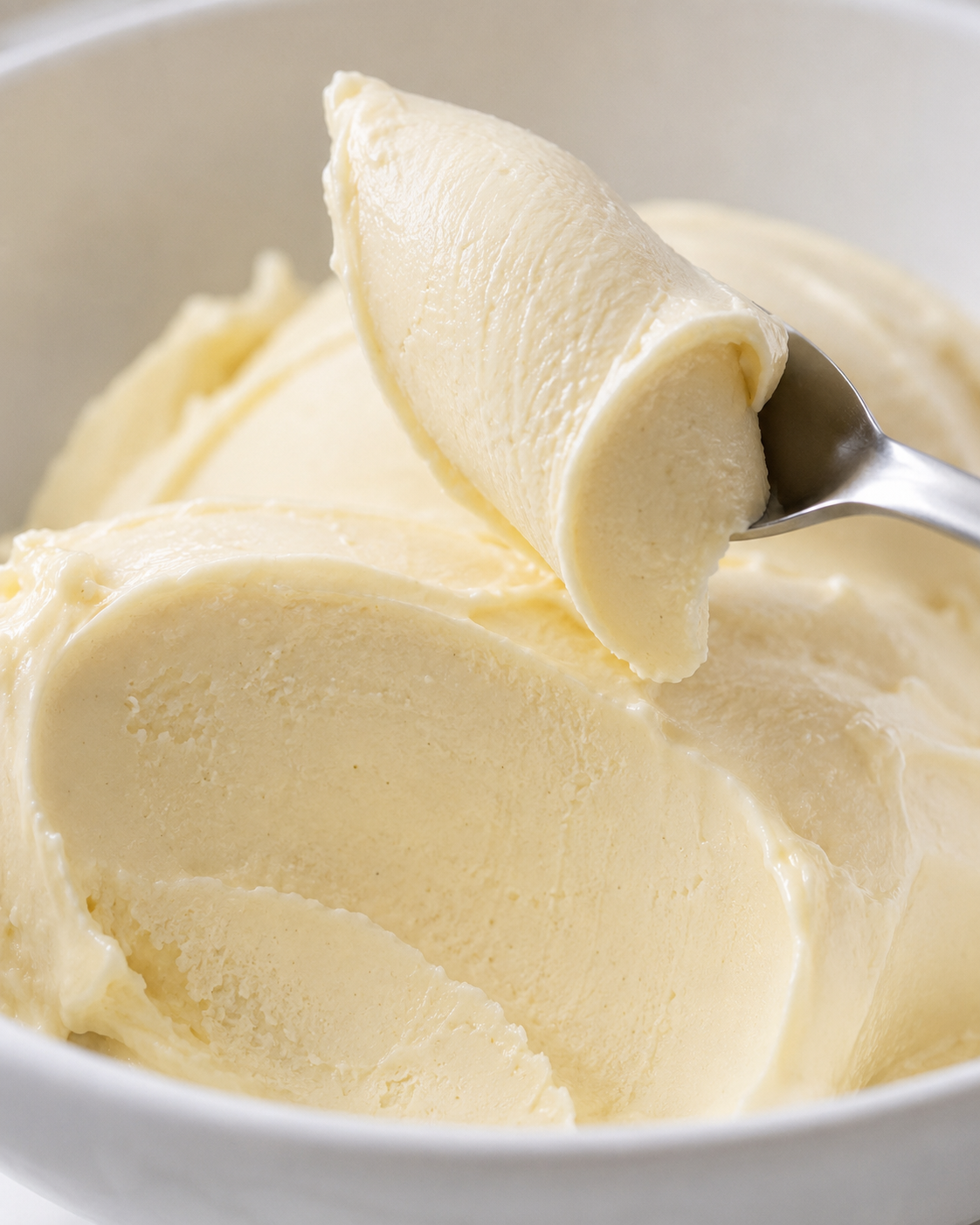
This gelato should be dense, softly elastic, and relatively soft when it leaves the machine. It should not look fluffy, double dramatically in volume, or remain ready to scoop straight from a 0°F home freezer.
- The cooked base is pale yellow and fluid enough to pour, not thick like pastry cream.
- The matured base is only moderately thicker and remains completely homogeneous.
- Freshly churned gelato resembles dense soft serve and may need 2–4 hours for round scoops.
- Gelato stored overnight becomes firm in a standard freezer and needs 15–30 minutes of refrigerator tempering.
How to Make Authentic Italian Gelato
The method moves through preparation, pasteurization, rapid cooling, maturation, churning, and controlled service. Follow the visual and temperature cues in sequence; no later step can fully repair a warm base, inaccurate stabilizer dose, or under-frozen machine bowl.
1. Prepare the Machine and Chilling Setup
Prepare the ice cream machine exactly as its manufacturer directs, chill the shallow storage container, and assemble a deep ice bath around a clean metal bowl before you begin cooking.
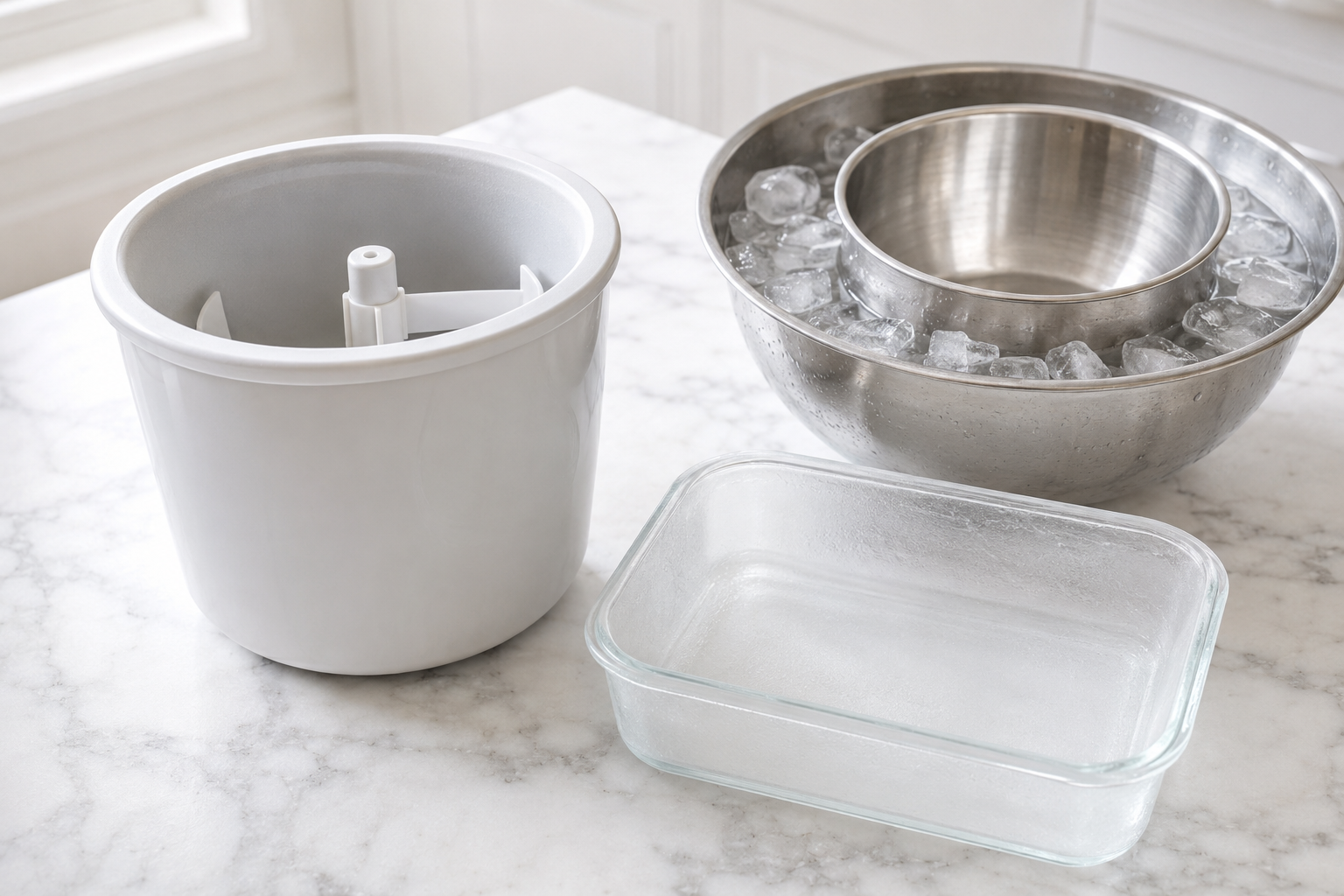
What you should see: the removable bowl is frozen solid with no liquid movement inside, or the compressor machine is fully prechilled; the storage container feels cold and the ice bath reaches high around the empty metal bowl.
2. Blend the Dry Ingredients
Whisk the granulated sugar, dextrose, atomized glucose, nonfat dry milk, locust bean gum, and salt together thoroughly. Diluting the gum through the larger dry mixture prevents it from forming stubborn clumps when it reaches liquid.
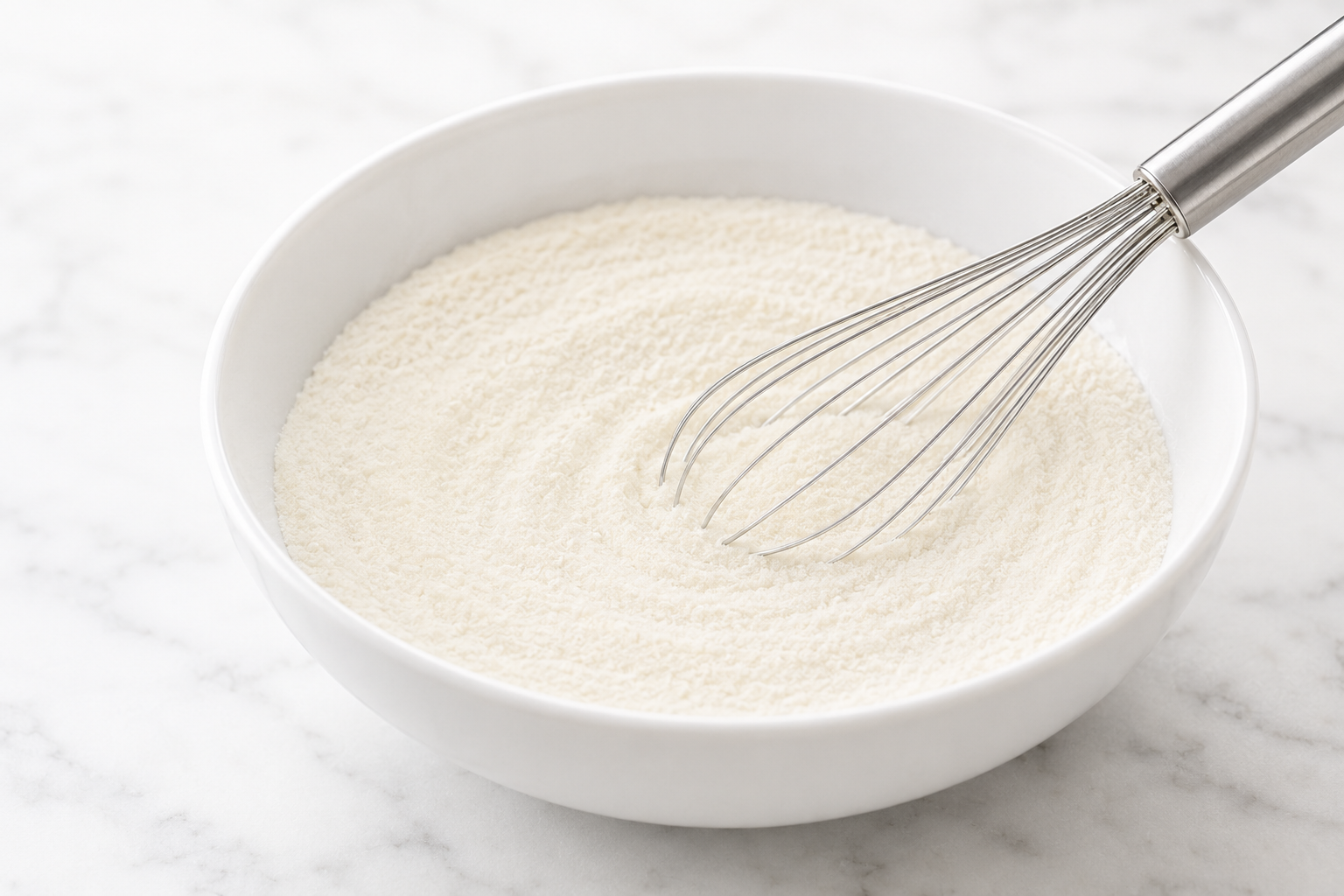
What you should see: a completely uniform pale powder with no visible streaks, gum pockets, or small compacted lumps.
3. Infuse the Milk
Split the vanilla bean lengthwise and scrape the seeds into a heavy saucepan. Add the pod, whole milk, and lemon peel, then warm gently to about 104°F.
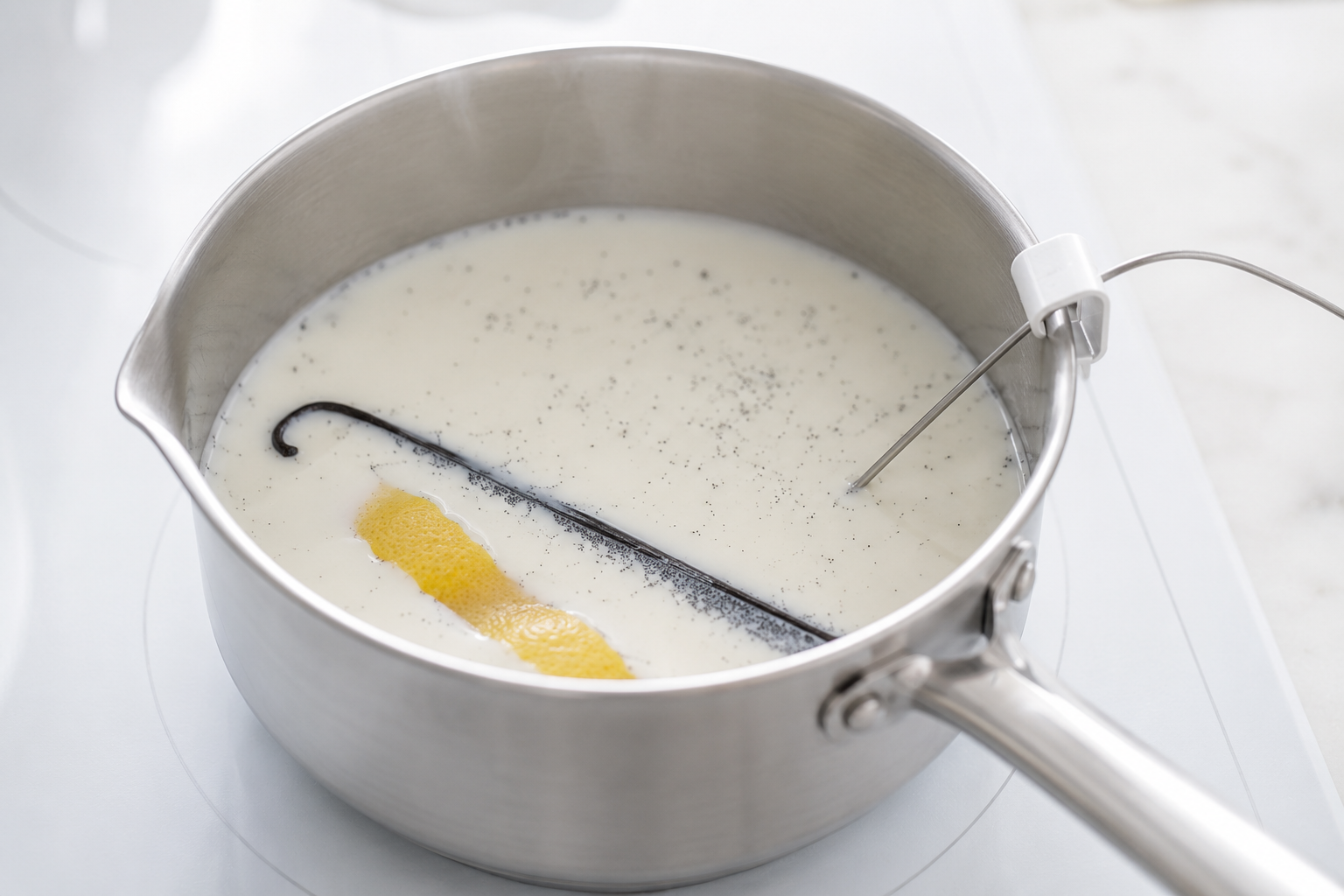
What you should see: vanilla seeds dispersed through warm milk, the peel fully submerged, and little to no steam; stop at approximately 104°F rather than bringing the milk to a simmer.
4. Add the Dry Blend and Cream
Whisk the dry mixture into the warm milk in a slow, steady stream. Continue heating and whisking; when the base reaches about 113°F, add the cream and mix until completely smooth.
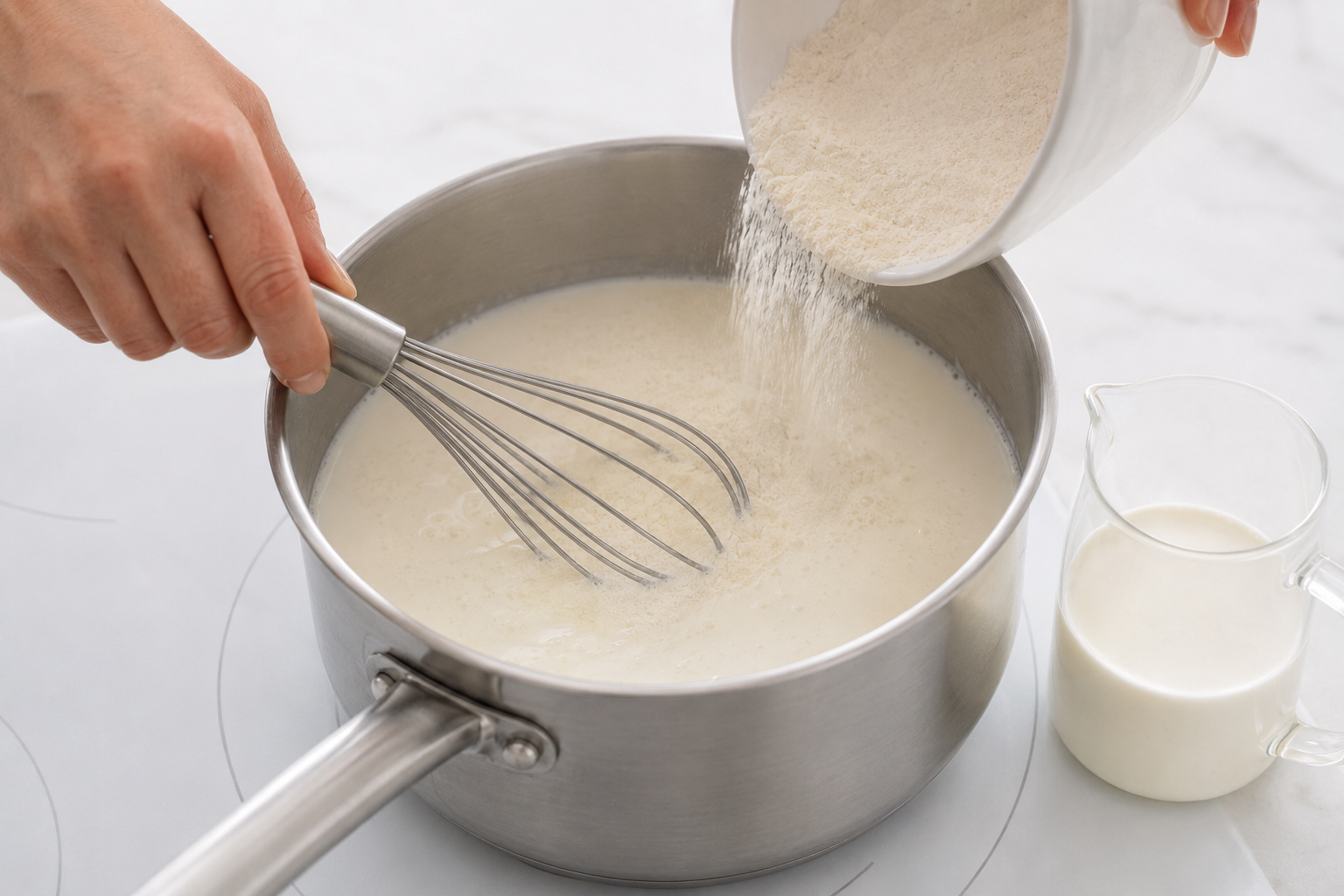
What you should see: a fluid, evenly colored dairy mixture with dissolved powders, no gum beads, no dry milk specks, and no thick layer of foam.
5. Temper the Egg Yolks
Whisk the yolks in a separate heatproof bowl. Add the warm dairy mixture gradually while whisking, beginning with a small stream, then return the tempered yolk mixture to the saucepan.
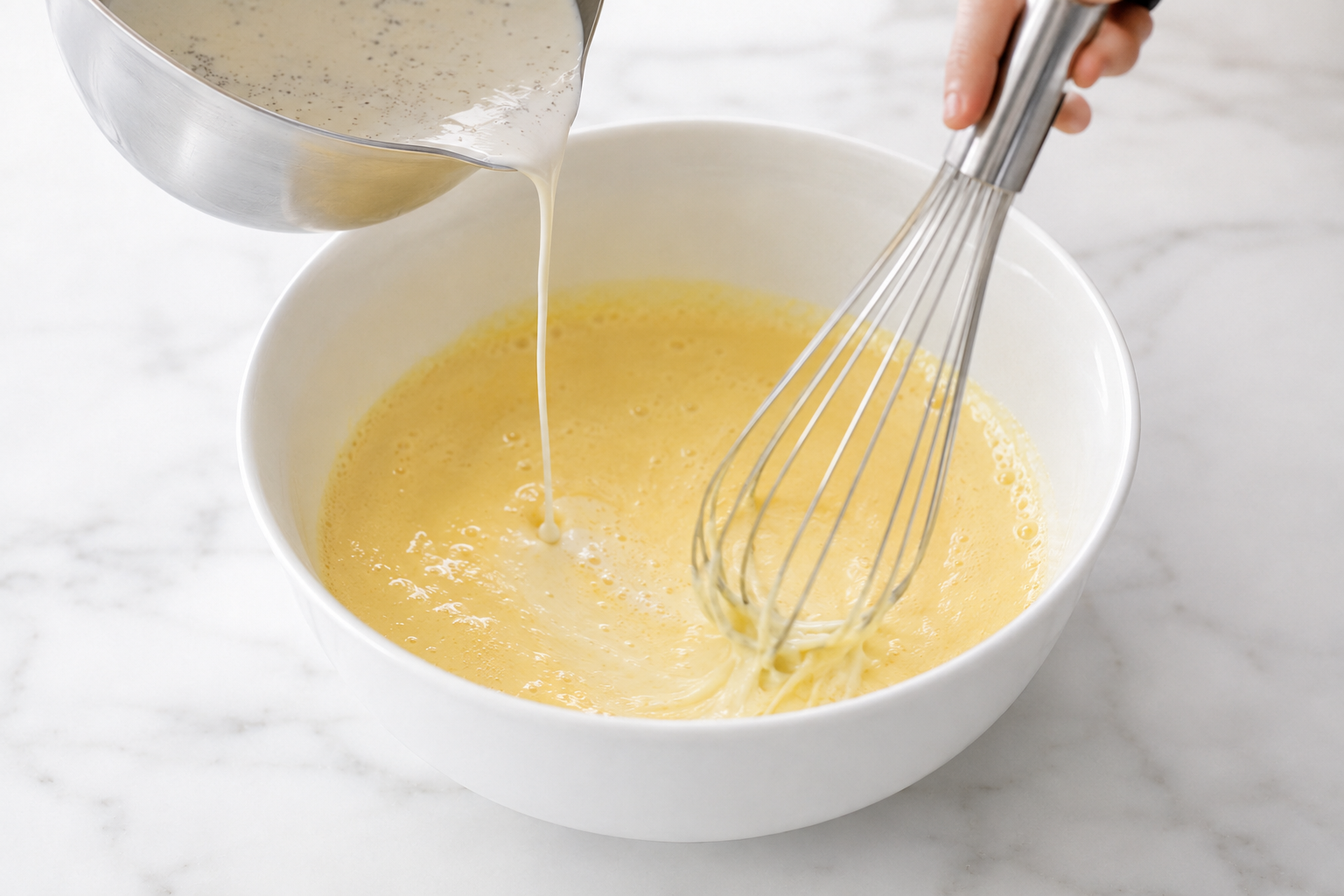
What you should see: smooth, fluid yolks that warm gradually without pale cooked flecks, strings, or scrambled particles.
6. Pasteurize the Base
Cook over medium-low heat, stirring constantly across the bottom and corners of the pan, until the entire base reaches 180–183°F. Do not boil or extend the hold after the target temperature is reached.
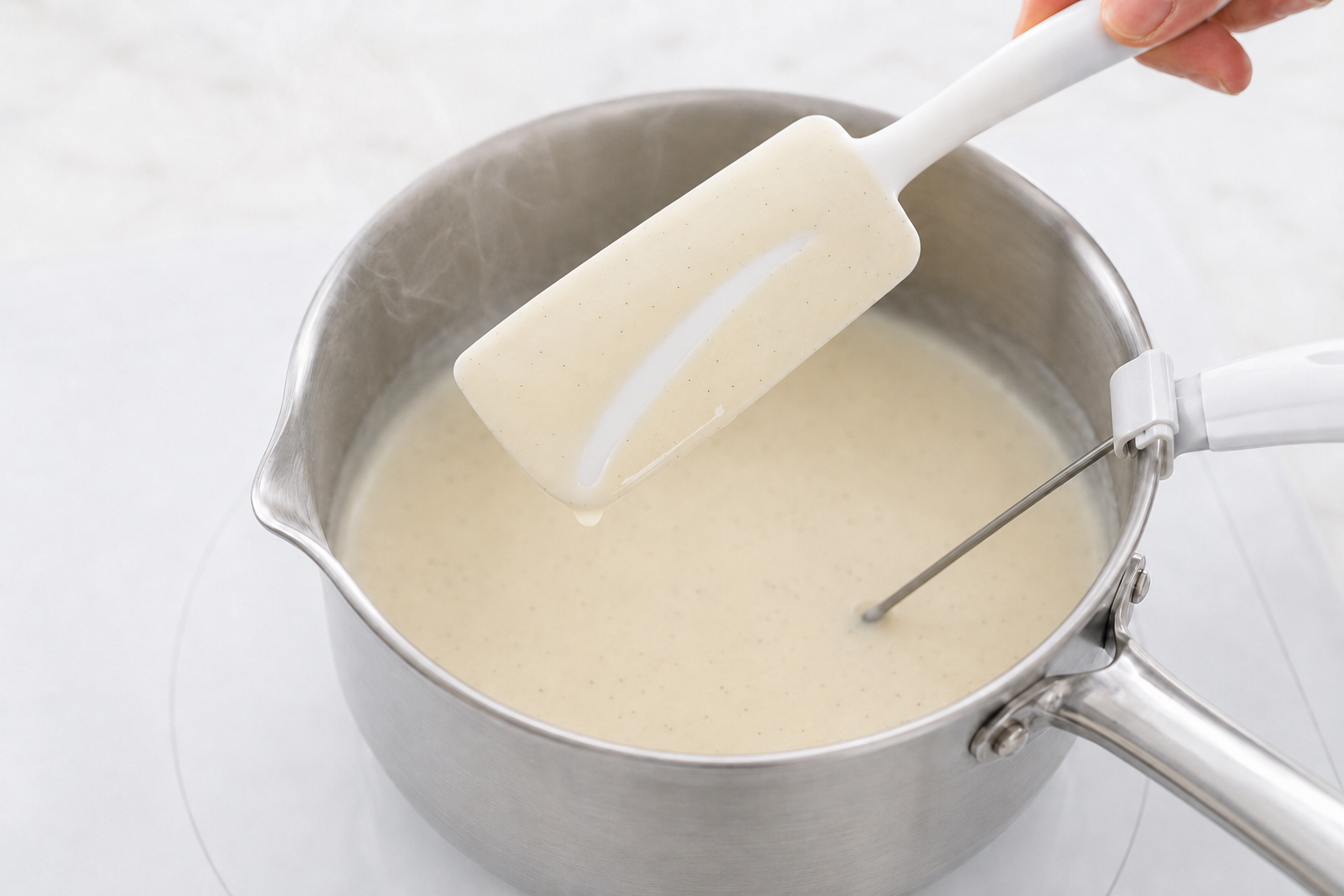
What you should see: a smooth pale-yellow base that lightly coats a spatula but still pours freely; stop immediately at 180–183°F, before it thickens like pastry cream or develops a cooked-egg smell.
7. Homogenize and Chill Rapidly
Remove the vanilla pod and lemon peel. Blend the hot base for 30–60 seconds with the immersion-blender head fully submerged, then transfer it immediately to the prepared metal bowl and stir over the ice bath until cold.
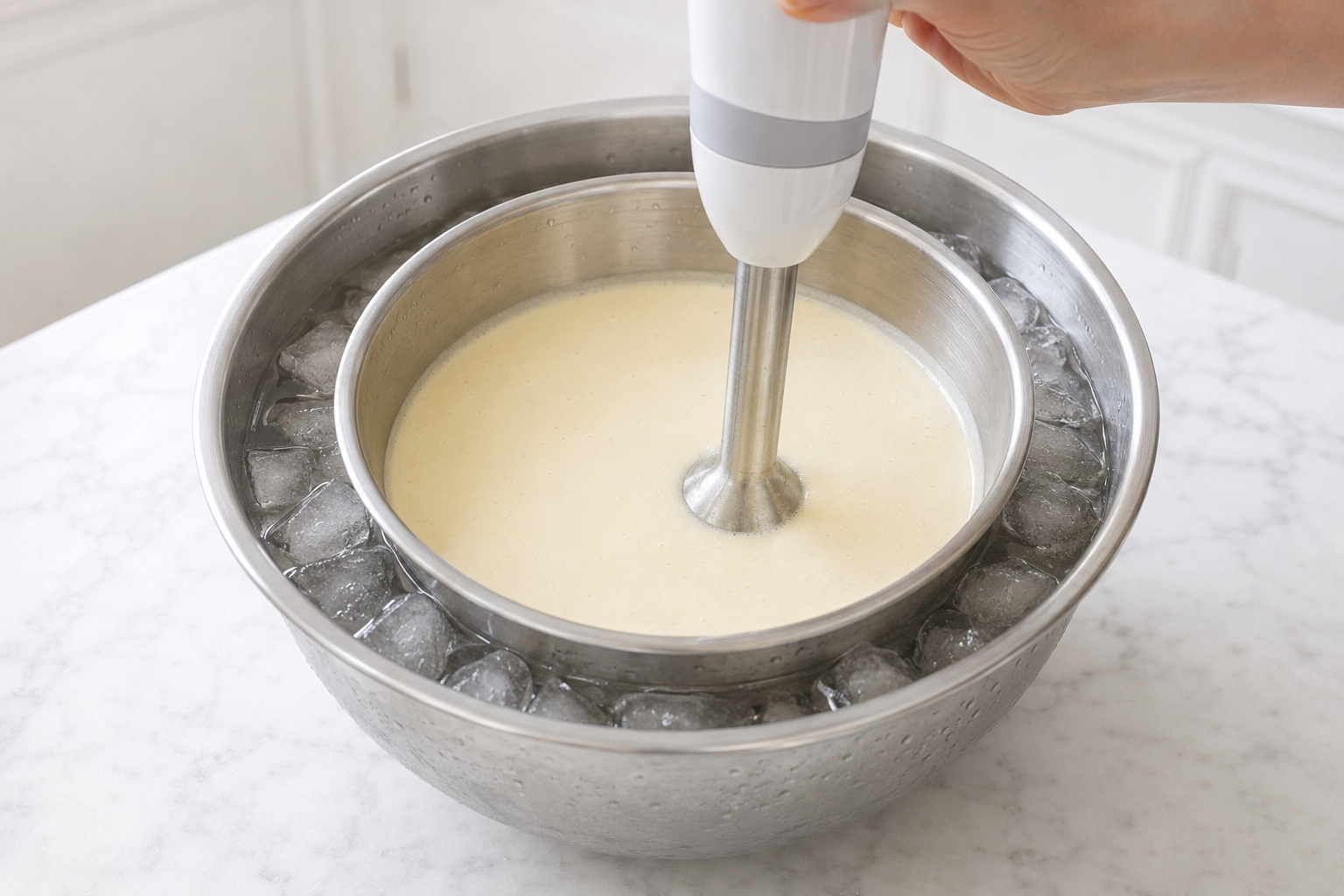
What you should see: a glossy, fully uniform base without a fat layer or foam cap, followed by a rapid temperature drop as it is stirred in the ice bath.
8. Mature for 6–12 Hours
Cover the cold base and refrigerate it at 39–40°F or below for 6–12 hours. This rest is an active part of the texture design, not optional waiting time.
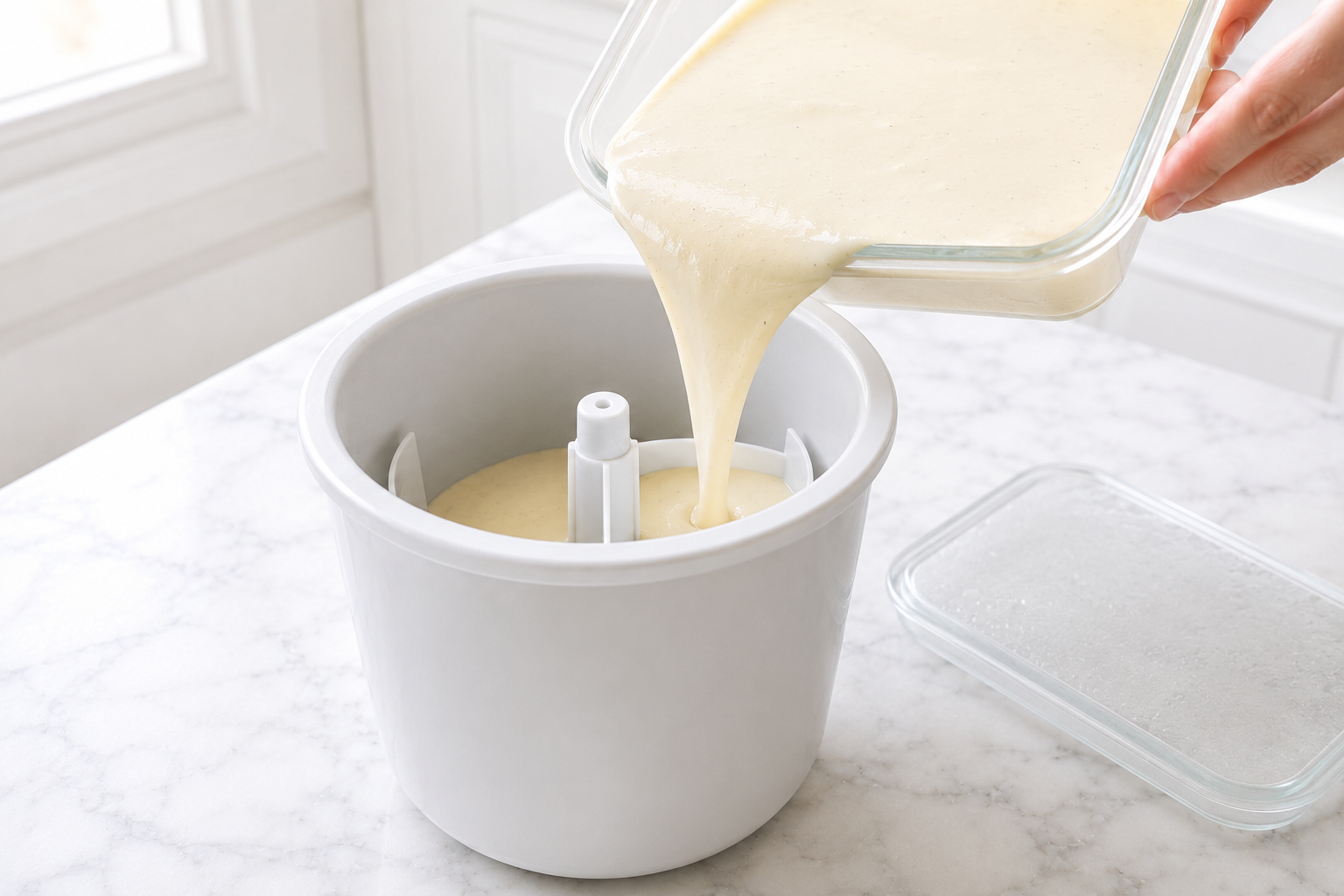
What you should see: a thoroughly cold, homogeneous base that is slightly thicker than it was after cooking and pours in one continuous ribbon without sediment or a separated fat layer.
9. Churn to the Extraction Cue
Stir or briefly blend the matured base, pour it into the running machine, and churn according to the manufacturer’s directions. Begin checking texture early rather than treating 20–35 minutes as a guaranteed endpoint.
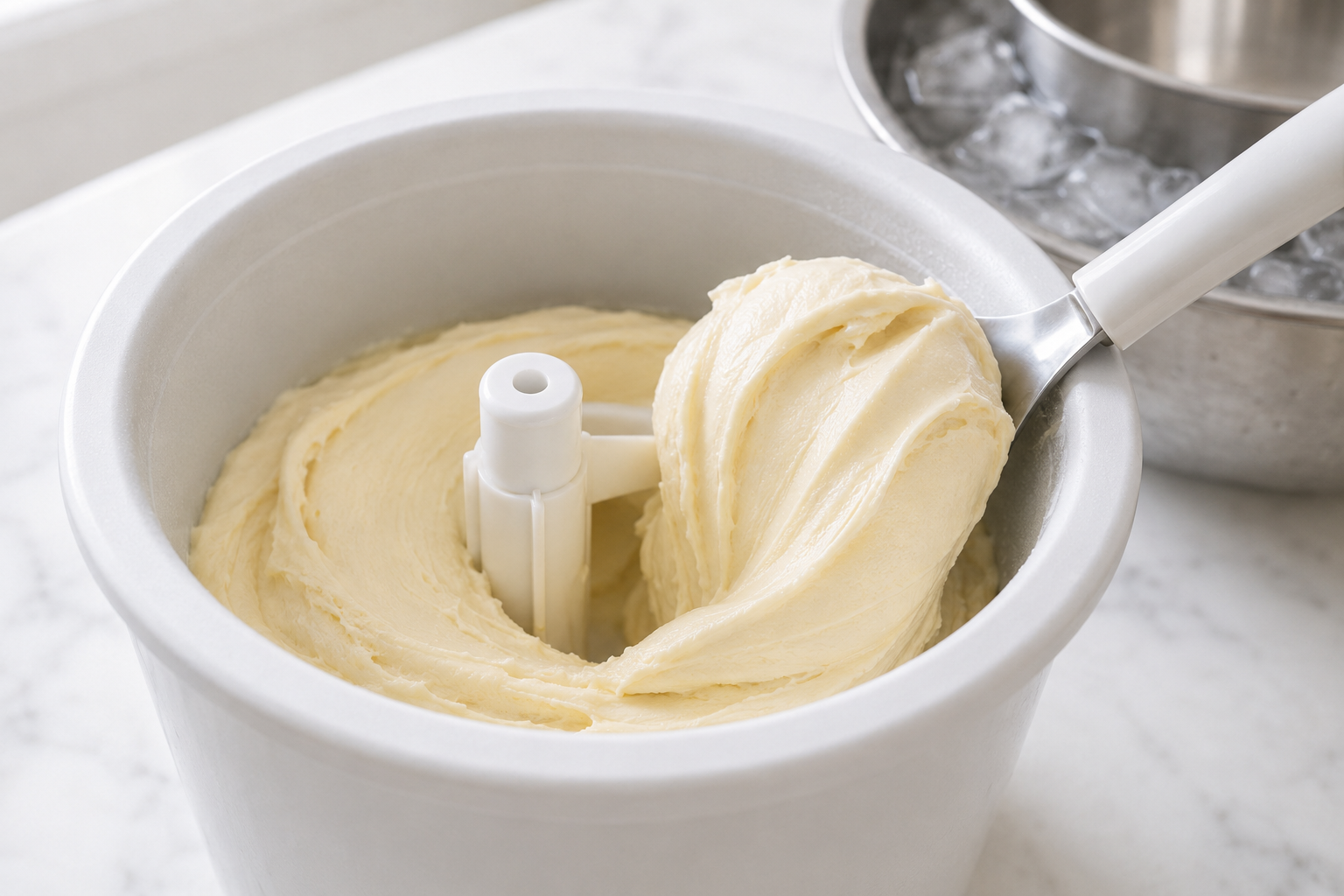
What you should see: dense soft-serve folds, a matte-to-satin surface, and a shallow groove that remains behind the paddle; stop when the gelato mounds softly and no longer flows like a milkshake.
10. Pack and Harden
For firmer scoops, transfer the gelato immediately to the chilled shallow container, press out obvious air pockets, cover the surface directly with parchment or reusable freezer film, and seal the lid.
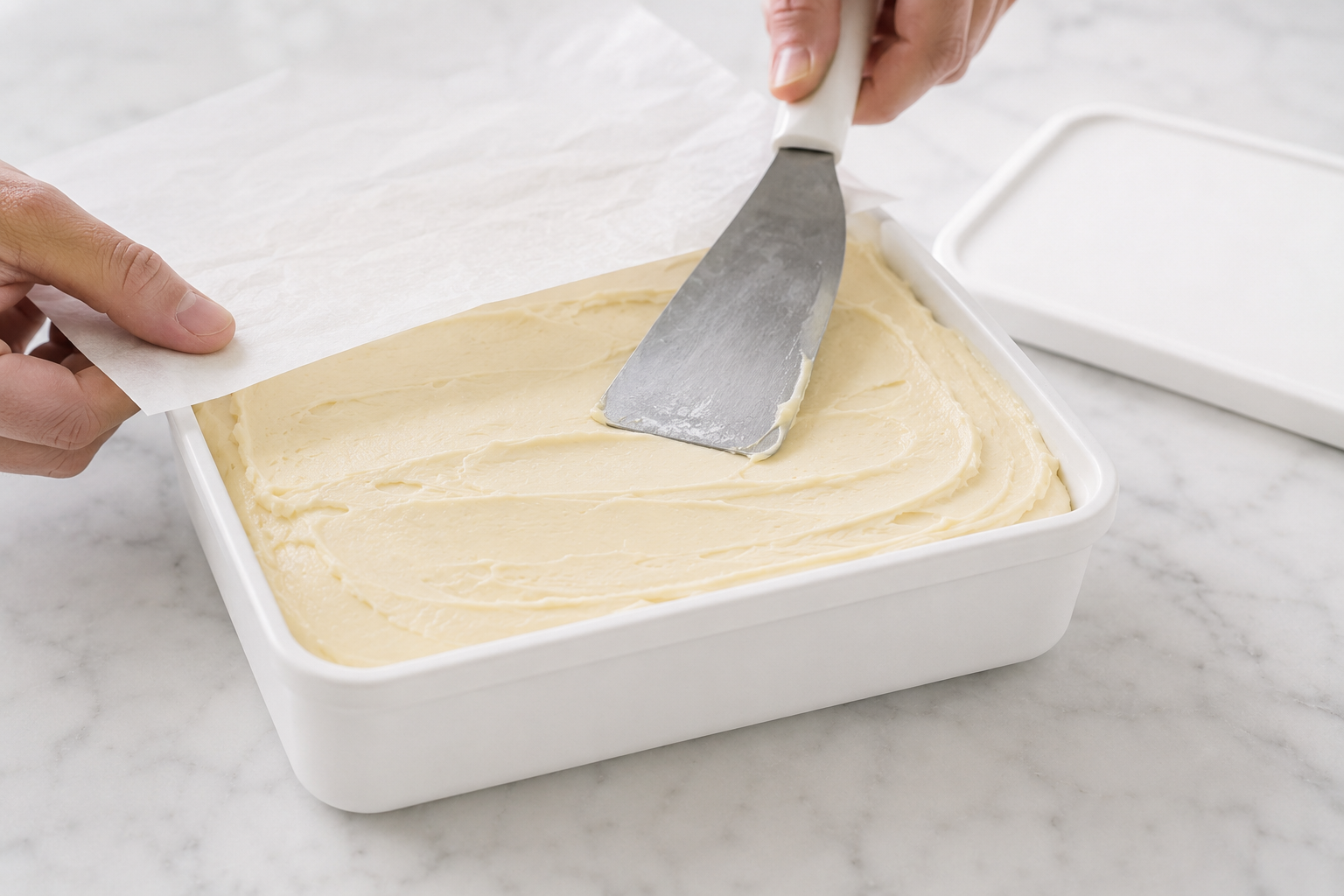
What you should see: an evenly packed shallow layer with soft ridges, minimal trapped air, and a protective surface covering in complete contact; harden for 2–4 hours.
11. Temper and Scoop
Serve freshly churned gelato immediately for the softest texture. After overnight storage, move the covered container to the refrigerator for 15–30 minutes before scooping.
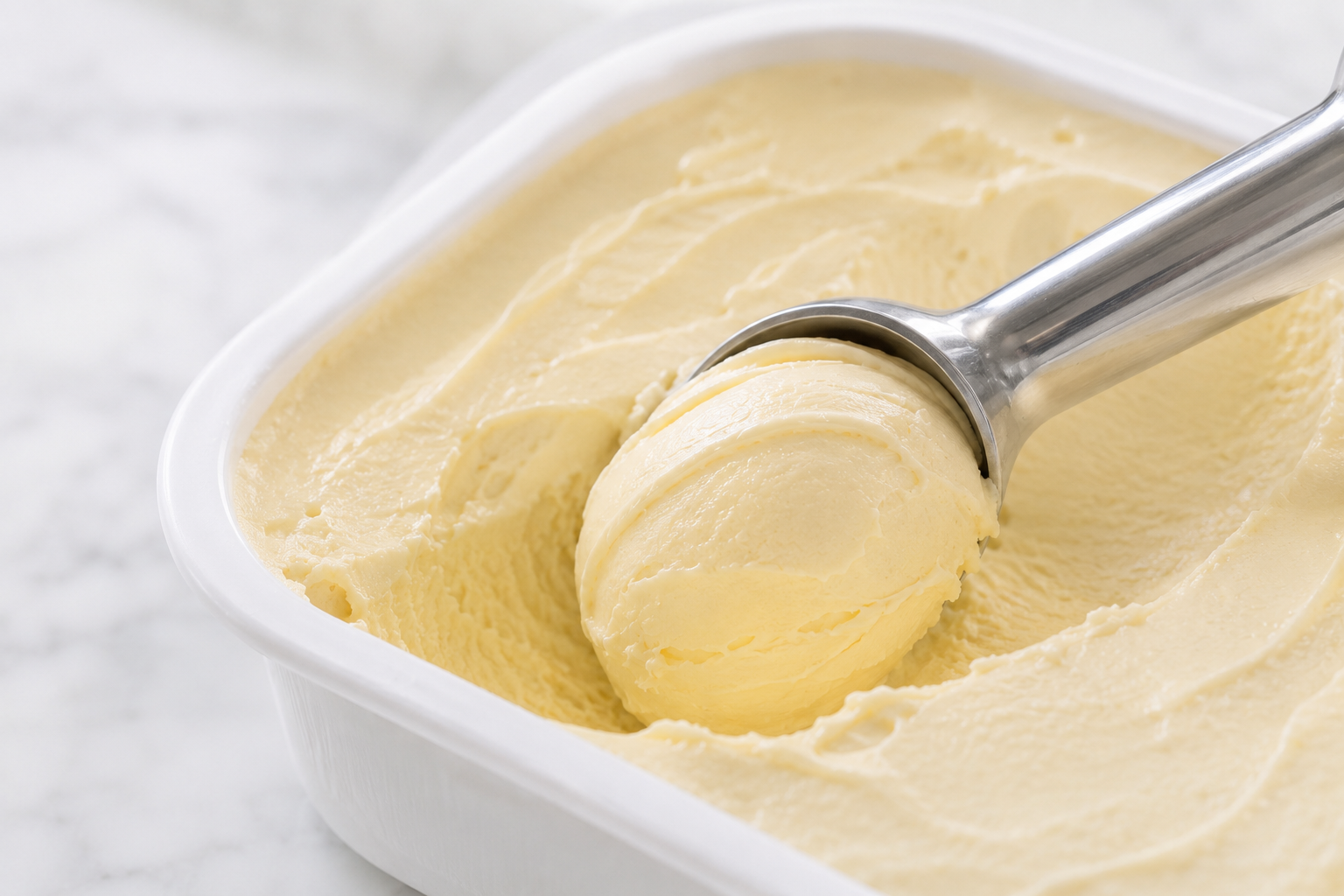
What you should see: the scoop passes through smoothly, the gelato curls into rounded folds, and the serving holds its shape without looking brittle, icy, melted, or foamy.
Gelato Doneness and Texture Cues
Gelato readiness is a sequence of controlled states, not one churn time. Check the cooked base, matured base, extraction texture, and serving texture separately.
| Stage | Ready | Not ready or failed |
|---|---|---|
| Pasteurized base | Smooth, fluid, lightly coats a spatula, clean vanilla-custard aroma | Curdled particles, pastry-cream thickness, gum clumps, or cooked-egg smell |
| Matured base | Thoroughly cold, homogeneous, slightly thicker, continuous ribbon | Warm center, fat layer, sediment, or visible separation |
| Extraction | Dense soft-serve folds, shallow paddle groove, satin surface | Milkshake-thin, visibly crystalline, foamy, or greasy |
| Serving | Smooth scoop, rounded fold, cool and creamy release | Rock-hard, brittle, icy, gummy, or collapsing from excess warmth |
Expert Techniques for Dense, Silky Gelato
These controls target the small technical decisions that have an outsized effect on a professional-style frozen texture.
Working on my strawberry ice cream recipe reinforced how much texture depends on starting with a thoroughly cold base. Gelato makes that lesson even more exacting: maturation is part of the structure, not simply waiting time.
- Measure the gum to 0.1 g. A spoon cannot control a 2 g dose precisely enough, and a small excess can turn a smooth body into a gummy one.
- Dilute before hydrating. Whisking the locust bean gum through the complete dry blend separates its particles so they hydrate evenly instead of clumping on contact.
- Blend below the surface. Keep the immersion-blender head submerged to create a stable emulsion without building foam and false overrun.
- Do not extend the final heat. Additional cooking after 180–183°F concentrates the base and increases the risk of a heavy, eggy finish.
- Trust folds, not another machine’s timer. Home machines vary in thermal power, so the shallow paddle groove and dense folds are more reliable than a copied minute count.
- Use a shallow cold container. A thinner layer loses heat faster, reducing the time the center spends freezing slowly.
Common Mistakes and How to Fix Them
When gelato fails, the symptom usually points to a specific temperature, measurement, or capacity problem. Use the result to identify the cause before deciding whether the batch can be recovered.
| Mistake | What happens | Why it happens | Prevention or realistic recovery |
|---|---|---|---|
| Churning a warm or under-matured base | Coarse, icy texture with weak body | Freezing is slow and solids are not fully hydrated | Chill completely and mature 6–12 hours; a fully hardened icy batch has no reliable complete recovery |
| Using an under-frozen bowl or overfilling the machine | The base stays loose and freezes too slowly | The machine lacks enough thermal capacity | Prepare the machine fully and respect capacity; stop and rechill the base if thickening never begins |
| Swapping sugars by equal weight | Sweetness, body, or frozen hardness moves outside the intended balance | The sugars affect sweetness and freezing differently | Use the formula exactly or rebalance the entire mix professionally |
| Measuring locust bean gum inaccurately | The gelato becomes gummy or insufficiently stabilized | The 2 g dose has little tolerance for spoon error | Use a 0.1 g scale; excess gum has no complete recovery |
| Overheating or poorly tempering the yolks | Curds and cooked-egg flavor develop | Localized heat or excess temperature coagulates the yolks | Strain immediately only if particles are minimal; discard a strongly curdled or eggy base |
| Serving directly from a 0°F freezer | Correct gelato seems incorrectly rock-hard | The freezer is colder than gelato service temperature | Temper 15–30 minutes in the refrigerator |
Beautiful Ways to Serve Gelato
Serve crema gelato with restrained contrasts that sharpen its milk, vanilla, and delicate lemon notes instead of covering them with heavy toppings.
Classic Gelateria Cup
Shape two softly rounded scoops in a chilled cup and finish with a small amount of shaved dark chocolate or finely chopped pistachios. The simple presentation keeps the dense fold and pale crema color visible.
Affogato-Style
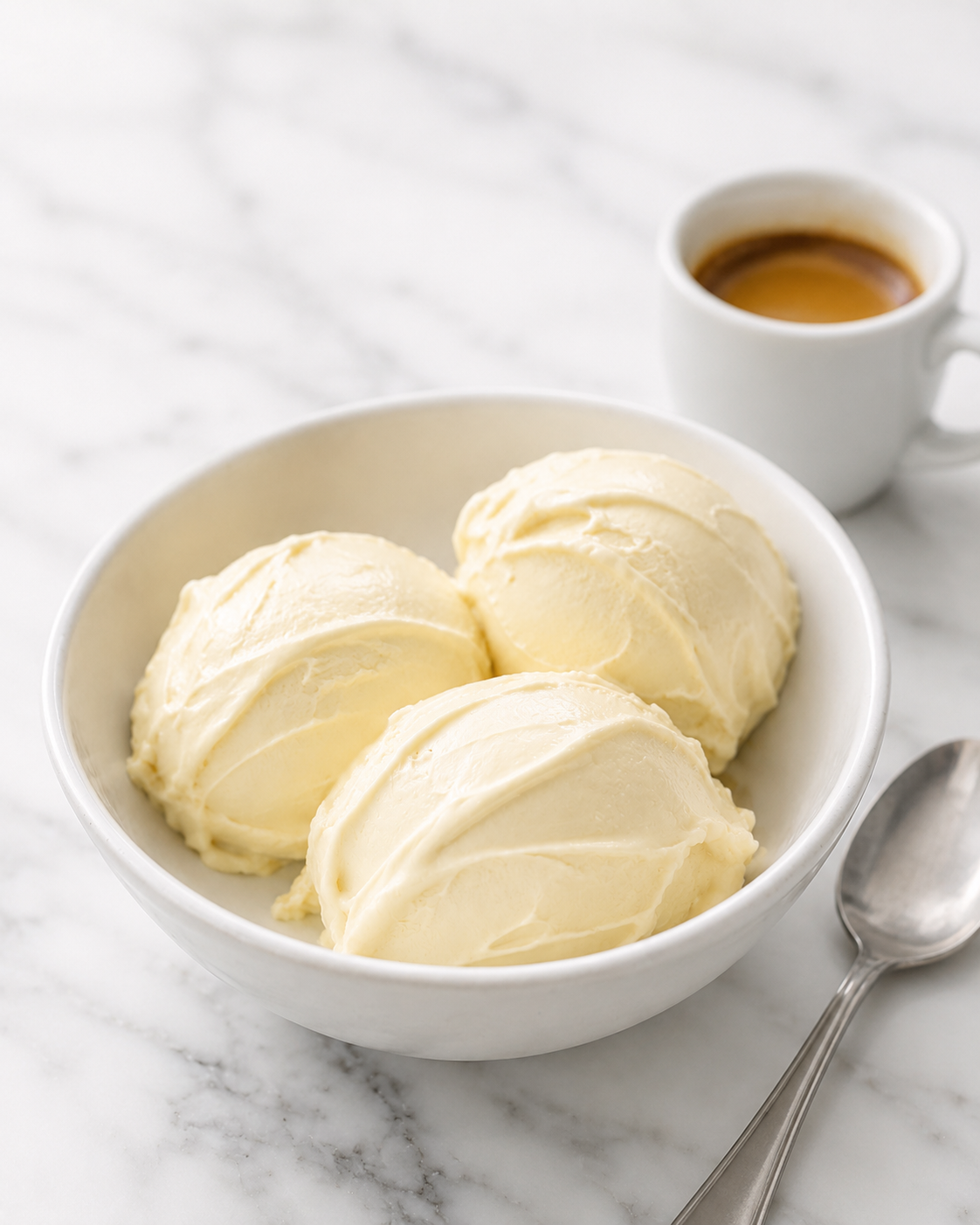
Place one small scoop in a heatproof glass and pour freshly brewed espresso over it at the table. Use a restrained amount of coffee so the hot-cold contrast opens the vanilla aroma without immediately drowning the gelato.
With a Warm Bubble Waffle
Tuck a scoop into a warm, crisp bubble waffle just before serving. The airy golden shell provides temperature and texture contrast while the pockets catch the softening crema.
With Fresh Fruit and Crisp Cookies
Pair the gelato with ripe berries or sliced stone fruit and one thin almond cookie. Fresh acidity and a crisp edge make the milk-forward flavor feel brighter without requiring a sauce.
Pairings That Keep Crema in Focus
Espresso and dark chocolate add bitterness, toasted nuts add warmth, and berries or stone fruit add acidity. Lightly spiced crisp pastries also work well, but strongly flavored syrups and thick frostings can bury the delicate vanilla-custard profile.
Storage, Make-Ahead, and Tempering
The uncooked schedule and the finished-gelato schedule need different controls: mature the base only in the refrigerator, then freeze the churned gelato quickly and limit repeated temperature changes.
| Stage | How to hold it | Quality window |
|---|---|---|
| Matured base | Covered at 39–40°F or below | 6–12 hours before churning |
| Freshly churned gelato | Serve immediately or pack in a chilled shallow container | Softest gelateria-style texture immediately |
| Finished gelato | Airtight at 0°F or below, with parchment or reusable freezer film touching the surface | Best texture within 3 days; use within 1 week for quality |
| After overnight freezing | Temper covered in the refrigerator | 15–30 minutes, then serve promptly |
Avoid repeated softening and refreezing because each cycle encourages larger crystals and weakens the emulsion. For safety, do not leave the gelato at room temperature for more than 2 hours, or more than 1 hour when the temperature is above 90°F.
Substitutions, Scaling, and Formula Boundaries
This is a balanced formula, so the safe changes are narrow. A new sugar system, egg-free base, starch-thickened style, or no-machine method requires a separate recipe rather than a casual substitution note.
- For a 1-quart machine: halve every metric weight exactly; do not halve by approximate cups.
- For vanilla-only crema: omit the lemon peel and expect a rounder, less lifted aroma.
- For the dairy: use whole milk near 3.5% fat and heavy cream at 35–36% to preserve the validated fat balance.
- For the sugar system: do not replace atomized glucose with dextrose, liquid corn syrup, or another sugar by equal weight.
- For milk powder and locust bean gum: do not omit them and expect the same validated texture.
- For larger batches: never fill the machine beyond its rated capacity; churn in separately weighed batches.
Continue Your Baking Journey
Use these three paths to compare frozen-dessert bases, stay with creamy vanilla flavors, or build a warm-and-cold plated dessert around your gelato.
Keep Exploring Homemade Frozen Desserts
These recipes show how different dairy, custard, fruit, and flavor systems change the body and character of a homemade frozen dessert.
- Vanilla Ice Cream — choose this for a classic cream-forward vanilla profile.
- Chocolate Ice Cream — explore a custard-style base built around deep chocolate flavor.
- Strawberry Ice Cream — see how fruit changes water balance, color, and freshness.
- Homemade Ice Cream — return to a broader home ice-cream method and its foundational cues.
Stay with Creamy Vanilla Desserts
If the soft dairy-and-vanilla comfort is what you love most, these non-frozen desserts carry that familiar flavor into spoonable custard, cake, and celebration formats.
- Vanilla Pudding — make a warm or chilled stovetop custard with a spoonable finish.
- Vanilla Cake — translate pure vanilla into soft, tender layer cake.
- Vanilla Cupcake — choose individual portions for an easy celebration dessert.
- White Cake — keep the flavor light and elegant with a vanilla-almond profile.
Serve It with Something Warm
Crisp edges, warm fruit, or a molten center create the strongest contrast when the gelato is tempered just enough to curl into soft scoops.
- Bubble Waffle — make a crisp, airy edible cup for soft gelato.
- Chocolate Lava Cake — pair cold crema with a flowing dark chocolate center.
- Peach Dump Cake — serve juicy warm peaches and buttery topping beside the gelato.
- Apple Pie Filling — spoon warm cinnamon apples alongside a simple scoop.
Why This Recipe Belongs in Your Recipe Box
Keep this recipe as a working reference for the decisions that separate balanced gelato from a merely frozen dairy mixture.
- Teaches Gelato Balance. It shows how fat, sugars, milk solids, yolks, and stabilizer function as one formula.
- Protects Fine Texture. It connects rapid chilling, maturation, churning, hardening, and tempering to the final scoop.
- Explains Specialized Ingredients. It gives each powder a clear role instead of asking you to trust an unexplained list.
- Prevents Costly Swaps. It makes the non-equivalent sugar and stabilizer boundaries clear before ingredients are wasted.
- Builds Transferable Skill. It teaches temperature and extraction cues that remain useful with other frozen-dessert formulas.
- Sets Honest Expectations. It separates authentic gelato behavior from what a standard home freezer can realistically deliver.
Final Thoughts
This gelato alla crema is special because its dense, silky texture comes from measured balance rather than an excess of cream. Milk, vanilla, yolks, and a delicate lemon note stay clear from the first cold spoonful to the softer, more aromatic finish.
Return to it when you want an elegant make-ahead dessert that can stand alone in a chilled cup, meet espresso in an affogato, or soften slowly beside something warm and crisp.
Excellent gelato is a discipline of balance, temperature, and timing!
Love this? There are twenty more like it.
128 pages, five chapters, 15 kitchen guides and 16 printable planning pages — in US Letter and A4.

Authentic Italian Gelato (Gelato alla Crema)
Authentic Italian gelato alla crema made with whole milk, egg yolks, vanilla, a delicate lemon note, and a professionally balanced sugar system for a dense, silky texture.
Ingredients
Dry blend
- 140 g granulated sugar
- 15 g dextrose powder
- 45 g atomized glucose powder, DE 38–40
- 38 g nonfat dry milk powder
- 2 g food-grade locust bean gum
- 0.8 g fine sea salt, about a scant 1/8 teaspoon
Dairy, yolks, and aromatics
- 580 g fresh whole milk, approximately 3.5% fat; about 2 3/8 cups
- 1 vanilla bean, split lengthwise and seeds scraped
- 1 wide strip untreated lemon peel, with all white pith removed
- 80 g heavy cream, 35–36% fat; about 1/3 cup
- 100 g egg yolks; approximately 6 large yolks
Instructions
- Prepare the machine and chilling setup. Freeze a removable machine bowl for the manufacturer's full required time, or prechill a compressor machine. Chill the shallow storage container and assemble a complete ice bath around a clean metal bowl.
- Blend the dry ingredients. Whisk the granulated sugar, dextrose, atomized glucose, nonfat dry milk, locust bean gum, and salt until completely uniform. No gum pockets or visible streaks should remain.
- Warm and infuse the milk. Combine the whole milk, vanilla bean and seeds, and lemon peel in a heavy saucepan. Warm to about 104°F / 40°C; the vanilla seeds should be dispersed and the peel submerged.
- Add the dry blend and cream. Whisk the dry mixture gradually into the warm milk. At about 113°F / 45°C, add the heavy cream and blend until smooth with no powder or gum clumps.
- Temper the egg yolks. Whisk the yolks in a separate bowl. Add several small ladlefuls of the warm dairy mixture gradually while whisking, then return the warmed yolks to the saucepan. The mixture must remain completely smooth.
- Pasteurize the base. Cook over medium-low heat, stirring constantly across the bottom and corners, until the entire base reaches 180–183°F / 82–84°C. Do not boil or hold it beyond the target. The base should lightly coat a spatula but remain fluid, with no curds or cooked-egg aroma.
- Homogenize and chill rapidly. Remove the lemon peel and vanilla pod. Blend with an immersion blender for 30–60 seconds without drawing in excess air. Transfer immediately to the metal bowl in the ice bath and stir until cold, then cover and refrigerate at 39–40°F / 4°C or below.
- Mature the base. Refrigerate for 6–12 hours. The matured base should be thoroughly cold, homogeneous, slightly thicker, and able to pour in a continuous ribbon.
- Churn to the extraction cue. Stir or briefly blend the cold base, then churn according to the machine instructions, commonly 20–35 minutes. Stop when the gelato forms dense, softly satin folds, holds a shallow paddle groove, and resembles dense soft serve rather than a milkshake.
- Pack and harden. Serve immediately for the softest gelateria-style texture, or pack into the chilled shallow container. Press parchment or reusable freezer film against the surface, cover, and freeze for 2–4 hours for firmer scoops.
- Temper and serve. After overnight storage at 0°F / -18°C, temper the covered gelato in the refrigerator for 15–30 minutes. Serve as soon as a spoon or scoop moves through it smoothly.
Notes
- Metric weights are authoritative. The cup measures are working references only. Dextrose, atomized glucose powder, nonfat dry milk, and locust bean gum must be weighed.
- A 1.5-quart machine is the minimum for the full batch. For a 1-quart machine, make the exact half batch; do not overfill the machine.
- Do not replace atomized glucose powder with dextrose, liquid corn syrup, or another sugar by equal weight. Each sugar has a different effect on sweetness, body, and freezing.
- Do not omit the nonfat dry milk or locust bean gum and expect the same dense, silky texture.
- Locust bean gum is not replaced by an equal amount of xanthan gum.
- A standard home freezer is colder than traditional gelato service temperature. Firm texture after overnight freezing is normal; temper in the refrigerator rather than at room temperature.
- If the base is strongly curdled or smells distinctly of cooked egg, discard it. A few isolated particles may be strained immediately, but the base must remain smooth and fluid.
- Mature the covered base for 6–12 hours at 39–40°F / 4°C or below.
- Store finished gelato airtight at 0°F / -18°C or below, with parchment or reusable freezer film touching the surface.
- Best texture is expected within 3 days; use within 1 week for quality.
- Temper overnight-frozen gelato in the refrigerator for 15–30 minutes before serving.
- Avoid repeated softening and refreezing.
- Do not leave the dairy-and-egg gelato at room temperature for more than 2 hours, or more than 1 hour above 90°F / 32°C.
Nutrition Information:
Yield: 10 Serving Size: 1/2 cupAmount Per Serving: Calories: 187Total Fat: 7.5gSaturated Fat: 3.9gCholesterol: 124mgSodium: 84mgCarbohydrates: 25.3gSugar: 25.2gProtein: 5g
Nutrition information is provided as an estimate only and may vary based on specific ingredients, brands, and portion sizes used. This information should not be considered medical or nutritional advice.
12 Sweet Favorites — Yours, Free 🍰
Tiramisù, no-bake cheesecake, the perfect chocolate chip cookie & 9 more reader-loved desserts — gathered into one beautiful free recipe book. From my kitchen to yours.
No spam, just sweet things. Unsubscribe anytime.