Bubble Waffle Recipe
🎁 FREE E-BOOK: 12 Sweet Favorites — reader-loved desserts in one beautiful recipe book.
A freshly lifted Bubble Waffle crackles first at its thin golden seams, then gives way to warm, tender bubbles with a gentle spring and a soft egg–vanilla–custard aroma. Torn apart while it is still warm, the contrast is unmistakable: crisp where the bubbles connect, delicate inside, and never thick or bready like a Belgian waffle.
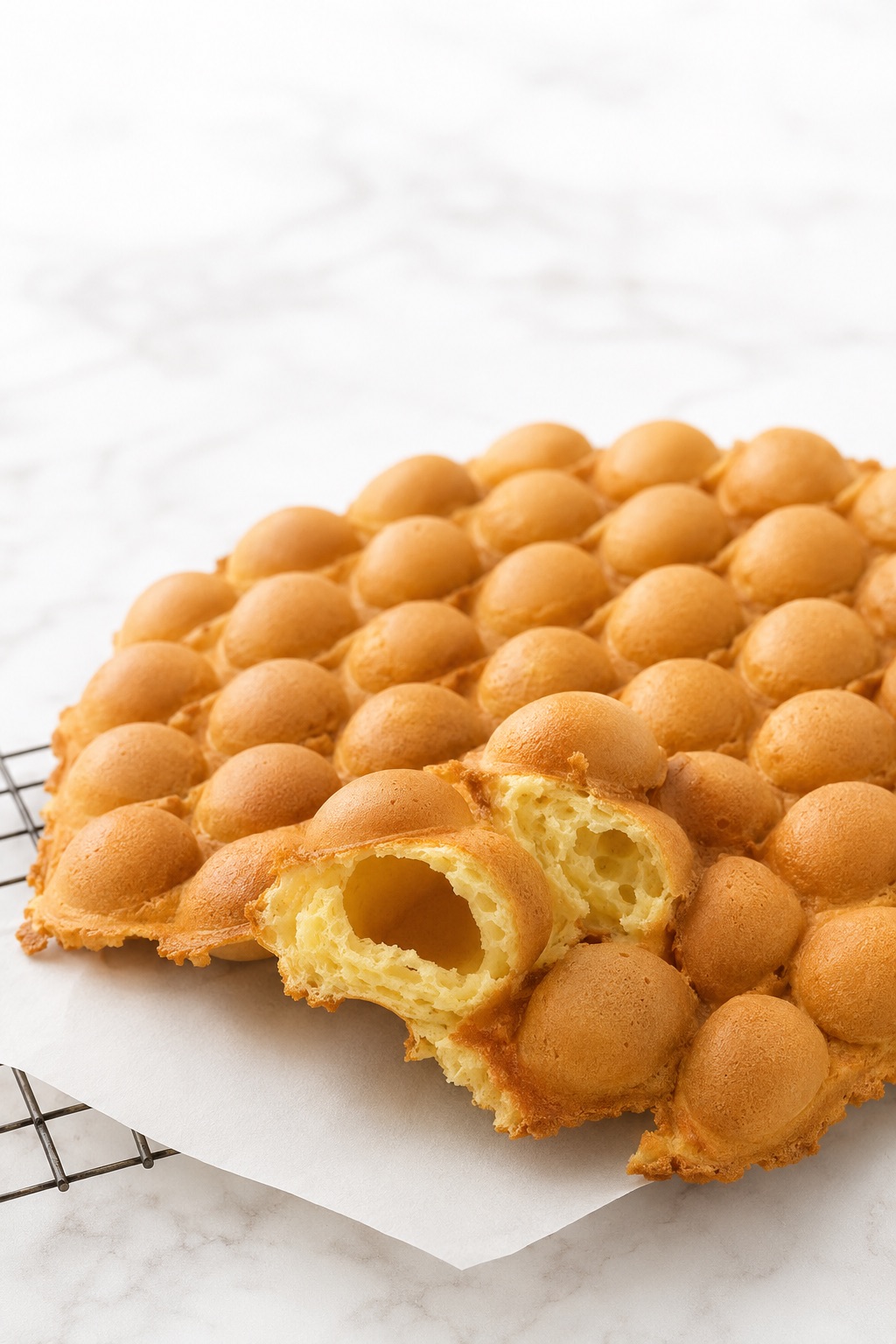
This is the classic Hong Kong–style egg waffle, or gai daan jai, made in a rotating bubble-shaped iron. A measured blend of all-purpose flour, regular rice flour, and tapioca starch creates the characteristic crisp–tender structure, while custard powder and evaporated milk give the batter its familiar color and fragrance.
Part of the pleasure is how immediate it feels: one warm sheet, a few naturally hollow bubbles, and rounded pieces that pull away one by one. It can be eaten plain like the street snack that inspired it, or shaped into a loose cone and filled only after the shell has had time to crisp.
This is the kind of recipe worth saving because it explains the part most instructions leave uncertain: the first waffle calibrates your specific machine. Once you know whether its plates need 10 grams less batter or 20 seconds more heat, the rest of the batch becomes much more consistent.
Quick Recipe Overview
This overview gives you the essential shape of the recipe before you mix the batter, including the specialized appliance, rest time, yield, and short peak-quality window.
| Recipe | Classic Hong Kong–style Bubble Waffle |
|---|---|
| Yield | 4 large waffles, approximately 8 inches each |
| Appliance | Rotating electric Bubble Waffle maker |
| Texture | Crisp shell and connecting membranes; tender-springy bubbles with a light chew |
| Flavor | Egg, vanilla, and custard with restrained sweetness |
| Prep time | 15 minutes |
| Rest and temper | 1 hour 20 minutes |
| Cook time | About 20 minutes |
| Total time | 1 hour 55 minutes |
| Best served | Warm, within 10 minutes of cooking |
Why This Bubble Waffle Recipe Works
The formula is designed around the structure of a Bubble Waffle rather than borrowing a standard waffle batter. Each ingredient and control has a specific job in creating a thin shell, connected membranes, and bubbles that stay tender without becoming cakey or gummy.
- Three-part flour system: all-purpose flour supplies connected structure, regular rice flour encourages a drier crisp shell, and a restrained amount of tapioca starch adds gentle elasticity.
- Controlled rest: one hour in the refrigerator hydrates the flours and relaxes small lumps without relying on an overnight batter that can lose ideal leavening behavior.
- Immediate rotation: turning the closed iron 180 degrees distributes the batter into both halves of each bubble before the structure begins to set.
- Rack crisping: the waffle leaves the iron flexible, then becomes crisper as steam escapes for 1–2 minutes in a single uncovered layer.
- Appliance calibration: a weighed first pour gives you usable information about the cavity depth and heat pattern of your particular machine.
What Is a Bubble Waffle?
A Bubble Waffle is a Hong Kong egg waffle cooked between two plates filled with rounded cavities. Also called an egg waffle, egg puff, eggette, puffle, or gai daan jai, it forms one connected honeycomb-like sheet rather than separate spherical cakes.
The traditional identity is a warm street snack with a crisp shell, softer interior, and pronounced egg aroma. Some bubbles may be almost hollow, which is part of the format rather than a defect. Christine’s Recipes’ Hong Kong egg waffle reference documents the characteristic molded shape, evaporated-milk batter, refrigerated rest, rotation, and cooling-rack finish.
A Belgian or American waffle maker can cook the batter, but it cannot reproduce the same thin membranes, rounded cavities, or two-sided bubble structure. For this recipe, the specialized mold is part of the recipe’s identity.
Before You Begin
Five checks matter before the first ingredient is mixed. They protect the rest window, the appliance temperature, and the narrow span between flexible hot release and crisp final texture.
- Confirm that your Bubble Waffle maker rotates or flips 180 degrees and note whether its manual permits oiling the plates.
- Reserve 1 hour for refrigerated batter rest and another 20 minutes for the batter to move toward room temperature.
- Have a digital scale ready for the 170 g first pour; cup measures cannot calibrate the machine as precisely.
- Set a large wire rack beside the appliance before cooking so every waffle can cool uncovered in a single layer.
- Plan to serve the waffles promptly; their best crisp–tender contrast belongs to the first 10 minutes after cooking.
Do not taste the uncooked batter. Both flour and eggs are raw ingredients, and the FDA’s flour-safety guidance recommends cooking rather than tasting raw flour, dough, or batter.
Bubble Waffle Ingredients
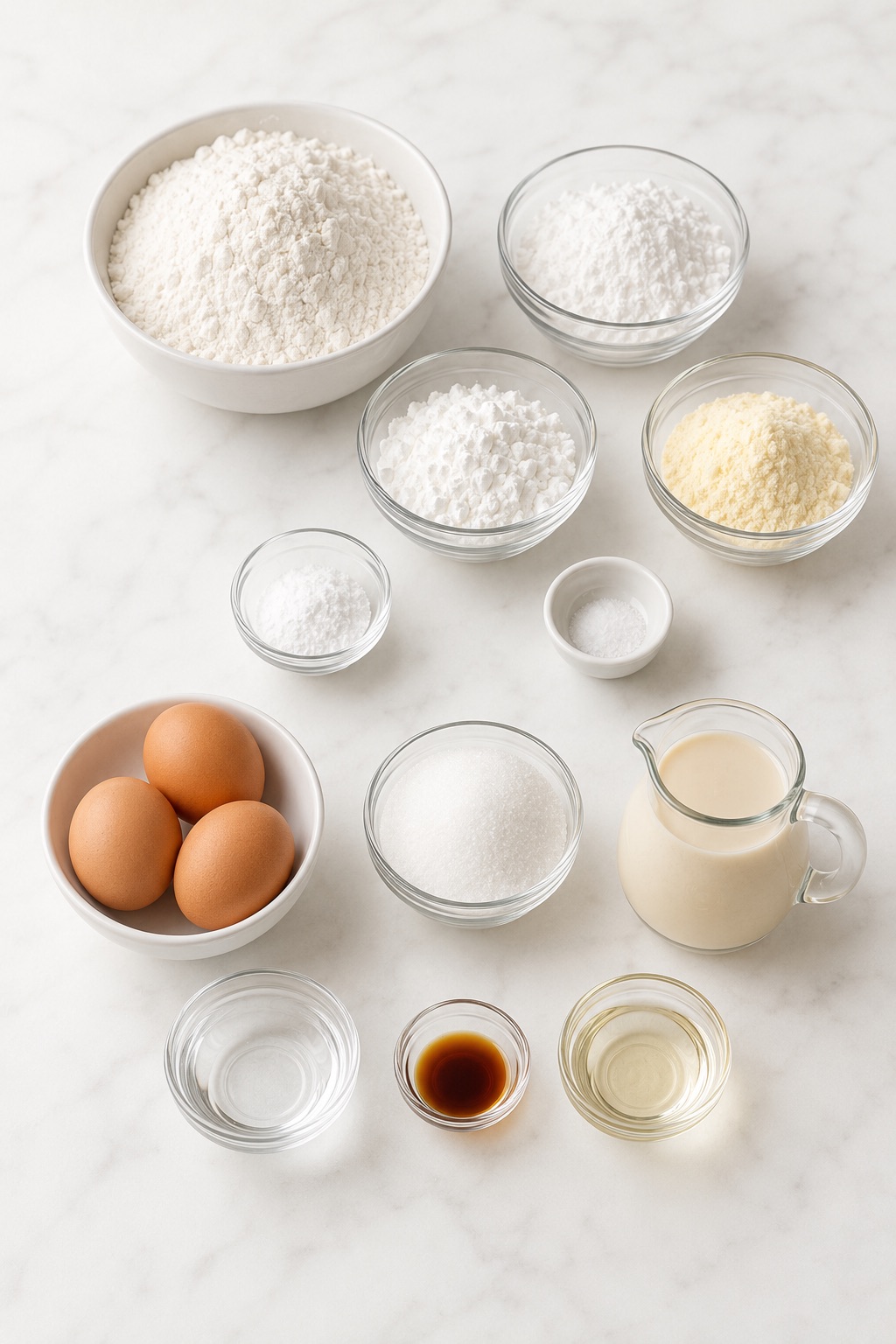
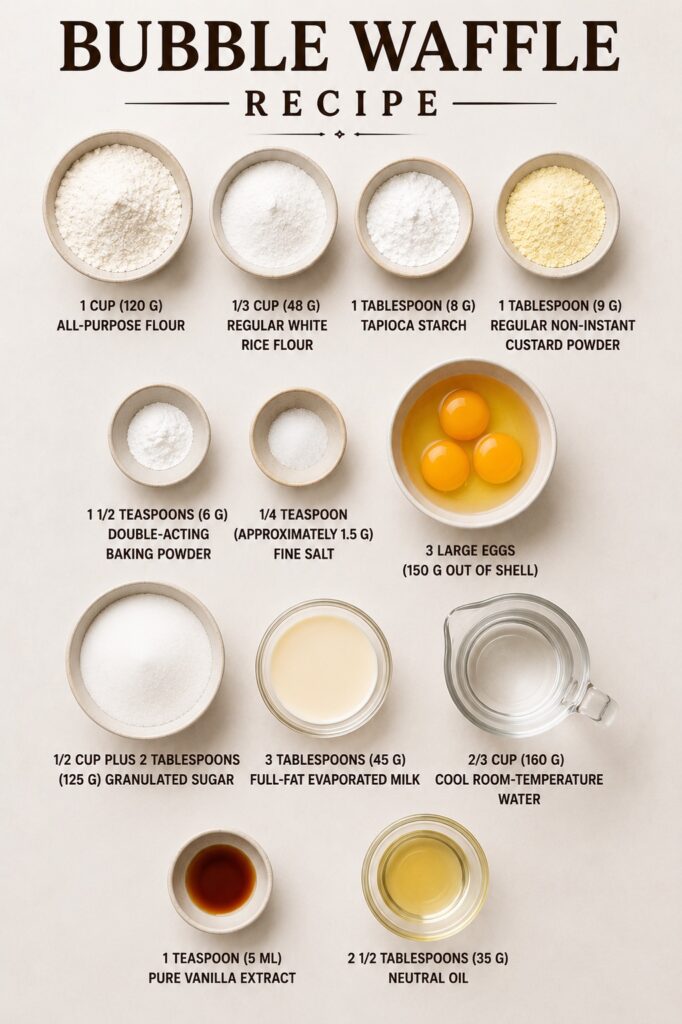
The ingredient list is compact, but the flour type, custard powder, milk product, and oil all affect the final structure. Weights are the authoritative measurements for this formula.
Dry ingredients
- 1 cup (120 g) all-purpose flour
- ⅓ cup (48 g) regular white rice flour, not sweet or glutinous rice flour
- 1 tablespoon (8 g) tapioca starch
- 1 tablespoon (9 g) regular non-instant custard powder
- 1½ teaspoons (6 g) double-acting baking powder
- ¼ teaspoon (approximately 1.5 g) fine salt
Wet ingredients
- 3 large eggs (150 g out of shell)
- ½ cup plus 2 tablespoons (125 g) granulated sugar
- 3 tablespoons (45 g) full-fat evaporated milk
- ⅔ cup (160 g) cool room-temperature water
- 1 teaspoon (5 ml) pure vanilla extract
- 2½ tablespoons (35 g) neutral oil, plus the thinnest film for the plates if permitted
Ingredient Intelligence
The three starches are not interchangeable, and the familiar dairy and custard ingredients are selected for identity as much as for flavor. These distinctions prevent the most common dense, gummy, or Belgian-style results.
All-purpose flour, rice flour, and tapioca
All-purpose flour provides enough gluten to keep the sheet connected when it is lifted. Regular rice flour lowers the wheat proportion and promotes a crisper, drier shell. Tapioca starch supplies only a small amount of spring; increasing it substantially would move the bubbles toward a gummy or mochi-like chew. A comparable flour architecture is also used in Hungry Huy’s Hong Kong egg waffle reference.
Use ordinary white rice flour. Sweet rice flour, glutinous rice flour, and mochiko behave differently and are not supported as one-for-one substitutes.
Custard powder
Regular non-instant custard powder contributes the recognizable vanilla-custard aroma, pale golden color, and a small amount of starch. Bird’s Original or an equivalent non-instant product is the intended style. Instant pudding mix is not a reliable substitute because sugar, gums, milk solids, and flavor strength vary by brand.
Evaporated milk, water, and neutral oil
Evaporated milk gives the batter quiet dairy depth and helps browning without making milk the dominant liquid. Water keeps the batter fluid enough to spread through the cavities. Neutral oil supports clean release and tenderness without creating the buttery flavor associated with Belgian waffles. Sweetened condensed milk is not interchangeable with evaporated milk.
Equipment
The rotating Bubble Waffle maker is the one non-negotiable tool because cavity volume, plate contact, and the immediate flip create the defining shape. The remaining equipment makes the dose and texture easier to control.
- Approximately 8-inch rotating electric Bubble Waffle maker
- Digital kitchen scale
- Two medium mixing bowls
- Fine-mesh sieve
- Balloon whisk and flexible silicone spatula
- Spouted measuring jug
- Heat-resistant silicone or wooden release utensil
- Large wire cooling rack
Models differ in cavity depth, wattage, hinge clearance, and indicator-light behavior. Follow the manufacturer’s instructions for locking, rotation direction, greasing, and safe cleaning; the recipe’s 3½–4½-minute cooking range remains a starting window, not a replacement for the appliance manual.
What to Expect
Several normal Bubble Waffle characteristics can look like failure if you expect a Belgian waffle. Use these expectations to judge the finished result correctly before changing the batter.
- The batter is pourable rather than thick.
- The first waffle may need a small dose or timing correction for your machine.
- The waffle is flexible and slightly soft during the first seconds after release.
- It becomes noticeably crisper after 1–2 minutes on an uncovered rack.
- The thin membranes become crisper than the centers of the bubbles.
- Some bubbles will be full, while others will be partly or almost completely hollow.
- The crispest texture is brief and is best enjoyed soon after cooking.
How to Make Bubble Waffles
The method moves from a smooth, rested batter to a weighed pour, immediate rotation, sensory doneness, and a short uncovered rack set. Keep that order intact; changing it alters either batter distribution or final crispness.
1. Combine and sift the dry ingredients
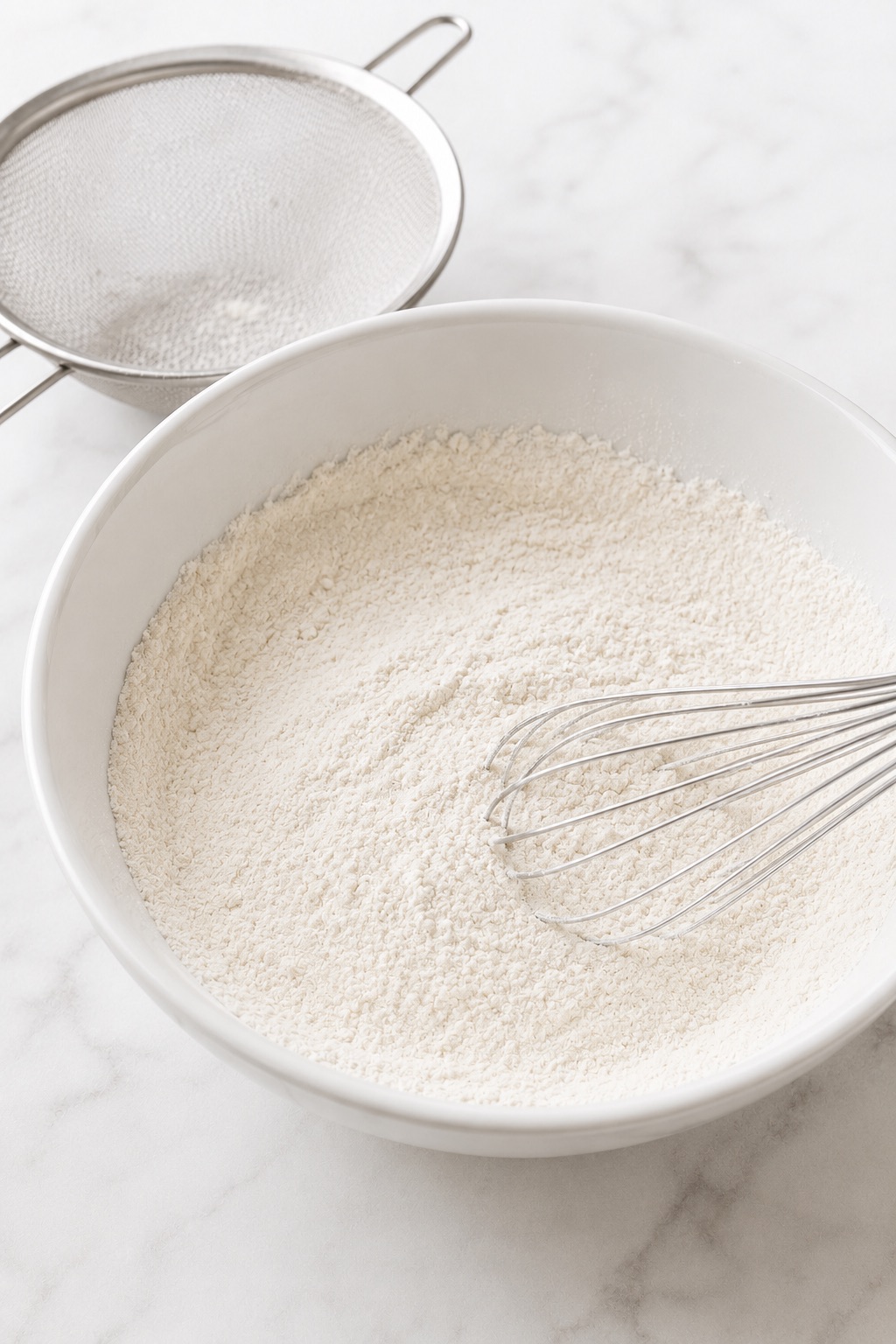
Whisk the all-purpose flour, rice flour, tapioca starch, custard powder, double-acting baking powder, and fine salt in a medium bowl. Sift the mixture once to break up compact starch and custard-powder pockets.
What you should see: a fine, evenly colored mixture with no yellow pockets or firm white lumps.
2. Build the egg and sugar base
In a second bowl, whisk the eggs and granulated sugar for 30–45 seconds, just until completely uniform and slightly lighter. Do not whip to a thick ribbon.
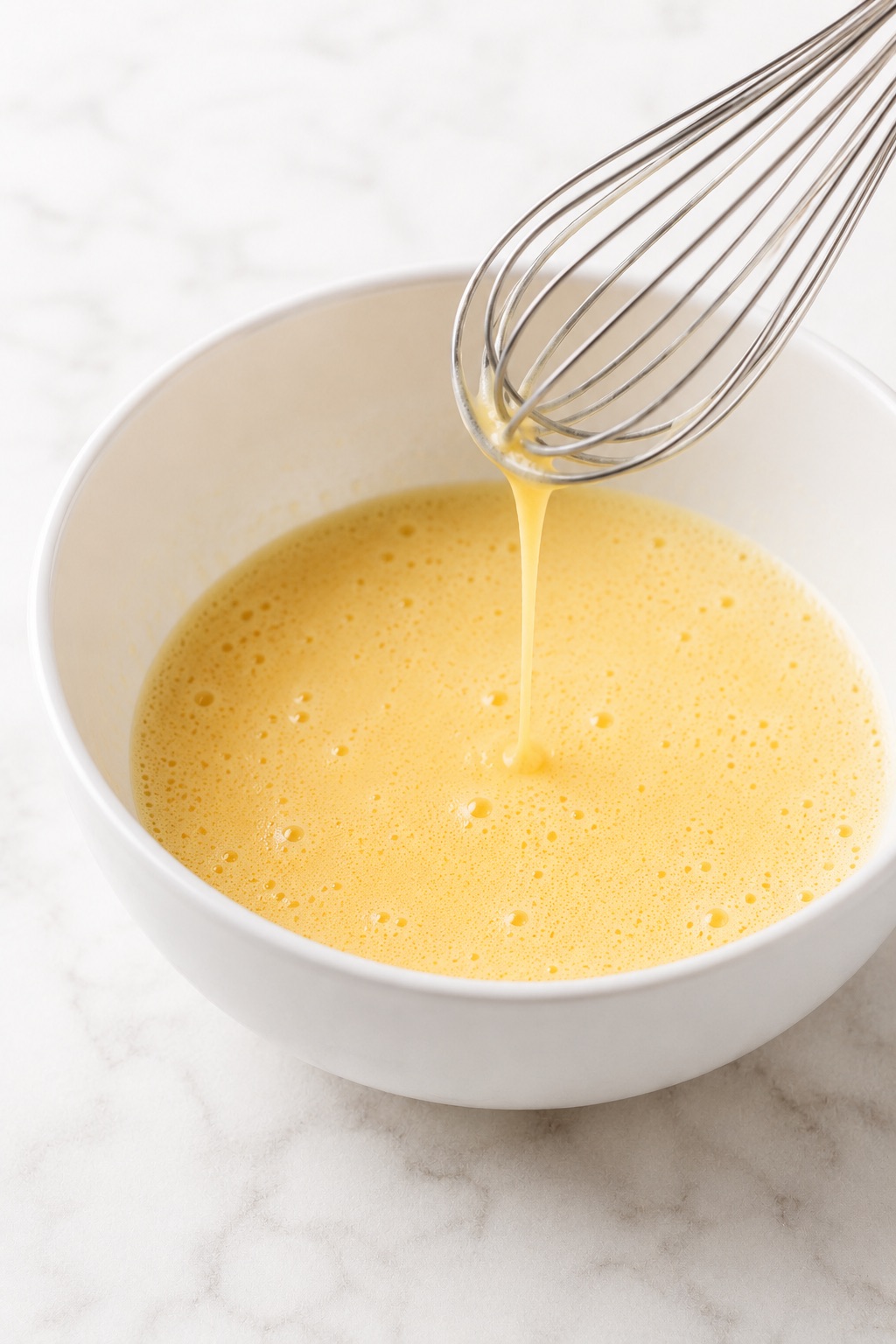
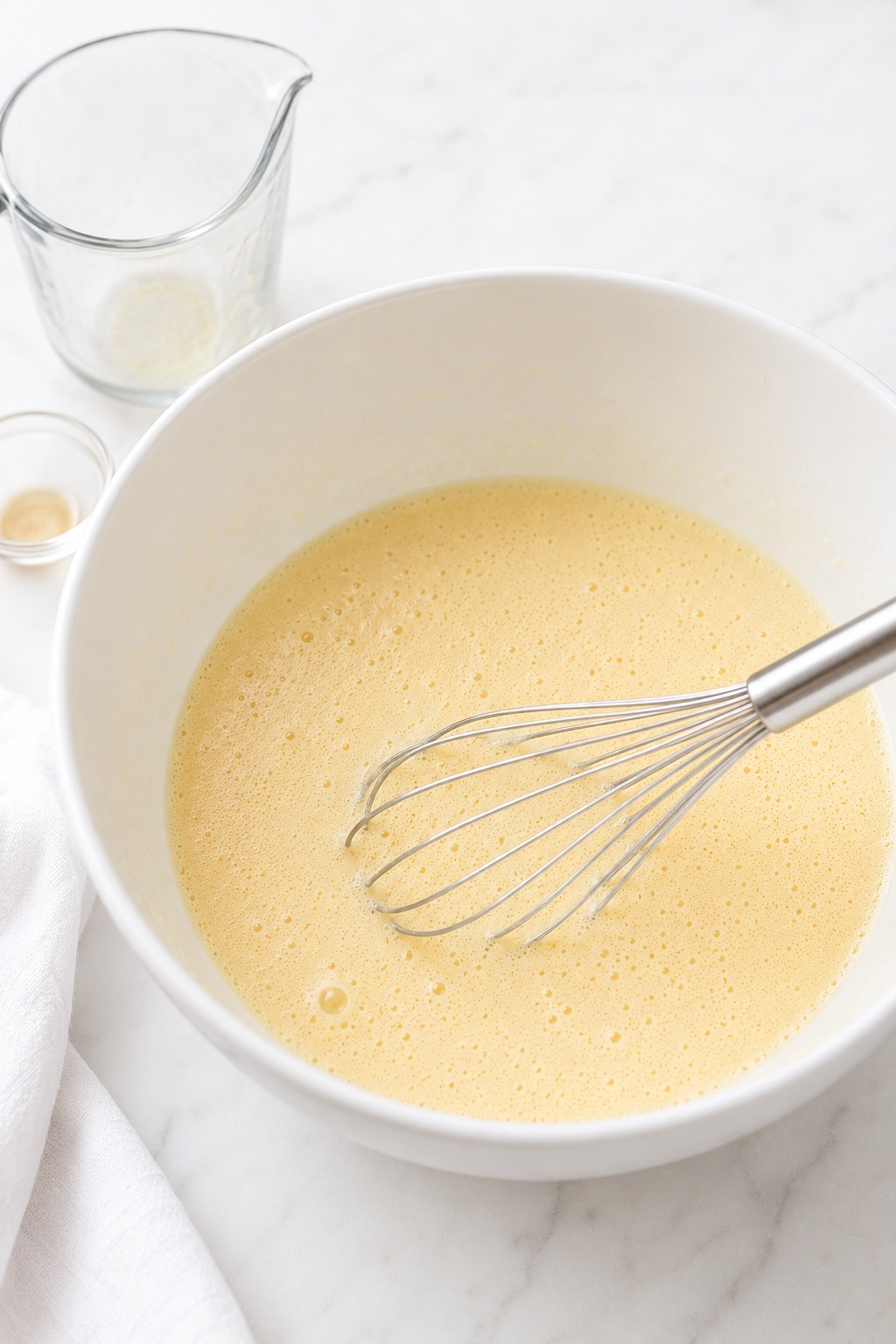
Whisk in the evaporated milk, water, and vanilla.
What you should see: a fluid pale-yellow mixture with the sugar mostly dissolved and only a light cap of foam.
3. Finish and strain the batter
Add the dry mixture in two additions, whisking gently only until no dry flour remains. Pass the batter through a fine-mesh sieve into a clean bowl or spouted jug.
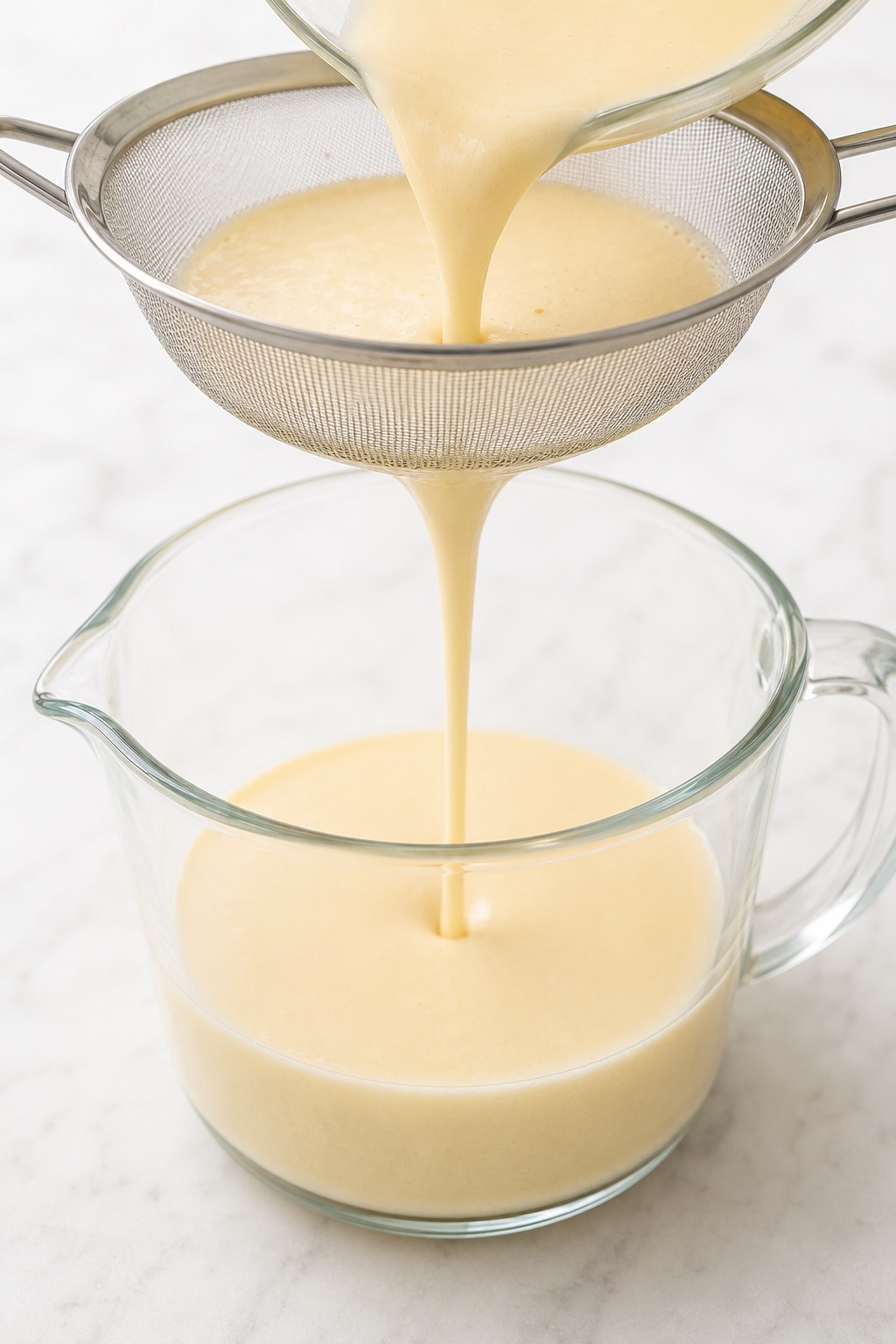
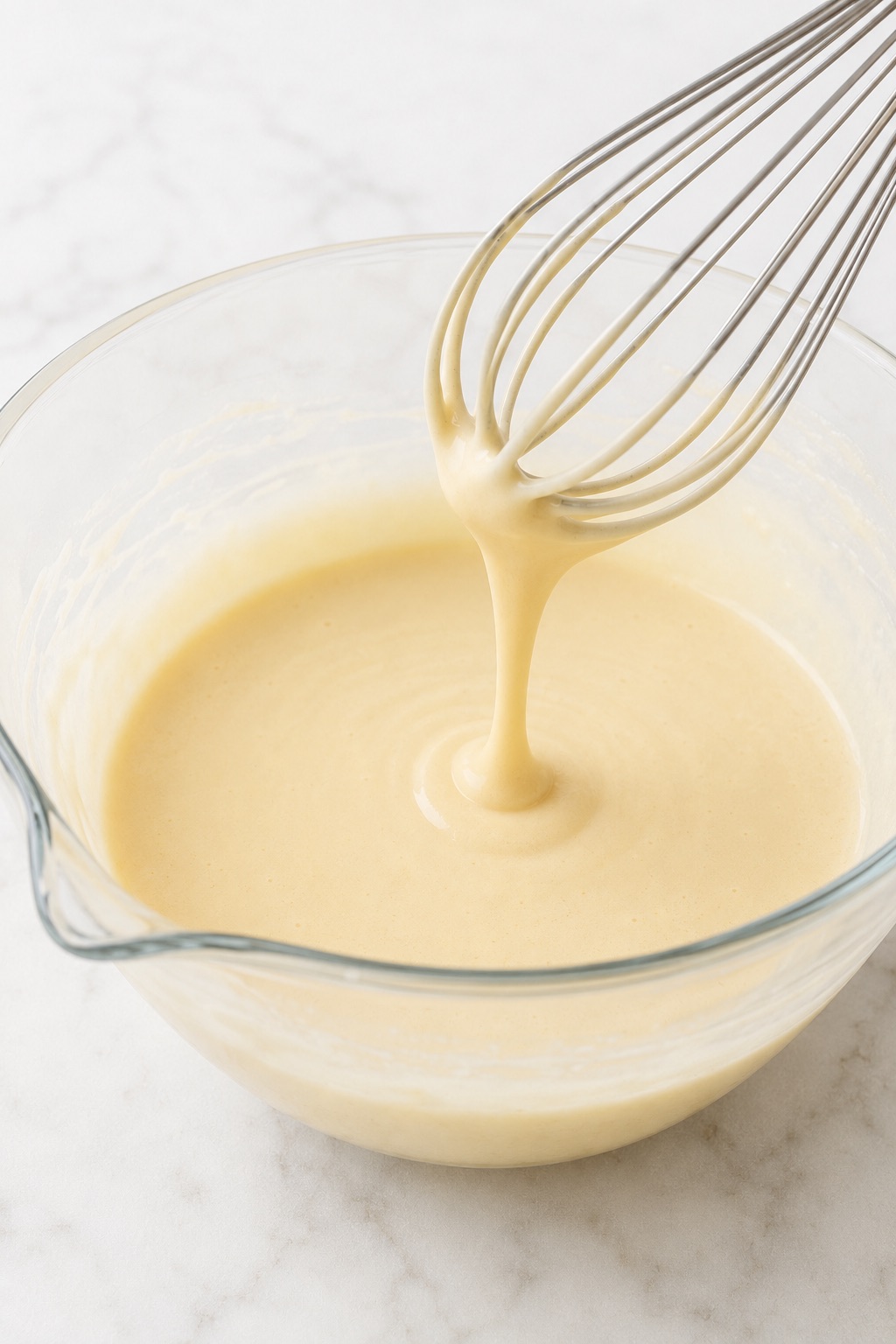
Whisk in the 35 g neutral oil until it is fully emulsified.
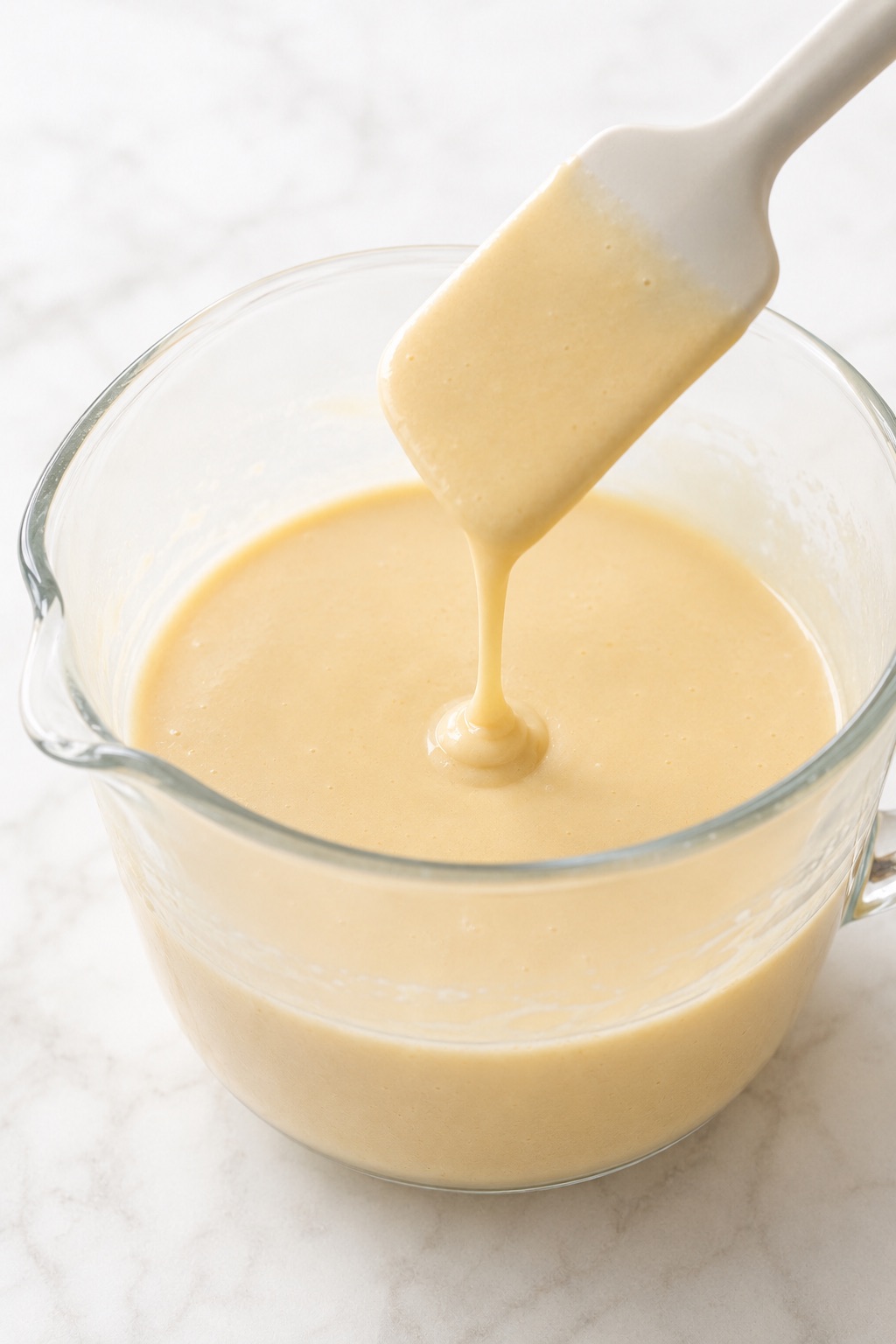
What you should see: smooth batter slightly thicker than heavy cream, with no dry pockets, large lumps, oil beads, or surface slicks.
4. Rest and temper the batter
Cover and refrigerate the batter for 60 minutes. Remove it 20 minutes before cooking. During the final 10 minutes, preheat the closed Bubble Waffle maker according to its manual. Stir the rested batter gently with 8–10 strokes.
What you should see: the batter is still fluid but slightly more cohesive; a thin ribbon settles back into the jug within a few seconds.
5. Prepare the fully heated plates
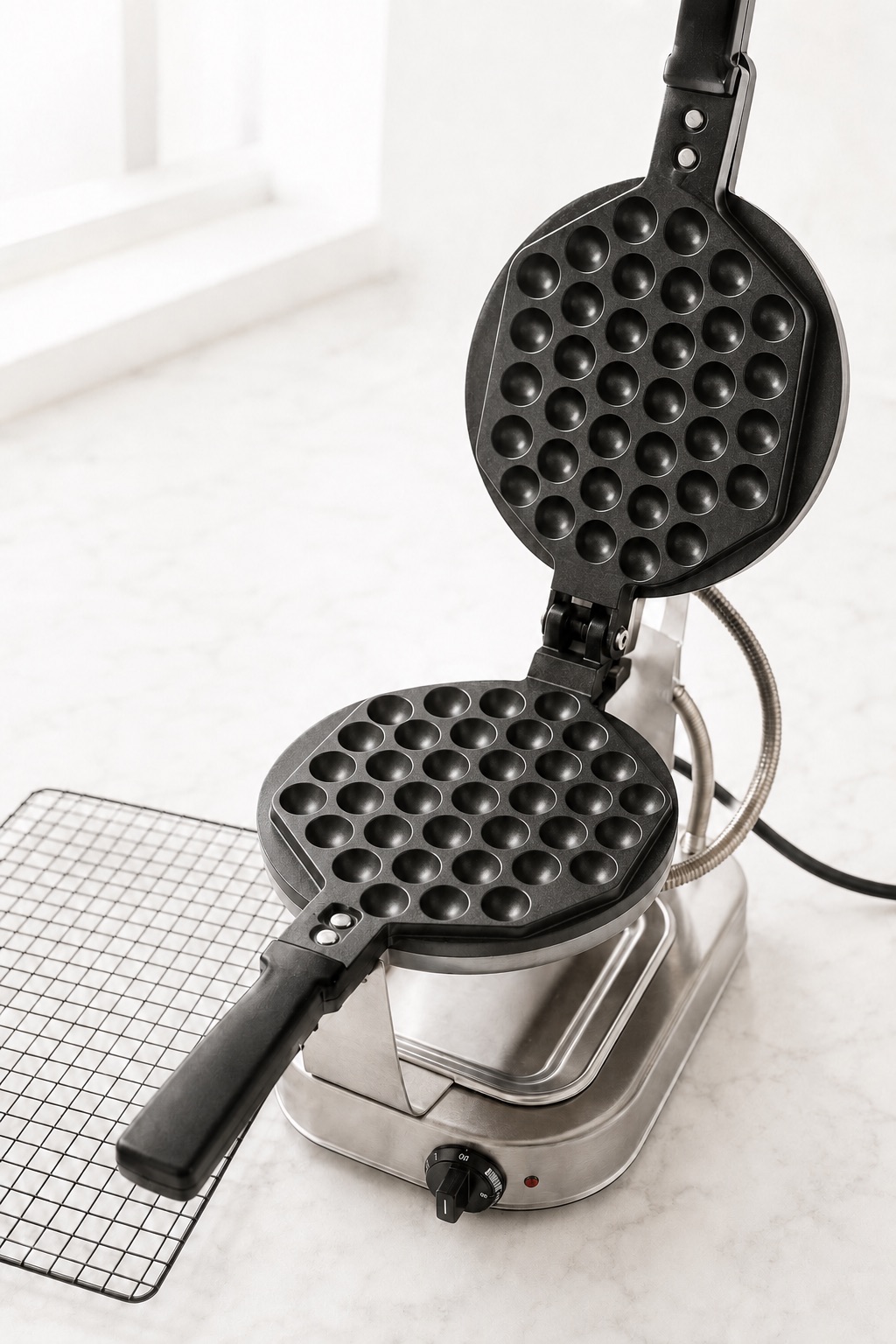
Place the preheated appliance on a level, heat-safe surface. If the manufacturer permits greasing, brush or wipe both plates with the thinnest continuous film of neutral oil. Keep the wire rack within reach before pouring.
What you should see: evenly coated plates with a faint sheen but no visible pools, droplets, or oil collecting near the hinge.
6. Pour, close, and rotate immediately
Weigh 170 g batter, approximately ⅔ cup, for the first waffle. Pour into the center and sweep briefly across the main field so the batter reaches most lower cavities.
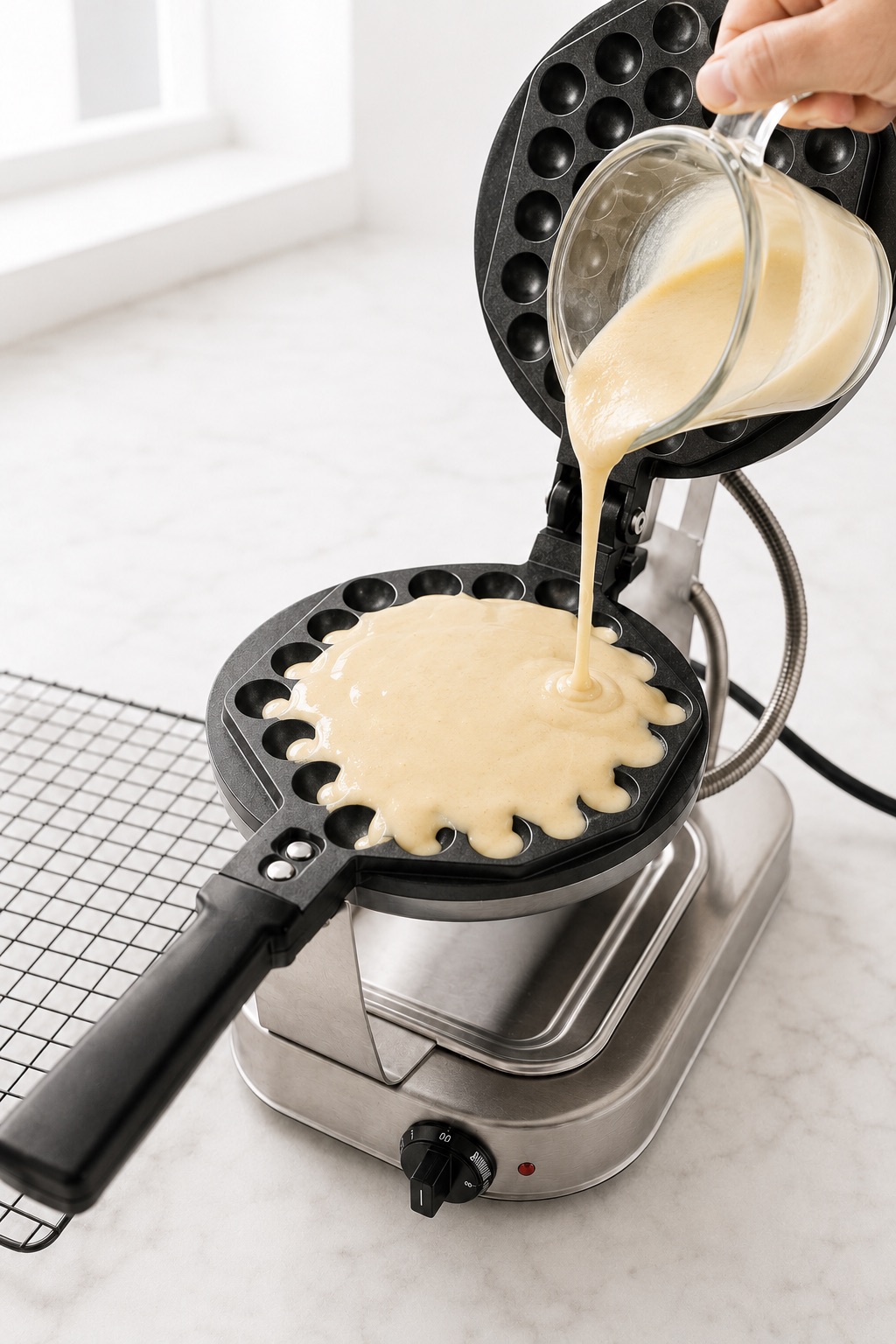
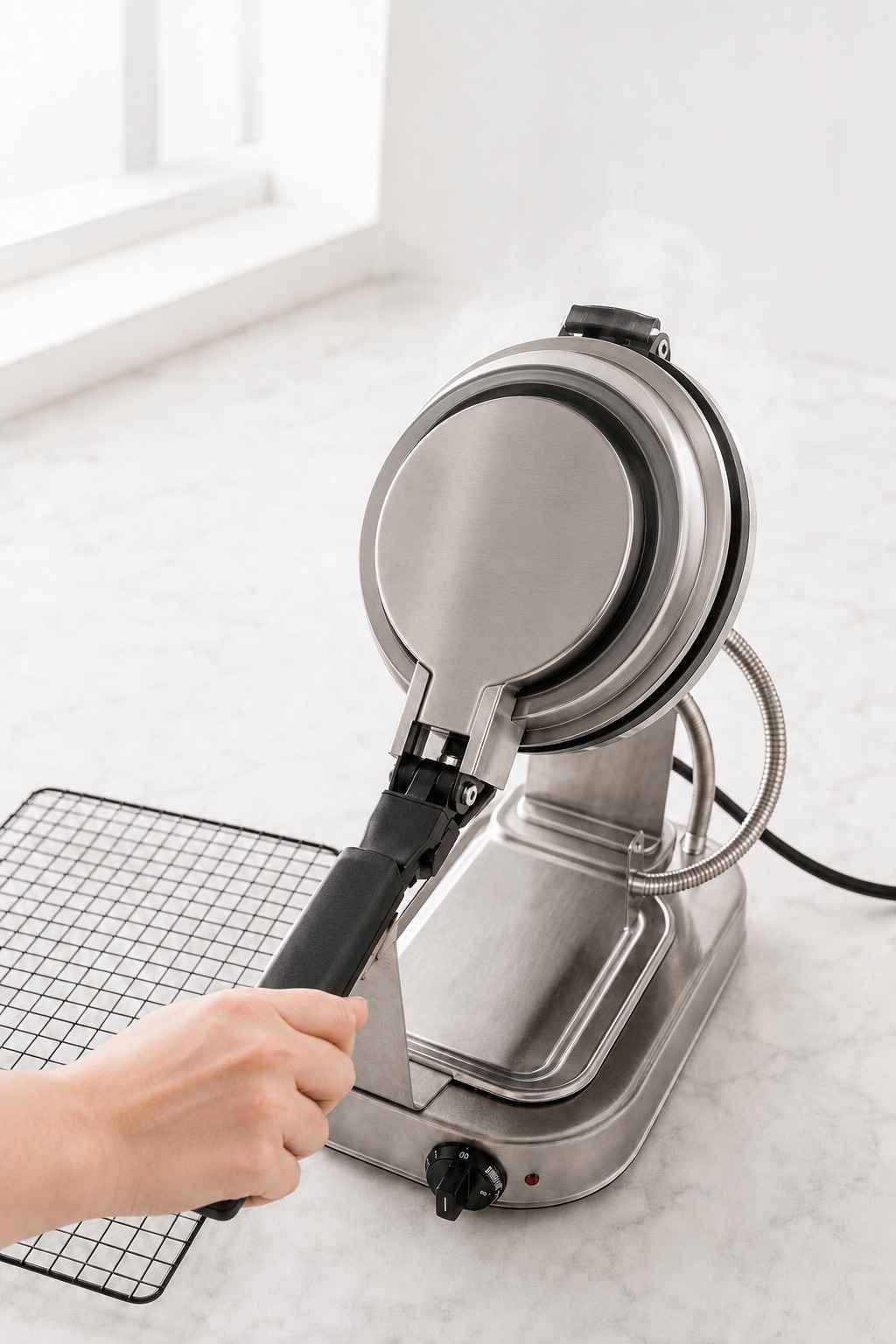
Close and lock the maker at once, then rotate it 180 degrees immediately. Do not open it during the first 3 minutes.
What you should see: the batter covers the main lower field and reaches most outer channels without flooding the perimeter or hinge.
7. Cook to deep-golden sensory doneness
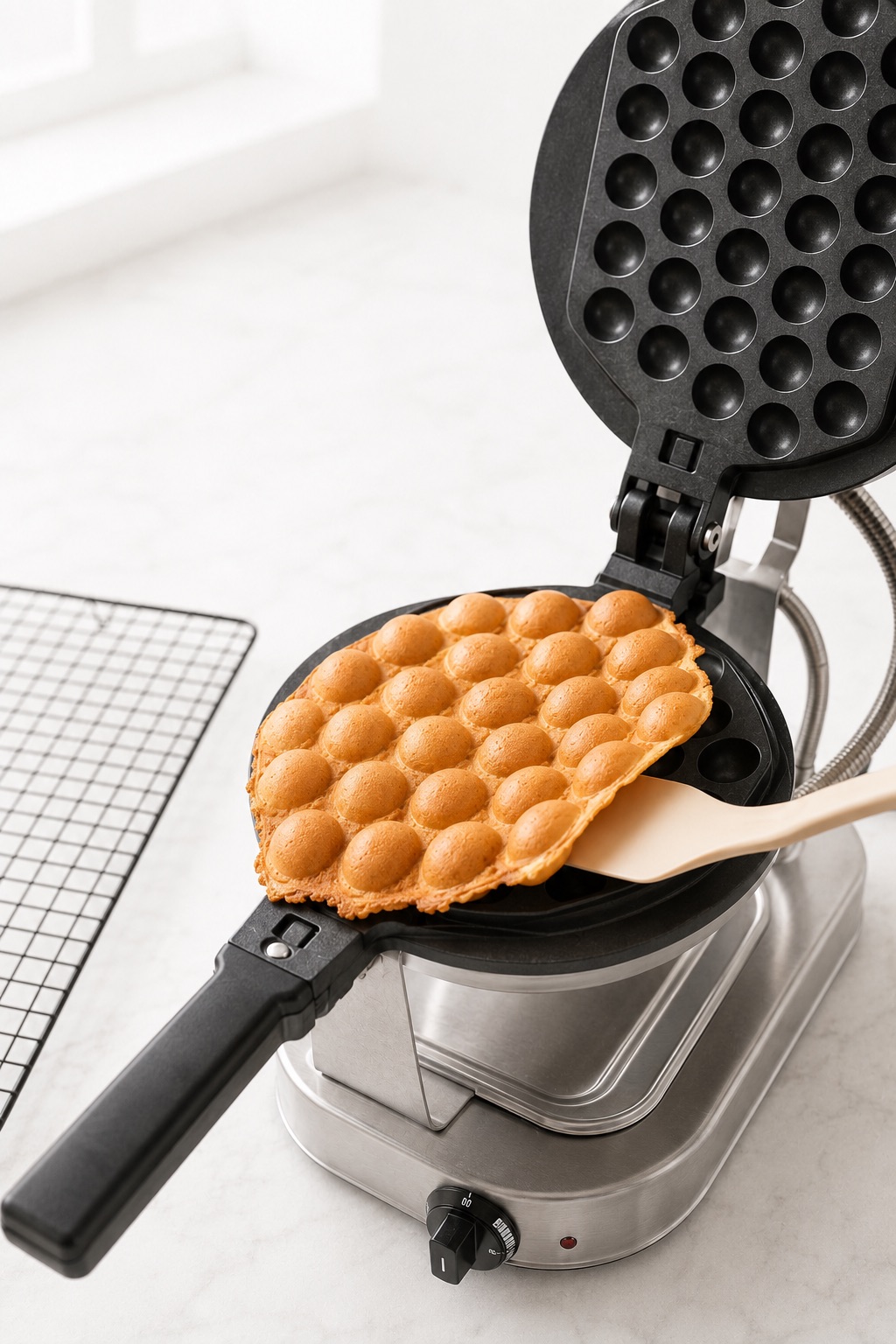
Cook for approximately 3½–4½ minutes total, returning the appliance to its release position when required by the model. Check only after the protected first 3 minutes. If the waffle releases but remains pale, close the maker and cook for another 20–30 seconds.
What you should see: a deep golden-yellow to light-amber sheet with dry connecting membranes, intermittent rather than vigorous steam, a toasted egg–custard aroma, and clean structural release.
8. Release, crisp, and calibrate the next waffle
Loosen one edge with a silicone or wooden utensil and lift the waffle onto the rack. Leave it uncovered for 1–2 minutes before judging crispness.
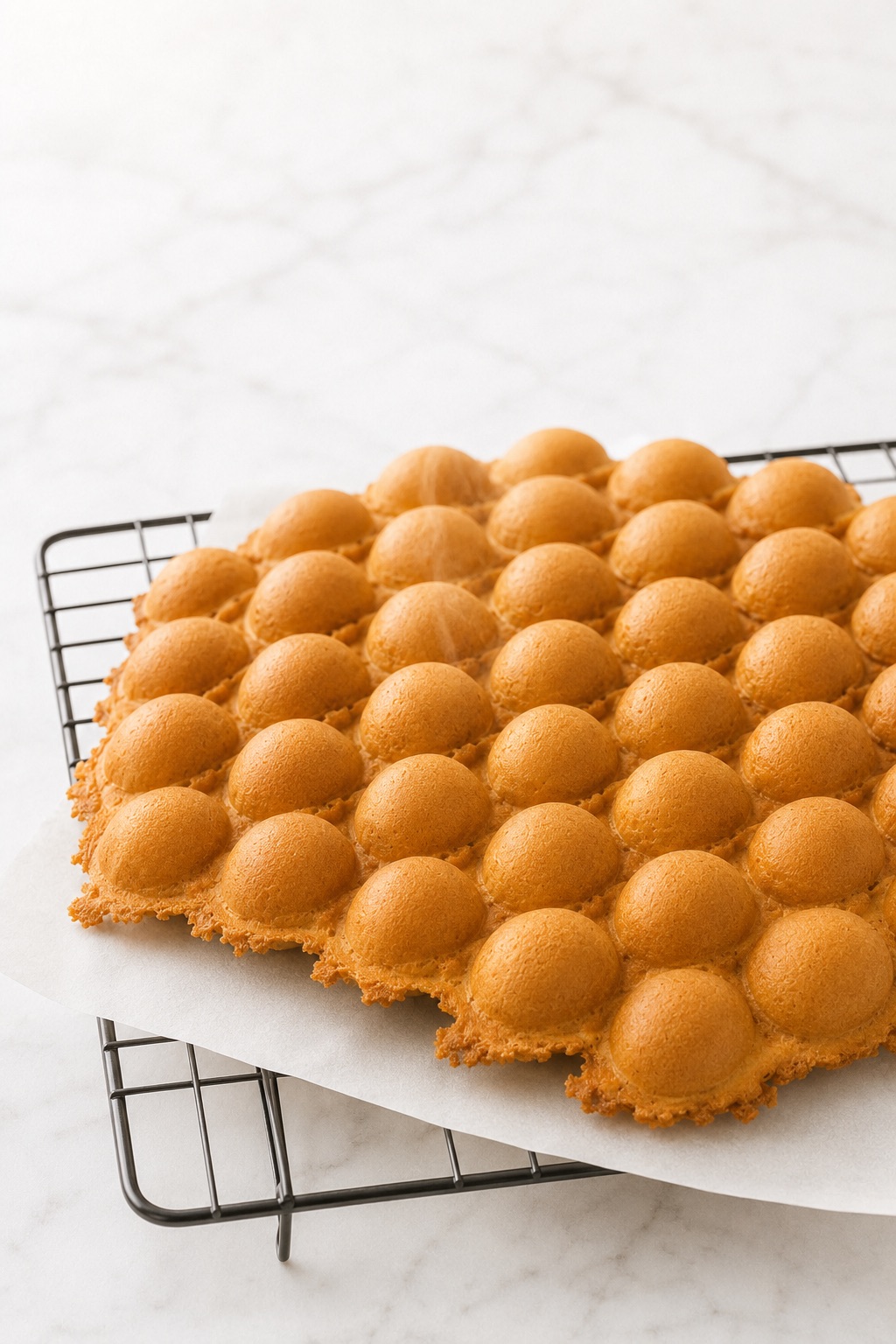
If the first waffle overflowed heavily, reduce the next pour by 10–15 g. If the outer row is largely missing, add 10–15 g. Adjust time in 15–30-second increments, then repeat with the remaining batter.
What you should see: a flexible sheet that firms as steam escapes, with crisping membranes, rounded bubbles, and a natural mixture of filled and hollow cavities.
Bubble Waffle Doneness Guide
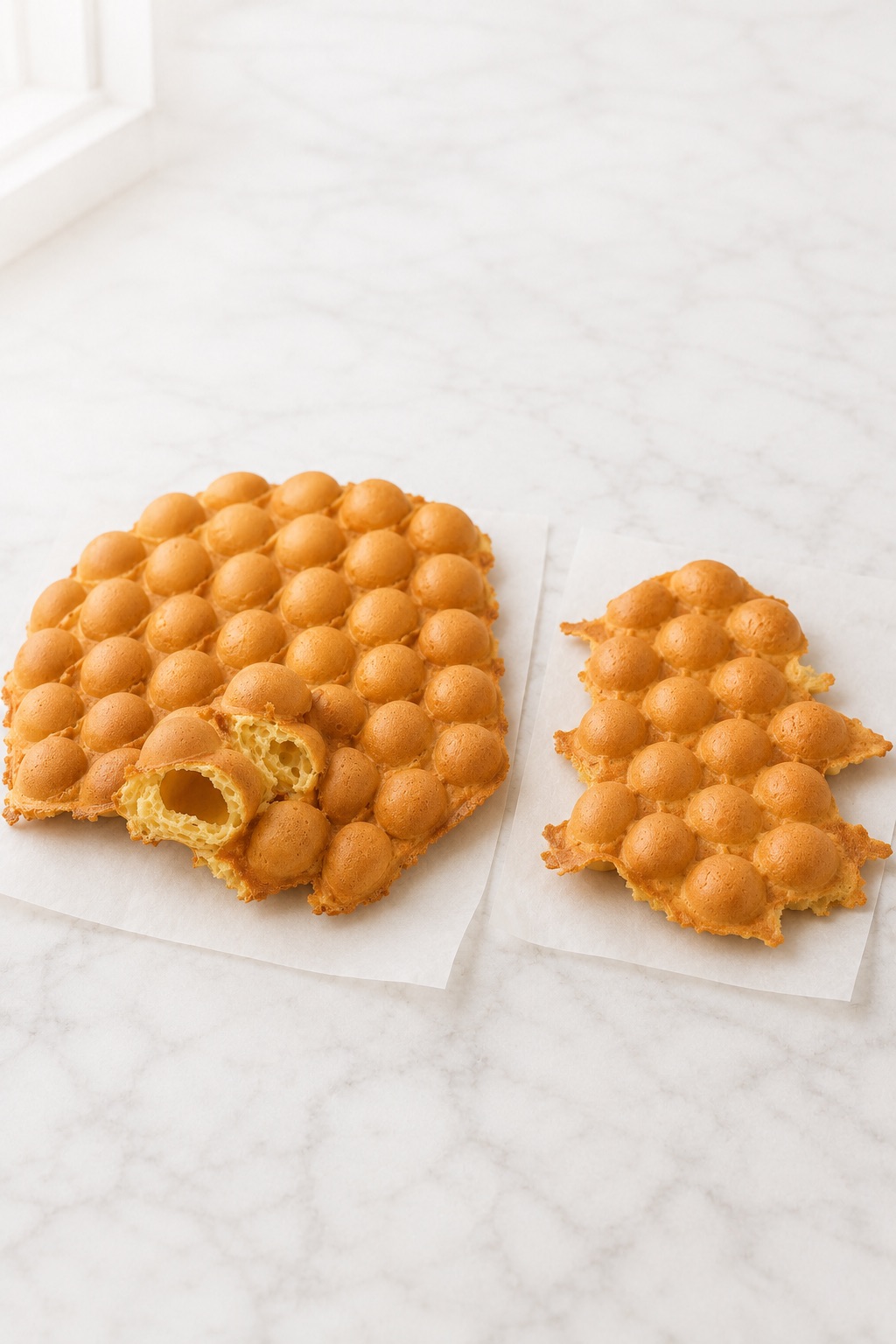
Doneness is a combined judgment rather than a single clock reading. The waffle is finished inside the maker when structure, color, steam, aroma, and release all point to the same endpoint; final crispness develops on the rack.
| Signal | Correct endpoint | What it means |
|---|---|---|
| Color | Deep golden yellow to light amber | The shell has browned enough to dry and crisp. |
| Steam | Reduced to intermittent wisps | Most free moisture has escaped without overdrying the centers. |
| Aroma | Toasted egg, vanilla, and custard | The raw sweet-batter smell has cooked away. |
| Release | Lid lifts without tearing; sheet can be raised intact | The membranes have set. |
| Rack behavior | Surface firms and becomes audibly crisper in 1–2 minutes | The normal post-cook steam release is complete. |
An underdone waffle stays pale, damp, and uniformly soft after 2 minutes on the rack. An overdone waffle turns dark brown before the steam subsides and becomes brittle through the centers rather than crisp only at the shell and seams.
Bubble Waffle Texture Guide
The correct texture changes at three meaningful points. Judge each stage on its own terms so normal hot flexibility is not confused with underbaking.
Rested batter
The rested batter should pour in a continuous ribbon and level within seconds. It is more cohesive than freshly mixed batter but nowhere near the thickness of pancake or Belgian-waffle batter.
Immediate hot release
The sheet bends and feels slightly soft because steam is still moving through the shell. The bubbles should hold their rounded walls even while the connecting membranes remain flexible.
After 1–2 minutes on the rack
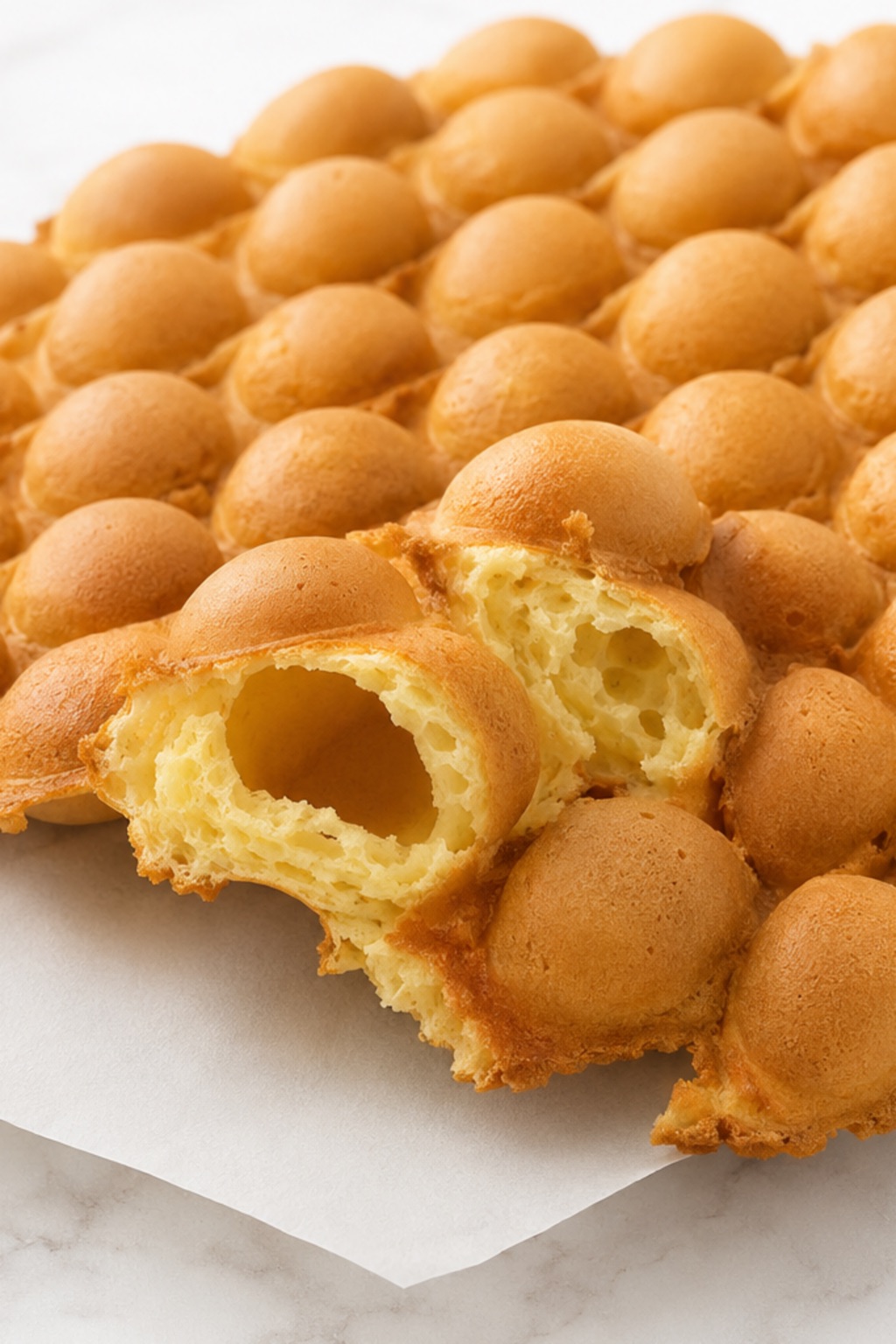
The surface becomes drier, the membranes develop a delicate crackle, and the bubble centers remain tender-springy with a subtle chew. Hollow cavities feel light and crisp; filled cavities feel softer without becoming gummy or cake-like.
Expert Tips
These decisions go beyond the basic method and help you interpret a model-dependent appliance without chasing inconsistent fixes from waffle to waffle.
- Use the first waffle as data. I recommend treating the first Bubble Waffle as a calibration waffle rather than judging the entire batch by it. Change only one variable next—dose or time—so you know which adjustment improved the result.
- Read the overflow pattern, not only its presence. A thin lace at the outer edge can mean the field filled correctly; a thick ribbon at the hinge means the dose is too large or closure was delayed. Reduce the next pour only for the second pattern.
- Let steam choose the final seconds. When two waffles reach the same color at different times, the one still releasing vigorous steam needs longer. Color alone can be misleading in an appliance with hot spots.
- Keep the rack clear underneath. A rack placed flat on a plate traps steam below almost as effectively as stacking. Elevate it so air can circulate beneath the waffle and preserve the crisp seams.
Common Bubble Waffle Mistakes
Most failures come from ingredient identity, appliance calibration, or trapped steam. This table separates the visible symptom from the cause and gives the smallest useful correction for the next waffle.
| Mistake | What Happens | Why It Happens | How to Prevent or Fix It |
|---|---|---|---|
| Opening before 3 minutes | The sheet splits or clings to both plates. | The connecting membranes have not set. | Keep the maker closed during the protected opening window; if opened accidentally, close promptly if safe and continue cooking. |
| Using sweet rice flour | The bubbles become dense, sticky, or mochi-like. | Glutinous rice flour develops a different elastic structure. | Use regular white rice flour; the current batch cannot be fully corrected after mixing. |
| Pouring too much batter | Heavy overflow reaches the hinge and the waffle stays thick or soft. | The dose exceeds the mold capacity. | Reduce the next pour by 10–15 g and clean only after the unplugged maker has cooled, following its manual. |
| Delaying the rotation | One side fills while the opposite bubbles remain thin or hollow. | The batter starts setting before it reaches both plates. | Close, lock, and rotate immediately after pouring. |
| Judging crispness at the lid | A properly cooked waffle is returned to the maker until it becomes brittle. | Normal hot softness is mistaken for underbaking. | Give the waffle 1–2 uncovered minutes on the rack before changing the cook time. |
| Stacking warm waffles | The shells soften rapidly and feel damp. | Condensation moves back into the surface. | Keep every waffle in a single uncovered layer; refresh softened waffles in the oven. |
| Overgreasing the plates | The surface looks shiny or fried instead of dry and crisp. | Oil pools around the cavities. | Use only a faint continuous film and reapply only if release weakens. |
| Whipping the egg mixture | The batter foams excessively and bakes with uneven fragile walls. | Too much air is introduced before the controlled expansion in the maker. | Whisk only 30–45 seconds, until uniform rather than ribbon-thick. |
Beautiful Ways to Serve Bubble Waffles
The most beautiful serving style is also the simplest: preserve the crisp golden shell, let the rounded bubbles remain visible, and add only what supports the egg–custard aroma. Serve each waffle warm and avoid sauces or cold fillings until steam has escaped.
Warm and plain, Hong Kong street-snack style
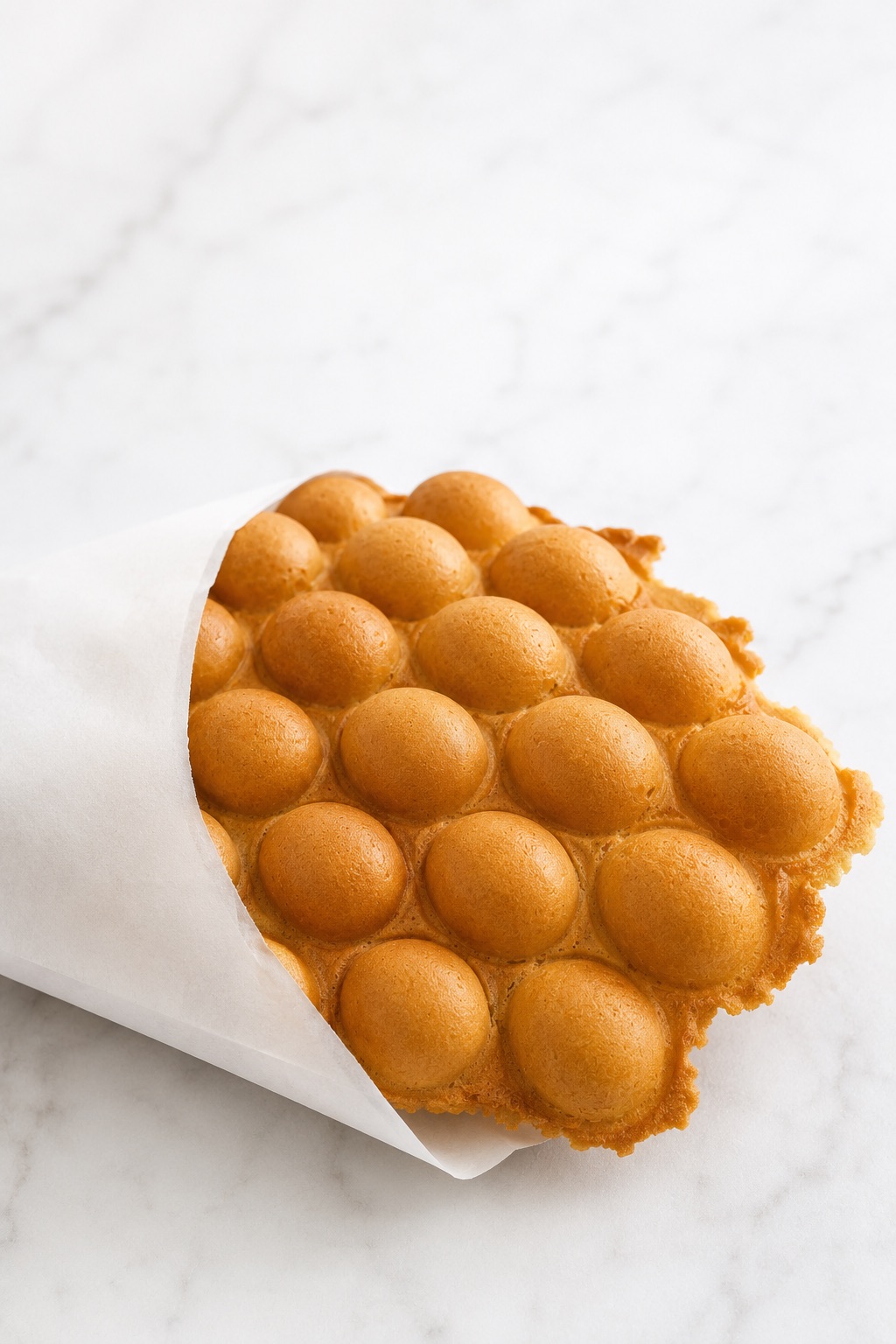
Fold the waffle loosely into a paper sleeve or place it on a small warm plate, then tear the bubbles away one at a time. The lacy seams stay crisp, the centers remain soft, and nothing competes with the toasted egg and vanilla fragrance. This is the canonical way to understand the recipe.
Folded into an ice cream cone
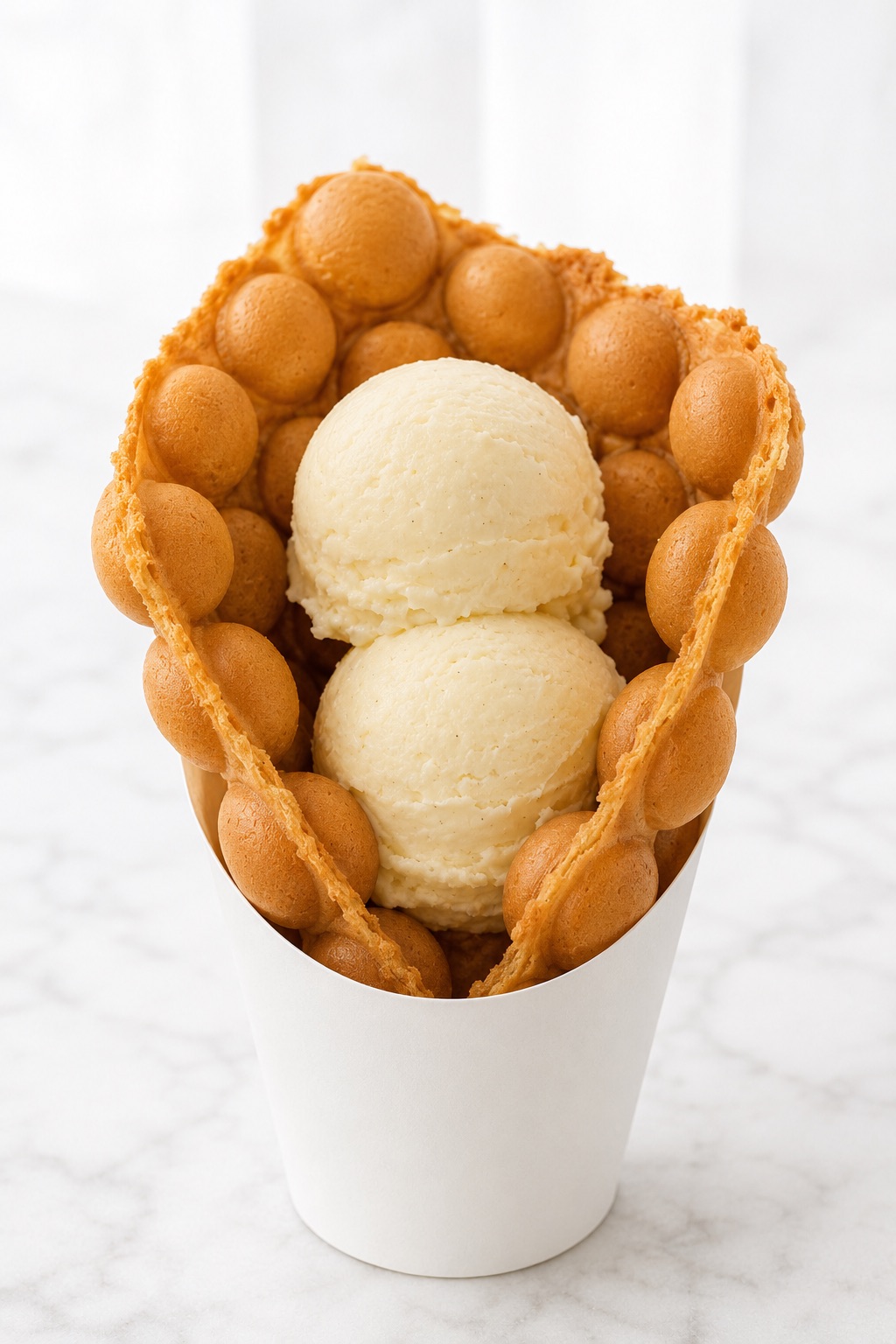
Shape the waffle immediately after release while it is flexible, support it upright in a cup, and wait until the shell has crisped before adding one or two scoops. Vanilla keeps the custard flavor clear; chocolate creates a deeper dessert contrast; strawberry adds brightness without hiding the golden waffle.
Light pairings that preserve the texture
A fine dusting of powdered sugar, a small spoonful of barely sweetened whipped cream, or a restrained scattering of toasted sesame works better than a heavy blanket of sauce. If serving fruit, place it beside the waffle rather than over it so the juices do not soften the crisp membranes.
Storage and Make Ahead
Bubble Waffles are a cook-and-serve recipe. Storage can preserve the food, but it cannot hold the same just-cooked contrast without a dry-heat refresh.
Make-ahead batter
Combine the dry ingredients up to 1 day ahead and keep them covered. Mix the complete batter about 1 hour 20 minutes before cooking. An overnight combined batter is not supported because hydration, gas retention, and final texture may drift.
Room-temperature storage
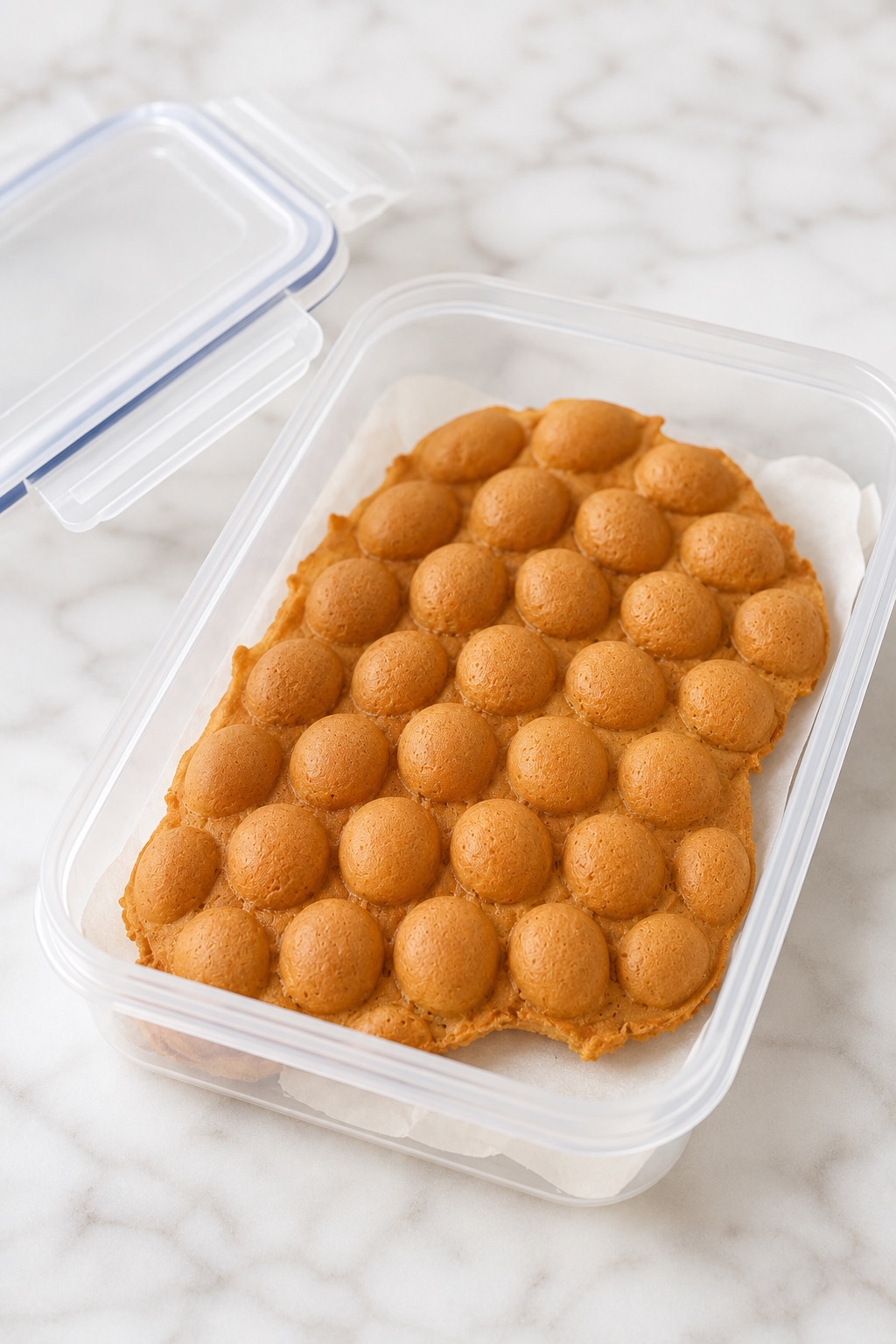
For best quality, serve within 10 minutes. Once completely cool, store the waffles airtight at room temperature for up to 1 day, with expected softening. Refrigeration is not preferred because it firms the crumb without preserving the crisp shell.
Freezing and refreshing
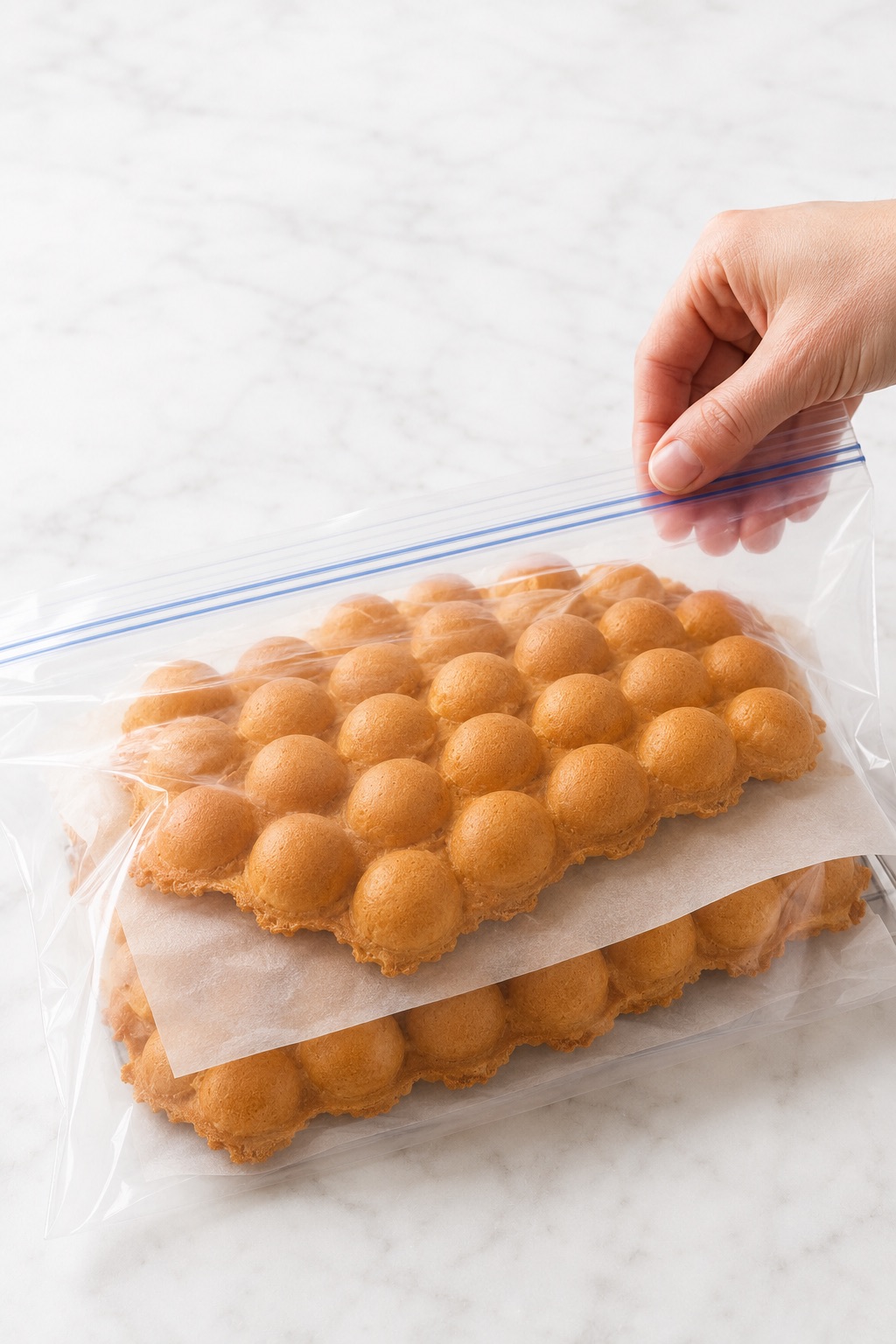
Cool the waffles completely, separate them with parchment, wrap airtight, and freeze for up to 2 weeks for best quality. Refresh room-temperature or frozen waffles in a 350°F (177°C) oven or toaster oven for about 4–6 minutes, adding only as much time as needed for a hot, dry shell. Rest them on a rack for 1 minute before serving. Microwaving is not recommended because it softens the membranes.
Keep raw batter refrigerated outside the controlled 20-minute temper and active cooking period. Under the FDA two-hour rule, discard perishable batter after more than 2 cumulative hours at room temperature, or after 1 hour when the air temperature is above 90°F (32°C).
Bubble Waffle Variations
These variations preserve the rotating-mold method while changing one controlled part of the flavor or serving format. They are separate outcomes, not substitutions claimed to be identical to the classic waffle.
Chocolate Bubble Waffle
Replace 2 tablespoons (15 g) of the all-purpose flour with 2 tablespoons (10 g) Dutch-process cocoa powder and add 1 tablespoon (15 g) water. Keep the remaining method unchanged. Because cocoa darkens the batter before it browns, rely more heavily on steam reduction, dry membranes, aroma, and clean release than on golden color.
Black Sesame Bubble Waffle
Replace 1 tablespoon (8 g) of the rice flour with 1 tablespoon (8 g) finely ground toasted black sesame. Sift it with the dry ingredients. The waffle will taste nuttier and look naturally speckled, with slightly less of the classic pale-golden appearance.
Bubble Waffle Cone
Make no batter changes. Fold one hot waffle into a loose cone immediately after release and support it in a cup while it cools. Add ice cream only after the shell becomes crisp; earlier filling traps steam and shortens the crisp serving window.
Frequently Asked Questions
These questions address the remaining practical uncertainties readers commonly have about the specialized pan, custard powder, hollow bubbles, batch size, and appliance-dependent cooking behavior.
Can I make Bubble Waffles without a Bubble Waffle maker?
You need either a rotating electric Bubble Waffle maker or a two-sided stovetop egg-waffle pan to create the connected sheet of rounded bubbles. A Belgian or standard waffle iron can cook the batter, but it cannot reproduce the same thin connecting membranes, two-sided cavities, or characteristic mixture of full and hollow bubbles.
Can I use a stovetop Bubble Waffle pan for this recipe?
Yes, but the cooking procedure must follow the pan manufacturer’s directions rather than the electric-machine timing in this recipe. Preheat both sides evenly, add a calibrated amount of batter, close and flip the pan immediately, then cook over controlled heat until both sides are deep golden and the steam has substantially reduced. Because stovetop burners and pans vary widely, begin with the same 170 g batter dose but expect to adjust both heat and cooking time.
What can I use instead of custard powder in Bubble Waffles?
There is no exact one-for-one substitute that preserves the same color, aroma, starch balance, and classic egg-custard flavor. If custard powder is unavailable, replace the 9 g custard powder with 7 g cornstarch and add another ¼ teaspoon vanilla extract. The waffles should still cook successfully, but they will taste less distinctly like traditional Hong Kong egg waffles and may be slightly paler.
Why are some of my Bubble Waffle bubbles hollow?
Partly or almost completely hollow bubbles are normal. When the closed maker is rotated, the fluid batter coats both sides of the rounded cavities while expanding steam creates open space inside. A successful waffle usually contains a natural mixture of hollow and more fully filled bubbles. It is only a problem when most cavities are missing, collapsed, or separated from the sheet.
Why did my Bubble Waffle not get crispy?
First allow the waffle to rest uncovered on an elevated wire rack for 1–2 minutes; it normally leaves the maker flexible and crisps as steam escapes. If it remains pale, damp, and uniformly soft after that rest, the plates may not have been fully preheated or the waffle may need another 15–30 seconds of cooking. Heavy overfilling, excessive oil, stacking, or placing the rack flat on a plate can also trap moisture and soften the shell.
Why is my Bubble Waffle sticking to the maker?
Sticking usually means the plates were not fully heated, the waffle was opened before its membranes had set, or the appliance needs a very thin film of oil. Preheat the closed maker completely, do not open it during the first 3 minutes, and grease only if permitted by the manufacturer. If the waffle releases cleanly at first but later waffles begin sticking, wipe on the faintest additional film of neutral oil rather than pouring oil into the cavities.
Can I double this Bubble Waffle recipe?
Yes. Double every ingredient by weight and mix the batter in a bowl large enough to combine it without vigorous whisking. Keep the same 60-minute refrigerated rest, 20-minute temper, and calibrated batter dose for each waffle. Cook the waffles individually and stir the waiting batter gently every two or three waffles if settling becomes visible. Do not stack the finished waffles while warm.
Keep the Waffle-Making Going
If the crisp edges and warm batter aroma are what brought you here, choose your next recipe by the part you want to repeat: another waffle shape, a different griddle-style batter, or the cold creamy pairing that turns a Bubble Waffle into dessert.
Try Another Homemade Waffles
Stay close to the same cook-at-the-iron rhythm while exploring how different formulas change lift, crispness, and flavor.
- Waffle Recipe is the closest everyday route when you want a familiar grid waffle with a simpler appliance.
- Belgian Waffle Recipe moves toward deeper pockets and a more bread-like, airy structure.
- Pumpkin Waffle Recipe adds a warmly spiced seasonal batter without leaving the waffle format.
- High Protein Waffles offers a more substantial breakfast direction when protein matters more than street-snack crispness.
Explore Another Pourable Batter
These recipes keep the satisfying pour-and-cook process but change the pan, texture, or level of richness.
- Crepe Recipe turns a thin batter into soft, foldable layers that welcome either sweet or simple fillings.
- Buttermilk Pancake Recipe is the natural choice for fluffy stovetop rounds with tang and a tender crumb.
- German Pancakes replace individual flipping with one dramatic oven-puffed pancake.
- Cinnamon Roll Pancakes take the griddle route in a sweeter, cinnamon-swirled direction.
Build a Bubble Waffle Dessert
Choose an ice cream that complements the egg–custard base, then add it only after the shaped waffle has released its steam and crisped.
- Vanilla Ice Cream Recipe keeps the pairing classic and lets the waffle’s custard aroma remain clear.
- Chocolate Ice Cream adds a darker, richer contrast to the light golden shell.
- Strawberry Ice Cream brings a bright fruit note and a beautiful pink-and-gold presentation.
- Homemade Ice Cream gives you a flexible base when you want to choose your own flavor direction.
Final Thoughts
The defining skill in homemade Bubble Waffles is not mixing a complicated batter; it is learning how that batter behaves inside your particular mold. The first pour establishes the correct dose, the steam reveals whether the shell has dried, and the short rack rest shows the texture the maker alone cannot provide.
Once those three signals are understood, the process becomes remarkably repeatable. Serve the waffle while its seams still crackle and its rounded centers remain warm and tender, and the result captures what makes gai daan jai distinct from every conventional waffle.

Bubble Waffle
Classic Hong Kong–style egg waffles with a thin crisp shell, tender-springy bubbles, and a warm egg–vanilla–custard aroma. A weighed first pour and immediate rotation make a home Bubble Waffle maker easier to calibrate.
Ingredients
Dry ingredients
- 1 cup (120 g) all-purpose flour
- 1/3 cup (48 g) regular white rice flour, not sweet or glutinous rice flour
- 1 tablespoon (8 g) tapioca starch
- 1 tablespoon (9 g) regular non-instant custard powder
- 1 1/2 teaspoons (6 g) double-acting baking powder
- 1/4 teaspoon (approximately 1.5 g) fine salt
Wet ingredients
- 3 large eggs (150 g out of shell)
- 1/2 cup plus 2 tablespoons (125 g) granulated sugar
- 3 tablespoons (45 g) full-fat evaporated milk
- 2/3 cup (160 g) cool room-temperature water
- 1 teaspoon (5 ml) pure vanilla extract
- 2 1/2 tablespoons (35 g) neutral oil
Instructions
- Whisk the all-purpose flour, rice flour, tapioca starch, custard powder, baking powder, and salt in a medium bowl. Sift once to remove compact lumps.
- In a second bowl, whisk the eggs and sugar for 30–45 seconds, just until uniform and slightly lighter. Do not whip to ribbon stage. Whisk in the evaporated milk, water, and vanilla.
- Add the dry mixture in two additions and whisk gently only until no dry flour remains. Pass the batter through a fine-mesh sieve into a clean bowl or spouted jug.
- Whisk in the 35 g neutral oil until no separated beads or slicks remain. Cover and refrigerate for 60 minutes.
- Remove the batter 20 minutes before cooking. During the final 10 minutes, preheat the closed Bubble Waffle maker according to its manual. Stir the batter gently with 8–10 strokes.
- If permitted by the manufacturer, wipe the fully heated plates with the thinnest film of neutral oil. Set a wire rack beside the appliance.
- Weigh 170 g batter, approximately 2/3 cup, into the first waffle. Pour across the main field, close and lock immediately, then rotate the maker 180 degrees at once. Do not open during the first 3 minutes.
- Cook for approximately 3 1/2–4 1/2 minutes, until deep golden to light amber, vigorous steam has slowed, the aroma is toasted rather than raw, the membranes look dry, and the waffle releases intact. If pale but released, cook 20–30 seconds longer.
- Lift the waffle with a silicone or wooden utensil and cool uncovered on the wire rack for 1–2 minutes. The sheet should become visibly crisper as steam escapes.
- Calibrate the remaining batch: reduce the next pour by 10–15 g after heavy overflow, increase it by 10–15 g if the outer row is largely missing, and adjust time only in 15–30-second increments. Keep cooked waffles unstacked and serve warm.
Notes
- The first waffle is the equipment-calibration waffle, not an automatic recipe failure.
- Use regular white rice flour. Sweet/glutinous rice flour or mochiko creates a materially different chew.
- Use regular non-instant custard powder. Instant pudding mix is not a supported 1:1 replacement.
- Evaporated milk and sweetened condensed milk are not interchangeable.
- Do not taste raw batter.
- Best quality is within 10 minutes. Once completely cool, store airtight at room temperature for up to 1 day with expected softening.
- Freeze cooled waffles separated with parchment and wrapped airtight for up to 2 weeks for best quality.
- Refresh in a 350°F (177°C) oven or toaster oven for approximately 4–6 minutes, then rest on a rack for 1 minute. Do not microwave when crispness matters.
- For eight waffles, prepare two separate 1x batches rather than holding one doubled batter through a long appliance cycle.
- Contains wheat, egg, and milk. Check custard-powder and packaged-ingredient labels for additional allergen statements.
Nutrition Information:
Yield: 4 Serving Size: 1 waffleAmount Per Serving: Calories: 439Total Fat: 14gSaturated Fat: 3gUnsaturated Fat: 10gCholesterol: 143mgSodium: 364mgCarbohydrates: 69gFiber: 1gSugar: 33gProtein: 9g
Nutrition information is provided as an estimate only and may vary based on specific ingredients, brands, and portion sizes used. This information should not be considered medical or nutritional advice.
12 Sweet Favourites — Yours, Free 🍰
Tiramisù, no-bake cheesecake, the perfect chocolate chip cookie & 9 more reader-loved desserts — gathered into one beautiful free recipe book. From my kitchen to yours.
No spam, just sweet things. Unsubscribe anytime.