White Chocolate Chip Cookies (Thick & Chewy)
🎁 FREE E-BOOK: 12 Sweet Favorites — reader-loved desserts in one beautiful recipe book.
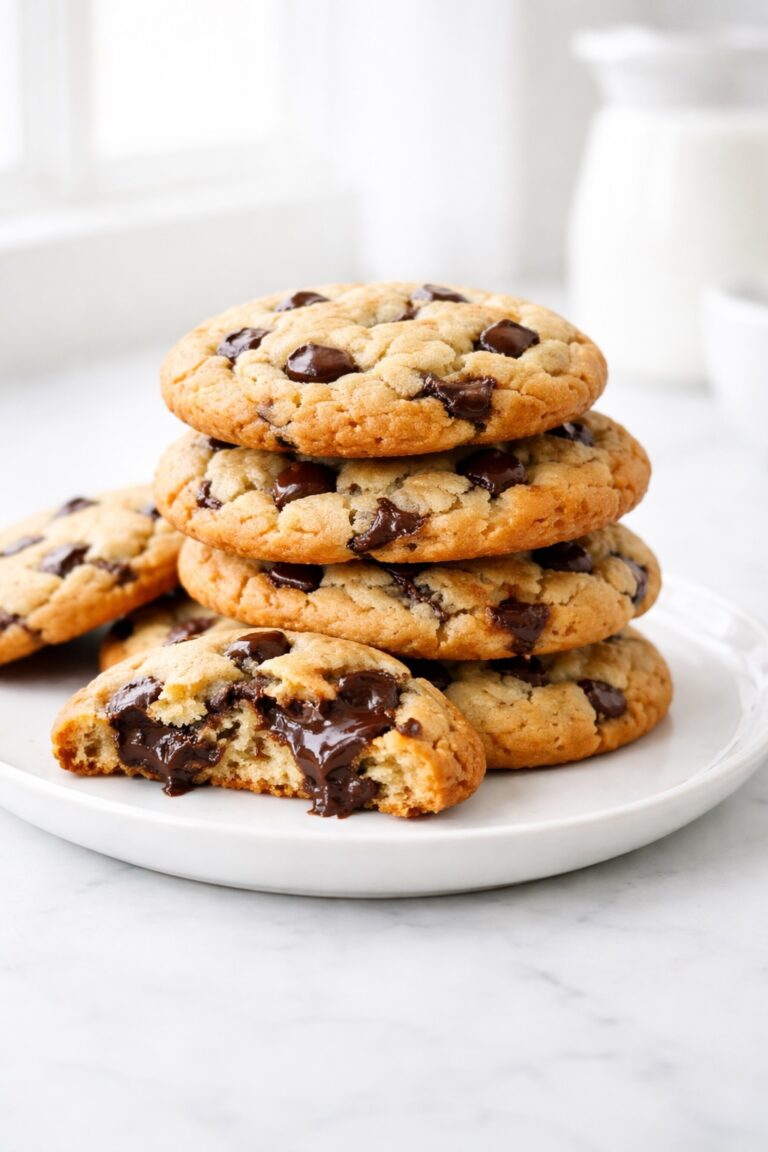
White chocolate chip cookies should have lightly golden edges, soft chewy centers, and creamy pieces of white chocolate in every bite. This version keeps the vanilla-butter cookie pale at the center while giving the rim just enough color and crispness to frame that tender middle.

They follow the familiar rhythm of a classic chocolate chip cookie—cream the butter and sugars, fold in the chocolate, portion, chill, and bake—but white chocolate gives the whole batch a softer, creamier character. Brown sugar, vanilla, and a full teaspoon of salt keep the cookies flavorful without making them overly sweet.
This recipe is easy to repeat because every important step has a clear cue. You will know how soft the butter should feel, how much each portion should weigh, how the dough changes during chilling, and exactly what the cookies should look like when they are ready to leave the oven.
White Chocolate Chip Cookies at a Glance
These thick cookies start with a classic creamed-butter dough. Weighing each portion and chilling the shaped dough helps them bake evenly with soft centers and lightly golden edges.
| Yield | 24 cookies |
|---|---|
| Portion size | 50 g dough per cookie |
| Active preparation | About 20 minutes |
| Chill time | 30 minutes |
| Oven | 350°F / 175°C, conventional, center rack |
| Bake time | 11–13 minutes per tray; bake one tray at a time |
| Tray set | 5 minutes before moving to a rack |
| Total elapsed time | About 1 hour 15 minutes to 1 hour 25 minutes |
Why This White Chocolate Chip Cookie Recipe Works
The cookies stay thick because the butter is softened but not greasy, each dough portion weighs 50 g, and the shaped dough chills for 30 minutes.
- Balanced sweetness: Light brown sugar, granulated sugar, salt, vanilla, and 255 g of white chocolate are proportioned so no single note overwhelms the cookie.
- Thick cookies: Properly softened butter and a short chill keep the dough from spreading too quickly.
- Even baking: Each 50 g portion bakes at the same rate and produces a cookie roughly 3 inches across.
- Soft, chewy centers: Baking soda provides enough spread and browning without making the cookies cakey.
- Bakery-style tops: Reserving some of the chips for the warm cookies gives every top plenty of visible white chocolate.
Why You’ll Love These White Chocolate Chip Cookies
This recipe fits the moments when you want a familiar homemade cookie with a little more elegance, but without specialty equipment or an overnight wait.
- It uses familiar pantry and refrigerator ingredients.
- The 30-minute chill is long enough to help the dough but short enough for same-day baking.
- The 24-cookie yield is easy to divide across two standard half-sheet pans.
- The dough portions can be frozen for a small fresh batch later.
- The cookies work for everyday baking, cookie boxes, parties, or a simple warm dessert.
- Each important step includes a visual or tactile cue, so you do not have to rely on the timer alone.
Ingredients for Thick, Chewy White Chocolate Chip Cookies
Accurate weights matter here because a small flour or chocolate difference can change both spread and sweetness.
Ingredient List
Measure the ingredients in this order and divide the white chocolate before you begin mixing.
- 1 cup (226 g) unsalted butter, softened to 65–68°F / 18–20°C
- 3/4 cup packed (160 g) light brown sugar
- 1/2 cup (100 g) granulated sugar
- 2 large eggs (about 100 g without shells), at room temperature
- 2 teaspoons (10 ml) pure vanilla extract
- 2 3/4 cups (345 g) all-purpose flour; weigh for best results
- 1 teaspoon (5 g) baking soda
- 1 teaspoon (5 g) fine sea salt
- 1 1/2 cups (255 g) white chocolate chips, divided: 210 g for the dough and 45 g for finishing

Ingredient Notes for the Best Texture and Flavor
Each ingredient has a specific job, but the butter, flour, sugars, and white chocolate have the greatest effect on the final cookie.
- Unsalted butter: It should dent easily when pressed but still look matte and hold its shape. If you use salted butter, reduce the added fine sea salt to 1/2 teaspoon; salt levels vary by brand, so unsalted butter makes the final salt level easier to control.
- Light brown sugar: Its moisture supports a soft, chewy center and adds a mild caramel note without making the dough too dark.
- Granulated sugar: It helps the edges spread and become lightly crisp. The amount is intentionally lower than the brown sugar.
- Eggs: Room-temperature eggs blend more smoothly into creamed butter. Add them one at a time so the butter mixture stays smooth.
- All-purpose flour: Use 345 g. Scooping directly from the bag can compact flour into the cup and create cookies that stay thick, dry, and cakey.
- Baking soda: This supports spread and browning. Do not add baking powder, which would make the cookies puffier and more cake-like.
- White chocolate: For a true cocoa-butter flavor, look for a product labeled white chocolate. Under the FDA standard of identity for white chocolate, it contains at least 20% cocoa butter along with required milk-solids and milkfat levels.
A direct gluten-free flour swap is not recommended here. For a version developed specifically with gluten-free flour, use my gluten-free chocolate chip cookies instead.

Kitchen Tools for Even White Chocolate Chip Cookies
The most useful tools are the ones that keep the butter mixture smooth, the portions equal, and both baking sheets cool and consistent.
- Mixer and bowls: Use a stand mixer fitted with the paddle attachment or a handheld electric mixer with a large mixing bowl, plus a medium bowl for the dry ingredients.
- Scale and portioning tools: Use a digital kitchen scale for the flour and the 50 g dough portions. A roughly 2-tablespoon cookie scoop makes portioning faster, then the scale helps you fine-tune each mound.
- Baking sheets and liners: Use two cool, light-colored 18×13-inch half-sheet pans lined with parchment. Dark, insulated, or hot reused pans can change browning and spread, so use parchment rather than a silicone baking mat for this recipe.
- Whisk and silicone spatula: A whisk distributes the baking soda and salt, while a flexible spatula scrapes the bowl and finishes the dough gently by hand.
- Cooling rack and oven thermometer: Cool the cookies on a wire rack. If your oven temperature is unreliable, an oven thermometer can help you check it.
Before You Begin These White Chocolate Chip Cookies
Set up these six details before mixing so the dough reaches the oven at the correct temperature, weight, and consistency.
One lesson I keep coming back to with cookie dough is that butter has a narrow sweet spot: cold butter will not cream evenly, while melted butter sends the spread too far. For these cookies, the butter should be soft enough to indent easily but still hold its shape.
- Check the butter: It should be 65–68°F / 18–20°C, easy to indent, matte rather than shiny, and never partially melted.
- Take the chill off the eggs: Room-temperature eggs blend into the butter more easily and help the mixture stay smooth rather than curdled or oily.
- Weigh the flour: For the most reliable texture, weigh the flour and use 345 g.
- Divide the white chocolate: Set aside 210 g for the dough and 45 g for pressing into the baked cookies.
- Prepare two cool trays: Line both light-colored half-sheets with parchment so you never place dough on a pan that is still warm.
- Keep raw dough off the tasting spoon: Flour is a raw food and eggs may carry harmful bacteria, so follow the FDA guidance on raw flour and dough and bake this dough before eating. If you want a safe spoonable option, make my edible cookie dough recipe instead.

Plan the Two-Tray Cookie Timeline
The recipe uses two trays but bakes only one at a time, so the second tray must remain refrigerated while the first is in the oven.
| Relative window | What happens | Readiness detail |
|---|---|---|
| Start to about 20 minutes | Mix and portion the dough | Complete all 24 portions before the chill begins |
| About 20–50 minutes | Chill both trays for 30 minutes | Keep the dough covered and cold |
| About 50–63 minutes | Bake tray 1 | Tray 2 stays refrigerated |
| About 63–76 minutes | Bake tray 2 | Finish and cool tray 1 while tray 2 bakes |
| About 76–85 minutes | Let the second tray rest for 5 minutes | Serve once the cookies are firm enough to lift, or cool completely for the chewiest texture |
What to Expect from This White Chocolate Cookie Dough
The dough should be soft enough to portion but sturdy enough to hold a rounded mound, and the baked centers should remain paler than the edges.
- The freshly mixed dough is soft but should not flow, look oily, or collapse into a puddle.
- After 30 minutes in the refrigerator, the portions feel cooler and firmer but are not rock-hard.
- The cookies are ready before their centers become uniformly brown; look for a golden outer rim and a mostly matte top.
- White chocolate chips retain more of their shape than chopped white chocolate, so visible pieces are normal rather than a sign that the cookie is underbaked.
This recipe makes pale vanilla and brown-sugar cookies filled with white chocolate. They are not cocoa cookies, macadamia cookies, stuffed cookies, blondies, or a no-chill version.
How to Make White Chocolate Chip Cookies
Follow these seven steps, watching the butter mixture, finished dough, and baked edges as you go. The visual cues will tell you when each step is complete.
1. Prepare the Oven and Baking Sheets
Place a rack in the center of the oven and preheat to 350°F / 175°C in conventional mode. Line two cool, light-colored 18×13-inch half-sheet pans with parchment paper.
What you should see: Two flat, cool prepared pans and a fully preheated oven with no tray crowded above or below the center rack.
2. Whisk the Dry Ingredients
In a medium bowl, whisk together the 345 g all-purpose flour, 1 teaspoon baking soda, and 1 teaspoon fine sea salt until evenly blended.
What you should see: A uniform flour mixture with no visible pockets or clumps of baking soda or salt.

3. Cream the Butter and Sugars
Place the 226 g softened butter, 160 g light brown sugar, and 100 g granulated sugar in the mixer bowl. Beat on medium speed for about 3 minutes, stopping once to scrape the bowl and paddle. Avoid beating until extremely fluffy.
What you should see: A lighter, creamy mixture that holds soft ridges. It should look creamy and slightly lighter in color, with soft ridges and no greasy shine.

4. Add the Eggs and Vanilla
Reduce the mixer to medium-low. Add the eggs one at a time, mixing for about 30 seconds after each addition. Add the vanilla, scrape the bowl and paddle thoroughly, and mix only until smooth.
What you should see: A smooth butter mixture with no liquid pooling, oily streaks, or large curdled-looking pieces.

5. Finish the Dough and Fold In the White Chocolate
Add the dry mixture and mix on low only until a few flour streaks remain. Stop the mixer, scrape to the bottom, and finish folding by hand. Fold in the 210 g portion of white chocolate chips until evenly distributed.
What you should see: A thick, soft dough with no dry flour at the bottom of the bowl and white chocolate distributed throughout rather than clustered in one area.

6. Portion and Chill the Dough
Divide the dough into 24 portions of 50 g each. Shape each portion into a naturally rounded mound that is slightly taller than it is wide. Arrange 12 portions on each prepared tray, leaving about 3 inches between them. Cover and refrigerate both trays for 30 minutes.

What you should see: Even mounds that hold their shape. After chilling, the surface feels cooler and firmer, but the dough is not frozen or difficult to press.

7. Bake, Finish, and Let the Cookies Set
Bake one tray on the center rack for 11–13 minutes while the second tray remains refrigerated. Rotate only if your oven has a known hot side. As soon as the tray comes out, press some of the reserved 45 g white chocolate chips into the hot tops. Leave the cookies undisturbed on the sheet for 5 minutes, then transfer them carefully to a wire rack. Repeat with the second tray.
What you should see: The outer 1/4–1/2 inch is lightly golden, the top has lost most of its wet shine, and the pale center is visibly soft but not glossy-liquid. The edges hold when the tray is moved gently.

How to Tell When White Chocolate Chip Cookies Are Done
Judge these cookies by the rim, surface shine, and center together; color alone can make a correctly pale cookie look less baked than it really is.
| Baking stage | Outer rim | Top and center | After the tray rest |
|---|---|---|---|
| Too early | Still pale | Wet shine or a glossy-liquid center | The cookie stays fragile or raw-looking |
| Ready | Lightly golden for the outer 1/4–1/2 inch | Mostly matte with a pale, visibly soft center | It holds after 5 minutes and finishes setting without drying |
| Too far | Deeply browned around the edge | The center is already firm before removal | The cooled cookie becomes drier and crisper |

The Texture After Cooling
A warm cookie is softer and the white chocolate feels creamier, while a fully cooled cookie gives the clearest contrast between the lightly crisp edge and chewy center. The crumb should be fully set and tender, with no dry flour line or wet raw band.

The Science Behind Thick, Chewy White Chocolate Chip Cookies
A few simple baking details help these cookies keep their thickness while developing soft centers and lightly crisp edges.
- The butter must be soft, not melted. Properly softened butter creams smoothly with the sugar, while shiny or partially melted butter makes the cookies spread too quickly.
- Each sugar contributes a different texture. Light brown sugar keeps the centers soft and chewy, while granulated sugar helps the edges spread and become lightly crisp.
- Equal portions bake more evenly. Weighing the dough into 50 g mounds gives every cookie a similar thickness, and the 30-minute chill slows the initial spread in the oven.
- The hot baking sheet finishes the centers. The cookies continue to bake gently during the 5-minute rest, so they can come out of the oven while the centers still look soft.
Expert Tips for Balanced, Even Cookies
These small details make the cookies more consistent without adding extra work.
- Use the indentation test. Press the butter gently; it should give without collapsing. Butter at this stage creams smoothly and does not make the cookies spread too quickly.
- Stop creaming at creamy, not cloudlike. Excess air can make this dough puffier and more cake-like before it settles.
- Finish the flour by hand. Stopping the mixer while a few streaks remain reduces overmixing and helps preserve tenderness.
- Chill after portioning. Small mounds cool faster and more evenly than one deep bowl of dough, and they are ready to bake without reshaping cold dough.
- Keep the waiting tray cold. Leaving tray 2 on the counter while tray 1 bakes gives the second batch a warmer starting point and encourages extra spread.
- Never reuse a hot sheet. A warm pan begins melting the underside before the cookie reaches the oven.
- Add some chips after baking. Press them into the warm tops so the cookies look generous and the white chocolate does not brown in the oven.
- Round only while hot. If a cookie spreads unevenly, swirl a round cutter around it immediately after baking; this can improve shape but cannot restore lost thickness.
White Chocolate Chip Cookie Mistakes and Fixes
Match the visible symptom to its most likely cause before changing the next tray; spread problems rarely come from the oven time alone.
| Mistake | What happens | Likely cause | How to prevent or fix it |
|---|---|---|---|
| Butter is too warm or dough skips the chill | Cookies spread thin and may look greasy | The butter melts before the cookies begin to set | Use 65–68°F butter, portion accurately, chill 30 minutes, and keep the waiting tray cold |
| Too much flour or butter is too cold | Cookies barely spread and stay dense | Too much flour makes the dough stiff, while cold butter limits spread | Use 345 g flour and properly softened butter; if needed, gently flatten only the portions that have not been baked |
| Dough is overcreamed or overbaked | Texture becomes puffy, cakey, or dry | Excess air, flour, added baking powder, or too much oven time | Cream about 3 minutes, omit baking powder, and stop at the visual doneness cues |
| Eggs are added too quickly | The mixture looks curdled or oily and cookies may bake unevenly | The butter and egg mixture separates | Use room-temperature eggs, add one at a time, and scrape thoroughly |
| A dark or hot sheet is used | Bottoms brown too fast while centers lag | A dark or hot pan browns the bottoms too quickly | Use cool light-colored sheets lined with parchment |
| Exposed chips bake too long | White chocolate develops brown or scorched spots | Too much direct oven heat | Keep the oven rack centered and reserve 45 g of chips for the hot cookie tops |
| Cookies are moved immediately | They bend or break during transfer | The cookies are still too soft to move | Leave them on the sheet for the full 5 minutes before moving |

Beautiful Ways to Serve White Chocolate Chip Cookies
Serve these cookies in a way that shows the contrast between their golden rims, pale centers, and visible pieces of white chocolate.
Warm with Soft White Chocolate
Serve the cookies after their 5-minute tray set, when they hold in the hand but the white chocolate is still soft. This is when the cookies are at their softest.
Build a Bright Cookie Platter
Overlap fully cooled cookies on a pale platter and turn a few so the golden rims and reserved finishing chips stay visible. Break one cookie near the front to reveal the chewy center.

Make White Chocolate Ice Cream Sandwiches
Pair two completely cooled cookies with a small scoop of vanilla ice cream. The chilled filling firms the cookies slightly while keeping the vanilla and white chocolate flavors clear.
Choose Pairings That Balance the Sweetness
Serve the cookies with cold milk, unsweetened coffee, or black tea to balance the sweetness and let the butter and vanilla flavors stand out.
How to Store, Freeze, and Reheat White Chocolate Chip Cookies
Keep the cookies airtight at room temperature and skip the refrigerator whenever possible so they stay soft and fresh.
Store Baked Cookies at Room Temperature
Cool the cookies completely, then keep them in an airtight container at cool room temperature for up to 4 days for best quality. Routine refrigeration is not recommended because chilled butter firms the texture and the refrigerator can accelerate staling.
Freeze and Thaw Baked Cookies
Wrap the cooled cookies airtight and freeze for up to 2 months. Thaw them while still covered at room temperature so condensation stays outside the wrapping instead of settling on the cookie surface.
Freeze Portioned Cookie Dough
Freeze the 50 g dough mounds on a tray until solid, then transfer them to an airtight freezer bag for up to 2 months. Bake from frozen at 350°F / 175°C, adding approximately 2–4 minutes and relying on the same golden-rim, matte-top, soft-center cues.
Refrigerate Ahead or Warm Gently
Covered unbaked portions may stay refrigerated for up to 24 hours. For a softer cookie, warm it briefly at low power. Too much heat can melt the butter and make the cookie greasy.

White Chocolate Chip Cookie Variations
You can change the type of white chocolate or add nuts without changing the basic dough. Keep the total amount of chocolate and nuts close to 255 g so the cookies still bake properly.
- Chopped white chocolate: Replace the 255 g chips with the same weight of chopped white chocolate. Expect irregular pools of chocolate and a more rustic appearance.
- White chocolate macadamia: Use 180 g white chocolate chips total and 75 g coarsely chopped macadamia nuts. Fold 135 g chips and all 75 g nuts into the dough, then reserve 45 g chips for finishing.
- White chocolate cranberry: Dried cranberries change both the sweetness and moisture of the cookies. For the best balance, use my white chocolate cranberry cookies instead.
- Salted butter: Use the same butter weight and reduce the added fine sea salt to 1/2 teaspoon, understanding that salt levels vary by brand.
- Doubling: Mix only if the bowl can hold the dough without crowding and prepare enough cool trays before starting. Do not crowd extra cookies onto the pans; bake no more than 12 cookies on each pan and bake one pan at a time.

White Chocolate Chip Cookies FAQ
Here are the answers to the most common questions about ingredients, chilling, spreading, doneness, and freezing.
Do I Have to Chill White Chocolate Chip Cookie Dough?
Yes. Chill the shaped dough for 30 minutes so the butter firms up and the 50 g portions hold their shape better in the oven.
What Are the Best White Chocolate Chips for Cookies?
Choose chips labeled white chocolate when you want true cocoa-butter flavor, and select pieces you enjoy eating on their own. Products labeled only as white baking chips may contain different fats, so their flavor and melting behavior can vary.
Can I Use Chopped White Chocolate Instead of Chips?
Yes. Use the same 255 g total weight, but expect irregular melted pools and less uniform pieces because chopped bars do not hold their shape like chips.
Why Don’t White Chocolate Chips Melt into Pools?
White chocolate chips are made to hold their shape in the oven. They soften rather than melting into wide pools like a chopped bar, which is why the pieces remain visible in the baked cookies.
Why Did My Cookies Spread Too Much?
The most likely causes are butter warmer than 68°F / 20°C, skipped or shortened chilling, undermeasured flour, a hot baking sheet, or a warmer second tray. Check these details before adjusting the oven temperature.
How Do I Know When the Cookies Are Done?
Remove them when the outer 1/4–1/2 inch is lightly golden, the top is mostly matte, and the pale center is soft but not glossy-liquid. Let them finish setting on the tray for 5 minutes.
Can I Freeze the Dough and Bake It from Frozen?
Yes. Freeze the 50 g portions solid, store airtight for up to 2 months, and bake from frozen at 350°F / 175°C. Add about 2–4 minutes and use the visual doneness cues rather than time alone.
Can I Add Macadamia Nuts or Cranberries?
For macadamias, replace 75 g of the white chocolate with 75 g of chopped nuts and still reserve 45 g of chips for the tops. For cranberries, follow the dedicated white chocolate cranberry cookie recipe so the dough does not become too dry or too sweet.
Continue Your Cookie Baking Journey
If you enjoyed these cookies, try another chocolate chip favorite, a playful celebration cookie, or one of the classics below.
More Chocolate Chip Cookies
Each of these recipes offers a different take on a homemade chocolate chip cookie.
- Chocolate Chip Cookie Recipe — start with the classic version filled with semisweet chocolate chips.
- Brown Butter Chocolate Chip Cookies — try them when you want a deeper, toasted butter flavor.
- Sourdough Chocolate Chip Cookies — use sourdough discard for a gentle tang.
- Oatmeal Chocolate Chip Cookies — choose these for extra chew from rolled oats.
Chocolate and Celebration Cookie Twists
Try one of these recipes when you want coconut, colorful sprinkles, red velvet, or a deeper cocoa flavor.
- Almond Joy Cookies — combine chocolate, coconut, and almond flavors in one cookie.
- Funfetti Cookies — make colorful vanilla cookies for birthdays and celebrations.
- Red Velvet Cookies — bake soft red velvet cookies with a hint of cocoa.
- Hot Chocolate Cookies — make these when you want a rich cocoa cookie.
Classic Cookies to Bake Next
These familiar favorites are perfect when you want something other than a chocolate chip cookie.
- Sugar Cookie Recipe — make a simple, buttery vanilla cookie.
- Snickerdoodle Cookies — enjoy soft cookies rolled in cinnamon sugar.
- Peanut Butter Cookies — enjoy a rich, nutty cookie with the familiar crisscross top.
- Shortbread Cookie Recipe — bake crisp, buttery cookies with a delicate crumb.
Why This Recipe Belongs in Your Recipe Box: White Chocolate Chip Cookies
This is a dependable recipe to keep whenever you want thick, chewy cookies with plenty of creamy white chocolate.
- Balanced Sweetness. There is plenty of white chocolate without overpowering the butter, vanilla, and salt.
- Even Cookies. Softened butter, equal 50 g portions, and a short chill help every tray bake consistently.
- Clear Doneness. The golden rim, matte top, and soft-center cues are more reliable than one exact minute.
- Freezer Ready. Portioned dough lets you bake only the number of cookies you want without remaking the dough.
- Easy to Share. The cookies feel at home on an everyday dessert plate or in a special cookie box.
- Helpful Visual Cues. The same butter, dough, and doneness checks are useful when baking other drop cookies.
A Final Note on White Chocolate Chip Cookies
These cookies are filled with enough white chocolate to taste creamy and generous, but not so much that it hides the butter, vanilla, and touch of salt. Their pale, soft centers and lightly golden edges give every bite a lovely contrast.
Bake a full batch for a cookie box, or keep a few portions in the freezer for an easy warm dessert. Because the dough is weighed and the doneness cues are easy to see, the recipe is just as approachable the next time you make it.
The best results come from a few simple details: soften the butter without melting it, weigh the dough portions, give them time to chill, and remove the cookies while the centers are still soft.

White Chocolate Chip Cookies
Thick, buttery white chocolate chip cookies with lightly golden edges, soft chewy centers, and creamy white chocolate in every bite. Weighing the dough and chilling the shaped cookies for 30 minutes helps every tray bake evenly.
Ingredients
- 1 cup (226 g) unsalted butter, softened to 65–68°F / 18–20°C
- 3/4 cup packed (160 g) light brown sugar
- 1/2 cup (100 g) granulated sugar
- 2 large eggs (about 100 g without shells), at room temperature
- 2 teaspoons (10 ml) pure vanilla extract
- 2 3/4 cups (345 g) all-purpose flour; weigh for best results
- 1 teaspoon (5 g) baking soda
- 1 teaspoon (5 g) fine sea salt
- 1 1/2 cups (255 g) white chocolate chips, divided: 210 g for the dough and 45 g for finishing
Instructions
- Prepare the oven and pans. Place a rack in the center of a conventional oven and preheat to 350°F / 175°C. Line two cool, light-colored 18×13-inch half-sheet pans with parchment paper.
- Whisk the dry ingredients. In a medium bowl, whisk together the 2 3/4 cups (345 g) all-purpose flour, 1 teaspoon (5 g) baking soda, and 1 teaspoon (5 g) fine sea salt until evenly blended with no visible clumps.
- Cream the butter and sugars. Place the 1 cup (226 g) softened butter, 3/4 cup packed (160 g) light brown sugar, and 1/2 cup (100 g) granulated sugar in the mixer bowl. Beat on medium speed for about 3 minutes, stopping once to scrape the bowl and paddle. The mixture should look lighter and creamy, with soft ridges but no greasy shine.
- Add the eggs and vanilla. Reduce the mixer to medium-low. Add the 2 room-temperature eggs one at a time, mixing for about 30 seconds after each addition. Add the 2 teaspoons (10 ml) vanilla, scrape the bowl and paddle thoroughly, and mix just until smooth. The mixture should not look oily or curdled.
- Finish the dough. Add the dry ingredients and mix on low just until a few flour streaks remain. Stop the mixer, scrape to the bottom of the bowl, and finish folding by hand. Fold in 210 g of the white chocolate chips. The dough should be thick and soft with no dry flour remaining. Reserve the final 45 g of chips for the tops.
- Portion and chill. Divide the dough into 24 portions of 50 g each and shape them into rounded mounds slightly taller than they are wide. Arrange 12 portions on each prepared tray, leaving about 3 inches between them. Cover and refrigerate both trays for 30 minutes. The chilled dough should feel cooler and firmer while still yielding slightly when pressed.
- Bake and finish the cookies. Bake one tray on the center rack for 11–13 minutes while the second tray stays refrigerated. Rotate the pan only if your oven has a known hot side. The cookies are ready when the outer 1/4–1/2 inch is lightly golden, the tops are mostly matte, and the pale centers look soft but not wet. Press the reserved white chocolate chips into the warm tops. Let the cookies rest on the pan for 5 minutes, then transfer them carefully to a wire rack. Repeat with the second tray.
Notes
- Use butter at 65–68°F / 18–20°C. It should dent easily, look matte, and still hold its shape.
- Weigh the flour and use 345 g. Flour packed into a measuring cup can make the cookies dry and prevent them from spreading.
- Divide the white chocolate before mixing: add 210 g to the dough and reserve 45 g for the warm cookie tops.
- Use cool, light-colored pans lined with parchment. Keep the second tray refrigerated and bake one tray at a time.
- Use baking soda only. Baking powder would make the cookies puffier and more cake-like.
- If using salted butter, keep the same butter weight and reduce the fine sea salt to 1/2 teaspoon. Salt levels vary by brand.
- Store completely cooled cookies in an airtight container at cool room temperature for up to 4 days. Refrigeration can make them firmer and speed up staling.
- Freeze cooled cookies in an airtight container for up to 2 months. Thaw them while still covered at room temperature.
- To freeze the dough, freeze the 50 g portions until solid and transfer them to an airtight freezer bag for up to 2 months. Bake from frozen at 350°F / 175°C, adding about 2–4 minutes and checking the same doneness cues.
- Covered portions of unbaked dough may be refrigerated for up to 24 hours.
- Do not eat the raw dough. Flour and eggs should be fully baked before eating.
Doubling
For a double batch, make sure the mixer bowl is large enough and prepare additional cool pans. Keep 12 cookies on each pan and bake one pan at a time.
Nutrition Information:
Yield: 24 Serving Size: 1 cookieAmount Per Serving: Calories: 226Total Fat: 12gSaturated Fat: 7gTrans Fat: 0gUnsaturated Fat: 5gCholesterol: 38mgSodium: 158mgCarbohydrates: 28gFiber: 0gSugar: 17gProtein: 3g
Nutrition information is provided as an estimate only and may vary based on specific ingredients, brands, and portion sizes used. This information should not be considered medical or nutritional advice.
12 Sweet Favourites — Yours, Free 🍰
Tiramisù, no-bake cheesecake, the perfect chocolate chip cookie & 9 more reader-loved desserts — gathered into one beautiful free recipe book. From my kitchen to yours.
No spam, just sweet things. Unsubscribe anytime.