Watermelon Fruit Salad (Sweet, Juicy & Refreshing)
🎁 FREE E-BOOK: 12 Sweet Favorites — reader-loved desserts in one beautiful recipe book.
Cold watermelon, glossy strawberries, deep-blue berries, and fresh mint make this watermelon fruit salad taste like the brightest part of summer. A light honey-lime dressing settles over the chilled fruit in a delicate sheen, giving every bite sweetness, citrus, and just enough contrast without covering the flavor of the watermelon.
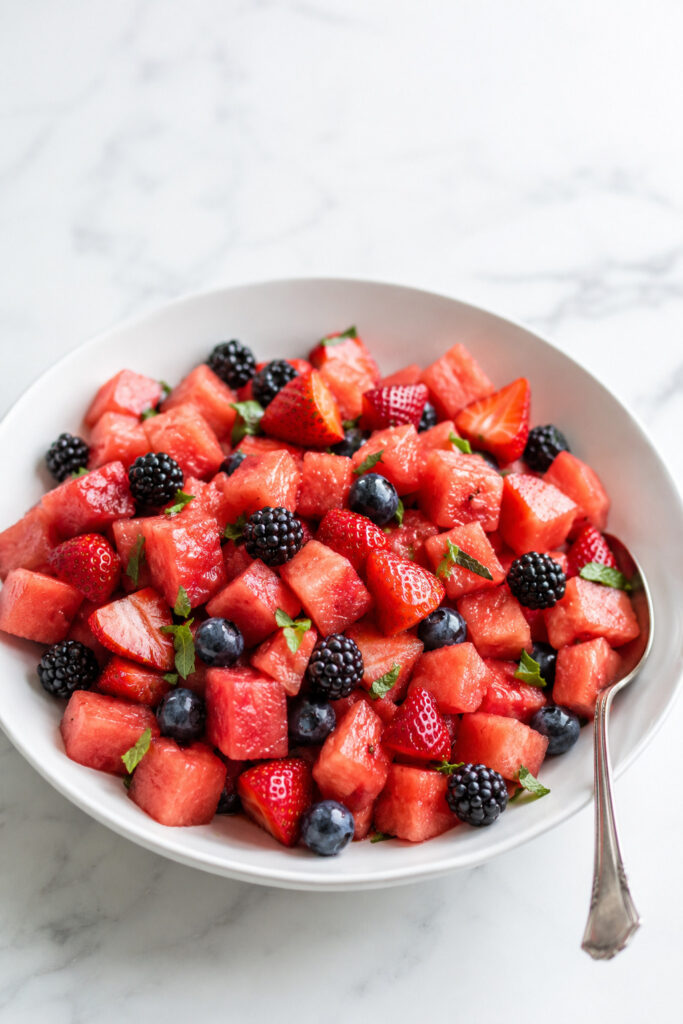
This is the bowl to bring out on a warm afternoon when a rich dessert feels like too much but plain cut fruit does not feel quite special enough. It is colorful enough for a brunch or shower, generous enough for a cookout or picnic, and refreshing enough to disappear quickly beside almost any summer spread.
I used to think fruit salad was one of those dishes that could be fully assembled ahead, but watermelon taught me that the dressing changes the bowl quickly. Now I keep everything cold and separate, then fold it together just before serving. That simple cold-dry-last-minute system is the reason this recipe is worth saving: the fruit stays distinct, the berries stay whole, and the flavor does not become diluted in a pool of juice.
The whole recipe takes about 15 minutes and requires no cooking. It is intentionally sweet and fruit-forward, with watermelon as the clear star. There is no feta, cucumber, onion, balsamic, olive oil, or leafy green in this version—only chilled summer fruit, mint, and a restrained honey-lime finish.
Watermelon Fruit Salad at a Glance
This recipe makes a generous bowl of sweet, fruit-forward watermelon salad with fresh berries, mint, and a light honey-lime dressing. It requires no cooking and comes together in approximately 15 minutes, but the fruit should be thoroughly chilled and dried before assembly for the brightest flavor and cleanest texture.
- Flavor: sweet watermelon and ripe berries brightened with honey, fresh lime, and cool mint.
- Texture: crisp watermelon cubes, tender strawberries, and whole berries with a light, glossy finish.
- Yield: approximately 11 cups, enough for 8 generous servings.
- Prep time: approximately 15 minutes.
- Cooking: none—this is a completely no-cook recipe.
- Skill level: easy, with careful drying and gentle folding as the two most important techniques.
- Best served: immediately after dressing, while the fruit is cold and distinct.
- Make-ahead plan: chill and prepare the components separately for up to 8 hours, then dress and add the mint just before serving.
Why This Watermelon Fruit Salad Works Beautifully
A good watermelon fruit salad needs more than an attractive mix of colors. The proportions, the amount of dressing, and the moment when everything comes together determine whether the bowl tastes fresh and vivid or watery and washed out.
- Watermelon remains the star. Seven cups of watermelon represent approximately 64% of the fruit by volume, so the recipe never loses its clear identity.
- Each berry contributes a different kind of contrast. Strawberries extend the juicy red-fruit profile, blueberries add a gentle pop, and whole blackberries bring deeper flavor and a firmer shape.
- The dressing is intentionally restrained. Two tablespoons each of honey and lime juice are enough to lightly coat the fruit without turning the bowl into fruit cocktail or heavy syrup.
- Lime zest adds aroma without unnecessary liquid. It makes the dressing taste more intensely citrusy while allowing the lime juice to stay balanced.
- The final assembly protects the texture. The dressing and mint go in only when the salad is ready to serve, and the fruit is folded only three or four times.
The result is naturally juicy, as a watermelon salad should be, but it begins bright and glossy rather than submerged.
Why You’ll Love This Bright Summer Fruit Salad
This is an easy recipe, but its simplicity is part of what makes it so useful. It can move between casual snacks and beautiful summer tables without needing complicated ingredients or decorative work.
- Ready in approximately 15 minutes
- Completely no-cook
- Sweet, refreshing, and naturally colorful
- Easy to prepare in separate components for a picnic or party
- Suitable for dessert, brunch, a BBQ, a potluck, or an afternoon snack
- Simple to double for a crowd
- Easy to make vegan with maple syrup or agave
- Naturally gluten-free and dairy-free as written
Fresh Ingredients for a Sweet, Juicy Fruit Salad
This recipe depends on ripe fruit more than on a long ingredient list. Begin with cold, firm watermelon and berries that taste good on their own; the honey-lime dressing should brighten that fruit, not rescue it.
Ingredient List
The amounts below create eight generous servings and keep watermelon clearly dominant in both the flavor and the finished bowl.
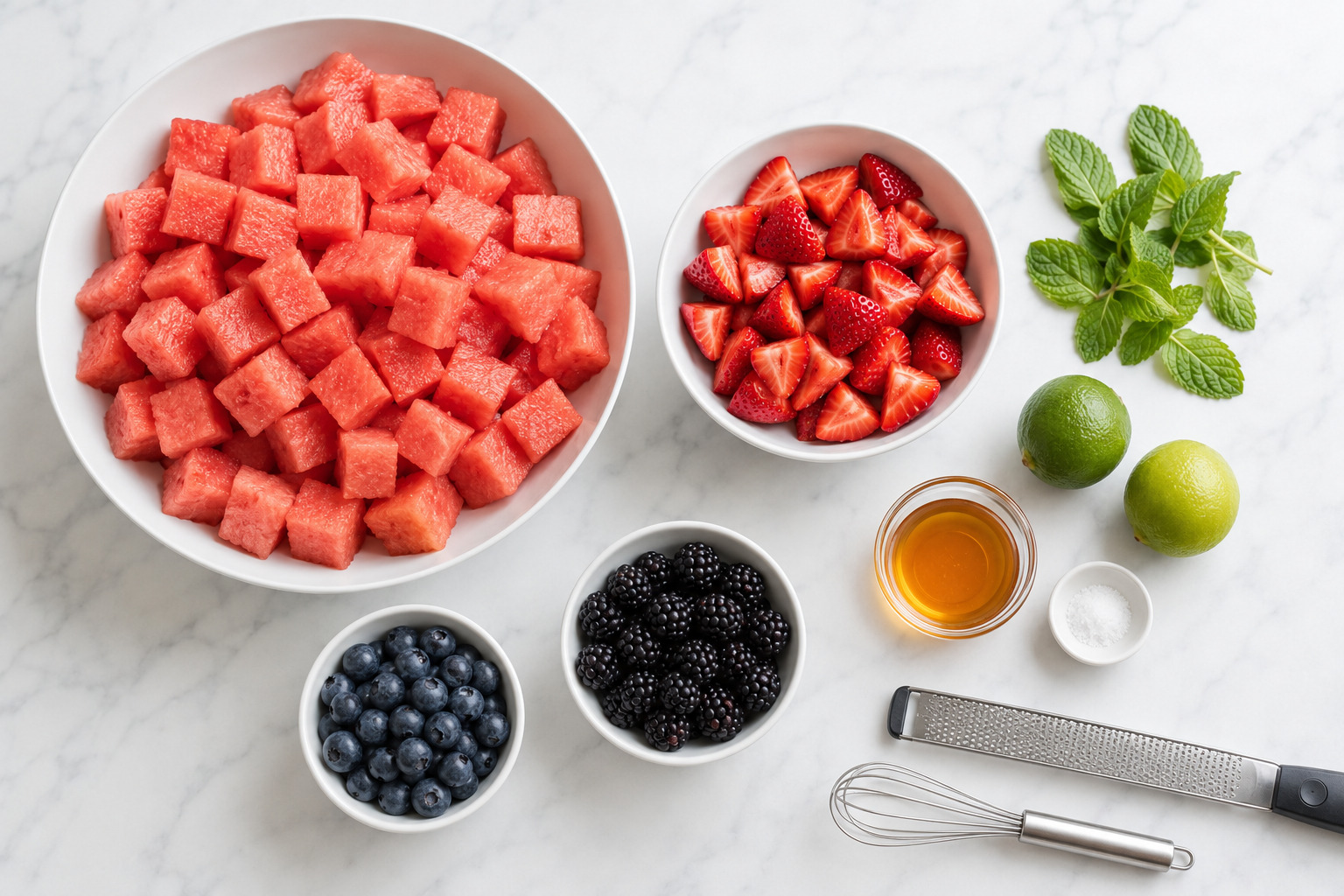
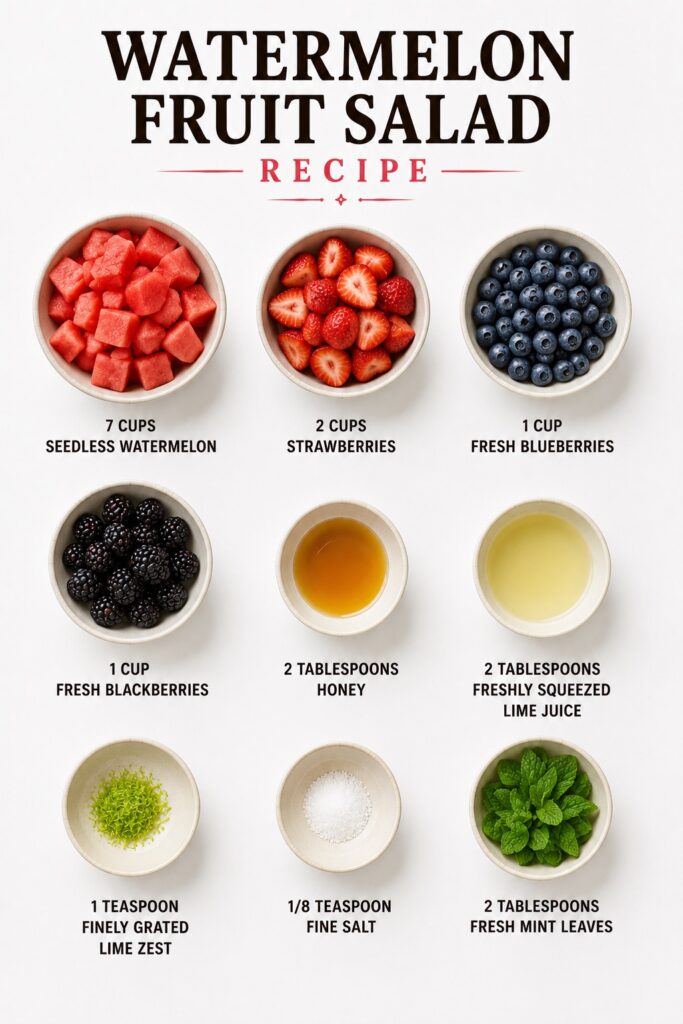
- 7 cups seedless watermelon, cut into 1-inch cubes (about 1.05 kg)
- 2 cups strawberries, hulled and quartered (about 300 g)
- 1 cup fresh blueberries (about 150 g)
- 1 cup fresh blackberries (about 145 g)
- 2 tablespoons honey (42 g)
- 2 tablespoons freshly squeezed lime juice (30 ml)
- 1 teaspoon finely grated lime zest
- 1/8 teaspoon fine salt
- 2 tablespoons fresh mint leaves, torn or thinly sliced (about 5 g)
Fresh Fruit and Mint Notes
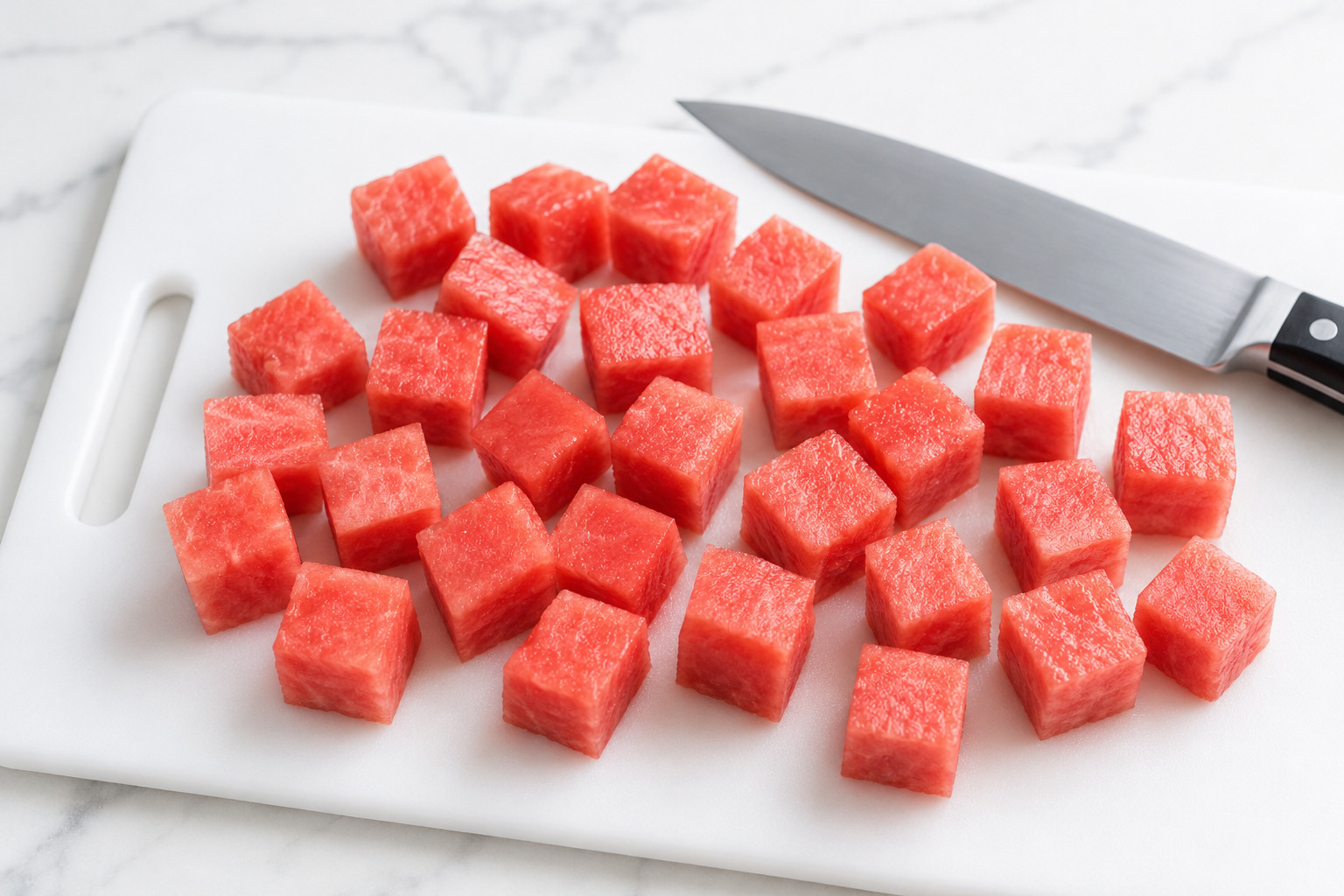
Seedless watermelon: Choose a watermelon with firm, crisp flesh rather than a soft or grainy center. Seedless varieties make the salad easier to eat, although the small white seed coats sometimes found inside are harmless. Cut the flesh into approximately 1-inch cubes so the pieces are large enough to stay intact but small enough to eat comfortably with berries.
Strawberries: Use fragrant, red strawberries that are ripe but still firm. Very soft berries release more juice and lose their edges quickly after quartering. If the strawberries are especially large, cut them into sixths so the pieces stay close to the size of the watermelon cubes.
Blueberries and blackberries: Fresh berries are essential here. Wash them gently and dry them completely before they enter the bowl. Keep the blackberries whole; their deep color can streak through the dressing if they are crushed.
Fresh mint: Mint should smell clean and bright, with green leaves and no dark, damp edges. Tear or slice it immediately before serving. If it is cut far in advance, the edges can darken and the aroma can become less fresh.
Honey-Lime Dressing Notes
Honey: A mild floral honey works best because it sweetens without overpowering the fruit. Honey becomes thicker when cold, which is why it should be whisked with the lime juice in a separate bowl instead of drizzled directly over chilled watermelon.
Fresh lime juice and zest: Freshly squeezed juice gives the cleanest flavor. Zest only the green surface; the white pith underneath is bitter. Zest the lime before squeezing it, when the whole fruit is still easy to hold.
Fine salt: The 1/8 teaspoon should never make the salad taste salty. It quietly sharpens the lime and makes the natural sweetness of the watermelon and berries feel fuller.
Kitchen Tools Needed
You do not need specialty equipment for this watermelon fruit salad, but a wide bowl and a sharp knife make it much easier to protect the berries and keep the pieces clean.
- Large mixing bowl: Choose a wide bowl with enough room to turn the fruit gently rather than stir it.
- Small bowl and whisk: Whisking separately allows the honey to dissolve into the lime juice before the dressing touches the cold fruit.
- Sharp chef’s knife and stable cutting board: A sharp blade creates even watermelon cubes without pressing out unnecessary juice.
- Microplane and flexible serving spoon or silicone spatula: Use the microplane for fine zest and the spoon or spatula for gentle folding.
How to Choose a Watermelon Worth Building the Salad Around
Because watermelon contributes most of the volume, its flavor and texture determine the quality of the entire recipe. The National Watermelon Promotion Board recommends a simple Look, Lift, Turn check when choosing one.
First, look for a firm watermelon without bruises, cuts, dents, cracks, or soft areas. Minor surface scratching is normal and does not mean the flesh is damaged. Next, lift it: a ripe watermelon should feel heavy for its size because of its high water content. Finally, turn it over and look for a creamy yellow field spot where it rested on the ground as it ripened. You can read the full selection guidance from the National Watermelon Promotion Board.
Once you are ready to prep, this guide to how to cut a watermelon will help you create even cubes with less waste and a more stable cutting setup.
Before You Begin: Keep the Fruit Cold and Dry
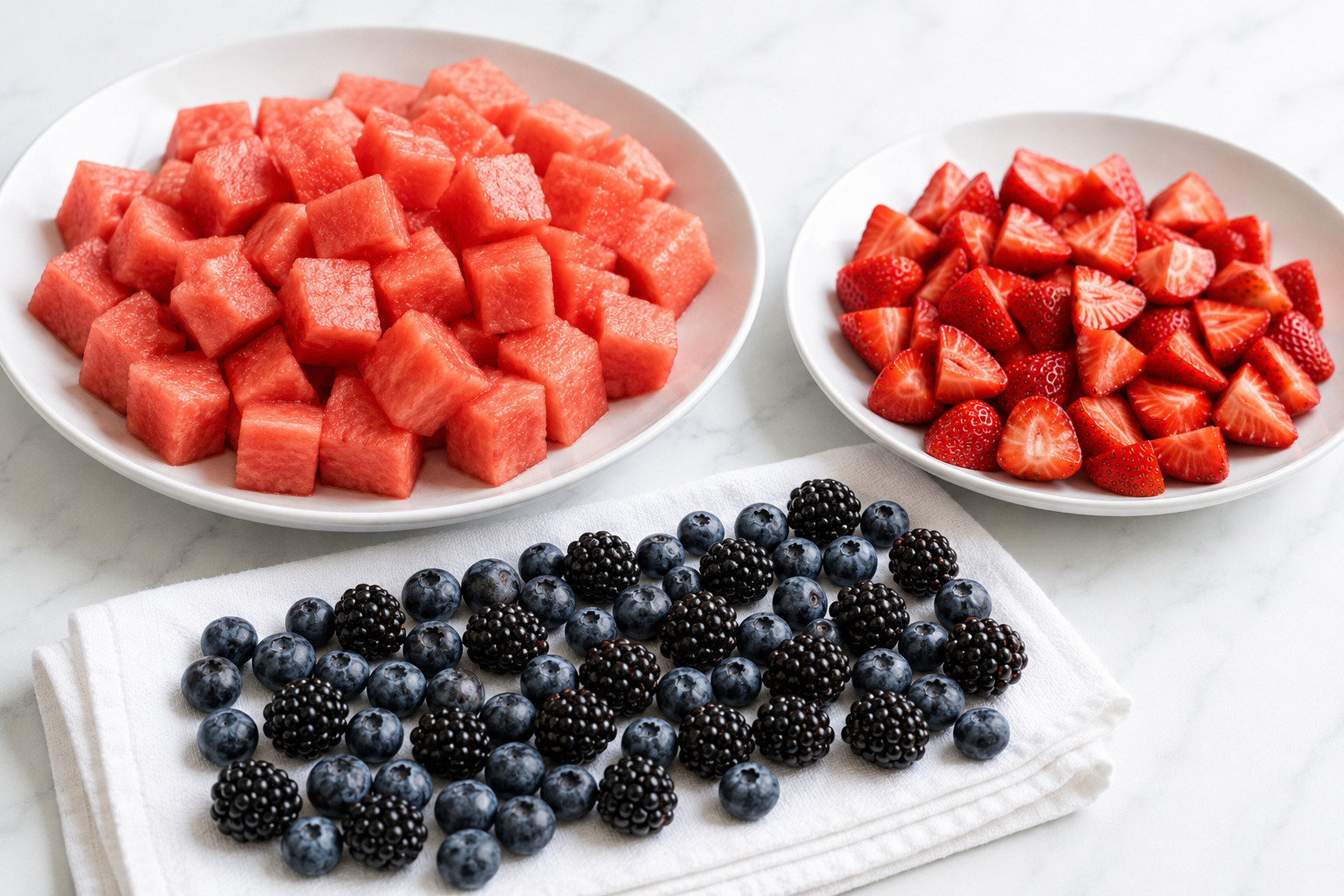
Four small preflight checks make the difference between a fruit salad that looks freshly assembled and one that begins releasing liquid before it reaches the table.
- Chill the fruit. Refrigerate the watermelon and berries before assembly. Cold watermelon feels firmer, cuts more cleanly, and is ready to serve without a long rest after dressing.
- Wash the whole watermelon before cutting. The FDA recommends rinsing produce under plain running water before peeling or cutting it, without soap or produce wash. Scrub firm melons with a clean produce brush, then dry the rind.
- Dry the berries completely. After rinsing, spread the strawberries, blueberries, and blackberries on a clean towel or paper towels until no surface water remains.
- Keep the components separate. Hold the cut fruit, dressing, and mint separately until the serving bowl is ready.
What to Expect from This Sweet Watermelon Fruit Salad
Expect a cold, sweet fruit salad led by crisp watermelon and berries, with a light honey-lime sheen and fresh mint. The strawberries will feel softer and juicier, while the blueberries and blackberries provide firmer bursts of fruit. Lime should make the bowl taste brighter, not sour, and the mint should remain a fresh accent rather than the dominant flavor.
The finished salad is intentionally juicy, but it should not begin with a pool of dressing in the bottom of the bowl. Watermelon naturally releases liquid after cutting, and that release increases with time after dressing. The goal is not an unnaturally dry salad; it is a fresh, distinct one at the moment of serving.
This is not the savory feta-and-cucumber style of watermelon salad, and it is not a creamy dessert salad or canned fruit cocktail in syrup. If you want a broader, traditional bowl with a larger variety of fruits, try this classic fruit salad recipe instead.
How to Make Watermelon Fruit Salad Without Crushing the Berries
The method is brief, but the order matters. Prepare everything before adding the dressing so the final fold can be gentle and the salad can move directly to the table.
Prepare Cold, Dry Fruit
Cut the chilled watermelon into 1-inch cubes and measure 7 cups. Hull and quarter the strawberries. Leave the blueberries and blackberries whole.
Place the watermelon, strawberries, blueberries, and blackberries in a wide serving bowl. If any liquid collected around the watermelon while you were cutting it, leave that liquid behind rather than pouring it into the salad.
What you should see: Firm, chilled fruit with clean cut surfaces, distinct colors, and no wash water pooling at the bottom of the bowl.
Whisk the Honey-Lime Dressing
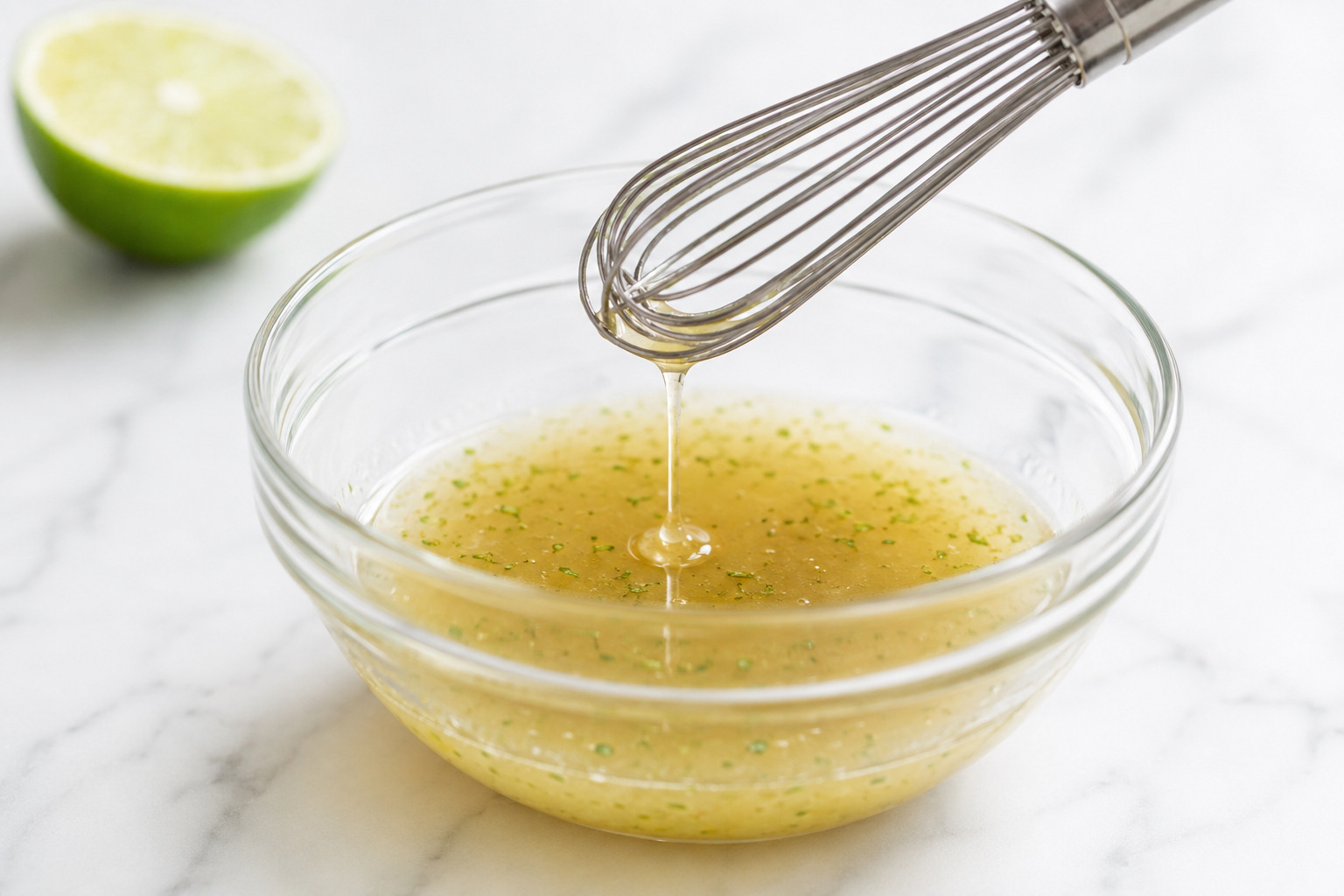
In a small bowl, combine the honey, fresh lime juice, finely grated lime zest, and fine salt. Whisk until the honey is fully loosened and the mixture looks uniform.
If the honey is unusually thick, let it stand at room temperature for a few minutes before whisking. Do not warm the dressing enough to heat the fruit.
What you should see: A thin, glossy, pale-gold dressing with fine green flecks of zest and no separate honey streaks.
Dress and Fold Gently
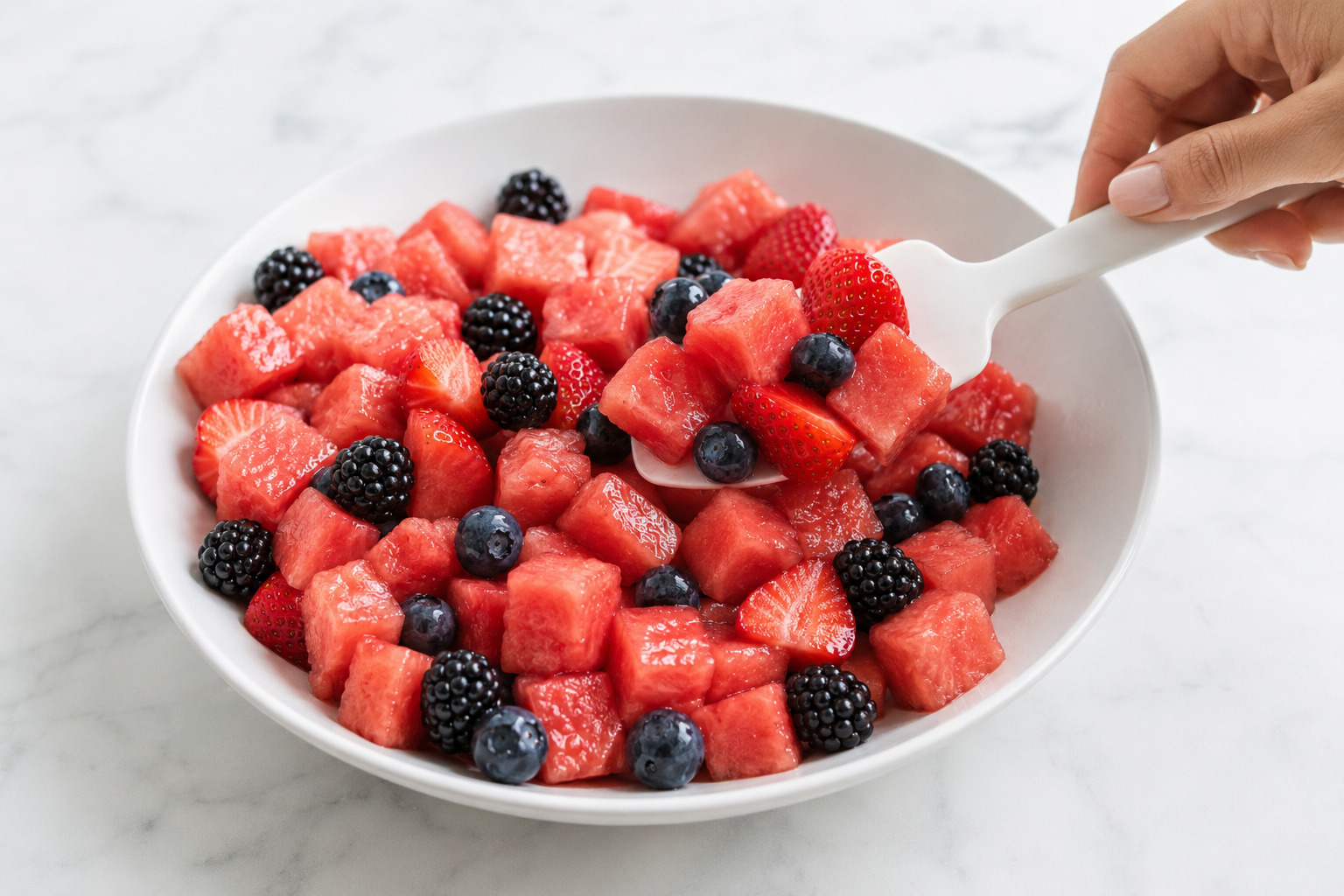
Pour the dressing evenly over the fruit only when you are ready to serve. Slide a flexible spoon or spatula down the side of the bowl, lift fruit from the bottom, and turn it over the top. Repeat only three or four times, rotating the bowl as needed.
Do not stir in circles. Circular stirring presses the softer strawberries against the watermelon and can break blackberries into the dressing.
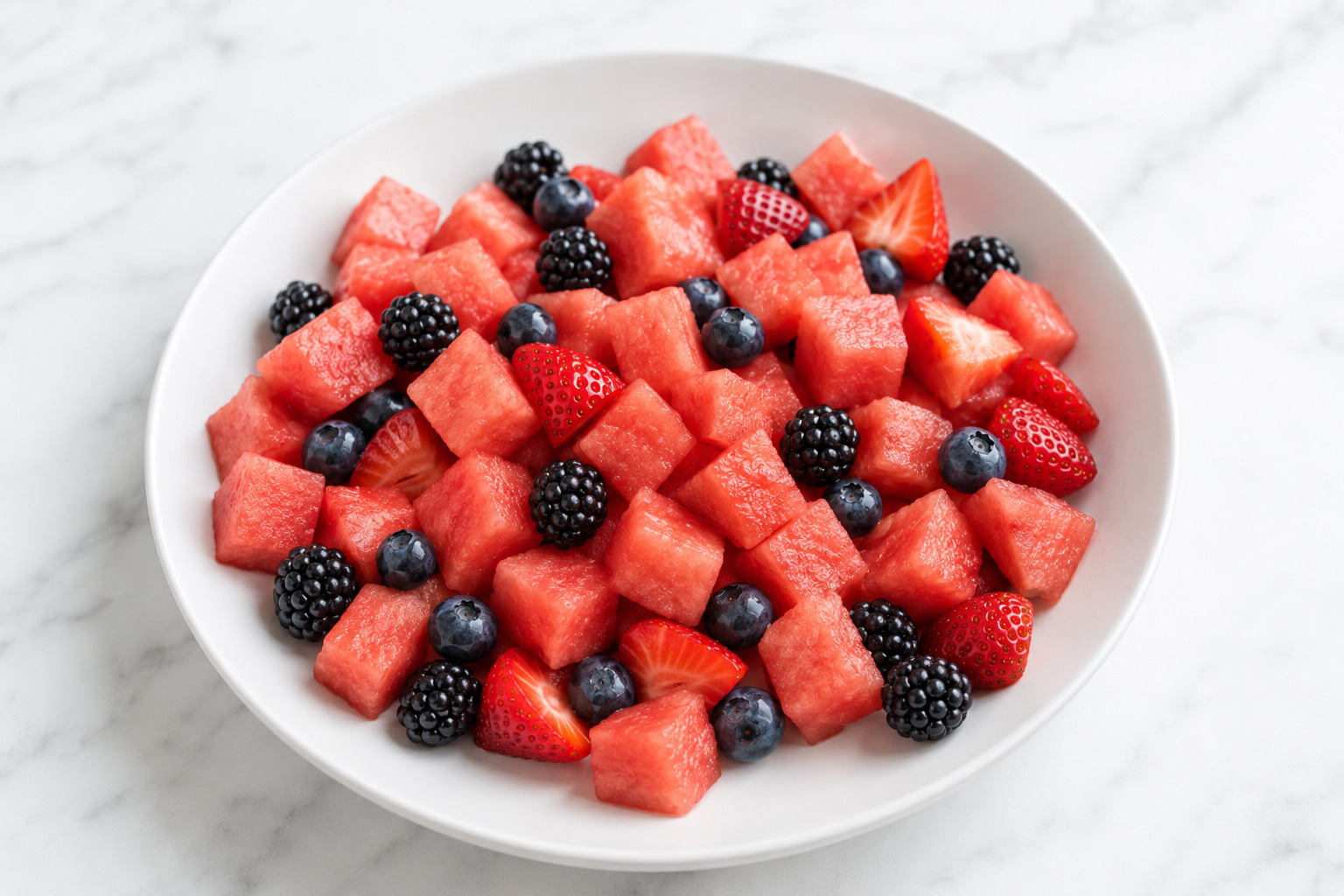
What you should see: A fine sheen over the fruit, intact berries, and little to no liquid collecting at the bottom of the bowl.
Finish with Mint and Serve Cold
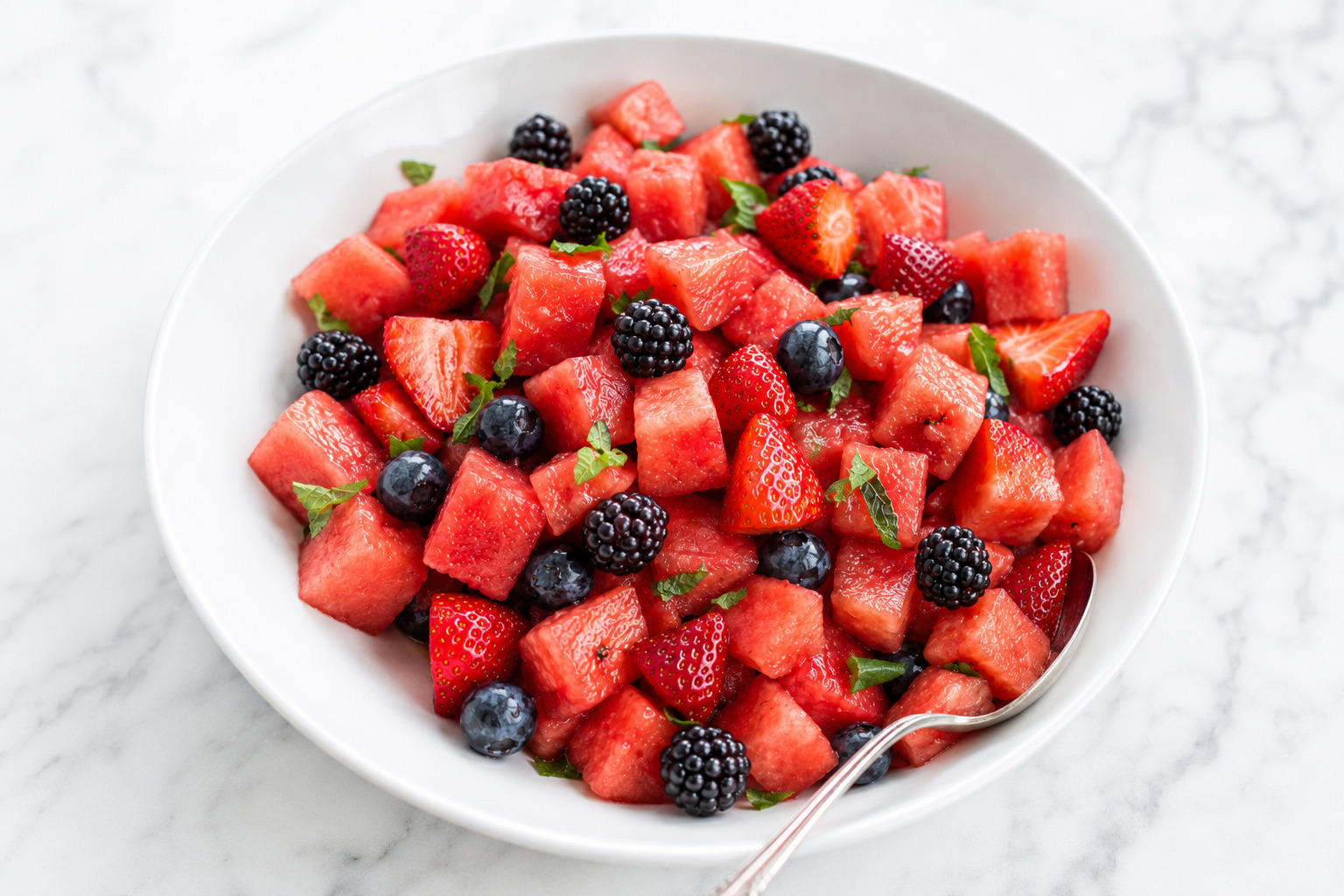
Tear or thinly slice the mint leaves, scatter them over the salad, and give the fruit one final gentle turn if needed. Serve immediately, or refrigerate for no more than 10 minutes before bringing the bowl to the table.
What you should see: Bright green mint distributed lightly through distinct red, blue, and purple fruit, with a fresh glossy surface rather than a softened, macerated appearance.
Why Watermelon Fruit Salad Turns Watery
Watermelon is made mostly of water, and cutting it opens thousands of moisture-rich cells along every surface. Some juice release is therefore normal even before any dressing is added. The technical goal is to slow the process and avoid introducing extra water—not to make watermelon behave like a dry fruit.
Honey, lime juice, and salt also change the environment around the fruit. Once those dissolved substances coat the cut surfaces, water gradually moves out of the fruit and into the dressing. The longer the dressed salad stands, the more visible that liquid becomes. This is why maceration is useful for some desserts but works against the fresh, distinct texture wanted here.
The recipe controls moisture in three connected ways:
- Dry surfaces: Water left from rinsing dilutes flavor immediately, before the fruit has released any of its own juice.
- Aromatic zest instead of extra juice: Lime zest intensifies citrus aroma without adding another stream of liquid and acid.
- Last-minute dressing: Keeping the dressing separate shortens the time in which moisture migration can occur.
Temperature helps as well. Chilled fruit is firmer and easier to fold without crushing. Mint enters last because cut or bruised leaves oxidize, darken, and release stronger herbal notes when they are repeatedly handled.
The Small Details That Keep Every Bite Fresh and Glossy
These are the details that make a simple bowl of fruit feel composed rather than improvised.
- Chill before cutting, not after dressing. A long refrigeration period after assembly gives the dressing time to draw out juice.
- Use a wide bowl. More surface area allows the dressing to reach the fruit with fewer folds and less pressure.
- Whisk the dressing separately. Honey drizzled directly over cold fruit can cling in heavy patches instead of forming a fine, even coating.
- Leave cutting-board juice behind. That liquid is flavorful, but adding it makes the salad look watery from the beginning.
- Prepare the mint at the last moment. Tear or slice it just before it enters the bowl so the edges stay green.
- Divide a very large batch between two bowls. An overfilled bowl requires aggressive mixing and puts the berries under the full weight of the watermelon.
- Taste the fruit before adjusting the dressing. If the watermelon is less sweet than expected, increase the honey by up to 1 tablespoon rather than adding granulated sugar to the fruit.
Common Mistakes That Dilute the Fruit
The most common problems are easy to identify because each one leaves a visible clue in the bowl.
Dressing the Fruit Too Early
What goes wrong: A noticeable layer of pink-red liquid collects at the bottom, and the fruit surfaces begin to look softened.
Why it happens: Honey, lime, and salt have had enough time to encourage moisture to leave the cut fruit.
How to correct it: Keep the dressing separate and fold it in immediately before serving. If the salad is already watery, use a slotted spoon for serving; do not add more honey to compensate for diluted flavor.
Adding Berries While They Are Still Wet
What goes wrong: The dressing tastes thin and slips off the fruit instead of leaving a glossy coating.
Why it happens: Rinse water dilutes the honey-lime mixture before it can season the fruit.
How to correct it: Dry berries in a single layer on a clean towel or paper towels. Pay special attention to the hollow stem area of hulled strawberries.
Using Warm or Overripe Watermelon
What goes wrong: Cubes break at the edges, the bowl warms quickly, and the texture feels soft rather than crisp.
Why it happens: Overripe flesh has already lost structural firmness, and warm fruit is more fragile during folding.
How to correct it: Choose firm watermelon and chill it before cutting. Save very soft watermelon for smoothies, agua fresca, or frozen drinks.
Stirring Repeatedly or Aggressively
What goes wrong: Blackberries stain the dressing, strawberries become ragged, and small pieces settle at the bottom.
Why it happens: Repeated pressure ruptures delicate berry cells.
How to correct it: Use a wide bowl and fold from the bottom only three or four times.
Adding More Lime Juice for Extra Brightness
What goes wrong: The salad becomes sharp, increasingly wet, and less clearly watermelon-led.
Why it happens: Extra juice adds both acid and liquid.
How to correct it: Add a small amount of finely grated zest for more lime aroma without upsetting the dressing balance.
Fresh-Fruit Substitutions That Preserve the Balance
Substitutions work best when they preserve the watermelon-dominant proportion, the fresh texture, and the light dressing.
- Raspberries for blackberries: Replace the blackberries cup for cup. Raspberries are more delicate, so place them on top and fold only once or twice.
- Mixed raspberries and blackberries: Use a total of 1 cup to maintain the fruit balance.
- Maple syrup or agave for honey: Use the same volume for a vegan watermelon fruit salad. Maple syrup adds a warmer flavor; agave is more neutral.
- Fresh basil for mint: Use 1 tablespoon of very thinly sliced basil. This creates a more aromatic, culinary profile, but the salad remains sweet.
- Lemon juice for lime: Use the same amount only if lime is unavailable. Lemon tastes clean and bright, although the finished salad will lose some of its tropical character.
Avoid frozen watermelon or frozen berries because thawing damages their structure and adds excess liquid. Canned fruit, banana, and apple pull the recipe toward a different kind of fruit salad. A large addition of grapes also dilutes the watermelon-and-berry identity. Do not scatter granulated sugar directly over the fruit; it encourages more juice release and can remain gritty before dissolving.
Make-Ahead, Storage and Picnic Safety
The best make-ahead plan is to prepare the components separately, keep them cold, and assemble only the amount you expect to serve.
- Cut fruit without dressing: Refrigerate in separate airtight containers for up to 8 hours. Keep blackberries on top or in their own shallow container so they are not crushed.
- Honey-lime dressing: Whisk and refrigerate in a sealed jar or container for up to 2 days. Let it stand briefly at room temperature and shake or whisk again if the honey thickens.
- Mint: Wash and dry it ahead if helpful, but tear or slice it immediately before serving.
- Best quality after dressing: Serve immediately.
- Dressed leftovers: Refrigerate in an airtight container for up to 24 hours. The fruit remains edible when properly refrigerated, but it will become progressively softer and more liquid will collect.
- Freezing: Not recommended. Thawed watermelon and berries lose the crisp, fresh texture this salad depends on.
Keep cut fruit at 40°F/4°C or colder. For a picnic or cookout, transport the components in a cooler with ice packs and keep the serving bowl cold whenever possible. FoodSafety.gov advises that cut fruit and other perishable foods should not remain unrefrigerated for more than 2 hours, or more than 1 hour when the temperature is above 90°F/32°C. See the complete FoodSafety.gov chilling guidance.
Do not rely on appearance or smell alone to judge food safety. When the safe room-temperature limit has passed, discard the salad rather than refrigerating it again.
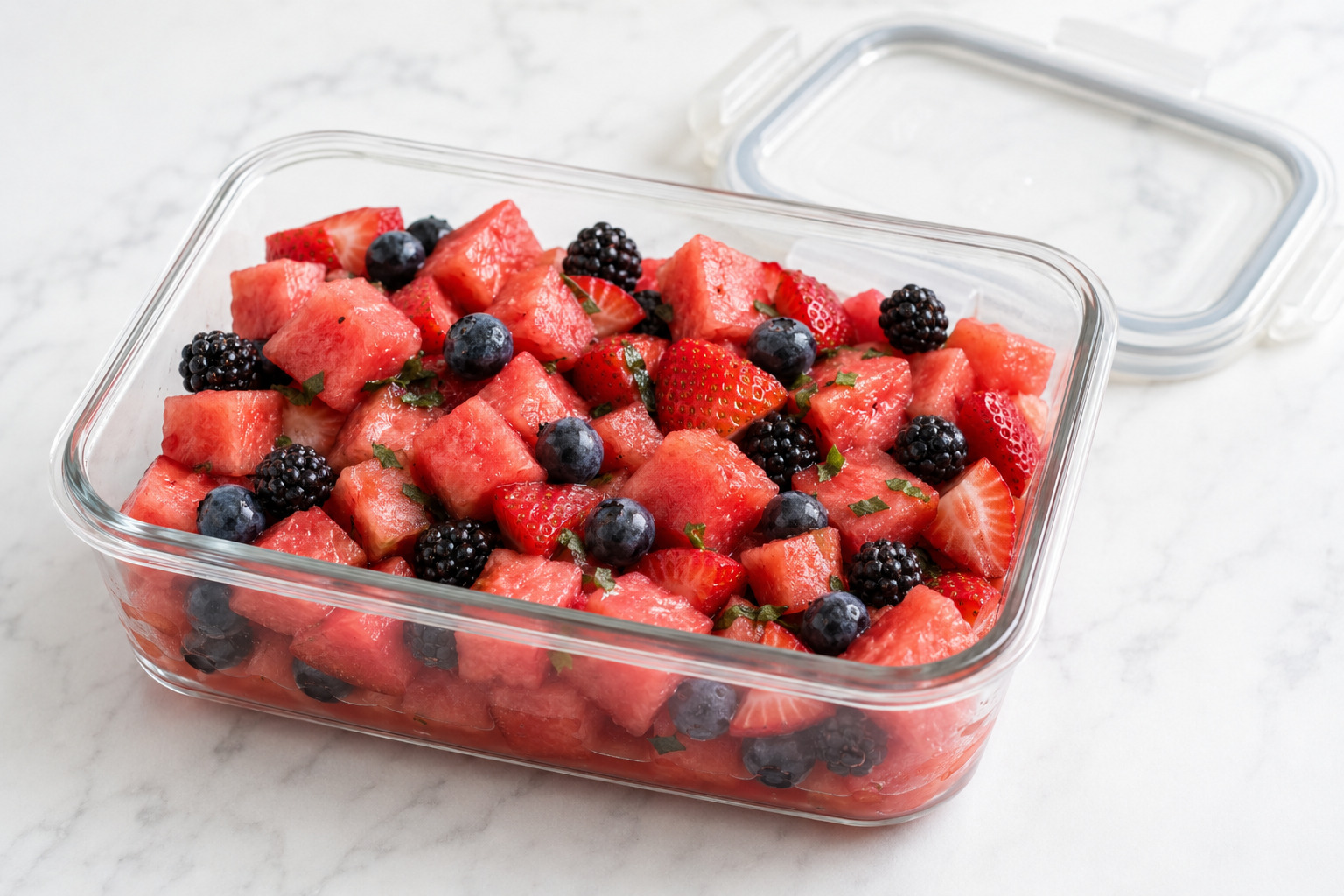
Beautiful Ways to Serve Watermelon Fruit Salad
The fruit already supplies the color, so the most elegant serving choices keep the presentation cool, simple, and spacious.
- In a chilled white ceramic bowl: White makes the watermelon, berries, and mint look especially vivid and works for almost any table.
- In individual glass cups: Clear cups display the fruit layers beautifully for brunches, showers, or a dessert buffet.
- Inside a hollowed watermelon half: Pat the shell dry before filling it, then set it securely on a platter so it cannot roll.
- In small clear picnic jars: Transport fruit and dressing separately and assemble just before eating.
- On chilled dessert plates: Spoon a neat portion onto each plate and finish with a few berries and one small mint tip placed intentionally on top.
For the cleanest appearance, lift servings with a slotted spoon if the salad has been standing long enough to release juice.
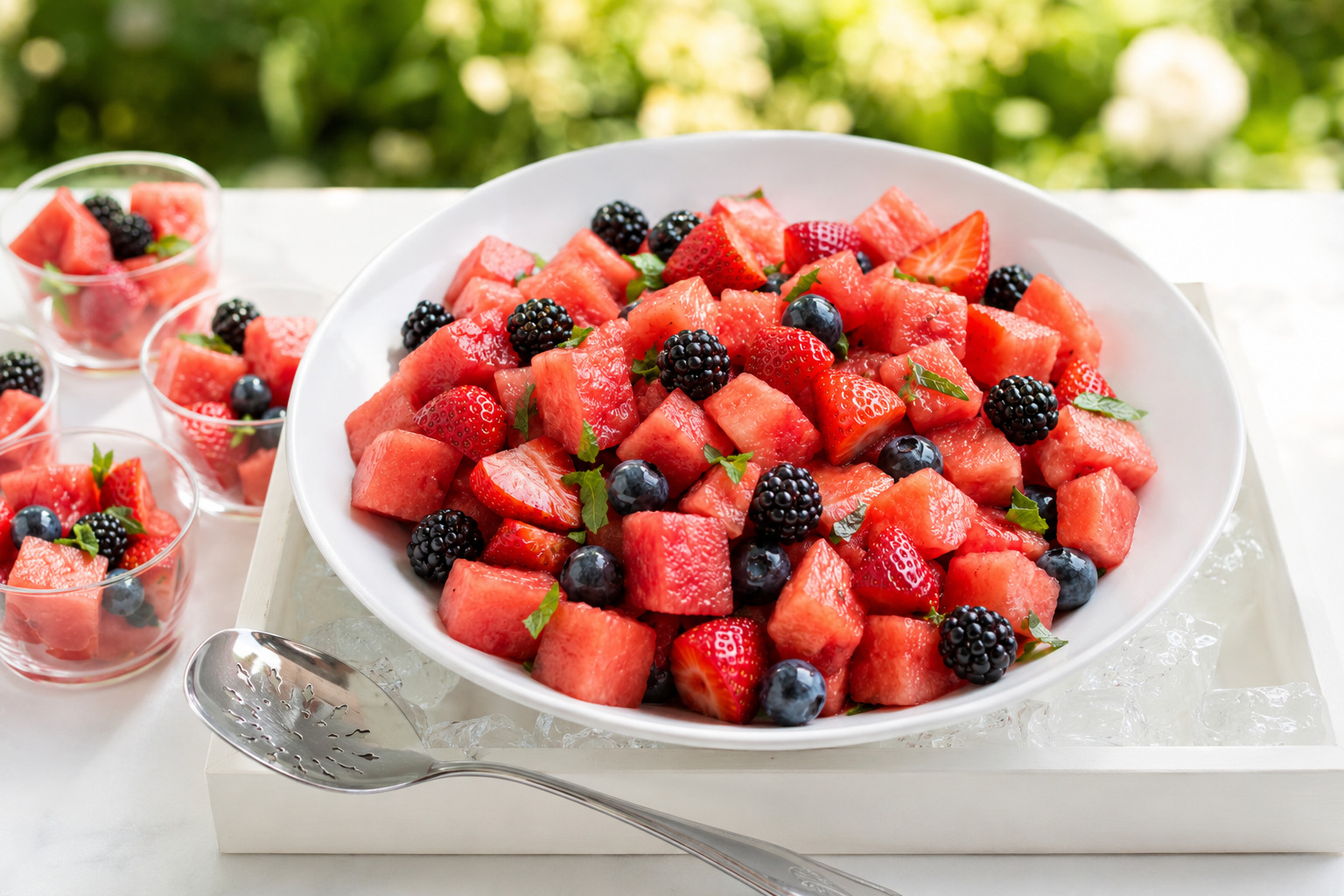
What to Pair with This Refreshing Summer Salad
This salad can function as a light dessert, a bright fruit side, or part of a larger brunch table. Its sweet, citrusy profile pairs best with foods that do not compete with the fresh fruit.
For brunch, serve it beside waffles, pancakes, French toast, scones, or a simple coffee cake. At a cookout, it brings cooling contrast to grilled foods and richer picnic sides. For a light lunch, pair it with simple sandwiches or a chilled pasta dish and keep the fruit salad as the sweet finish.
On a dessert table, combine it with vanilla panna cotta, shortcake, sugar cookies, or a small scoop of vanilla ice cream. Avoid pouring cream or heavy sauce over the full serving bowl; offer any creamy accompaniment separately so the fruit keeps its bright, refreshing identity.
Watermelon Fruit Salad FAQs
These answers cover the practical questions that usually come up when choosing, cutting, or scaling the fruit.
How Much Whole Watermelon Do I Need for 7 Cups of Cubes?
Seven cups of cubes weigh approximately 1.05 kg or 2.3 pounds. Because rind accounts for part of the whole fruit, a small seedless watermelon around 4–5 pounds should provide enough flesh with some extra. Yield varies with rind thickness and trimming, so measuring the cubes is more reliable than relying only on whole-fruit weight.
Can I Use Pre-Cut Watermelon?
Yes, provided it has been kept refrigerated and looks firm, fresh, and free of excess liquid. Choose pieces with clean edges rather than soft, translucent surfaces. Pre-cut watermelon saves time, but whole watermelon often has a crisper texture and gives you more control over cube size.
Can I Use a Melon Baller Instead of Cutting Cubes?
Yes. Watermelon balls create a beautiful presentation, especially for a shower or brunch. Measure 7 cups after shaping and choose a medium melon baller so the pieces remain easy to eat with the berries. Work with very cold watermelon because soft flesh is harder to shape cleanly.
What If My Watermelon Is Not Very Sweet?
Taste the fruit before making adjustments. Increase the honey from 2 tablespoons to 3 tablespoons if needed, whisking the extra tablespoon into the dressing. Do not sprinkle sugar directly over the watermelon, because it can draw out more liquid and create unevenly sweet patches.
Can I Leave Out the Mint?
Yes. The fruit and honey-lime dressing remain complete without mint. If you want a different fresh herb, use 1 tablespoon of very thinly sliced basil, understanding that it gives the salad a more aromatic flavor.
Can I Double This Recipe for a Party?
Yes. Double every ingredient, but divide the fruit between two wide bowls for folding. Dress each bowl separately just before serving. This protects the berries from the weight of a very large batch and makes it easier to keep a second bowl refrigerated until needed.
Why Did My Mint Turn Dark?
Mint darkens when it is bruised, cut too early, stored while wet, or mixed too aggressively. Dry the leaves completely, use a sharp knife if slicing, and add the mint only at the end. Tear it gently for a softer, more natural appearance.
Why This Recipe Deserves a Place in Your Recipe Box
This watermelon fruit salad solves the two things that matter most in a simple summer recipe: it creates a generous, beautiful bowl quickly, and it protects the fresh fruit from unnecessary handling.
Fifteen-Minute Freshness
The entire salad can move from chilled fruit to the table in approximately 15 minutes without cooking.
Watermelon Stays the Star
The fruit proportions keep every serving clearly watermelon-led rather than turning it into a generic mixed-fruit bowl.
A Dressing That Does Not Drown the Fruit
The restrained honey-lime formula adds gloss and flavor without creating a heavy syrup.
Built for Summer Tables
The recipe feels equally natural at brunch, a BBQ, a picnic, a potluck, or as a light dessert.
Easy to Scale
The formula doubles cleanly when the fruit is divided into wide bowls and dressed in manageable batches.
Simple Make-Ahead Control
Keeping the fruit, dressing, and mint separate lets you prepare early without sacrificing the best serving texture.
Keep the Summer Fruit Celebration Going
Once this watermelon fruit salad is on your summer rotation, choose the next recipe by deciding whether you want more fresh fruit, a chilled dessert, or a fruit-forward baking project.
Stay with Fresh, Colorful Fruit
These recipes keep fresh produce at the center while changing the balance of sweetness, creaminess, or savory contrast.
- Fruit Salad is the best next choice when you want a broader mix of classic fruits in one easy bowl.
- Mango Salad brings ripe mango together with crisp vegetables and lime for a brighter, more savory direction.
- Peach Salad pairs sweet peaches with greens, cheese, and nuts when you want fruit to lead a composed summer side.
- Grape Salad turns crisp grapes into a chilled, creamy fruit dish that feels richer and more dessert-like.
Turn Summer Fruit into a Chilled Dessert
Follow this path when the freshness of the salad has you craving something cold, creamy, and made for a warm afternoon.
- Strawberry Ice Cream carries the berry flavor into an easy frozen dessert with a soft, creamy finish.
- Panna Cotta gives you a silky Italian cream dessert that looks elegant with fresh berries beside it.
- Authentic Italian Gelato is the technical next project when you want dense, smooth gelato alla crema with carefully balanced sweetness.
- Homemade Ice Cream offers a classic vanilla base that pairs naturally with nearly any summer fruit.
Make the Next Fruit-Forward Dessert a Baking Project
Choose one of these when you are ready to turn ripe fruit into something more structured, celebratory, or warmly baked.
- Strawberry Shortcake layers tender buttery shortcakes with juicy berries and softly whipped cream.
- Peach Dump Cake transforms peaches, cake mix, and butter into a golden, scoopable dessert with almost no mixing.
- Lemon Blueberry Cake is an elegant three-layer project with plush lemon cake, curd, blueberry filling, and cream cheese buttercream.
- Fruit Pizza combines a soft sugar-cookie base, creamy frosting, and a colorful fresh-fruit finish for a shareable summer centerpiece.
Final Thoughts on a Fruit Salad Made for Summer
This watermelon fruit salad is designed to bring cold, vivid sweetness to a warm-weather table without feeling heavy or complicated. Watermelon remains the center of the bowl, berries provide color and contrast, and honey, lime, and mint supply only the finishing notes the fruit needs.
The cold-dry-last-minute system is the part worth remembering beyond this one recipe. Begin with chilled fruit, remove every trace of rinse water, and add the dressing only when the bowl is ready to serve; those three decisions keep the colors clear, the berries distinct, and the flavor concentrated.
Fresh summer fruit rarely needs more ingredients—it needs good timing and restraint. When the fruit is ripe and the method protects it, a simple bowl can feel every bit as thoughtful as a more elaborate dessert.

Love this? There are twenty more like it.
128 pages, five chapters, 15 kitchen guides and 16 printable planning pages — in US Letter and A4.

Watermelon Fruit Salad
A sweet, chilled watermelon fruit salad with strawberries, blueberries, blackberries, fresh mint, and a light honey-lime dressing, ready in 15 minutes.
Ingredients
- 7 cups seedless watermelon, cut into 1-inch cubes (about 1.05 kg)
- 2 cups strawberries, hulled and quartered (about 300 g)
- 1 cup fresh blueberries (about 150 g)
- 1 cup fresh blackberries (about 145 g)
- 2 tablespoons honey (42 g)
- 2 tablespoons freshly squeezed lime juice (30 ml)
- 1 teaspoon finely grated lime zest
- 1/8 teaspoon fine salt
- 2 tablespoons fresh mint leaves, torn or thinly sliced (about 5 g)
Instructions
- Prepare the fruit. Chill all fruit before beginning. Rinse the whole watermelon before cutting, then dry it. Cut the watermelon into 1-inch cubes and quarter the hulled strawberries. Keep the blueberries and blackberries whole. Make sure all fruit is thoroughly dry.
- Combine the fruit. Place the watermelon, strawberries, blueberries, and blackberries in a wide mixing or serving bowl. Leave any cutting-board juice behind.
- Make the dressing. In a small bowl, whisk the honey, lime juice, lime zest, and salt until the honey is fully dissolved and the dressing is thin, glossy, and uniform.
- Dress the salad. Immediately before serving, pour the dressing over the fruit. Fold gently from the bottom only three or four times, stopping when the fruit has a light, even sheen and the berries remain intact.
- Add the mint. Tear or thinly slice the mint, add it to the bowl, and give the salad one final gentle turn only if needed.
- Serve. Serve immediately, or refrigerate for no more than 10 minutes before serving.
Notes
- Taste the watermelon before adjusting the dressing. If it is less sweet than expected, increase the honey from 2 tablespoons to 3 tablespoons.
- Keep the cut fruit, dressing, and mint separate until serving to limit excess juice.
- Fresh raspberries may replace the blackberries cup for cup. Fold them only once or twice because they are more delicate.
- For a vegan version, replace the honey with the same volume of maple syrup or agave.
- Fresh lemon juice may replace the lime juice in the same amount, although the finished flavor will be less tropical.
- Do not use frozen watermelon, frozen berries, canned fruit, or granulated sugar scattered directly over the fruit.
- For a double batch, divide the fruit between two wide bowls and dress each bowl separately immediately before serving.
Make-Ahead, Storage, and Safety
- Refrigerate cut, undressed fruit in separate airtight containers for up to 8 hours.
- Refrigerate the honey-lime dressing separately for up to 2 days.
- Wash and dry mint ahead if useful, but tear or slice it immediately before serving.
- Serve the salad immediately after dressing for best quality.
- Refrigerate dressed leftovers promptly in an airtight container and use within 24 hours. Progressive softening and juice release are expected.
- Keep cut fruit at 40°F/4°C or colder.
- Do not leave the salad unrefrigerated for more than 2 hours, or more than 1 hour above 90°F/32°C.
- Freezing is not recommended.
Nutrition Information:
Yield: 8 Serving Size: 1 1/3 cupsAmount Per Serving: Calories: 90Total Fat: 0.5gSodium: 40mgCarbohydrates: 22gFiber: 3gSugar: 17gProtein: 1.5g
Nutrition information is provided as an estimate only and may vary based on specific ingredients, brands, and portion sizes used. This information should not be considered medical or nutritional advice.
12 Sweet Favorites — Yours, Free 🍰
Tiramisù, no-bake cheesecake, the perfect chocolate chip cookie & 9 more reader-loved desserts — gathered into one beautiful free recipe book. From my kitchen to yours.
No spam, just sweet things. Unsubscribe anytime.