Banana Cream Pie (Classic, Creamy & Made from Scratch)
🎁 FREE E-BOOK: 12 Sweet Favorites — reader-loved desserts in one beautiful recipe book.
This Banana Cream Pie layers a deeply golden, flaky pastry shell with silky vanilla pastry cream, tender fresh bananas, and a generous crown of softly whipped cream. Served refrigerator-cold, every slice brings crisp pastry, cool custard, and clear banana flavor together without becoming heavy or overly sweet.
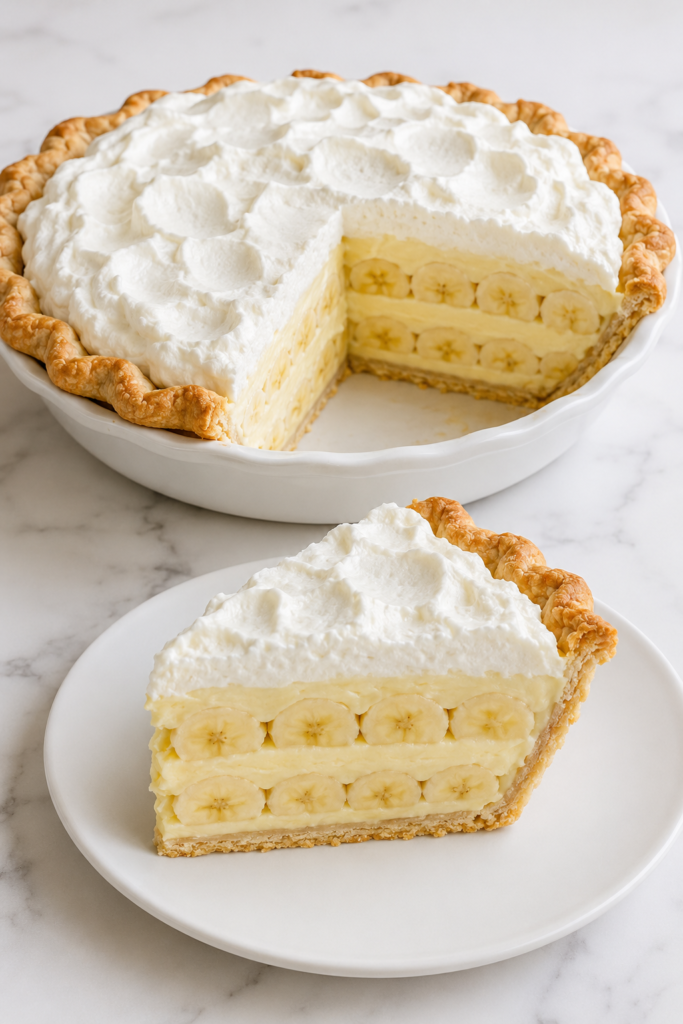
There is something instantly familiar about a classic cream pie: the tall pale filling, the golden crimped edge, and the promise of a soft, cool slice waiting in the refrigerator. Because most of the work happens before serving, it is also the kind of comforting dessert that lets you welcome people without rushing through the final hour.
This is a recipe worth keeping for its checkpoints as much as its flavor. It records exactly how far to bake the crust, when the pastry cream is truly cooked, how to enclose the bananas, and how to plan the chilling stages backward from serving time.
Quick Recipe Overview
This is a classic scratch Banana Cream Pie built in a standard 9-inch pastry shell, with two controlled banana layers enclosed in cooked vanilla pastry cream and finished with fresh whipped cream.
| Yield | 10 moderate slices or 8 generous slices |
|---|---|
| Difficulty | Approachable intermediate |
| Active time | About 1 hour 20 minutes |
| Total time | About 8 hours for the one-day path |
| Best workflow | Prepare the crust and pastry cream one day ahead |
| Serving state | Thoroughly refrigerator-cold |
| Best quality | Within 24 hours of assembly |
This version is a classic pastry-crust Banana Cream Pie with cooked vanilla pastry cream—not Banana Pudding Recipe set inside a cookie crust. It requires a full blind bake and two separate chilling stages, but each stage can be prepared on a calm, practical schedule.
Why This Recipe Works
Every component is designed around a clean, layered slice: the shell is fully baked and protected, the custard reaches a measurable cooking endpoint, and the bananas are enclosed only after everything is cold.
- The pastry cream reaches a true set. It cooks through the first broad bubble and a full 60-second hold instead of stopping when it merely looks thick.
- The crust has two moisture controls. A deep full blind bake builds a rigid shell, while a thin baked egg-white film slows moisture movement from the filling.
- Two banana layers keep the flavor present. A measured 340 g of firm-ripe fruit creates banana in every slice without crowding the standard pie plate.
- Complete enclosure limits browning. Three pastry-cream placements cover the cut banana surfaces without adding lemon flavor.
- Cold assembly protects structure. The shell is completely cool and the pastry cream is 40°F or colder before the fruit is layered.
- The topping stays proportionate. Lightly sweetened medium-firm whipped cream creates a generous crown without overpowering the banana and vanilla.
Why You’ll Love This Recipe
This pie suits the moments when you want a familiar, impressive dessert that can be staged before guests arrive and served directly from the refrigerator.
- It uses recognizable baking ingredients rather than instant pudding or frozen whipped topping.
- The crust and pastry cream can both be prepared ahead.
- The banana-and-vanilla flavor feels classic, gentle, and broadly appealing.
- One standard pie serves 8–10 people without specialty bakeware.
- The two-day path separates the technical work from final assembly.
- Cold slices hold their layers cleanly while remaining silky and tender.
The Food Science Behind a Sliceable Pastry Cream
A sliceable pastry cream depends on complete starch cooking, not simply on becoming visibly thick. Cornstarch begins setting before boiling, so the mixture can look finished while it still lacks the structure needed to remain stable after chilling.
The controlling endpoint is the first broad bubble breaking through the thick cream, followed by 60 seconds of continuous whisking and controlled cooking. That full hold develops the starch set and deactivates yolk enzymes that can otherwise weaken it later. A thermometer reading of 200–205°F / 93–96°C supports the visual cue, but it does not replace the bubble-and-hold step.
Cooked egg mixtures reach the safety threshold at 160°F / 71°C according to USDA guidance for cooked egg mixtures. This pastry cream continues well beyond that temperature because its texture also depends on fully cooking the cornstarch.
Ingredients You’ll Need
The recipe uses four simple components. Ingredient temperature and condition matter as much as quantity, especially for the butter, bananas, pastry cream, and whipping cream.
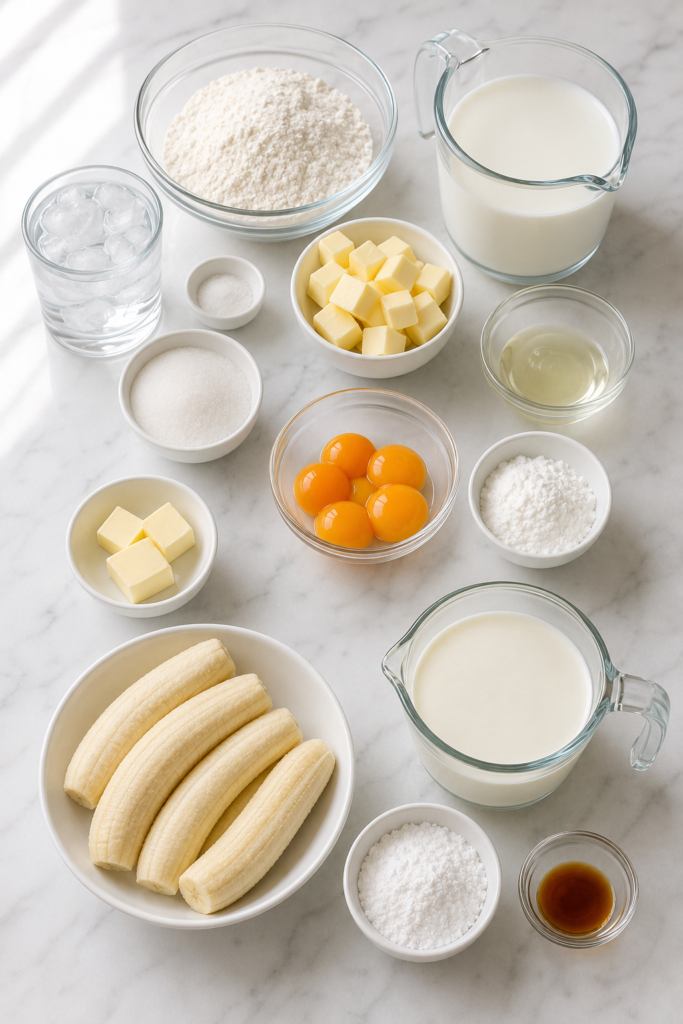
For the All-Butter Pastry Crust
Very cold butter and controlled hydration create a dough that can form flaky layers while remaining strong enough to support the chilled filling.
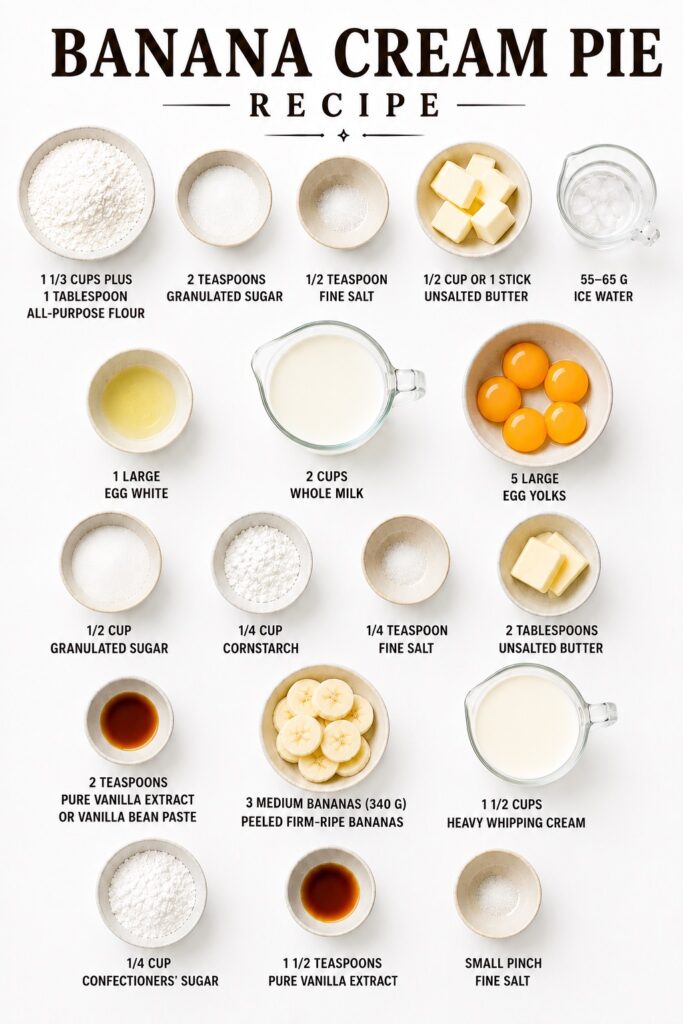
- 170 g all-purpose flour — 1 1/3 cups plus 1 tablespoon
- 8 g granulated sugar — 2 teaspoons
- 3 g fine salt — 1/2 teaspoon
- 113 g very cold unsalted butter — 1/2 cup or 1 stick, cut into 1/2-inch cubes
- 55–65 g ice water — begin with 3 tablespoons plus 2 teaspoons and add only as needed
- Lightly beaten egg white — use 8–12 g from 1 large egg white for the moisture barrier
For the Vanilla Pastry Cream
Whole milk, yolks, and cornstarch create a smooth filling that is rich enough for cream-pie flavor but firm enough to mound when cold.
- 480 g whole milk — 2 cups
- 90 g large egg yolks — 5 yolks
- 100 g granulated sugar — 1/2 cup
- 30 g cornstarch — 1/4 cup
- 1.5 g fine salt — 1/4 teaspoon
- 28 g unsalted butter — 2 tablespoons, cubed
- 10 g pure vanilla extract or vanilla bean paste — 2 teaspoons
For the Banana Layers
Choose bananas that are fully yellow and fragrant but still firm. Heavily spotted, soft fruit is better for baking because it releases more moisture and loses clean layer definition.
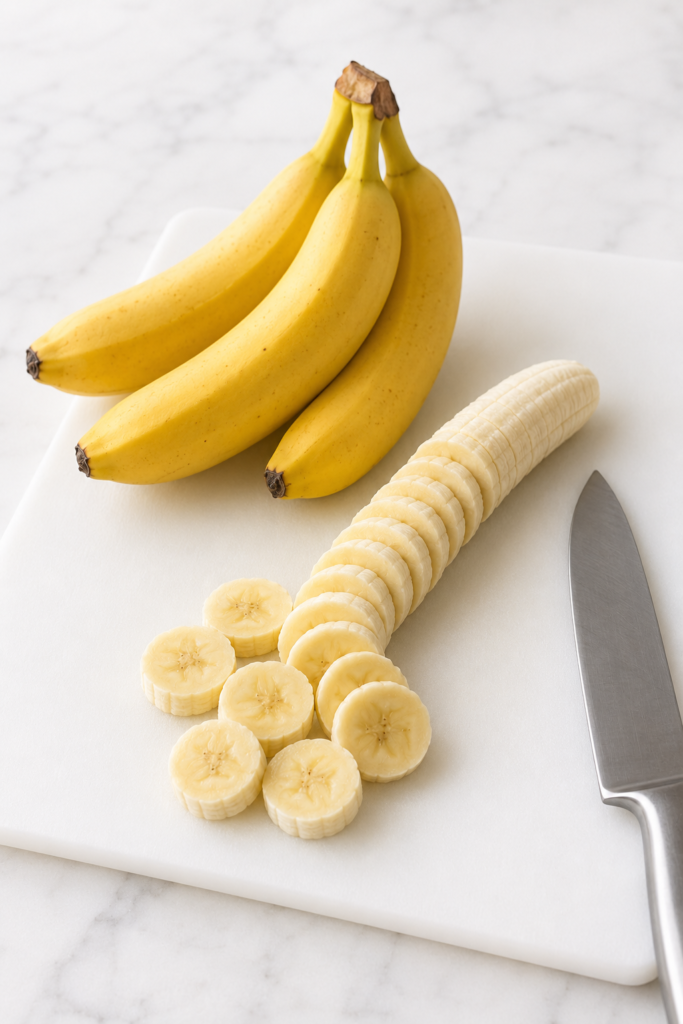
- 340 g peeled firm-ripe bananas — about 3 medium bananas, sliced 1/4 inch thick immediately before assembly
For the Whipped-Cream Topping
Cold heavy cream whipped at medium speed produces a smooth, controllable crown. Confectioners’ sugar adds restrained sweetness and modest starch-assisted stability.
- 355 g cold heavy whipping cream — 1 1/2 cups; 36% fat preferred
- 30 g confectioners’ sugar — 1/4 cup
- 7.5 g pure vanilla extract — 1 1/2 teaspoons
- 0.5 g fine salt — a small pinch
Equipment You’ll Need
The standard pie plate controls the filling depth, while the baking sheet, weights, thermometer, sieve, and ice bath protect the crust and custard at their most important decision points.
- Standard 9-inch / 23 cm pie plate, not deep-dish
- Rimmed metal baking sheet
- Parchment paper and enough pie weights or dry beans to fill the shell to the upper edge
- Rolling pin
- 2–3-quart heavy saucepan
- Heatproof mixing bowl and shallow heatproof cooling dish
- Whisk and flexible spatula
- Fine-mesh sieve
- Instant-read thermometer, recommended
- Large bowl or container for an ice bath
- Hand or stand mixer
Before You Begin
Complete these six checks before beginning. The pie is manageable when every cold stage, cooling space, and serving deadline is planned before the custard reaches the stove.
- Confirm that your vessel is a standard 9-inch pie plate rather than a deep-dish plate.
- Reserve at least 2 hours for dough chilling, 3 hours for pastry-cream chilling, and 4 hours for the assembled set.
- Make room for a shallow pastry-cream dish over an ice bath and inside the refrigerator.
- Set out enough pie weights or dry beans to support the shell all the way to the upper edge.
- Keep the bananas whole until both the baked shell and pastry cream are completely cold.
- Plan to add the unstabilized whipped cream no more than 4 hours before serving.
Banana Cream Pie Timeline and Workback Plan
Start at least 8 hours before serving for the one-day path. For the calmest schedule, work backward from serving time and prepare the crust and pastry cream the day before.
| When | What to prepare | Ready state | How to hold it |
|---|---|---|---|
| 24–48 hours before | Make and chill the pie dough | Dough is wrapped and has rested at least 2 hours | Refrigerate up to 2 days |
| 8–24 hours before | Fully blind-bake and cool the shell | Base is deep golden, dry, and completely cool | Keep airtight at cool room temperature |
| 8–24 hours before | Cook, rapidly cool, and chill the pastry cream | 40°F / 4°C or colder and fully firm | Refrigerate under direct surface cover |
| 4–24 hours before | Slice bananas and assemble | Fruit is completely enclosed in cold pastry cream | Refrigerate under direct surface cover |
| 0–4 hours before | Whip cream and finish the pie | Filling has completed its 4-hour set | Keep refrigerated |
| At serving time | Slice the pie cold | Layers are firm and topping is fresh | Use a clean hot-dry knife between cuts |
What to Expect
This is a staged cold-set pie, so several normal intermediate states look different from the finished slice. Use these expectations to judge progress without rushing the recipe.
- The dough may not need the full water range; it is ready when it holds under pressure, not when it becomes uniformly wet.
- The hot pastry cream should be very thick and fall in heavy ribbons, then become firmer after rapid chilling.
- The banana-and-custard filling should finish at or just below the inner crust rim before whipped cream is added.
- The full 4-hour assembled chill is separate from the pastry cream’s earlier 3-hour chill.
- The deeply baked crust is crispest during the first 24 hours and will gradually soften after assembly.
How to Make Banana Cream Pie
Make the pie in seven controlled phases. Do not advance from one component to the next until its visible, temperature, or texture endpoint is satisfied.
1. Make and Chill the Pie Dough
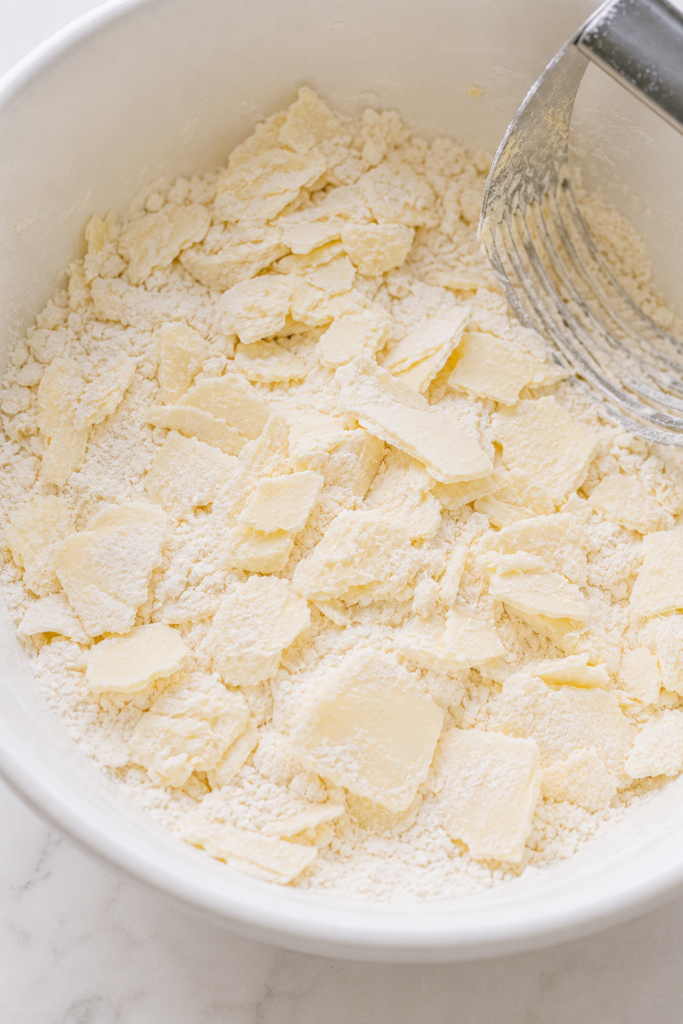
Whisk the flour, sugar, and salt. Toss in the very cold butter and flatten the pieces between your fingertips until irregular flour-coated flakes range from pea to nickel size.
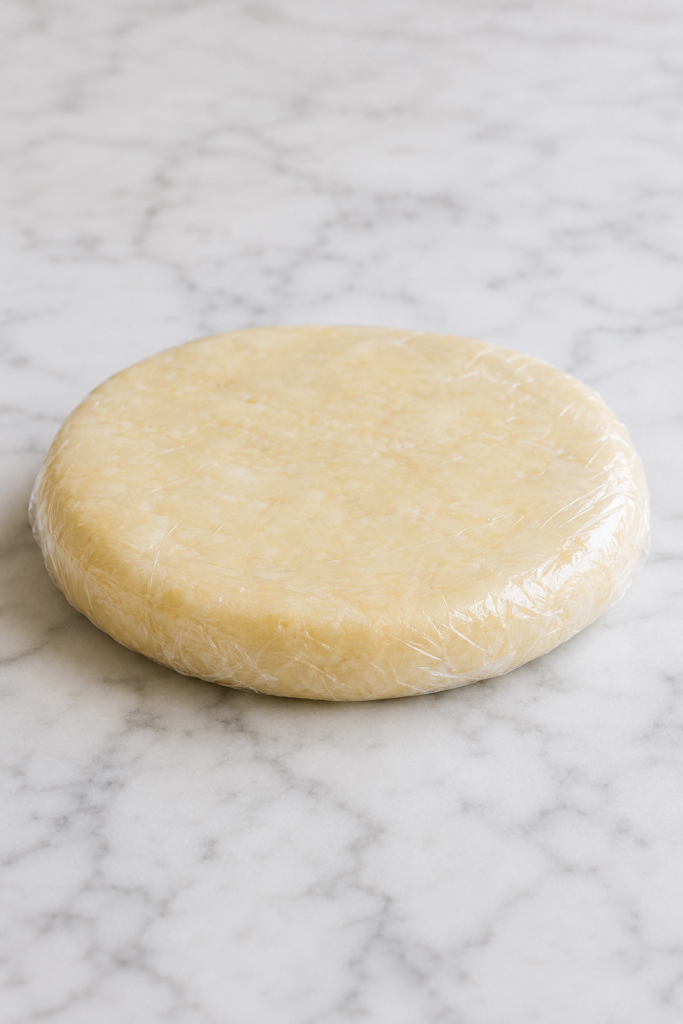
Add 55 g ice water, toss and fold, then add the remaining water 5 g or 1 teaspoon at a time only until a squeezed handful holds together. Form a 1-inch-thick disk, wrap, and refrigerate for at least 2 hours or up to 2 days.
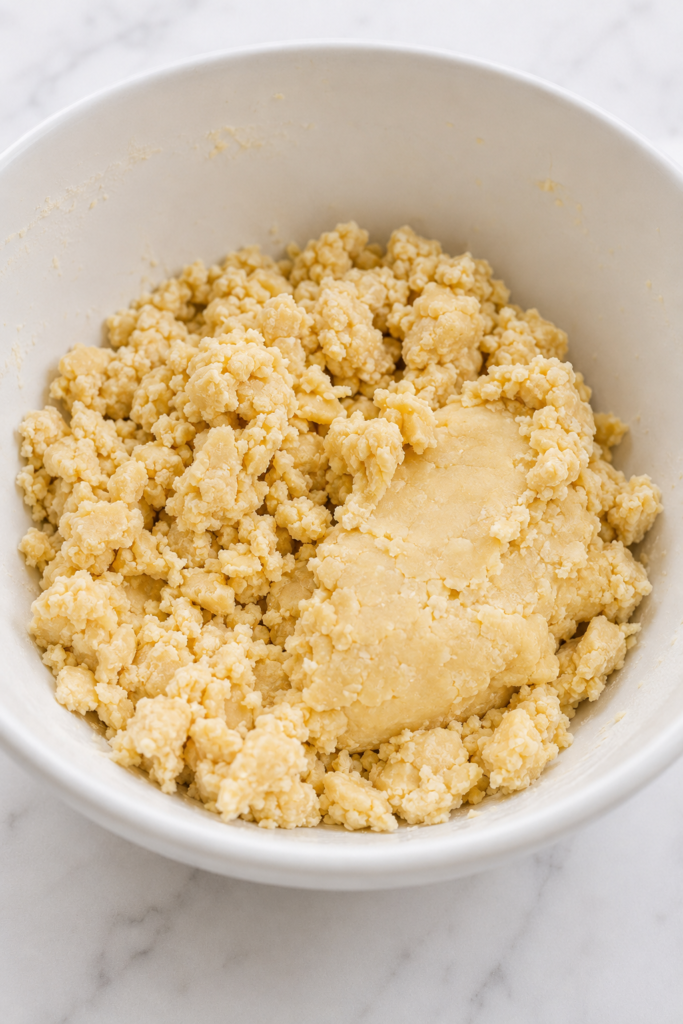
What you should see: distinct flat butter flakes in a cohesive but non-sticky dough; a pressed handful holds without dry flour, while the wrapped disk remains lightly marbled rather than uniformly smooth.
2. Roll and Chill the Pie Shell
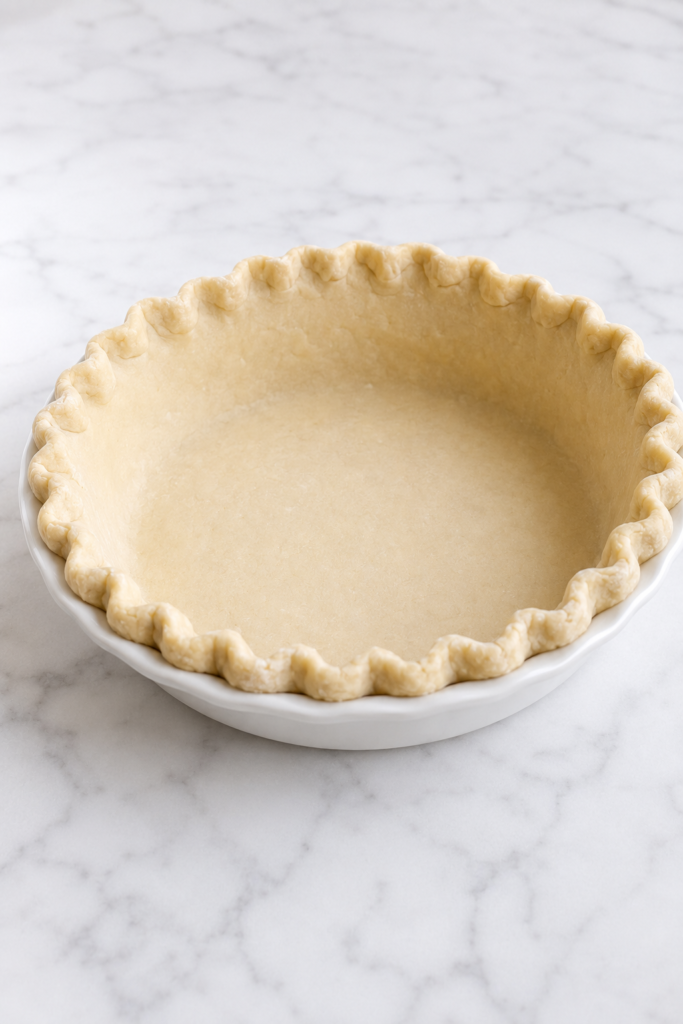
Roll the dough to a 13-inch circle about 1/8 inch thick. Ease it into the standard 9-inch plate without stretching, trim to a 1-inch overhang, fold the overhang under, and crimp above the rim. Refrigerate for 45 minutes or freeze for 20 minutes. Meanwhile, preheat the oven to 375°F / 190°C with a rimmed metal baking sheet on the lower-middle rack.
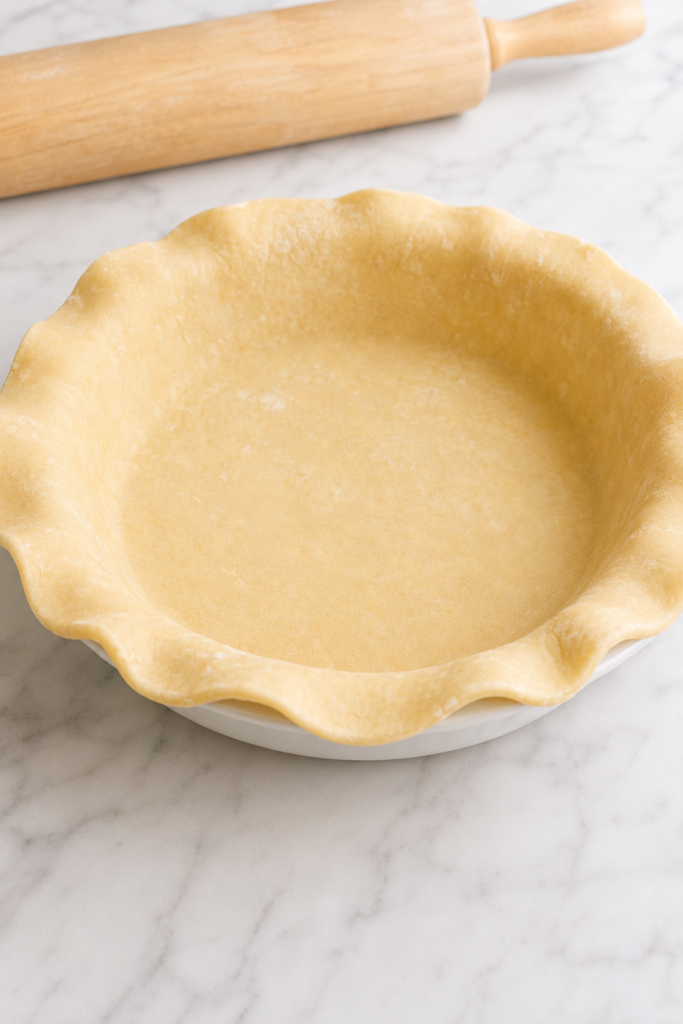
What you should see: an even 1/8-inch shell resting naturally against the plate, with a reinforced crimp above the rim and dough that feels firm before it enters the oven.
3. Fully Blind-Bake the Crust
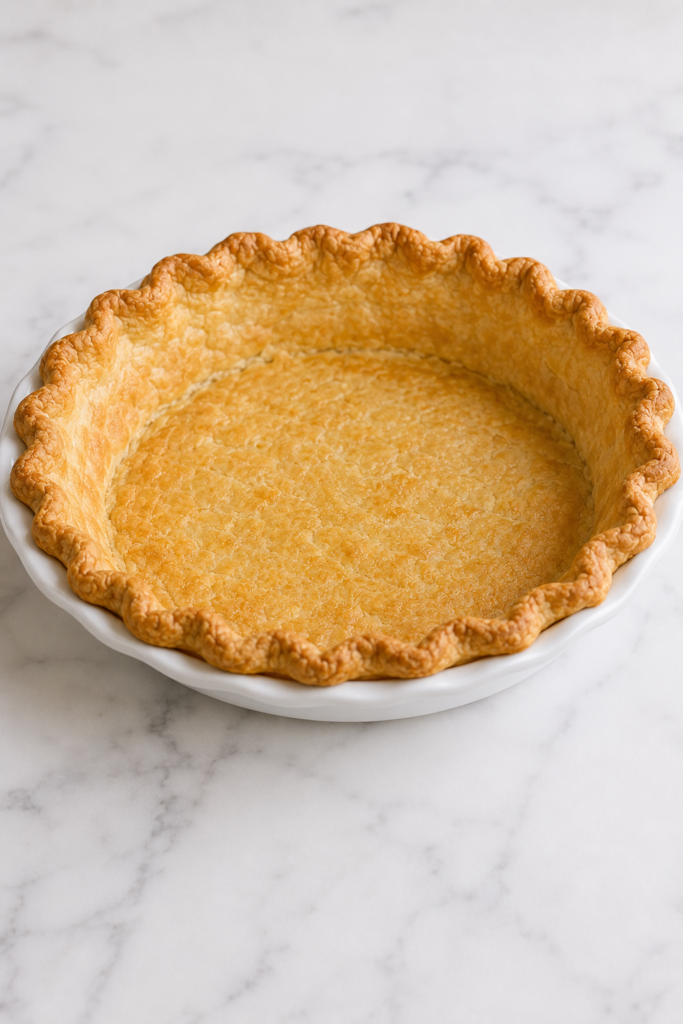
Line the cold shell with crumpled parchment and fill with weights or dry beans to the upper edge. Set the pie on the hot baking sheet and bake for 20 minutes, until the rim is set and beginning to color. Remove the parchment and weights, dock only any visibly puffed base areas, and brush the base and lower sides with the thinnest continuous film of beaten egg white. Bake for 15–20 minutes more, rotating once if needed. Tent only the rim if it reaches deep gold before the base. Cool on a rack for at least 1 hour.
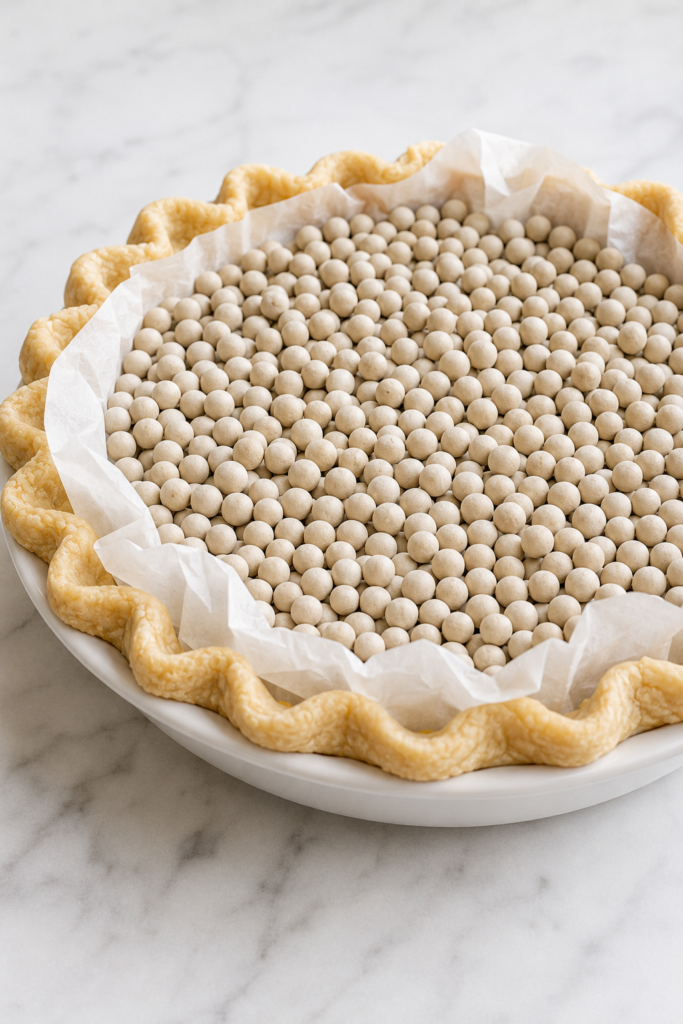
What you should see: a deep-golden rim and a dry, matte, rigid, visibly golden base with no blond, damp, greasy, or translucent areas; the shell is completely room temperature before filling.
4. Cook the Vanilla Pastry Cream
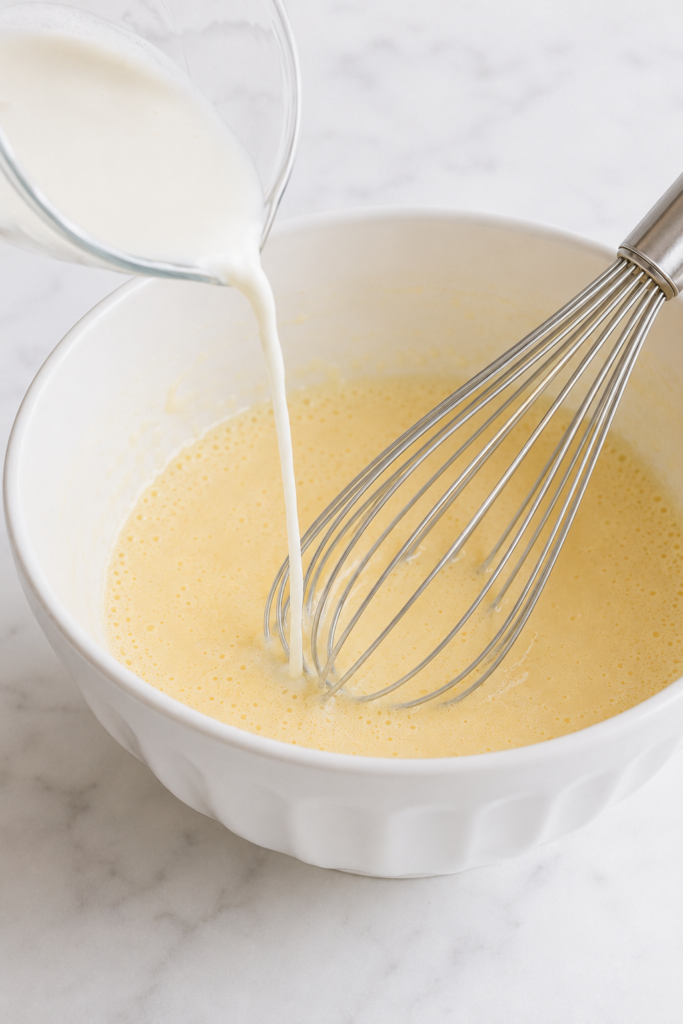
Prepare a large ice bath with a shallow heatproof dish before heating the milk. Whisk the yolks, sugar, cornstarch, and salt until smooth and slightly lightened. Heat the milk in a heavy saucepan until steaming and just beginning to simmer around the edge.
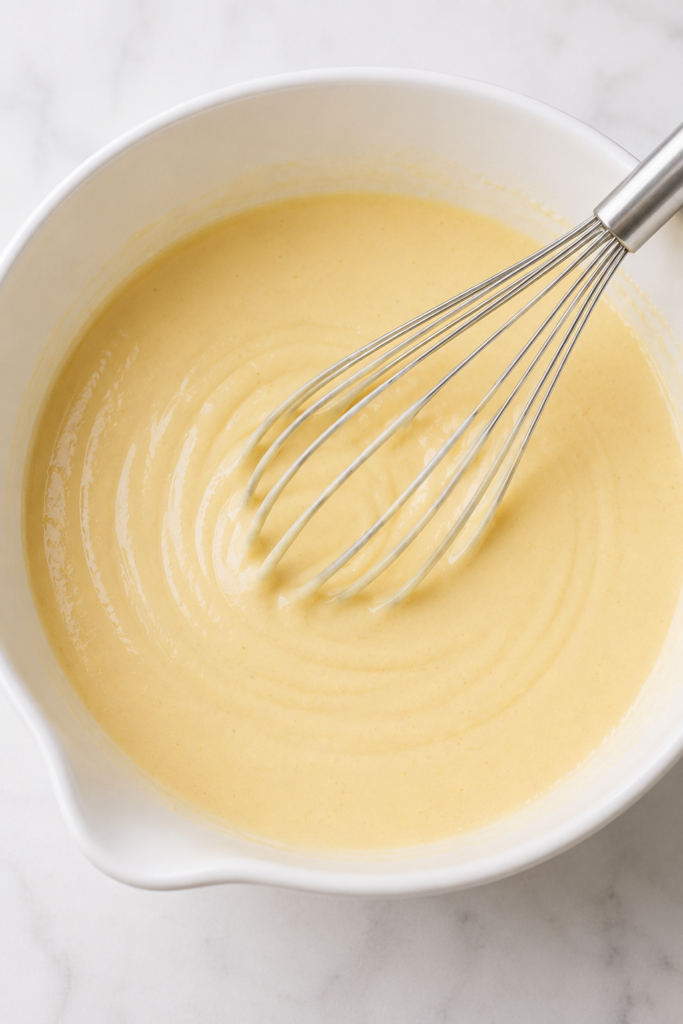
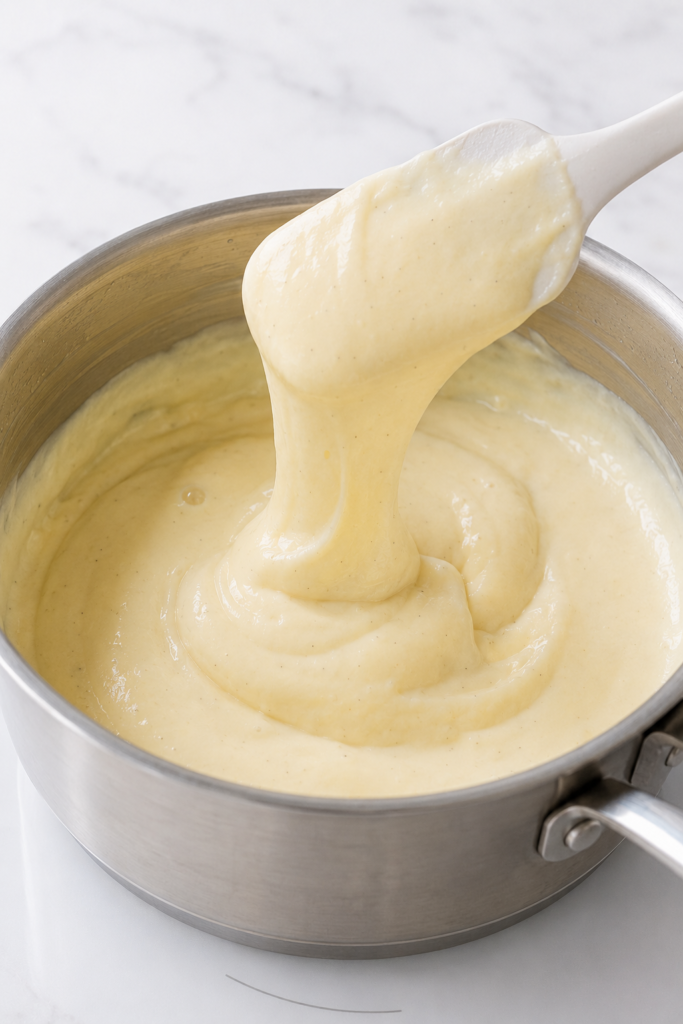
While whisking, slowly stream about half the hot milk into the yolks, then return everything to the saucepan. Cook over medium heat, whisking continuously across the bottom and corners. At the first broad bubble, continue cooking and whisking for exactly 60 seconds. Remove from the heat and whisk in the butter and vanilla.
What you should see: broad true bubbles breaking through the thick cream and heavy ribbons that briefly hold a trace before disappearing; 200–205°F / 93–96°C is a supporting temperature, not a substitute for the full bubble-and-hold cue.
5. Rapidly Cool the Pastry Cream
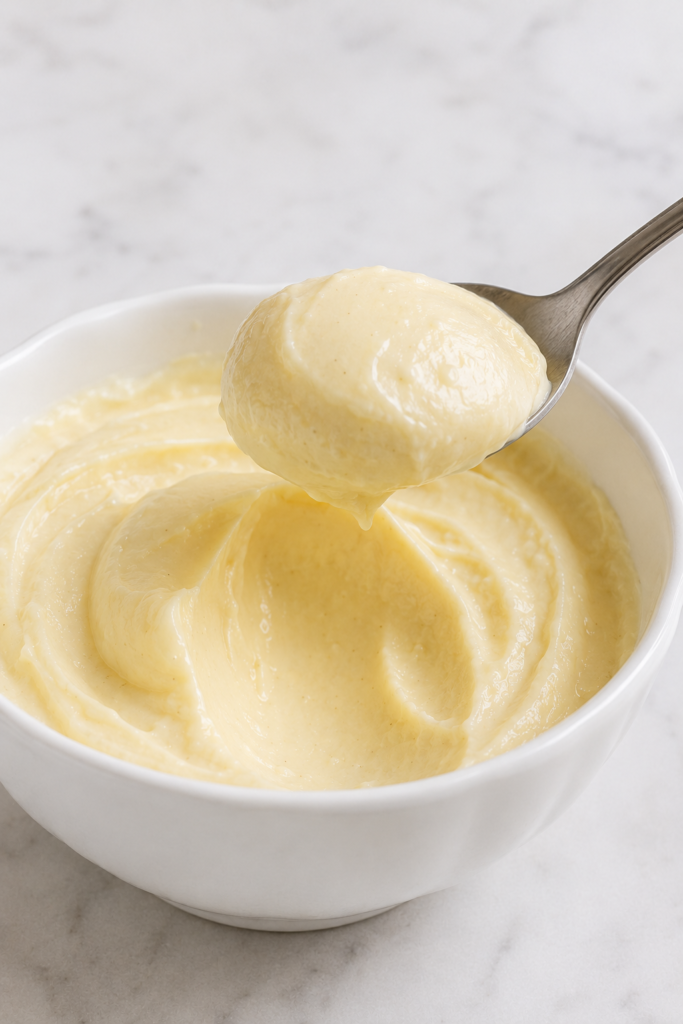
Immediately pass the hot pastry cream through a fine-mesh sieve into the shallow dish over the ice bath. Press food-safe wrap directly against the entire surface. Cool over the ice bath for 20–30 minutes, then refrigerate until 40°F / 4°C or colder and fully firm, at least 3 hours. Before assembly, whisk only 10–15 strokes to restore a smooth, spreadable texture.
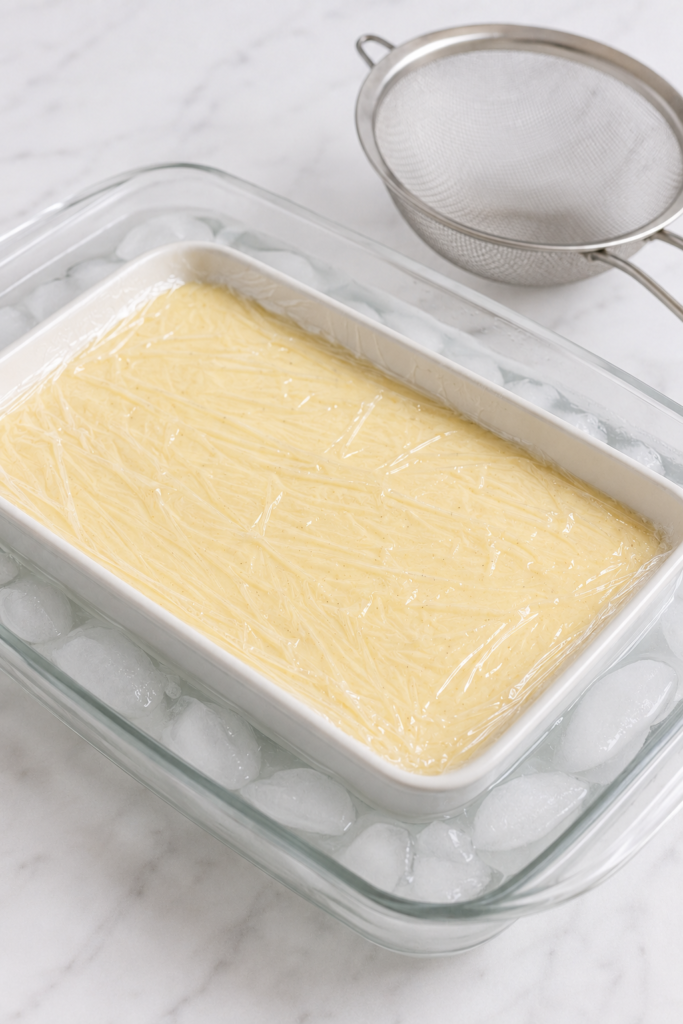
What you should see: a smooth, glossy cold cream that mounds on a spoon without flowing into a level pool; it spreads easily after brief whisking but has not been beaten loose or aerated.
6. Layer the Cold Pie
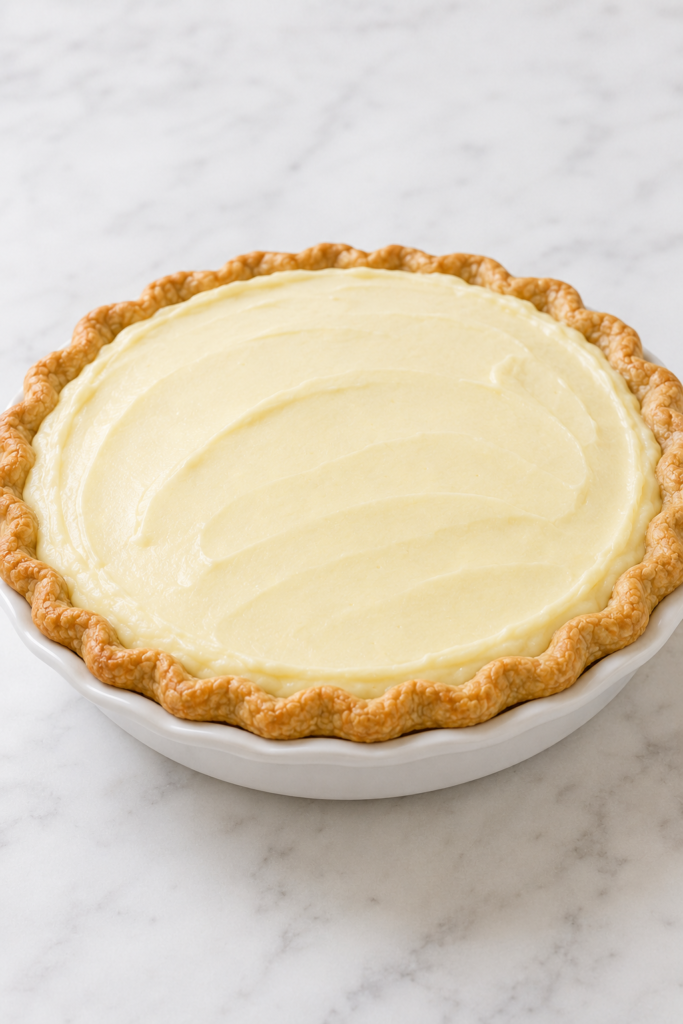
Confirm that the shell is completely cool and the pastry cream is 40°F / 4°C or colder. Slice the peeled bananas 1/4 inch thick and divide them into two 170 g portions. Spread 1/2 cup pastry cream across the bottom of the shell. Arrange the first banana portion in one tight, non-overlapping layer, then cover it with 1 cup pastry cream, filling every gap. Add the second banana layer and cover completely with the remaining pastry cream. Smooth the top and press food-safe wrap directly against the surface.
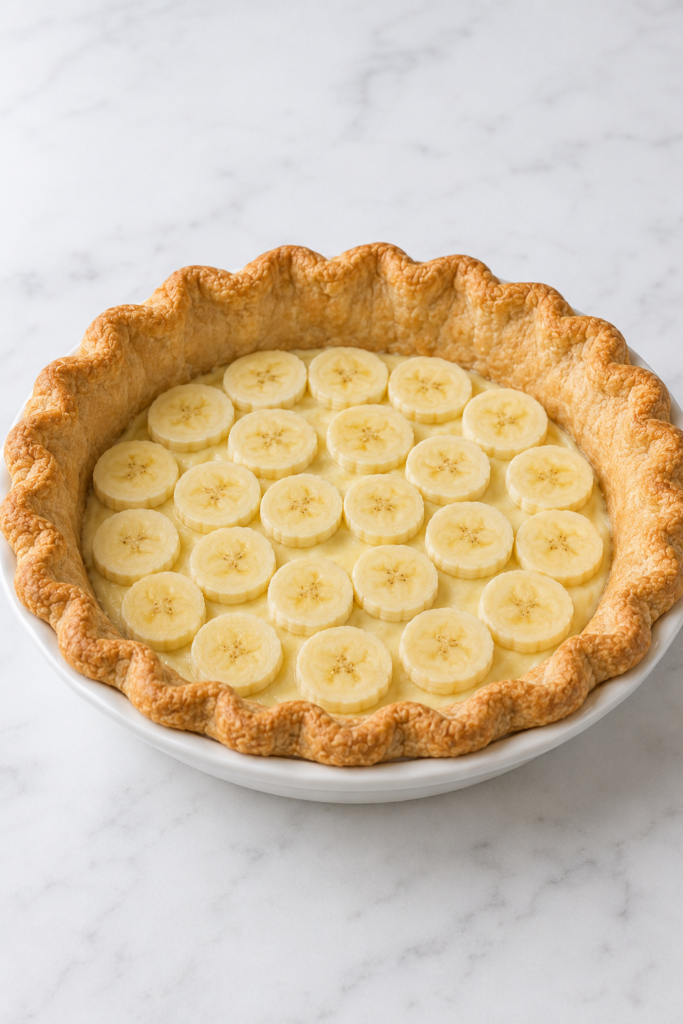
What you should see: two controlled banana layers with every cut surface enclosed, no banana edge exposed, and the finished custard layer at or slightly below the inner crust rim.
7. Chill and Finish with Whipped Cream
Refrigerate the assembled pie for at least 4 hours and up to 24 hours. No more than 4 hours before serving, whip the cold heavy cream, confectioners’ sugar, vanilla, and salt at medium speed to medium-firm peaks. Remove the surface wrap and spread or pipe the whipped cream over the cold filling. Add fresh banana garnish only as the pie reaches the table.
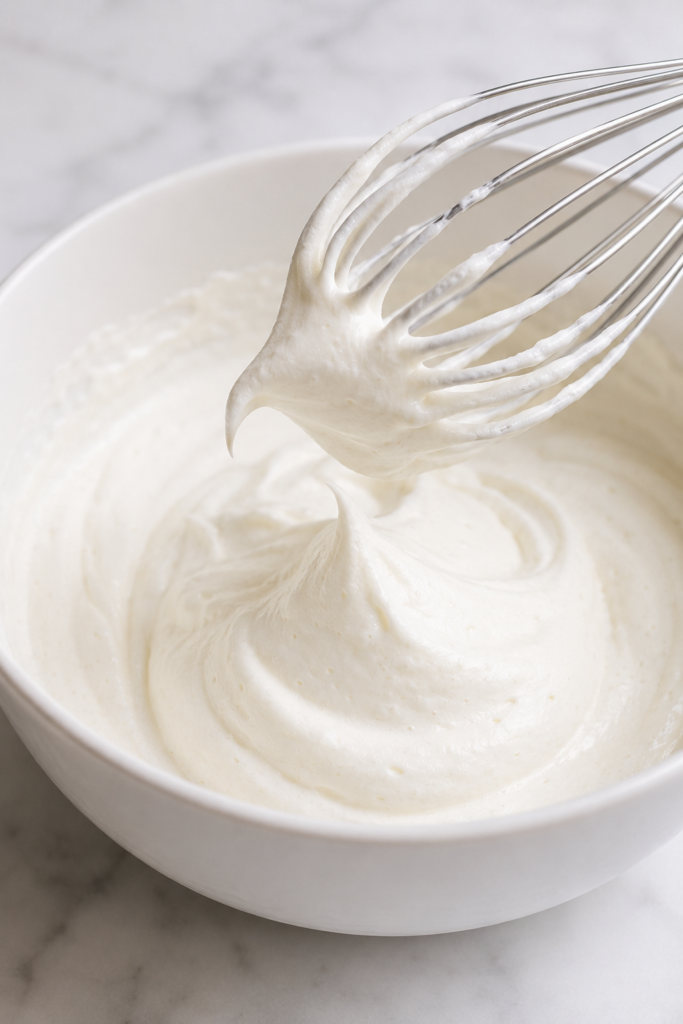
What you should see: whipped cream with a smooth peak that stands while only the tip bends, covering a thoroughly set pie without graininess, liquid at the bowl, or exposed custard.
Doneness and Texture Guide
The pie is ready through a sequence of component decisions rather than one final timer. Check the shell, hot and cold pastry cream, assembled filling, topping, and service slice independently.
| Stage | Ready cue | Too early or wrong | Decision |
|---|---|---|---|
| Baked shell | Dry, matte, rigid, golden base; deep-golden rim | Blond, damp, greasy, or translucent base | Continue baking; tent the rim if needed |
| Hot pastry cream | Broad bubbles and heavy ribbons after the 60-second hold | Thick but never truly bubbling | Continue controlled cooking |
| Cold pastry cream | Smooth, spreadable, and mounding on a spoon | Flows into a loose pool | Use the pre-assembly recovery boundary |
| Assembled filling | At or just below the inner rim; no banana exposed | Overfilled shell or visible banana surfaces | Stop adding excess and complete enclosure |
| Whipped cream | Smooth medium-firm peak with only the tip bending | Soft and flowing or grainy and broken | Continue briefly or stop before overwhipping |
| Service slice | Cold layers hold their order and the crust cuts cleanly | Warm filling slumps | Continue refrigeration |
How to Cut Clean Slices
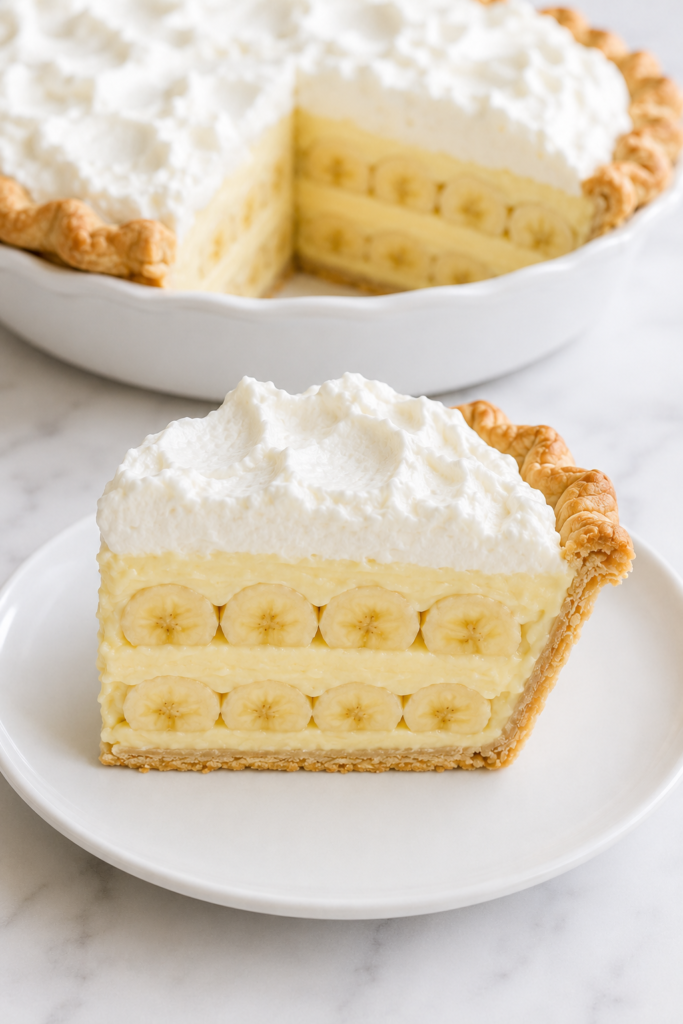
Serve directly from refrigeration. Dip a thin, sharp knife in hot water, wipe it completely dry, and make one clean downward cut. Wipe, warm, and dry the blade again before every cut so custard and banana do not drag across the next slice.
Expert Tips for Banana Cream Pie
These small controls protect the pie at the places where fruit size, temperature, volume, and whipping technique can quietly move the result away from the intended slice.
One lesson I learned from making pastry cream is not to stop cooking it the moment it thickens. Letting it reach a true bubble and cooking it for a full minute makes the difference between a filling that holds clean slices and one that loosens after chilling.
- Weigh the peeled bananas. Diameter changes the number of slices dramatically, while 340 g protects the intended layer depth.
- Let bubbles control the custard endpoint. Use 200–205°F / 93–96°C as confirmation; visible bubbling plus the full timed hold remains decisive.
- Whisk the cold pastry cream sparingly. Ten to fifteen strokes restore spreadability without loosening the set through unnecessary aeration.
- Respect the finished volume. Standard pie plates vary slightly, so protect the rim-capacity endpoint instead of forcing every trace of cream into the shell.
- Separate internal fruit from garnish. Enclosed bananas have limited oxygen exposure, while decorative slices brown quickly and belong only at the last moment.
- Whip at medium speed. The slower, more controllable build creates smoother medium-firm peaks; consult our guide on how to make whipped cream when you want a closer look at peak stages.
Common Mistakes
Most Banana Cream Pie failures can be traced to one missed endpoint or one dependency handled out of order. Diagnose the symptom before deciding whether the component can still be recovered.
| Mistake | What happens | Why it happens | Prevention or realistic recovery |
|---|---|---|---|
| Stopping when the custard merely thickens | Filling remains loose after chilling | The starch never completed the bubble-and-hold cook | Reach a true bubble and whisk for 60 seconds |
| Hoping refrigeration will fix undercooked custard | The pie stays runny overnight | Cold firms cooked custard but cannot create the missing starch set | Before assembly, recook to a true bubble, hold 60 seconds, strain, and rapidly cool; after bananas are layered, there is no reliable canonical repair |
| Leaving the crust pale | The bottom softens rapidly | Underbaked pastry retains moisture and weak structure | Bake to a dry, matte, visibly golden endpoint and use the egg-white film |
| Using heavily spotted bananas | Soft, wet pockets weaken the layers | Overripe fruit has less structure and more free moisture | Choose fragrant, fully yellow fruit that remains firm |
| Slicing bananas too early | Browning begins before assembly | Cut surfaces remain exposed to oxygen | Slice only when the cold shell and custard are ready, then cover every surface |
| Adding warm filling to the shell | The crust softens and the set weakens | Heat and steam move into the pastry while the custard is fluid | Assemble only with a cool shell and custard at or below 40°F / 4°C |
| Overwhipping the topping | The crown becomes grainy and heavy | Fat begins clumping beyond medium-firm peaks | Stop when the peak stands with only its tip bending |
| Using a deep-dish plate as a direct swap | The filling depth and proportions no longer match | Vessel capacity changes | Use the standard 9-inch plate or validate a separate formula |
Beautiful Ways to Serve
Let the clean layered slice remain the visual focus. Restrained decoration preserves the banana-and-vanilla identity and keeps the deep-golden crust visible.
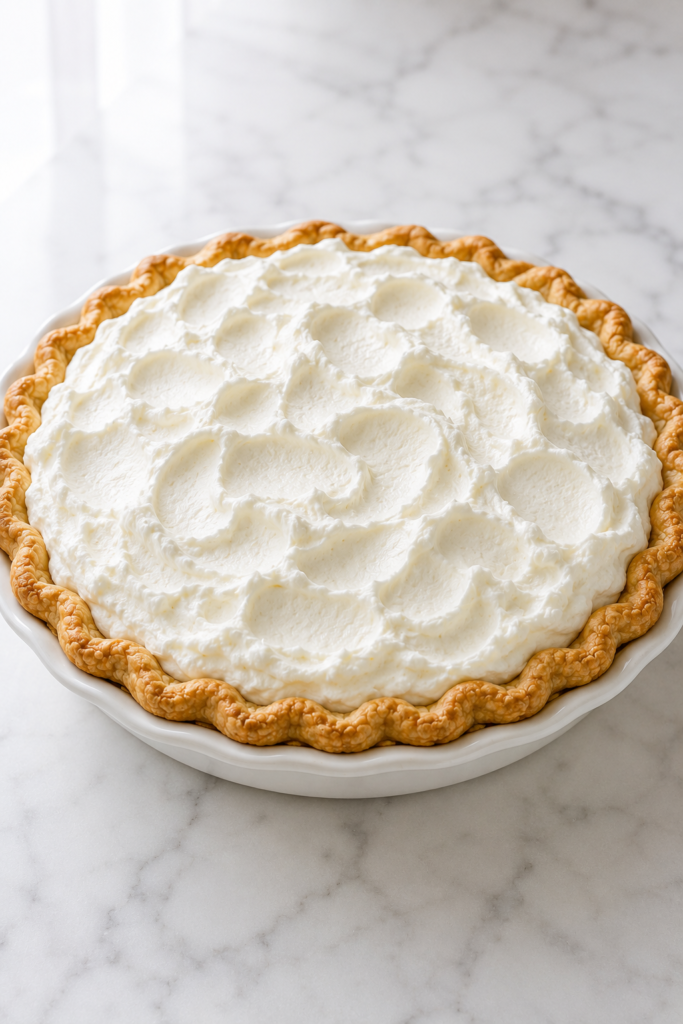
Classic Whipped-Cream Crown
Shape broad, soft swirls over the filling with a spoon or piping bag, leaving the crimped edge visible. A restrained center creates height without making the topping feel heavier than the custard.
Last-Minute Banana Detail
Add only a few freshly cut banana coins as the pie reaches the table. Keep them clustered rather than covering the entire top so the garnish looks intentional and has minimal time to brown.
Clean Bakery-Style Slices
Place refrigerator-cold wedges on simple white plates with the cut face turned toward the viewer. The crisp shell, two banana layers, pale custard, and whipped-cream crown provide all the contrast the serving needs.
Minimal Vanilla Finish
If you use vanilla bean paste, allow its fine speckles to provide the finishing detail. Leave the slice otherwise ungarnished so the banana layers and natural custard color stay clear.
Storage, Make Ahead, and Freezing
Each component has a different holding window. Keep the complete pie cold, protect direct custard surfaces from air, and expect crust crispness and banana texture to decline before the pie becomes unsafe.
| Component or stage | How to store it | Quality window |
|---|---|---|
| Raw pie dough | Wrapped in the refrigerator or airtight in the freezer | Up to 2 days refrigerated or 3 months frozen |
| Fully baked unfilled shell | Airtight at cool room temperature or airtight in the freezer | Up to 2 days at room temperature or 1 month frozen |
| Pastry cream | Refrigerated under direct surface cover | Up to 3 days |
| Assembled pie without topping | Refrigerated under direct surface cover | 4–24 hours before serving for best quality |
| Finished pie | Covered and refrigerated | Best within 4 hours after topping and within 24 hours of assembly |
| Leftover pie | Covered and refrigerated | Up to 3 days, with softer crust, more tender bananas, and possible loss of whipped volume |
Keep the pie at 40°F / 4°C or colder. Follow FDA cold-food safety guidance and limit total room-temperature time to 2 hours, or 1 hour when the temperature is above 90°F / 32°C.
Do not freeze the assembled pie. Thawed pastry cream may release water, bananas become soft and discolored, whipped cream loses its clean structure, and the crust absorbs the released moisture. Freeze only the raw dough or fully baked unfilled shell within the windows above. This is a chilled dessert and should not be microwaved or reheated.
Variations, Substitutions, and Scaling
The canonical formula has narrow substitution boundaries because milk fat, yolks, starch, fruit condition, vessel capacity, and batch size all affect the set. Changes outside the supported options create a different recipe rather than an equivalent swap.
- Vanilla: use pure vanilla extract or vanilla bean paste at the same 2-teaspoon pastry-cream measure.
- Store-bought pastry crust: a refrigerated pastry crust may be used as an accessibility variation, but it must still be fully blind-baked to the same deep-golden, dry endpoint.
- Graham or vanilla-wafer crust: these create adjacent banana-pudding-style variations rather than the classic pastry-shell result.
- Instant pudding: instant vanilla or banana pudding is not a substitute for sliceable pastry cream. If you want a spoonable custard reference, see this homemade vanilla pudding.
- Milk and eggs: low-fat, skim, nondairy, or lactose-free milk and whole eggs in place of yolks have not been validated as direct swaps.
- Alternative thickeners: flour, tapioca, arrowroot, custard powder, gelatin, and stabilized whipped cream are not supported in the base formula.
- Bananas: do not replace firm-ripe fruit with soft, heavily spotted bananas or brush the internal slices with lemon juice.
- Different formats: deep-dish, mini, slab, no-bake, and half-batch versions require separate capacity and timing validation.
- Two pies: prepare two normal-size formula batches; do not double the pastry cream in one saucepan because its heating and cooling behavior changes.
Continue Your Baking Journey
Use these three paths to keep banana at the center, explore another chilled cream pie, or build the next pastry and filling skill.
More Ways to Use the Banana Craving
These recipes keep banana as the dominant flavor while changing the structure from layered pudding to caramel pie, cake, or cookies.
- Banana Pudding Recipe — choose a spoonable layered dessert with pudding, bananas, and wafers.
- Banoffee Pie — pair banana with caramel in a richer pie format.
- Banana Cake Recipe — turn ripe fruit into a soft, sliceable cake.
- Banana Cookies Recipe — keep the flavor in a smaller, portable bake.
Stay with a Cool, Creamy Pie
These chilled pies preserve the creamy serving experience while changing the dominant flavor and filling structure.
- Coconut Cream Pie — move from banana to a soft tropical coconut profile.
- Chocolate Cream Pie — choose a deeper cocoa-forward cream filling.
- Peanut Butter Pie — explore a tall mousse-like filling over a dark cookie crust.
- French Silk Pie — make an exceptionally smooth, rich chocolate pie.
Build Your Next Pie Skill
Each recipe develops a different useful pie decision, from setting citrus filling and meringue to managing fruit moisture and a full pastry shell.
- Lemon Meringue Pie — practice a bright cooked filling with a finished meringue.
- Key Lime Pie — work with a compact citrus custard and clean cold set.
- Apple Pie Recipe — build a full fruit pie around pastry and moisture control.
- Blueberry Pie — learn to balance juicy berries with a sliceable filling.
Why This Recipe Belongs in Your Recipe Box
Keep this recipe as a practical reference for the readiness decisions that make a classic chilled pie dependable.
- Clear Readiness Cues. It records the visual and texture endpoints that make future batches easier to judge.
- A Dependable Workback. The component schedule can be reused whenever a chilled pie must meet a fixed serving time.
- Honest Quality Windows. Crispness, banana color, and whipped-cream stability are bounded instead of overpromised.
- Useful Recovery Limits. It distinguishes what can be corrected before assembly from what cannot be reliably repaired afterward.
- Classic Skill Building. One project strengthens pie-dough, blind-baking, pastry-cream, cold-assembly, and whipped-cream judgment.
- A Defined Reference Point. The standard 9-inch recipe gives future variations a clear base instead of an improvised starting point.
Final Thoughts
This recipe preserves what makes classic Banana Cream Pie recognizable—flaky pastry, vanilla cream, fresh banana, and a cloud of whipped cream—while replacing shortcut ambiguity with clear, measured checkpoints.
Return to it whenever you want a calm, planned dessert whose crust and filling can be prepared before the final day, leaving only assembly, chilling, and a fresh cream finish.
Dependable baking is often less about rushing and more about recognizing when each stage is truly ready.

Classic Banana Cream Pie
Classic Banana Cream Pie made from scratch with a fully blind-baked all-butter crust, two layers of firm-ripe bananas, silky vanilla pastry cream, and a generous crown of fresh whipped cream. A measured custard endpoint and completely cold assembly give the filling the structure it needs for clean, creamy slices.
Ingredients
For the All-Butter Pastry Crust
- 170 g all-purpose flour (1 1/3 cups plus 1 tablespoon)
- 8 g granulated sugar (2 teaspoons)
- 3 g fine salt (1/2 teaspoon)
- 113 g unsalted butter, very cold and cut into 1/2-inch cubes (1/2 cup or 1 stick)
- 55–65 g ice water (begin with 3 tablespoons plus 2 teaspoons; add up to 4 tablespoons plus 1 teaspoon only as needed)
- 1 large egg white, lightly beaten (use 8–12 g for the moisture barrier)
For the Vanilla Pastry Cream
- 480 g whole milk (2 cups)
- 90 g large egg yolks (5 large yolks)
- 100 g granulated sugar (1/2 cup)
- 30 g cornstarch (1/4 cup)
- 1.5 g fine salt (1/4 teaspoon)
- 28 g unsalted butter, cubed (2 tablespoons)
- 10 g pure vanilla extract or vanilla bean paste (2 teaspoons)
For the Banana Layers
- 340 g peeled firm-ripe bananas, about 3 medium bananas
For the Whipped-Cream Topping
- 355 g cold heavy whipping cream, 36% fat preferred (1 1/2 cups)
- 30 g confectioners’ sugar (1/4 cup)
- 7.5 g pure vanilla extract (1 1/2 teaspoons)
- 0.5 g fine salt (small pinch)
Instructions
- Make the Pie Dough
Whisk the flour, granulated sugar, and salt. Add the very cold butter and toss to coat. Flatten the butter pieces between your fingertips until the mixture contains irregular flour-coated flakes ranging from pea to nickel size. Add 55 g of ice water and toss and fold. Add the remaining water 5 g or 1 teaspoon at a time only until a squeezed handful holds together without dry flour. Bring the dough together without prolonged kneading, form a 1-inch-thick disk, wrap, and refrigerate for at least 2 hours or up to 2 days. The dough should be cohesive but not sticky or uniformly wet. - Shape and Chill the Shell
Roll the cold dough to a 13-inch circle about 1/8 inch thick. Ease it into a standard 9-inch pie plate without stretching. Trim to a 1-inch overhang, fold the overhang under, and crimp above the rim. Refrigerate for 45 minutes or freeze for 20 minutes, until firm. Meanwhile, preheat the oven to 375°F / 190°C with a rimmed metal baking sheet on the lower-middle rack. - Complete the Weighted Blind Bake
Line the cold shell with crumpled parchment and fill it with pie weights or dry beans all the way to the upper edge. Set the pie on the hot baking sheet and bake for 20 minutes, until the rim is set and beginning to color. - Finish Baking and Cool the Crust
Lift out the parchment and weights. Dock only visibly puffed areas of the base. Brush the base and lower sides with the thinnest continuous film of beaten egg white. Bake for 15–20 minutes more, rotating once if needed, until the base is dry, matte, and visibly golden and the rim is deep golden. Tent only the rim if it reaches the target first. Cool on a rack for at least 1 hour, until completely room temperature. - Prepare the Pastry-Cream Base
Before cooking, prepare a large ice bath and set a shallow heatproof dish inside it. Whisk the egg yolks, granulated sugar, cornstarch, and salt in a heatproof bowl until completely smooth and slightly lightened. Heat the milk in a 2–3-quart heavy saucepan over medium heat until steaming and just beginning to simmer around the edge. - Temper and Cook the Pastry Cream
While whisking continuously, slowly stream about half the hot milk into the yolk mixture. Return the tempered mixture to the saucepan with the remaining milk. Cook over medium heat, whisking continuously across the bottom and into the corners. Once the first broad bubble breaks through the thick cream, continue cooking and whisking for a full 60 seconds. A thermometer should read approximately 200–205°F / 93–96°C, but the true bubble and full timed hold are the controlling endpoint. - Finish and Rapidly Cool the Pastry Cream
Remove the pan from the heat and whisk in the butter and vanilla until glossy. Immediately pass the pastry cream through a fine-mesh sieve into the prepared shallow dish. Press food-safe wrap directly against the entire surface. Cool over the ice bath for 20–30 minutes, then refrigerate immediately until 40°F / 4°C or colder and fully firm, at least 3 hours. Before assembly, whisk only 10–15 strokes, until smooth and spreadable but still able to mound on a spoon. - Prepare the Bananas
Confirm that the pie shell is completely cool and the pastry cream is 40°F / 4°C or colder. Slice the peeled bananas crosswise 1/4 inch thick and divide them into two equal 170 g portions. Do not slice the bananas early or coat them with lemon juice. - Build the First Banana Layer
Spread 1/2 cup of cold pastry cream over the bottom of the shell, reaching the edges. Arrange one 170 g portion of banana slices in a tight, non-overlapping layer. Cover with 1 cup of pastry cream, filling the gaps and covering every cut banana surface. - Complete the Filling
Arrange the remaining 170 g of banana slices in a second controlled layer. Cover completely with the remaining pastry cream and smooth the top. No banana edge should remain exposed, and the filling should finish at or slightly below the inner crust rim. Do not force excess filling into the shell. - Chill the Assembled Pie
Press food-safe wrap directly against the pastry-cream surface. Refrigerate the assembled pie for at least 4 hours and up to 24 hours before serving. This assembled chill is separate from the earlier pastry-cream chill. - Whip, Finish, and Serve
No more than 4 hours before serving, whip the cold heavy cream, confectioners’ sugar, vanilla, and salt at medium speed to medium-firm peaks. The peak should stand with only its tip bending and the cream should remain smooth, not grainy. Remove the surface wrap and spread or pipe the whipped cream over the thoroughly chilled pie. Add fresh banana garnish only at the last moment, if desired. Slice refrigerator-cold with a hot, dry knife, wiping and reheating the blade between cuts.
Notes
- Use a standard 9-inch pie plate, not a deep-dish plate. Half batches, deep-dish pies, minis, slab pies, and no-bake versions require separately validated formulas.
- Weigh the bananas after peeling. Use fully yellow, fragrant fruit that still feels firm; soft, heavily spotted bananas release more moisture and lose layer definition.
- The pastry cream is not done when it merely thickens. Reach a true broad bubble and cook for the full 60-second hold.
- If the pastry cream is loose before assembly, return it to a clean saucepan, bring it to a true bubble while whisking, hold for 60 seconds, strain, and repeat the rapid-cooling sequence. Scorched custard, persistently scrambled custard, or filling already layered with bananas has no reliable canonical repair.
- Vanilla extract and vanilla bean paste are interchangeable at the same 2-teaspoon measure in the pastry cream. Low-fat, skim, nondairy, or lactose-free milk and whole eggs in place of yolks are not validated direct substitutions.
- A refrigerated store-bought pastry crust may be used as an accessibility variation, but it must still be fully blind-baked to the same dry, deep-golden endpoint. Graham crust, cookie crust, and instant pudding produce a materially different pie.
- Prepare two complete normal-size batches for two pies. Do not double the pastry cream in one saucepan because the heating and cooling behavior changes.
Storage and Make-Ahead
- Raw dough: refrigerate, wrapped, up to 2 days or freeze airtight up to 3 months.
- Fully baked unfilled shell: keep airtight at cool room temperature up to 2 days or freeze airtight up to 1 month. Bring it to room temperature while still wrapped.
- Pastry cream: refrigerate under direct surface cover up to 3 days; whisk briefly before use.
- Assembled pie without whipped cream: refrigerate 4–24 hours before serving for best quality.
- Finished pie: best within 4 hours after topping and within 24 hours of assembly.
- Leftovers: cover and refrigerate at 40°F / 4°C or colder for up to 3 days, expecting a softer crust, more tender bananas, and some loss of whipped-cream volume.
- Room-temperature limit: 2 cumulative hours, or 1 hour above 90°F / 32°C.
- Do not freeze the assembled pie and do not microwave or reheat the pie or individual slices.
Nutrition Information:
Yield: 10 Serving Size: 1 sliceAmount Per Serving: Calories: 443Total Fat: 28.5gSaturated Fat: 17.2gCholesterol: 173mgSodium: 236mgCarbohydrates: 41.1gFiber: 1.4gSugar: 21.7gProtein: 6.3g
Nutrition information is provided as an estimate only and may vary based on specific ingredients, brands, and portion sizes used. This information should not be considered medical or nutritional advice.
12 Sweet Favourites — Yours, Free 🍰
Tiramisù, no-bake cheesecake, the perfect chocolate chip cookie & 9 more reader-loved desserts — gathered into one beautiful free recipe book. From my kitchen to yours.
No spam, just sweet things. Unsubscribe anytime.