Stuffed French Toast with Strawberry Cream Cheese
🎁 FREE E-BOOK: 12 Sweet Favorites — reader-loved desserts in one beautiful recipe book.
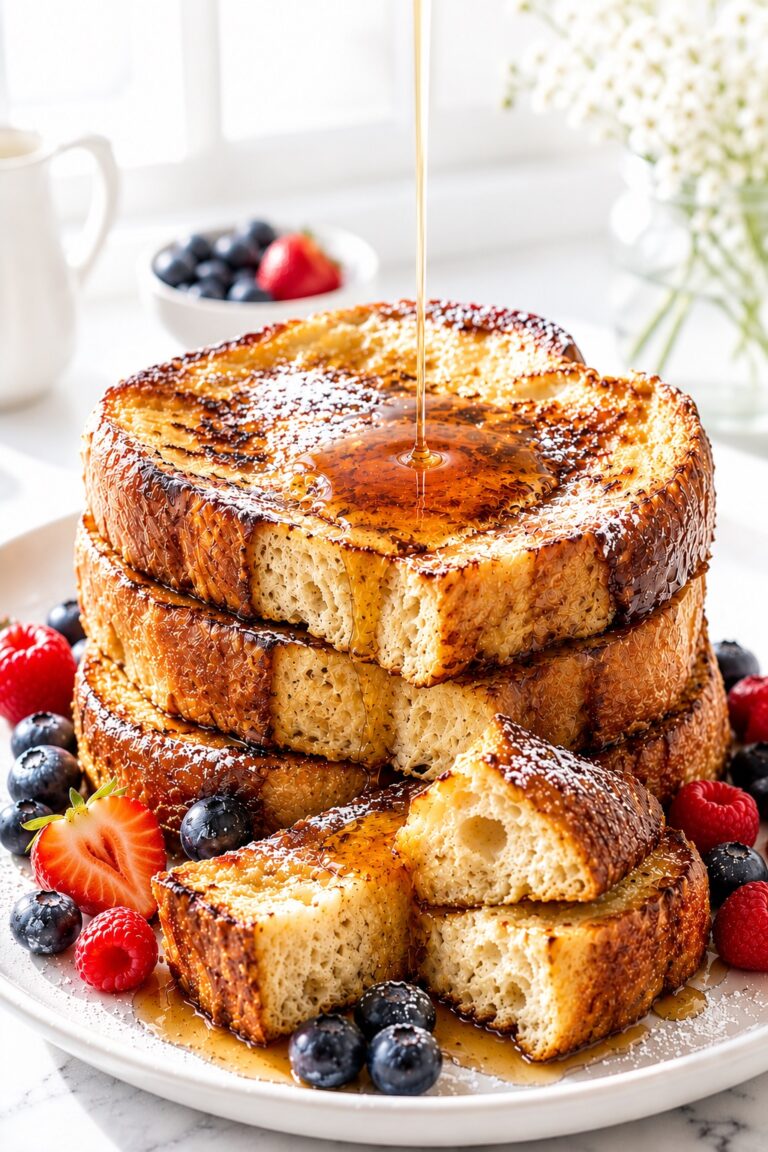
Stuffed French toast turns golden brioche into a warm breakfast sandwich with tender, fully set bread, smooth vanilla cream cheese, and a distinct ribbon of strawberry preserves. The lightly crisp edges and creamy center make every diagonal half feel generous without needing an oversized filling.

It is a lovely choice for a weekend breakfast or brunch when you want something more special than everyday toast but do not want an overnight bake. Everything happens on the stovetop, and four individual sandwiches make serving simple.
The details that matter are easy to recognize once you know where to look: a clean border around the filling, a short custard dip, gentle covered heat after turning, and a thermometer reading taken in the egg-soaked bread rather than the filling alone.
Stuffed French Toast at a Glance
This version of stuffed French toast is made from two brioche slices filled with separate layers of vanilla cream cheese and strawberry preserves. Each sandwich is dipped briefly in cinnamon-vanilla custard and cooked in a covered skillet, so it is different from a pocket-cut slice, an overnight bake, or a casserole.
- Yield: 4 full stuffed sandwiches
- Servings: 4 rich breakfast or brunch portions
- Preparation: 20 minutes
- Cooking: 20 minutes in 2 batches
- Total time: 40 minutes, excluding optional bread drying
- Doneness: 160°F or 71°C in the egg-soaked bread beside the filling
- Best service: Rest 2 minutes, then serve within 10 minutes
If you want the familiar unfilled version, this classic French toast recipe is the better place to begin. Because it has no filling, it does not need the same sealing or center-heating steps.
Why This Stuffed French Toast Recipe Works
A filled sandwich has three places where things can go wrong: the perimeter can open, the bread can absorb too much custard, or the center can remain cool while the surface darkens. The Three-Zone Stuffed French Toast Check keeps those decisions connected.
| Zone | What to control | Why it matters |
|---|---|---|
| Perimeter | Leave a clean 1/2-inch border around both filling layers | The bread edges can meet without filling being pushed into the pan |
| Absorption | Use surface-dried bread and dip for only 5 seconds per side | The coating reaches the surface without weakening the sandwich |
| Center | Brown first, then turn, cover over low heat, and verify 160°F | The egg-soaked bread can set before the exterior becomes too dark |
Why You’ll Love This Stuffed French Toast
This recipe brings the comfort of golden French toast and the color of strawberries into one manageable skillet breakfast. The optional finishes stay at the table, so each person can decide how sweet the final plate should be.
- Four individual sandwiches are easy to cut and serve as complete portions.
- The vanilla cream cheese and strawberry preserves remain in separate, visible layers.
- A 12-inch skillet cooks two sandwiches at a time without crowding.
- The filling and custard can be prepared separately before brunch.
- Fresh strawberries, confectioners’ sugar, and maple syrup are all optional.
- Visual, tactile, and temperature cues make the center easier to judge.

The Science Behind Stuffed French Toast That Cooks Through
Stuffed French toast cooks evenly only when the filling stays contained, the bread absorbs just enough custard, and the center has time to warm through. These details determine how the sandwich should be assembled, dipped, and cooked.
The Dry Border Protects the Seam
Turning and lifting place pressure on the sandwich, especially while the bread is damp. Leaving the outer 1/2 inch unfilled gives the slices direct contact around the edge, which reduces the chance of cream cheese or preserves being squeezed into the custard or pan.
The border cannot guarantee a perfectly sealed sandwich, so handling still matters. Press the perimeter gently, support the full sandwich with a wide spatula, and never press down on the center while it cooks.

A Short Dip Controls Brioche Absorption
Surface-dried brioche needs enough custard to coat both broad sides, but a long soak lets liquid move deeper into the bread and weakens the filled seam. Five seconds per side, followed by a five-second drip, keeps the sandwich evenly moistened and liftable.
This timing is designed for the specified 1/2-inch slices and this four-sandwich recipe. Much thicker bread takes longer for heat to reach the center, so it is not a direct substitute.
Covered Low Heat Warms the Center
The first side cooks uncovered over medium-low heat so the custard coating can set and develop color. After turning, low heat and a fitted lid hold gentle heat around the sandwich, giving warmth more time to move inward without rapidly darkening the brioche.
Removing the lid for the final minute or two lets surface moisture escape. The lid supports the center-heating stage, but it does not replace the final visual, tactile, seam, and temperature checks.
Before You Start Stuffed French Toast
Confirm the bread, filling, and skillet setup before any sandwich touches the custard. Once the brioche is wet, the sequence moves quickly and is easier when every tool is within reach.
- Check that all eight brioche slices have dry surfaces, flexible centers, similar dimensions, and a total weight near 340 g.
- Soften the brick cream cheese only to 65 to 70°F, where it spreads but still holds soft ridges.
- Stir the strawberry preserves and confirm that they are thick and refrigerator-set rather than runny.
- Place the fitted lid, wide spatula, shallow custard dish, and thin-probe thermometer beside the stove.
- Set a rack or separate warm plates nearby so the first batch never needs to be stacked or tightly covered.
A Two-Batch Timeline for Stuffed French Toast
The second batch is easiest when it is planned before the first sandwich is dipped. Preparing components separately and keeping the cooked sandwiches unstacked lets all four portions reach the table warm without sacrificing the surface.
| When | What to do | Ready signal |
|---|---|---|
| Up to 2 days ahead | Prepare and refrigerate the cream-cheese mixture in a sealed container | Cold and protected, then softened only until spreadable |
| Up to 1 day ahead | Mix and refrigerate the custard separately | Covered at 40°F or below and rewhisked before use |
| 30 to 60 minutes ahead, if needed | Air-dry very fresh brioche | Dry surface with a flexible interior |
| About 40 minutes before serving | Organize tools, assemble four sandwiches, and mix or rewhisk custard | Level sandwiches with clean 1/2-inch borders |
| About 25 minutes before serving | Preheat the skillet and cook the first two sandwiches | Cooked through and held separately |
| About 13 minutes before serving | Wipe the pan, recover the heat, add fresh fat, and cook batch two | Second batch browns at the same steady rate |
| Final 2 minutes | Rest, cut, add optional finishes, and serve | Distinct layers remain warm and softly contained |
The optional 275°F oven-drying method takes 8 to 10 minutes plus complete cooling and is not included in the 40-minute recipe time. Start earlier if the brioche needs this correction.
What to Expect from Stuffed French Toast
Tender bread and a warm, soft filling are intended. Wet egg, broken seams, or freely flowing filling are not, so use these normal states as a reference before starting the method.
- After assembly: Each sandwich sits level and lifts as one piece, with no filling visible beyond the edges.
- After dipping: The broad surfaces look evenly moist, but the bread remains firm enough to transfer without folding.
- In the skillet: Butter foams gently and the brioche becomes golden gradually rather than darkening at once.
- When cooked: The center springs back, the egg-soaked bread is set, and the warm filling stays within the seam.
- After cutting: The cream cheese and preserves remain distinct, although they soften slightly toward the warm cut face.
Ingredients for Stuffed French Toast
The ingredient list is short, but the condition of the brioche, cream cheese, and preserves affects how the sandwich handles. Use sturdy bread, spreadable brick cream cheese, and thick refrigerator-set preserves before changing flavor details.
Ingredient List
Measure the filling and bread carefully, especially if the brioche slices vary in size. The optional serving ingredients are listed separately and are not part of the filling.
- 4 oz (113 g) full-fat brick cream cheese, softened to 65 to 70°F (18 to 21°C)
- 2 tablespoons (15 g) confectioners’ sugar
- 1/2 teaspoon (2.5 ml) pure vanilla extract, for the filling
- 1/8 teaspoon fine sea salt, for the filling
- 1/4 cup (80 g) thick strawberry preserves
- 8 slices brioche bread, about 12 oz (340 g) total, day-old or surface-dried and about 1/2 inch thick
- 3 large eggs, about 150 g without shells
- 1/2 cup (120 ml) whole milk
- 1 tablespoon (13 g) granulated sugar
- 1 teaspoon (5 ml) pure vanilla extract, for the custard
- 1/2 teaspoon ground cinnamon
- 1/4 teaspoon fine sea salt, for the custard
- 1 tablespoon (15 ml) neutral oil, divided
- 1 tablespoon (14 g) unsalted butter, divided
- 1 tablespoon (8 g) confectioners’ sugar, optional for serving
- 1 cup (150 g) sliced fresh strawberries, optional for serving
- 1/4 cup (60 ml) pure maple syrup, optional for serving

Why Surface-Dried Brioche Matters
Use eight sturdy slices that weigh about 340 g total and are close to 1/2 inch thick. A dry surface accepts the quick custard coating while the flexible interior allows the sandwich to close without cracking.
Very fresh brioche can feel tacky and bend under the filling. Let it stand in one layer for 30 to 60 minutes, or dry it in a 275°F oven for 8 to 10 minutes, turning once, then cool it completely. Challah is the only direct bread substitution recommended here, and it must match the same weight and thickness.

Building a Filling That Stays Put
Full-fat brick cream cheese should be cool but easy to spread, ideally 65 to 70°F. Divide the smooth vanilla mixture into four 32 to 33 g portions, then add exactly 1 tablespoon or 20 g of thick preserves to each sandwich.
Keep both layers inside the same 1/2-inch border. The separate layers create a pale cream-cheese band and a red fruit ribbon while the unfilled perimeter gives the bread a cleaner place to meet.
Balancing the Cinnamon-Vanilla Custard
Three eggs with 1/2 cup of milk make an egg-forward coating that can set around a filled sandwich. One tablespoon of sugar supports browning, while vanilla, cinnamon, and salt give the brioche a warm but restrained flavor.
The dish may contain more custard than the bread should absorb. Keep the dip brief and discard any raw custard left after all four sandwiches have been coated.
Kitchen Tools Needed for Stuffed French Toast
The skillet size, fitted lid, and broad turning surface have the greatest effect on cooking. The remaining tools help you keep the filling allocations and doneness check accurate.
- 12-inch skillet with a fitted lid: Use a heavy-bottomed nonstick skillet or well-seasoned cast iron that holds two sandwiches without crowding.
- Shallow dipping dish and large whisk: A 9 x 13-inch dish, pie plate, or similar vessel should let one sandwich lie flat.
- Small mixing bowl and flexible spatula: Mix, smooth, and portion the cream-cheese filling without tearing the brioche.
- Wide thin spatula and kitchen tongs: Support the whole sandwich with the spatula and use the tongs only to steady an edge if needed.
- Measuring tools, scale, and instant-read thermometer: Control bread and filling amounts, then verify doneness with a thin probe.
A wire rack over a small sheet pan is useful for holding the first batch without trapped steam. A fine-mesh sieve makes the optional confectioners’ sugar dusting lighter and more even.
How to Make Stuffed French Toast
Follow the assembly, dipping, and cooking steps in sequence. Work with two sandwiches at a time so the skillet can recover and every sandwich receives the same brief custard contact.
1. Prepare the Bread and Skillet Setup
Arrange the eight brioche slices in one layer. Use them as-is if they are day-old and dry on the surface. If they are fresh and tacky, air-dry for 30 to 60 minutes, or bake at 275°F for 8 to 10 minutes, turning once, then cool completely. Set a wire rack near the stove.
What you should see: The surfaces feel dry rather than sticky, while the centers still bend slightly without cracking.
2. Make the Vanilla Cream Cheese Filling
In the small bowl, stir the softened cream cheese, 2 tablespoons confectioners’ sugar, 1/2 teaspoon vanilla, and 1/8 teaspoon salt until smooth. Divide the mixture into four equal portions of about 32 to 33 g each.
What you should see: The filling spreads without pulling the bread and holds soft ridges instead of flowing from the spatula.
3. Assemble Four Stuffed Sandwiches
Place four brioche slices on the work surface. Spread one cream-cheese portion over each, stopping 1/2 inch from every edge. Spoon 1 tablespoon or 20 g preserves into the center of each cream-cheese layer and spread it inside the same border. Add the remaining slices and press gently around the perimeter without compressing the center.
What you should see: The top slices sit level, the edges meet cleanly, and no cream cheese or preserves are visible outside the sandwiches.
4. Mix the Cinnamon-Vanilla Custard
Whisk the eggs, granulated sugar, cinnamon, and 1/4 teaspoon salt until the whites and yolks are completely combined. Whisk in the milk and 1 teaspoon vanilla, then pour the custard into the shallow dish.
What you should see: The custard is fluid and uniform with fine cinnamon specks, no dry spice clumps, and no ropes of egg white.

5. Preheat and Grease the First Batch
Heat the empty 12-inch skillet over medium-low for 3 minutes. Add 1 1/2 teaspoons oil and 1/2 tablespoon or 7 g butter, then swirl the skillet to coat the cooking area.
What you should see: The butter foams gently and smells nutty-sweet without smoking or developing nearly black specks.
6. Dip Two Sandwiches
Place one sandwich flat in the custard for 5 seconds. Turn and coat the second broad side for 5 seconds, then hold it above the dish for about 5 seconds so the excess can drip away. Repeat with one more sandwich and move both directly to the skillet.
What you should see: Both broad surfaces are evenly moistened, the bread lifts as one firm sandwich, and the seams remain closed.

7. Brown and Cook Through
Place the two dipped sandwiches in the skillet with space between them. Cook the first side for 3 to 4 minutes without pressing, until evenly golden. Turn each sandwich with the wide spatula.
First-side cue: The first side is evenly golden, releases cleanly from the pan, and has no scorched cinnamon or blackened butter patches.

Reduce the heat to low, cover the skillet, and cook for 3 minutes. Uncover and cook for 1 to 2 minutes more, until the second side is golden and the egg-soaked bread is set. If the first side softened beneath the lid, turn once more for 30 to 60 seconds. Check the thickest sandwich in the bread zone beside the filling.
What you should see: Both sides are golden rather than dark brown, the center springs back gently, no liquid egg appears at the seam, and the filling is warm without bubbling out.

8. Repeat with the Second Batch
Transfer the first two sandwiches to the rack or separate warm plates without stacking. Wipe away dark butter solids or leaked preserves. Return the skillet to medium-low for 1 to 2 minutes, then add the remaining oil and butter. Dip and cook the final two sandwiches in the same sequence.
What you should see: The fresh fat foams without smoking, and batch two develops color at a similar steady rate instead of darkening immediately.
9. Rest, Cut, and Serve
Rest each sandwich for 2 minutes. Cut diagonally with a sharp serrated knife, using light sawing strokes instead of downward pressure. Serve within 10 minutes with optional fresh strawberries, a light sugar dusting, and maple syrup on the side.
What you should see: The cut face shows separate brioche, pale vanilla cream cheese, and red preserves, with soft filling that does not pour across the plate.

How to Tell When Stuffed French Toast Is Done
Surface color, tactile set, seam behavior, and temperature should agree before the sandwich leaves the skillet. A beautifully browned outside cannot overrule wet egg or a cold bread zone near the filling.
Ready to Serve
The broad surfaces are evenly golden, the edges feel lightly crisp, and the center springs back after gentle pressure. No wet egg appears at the seam, and the cream cheese feels warm rather than refrigerator-firm.
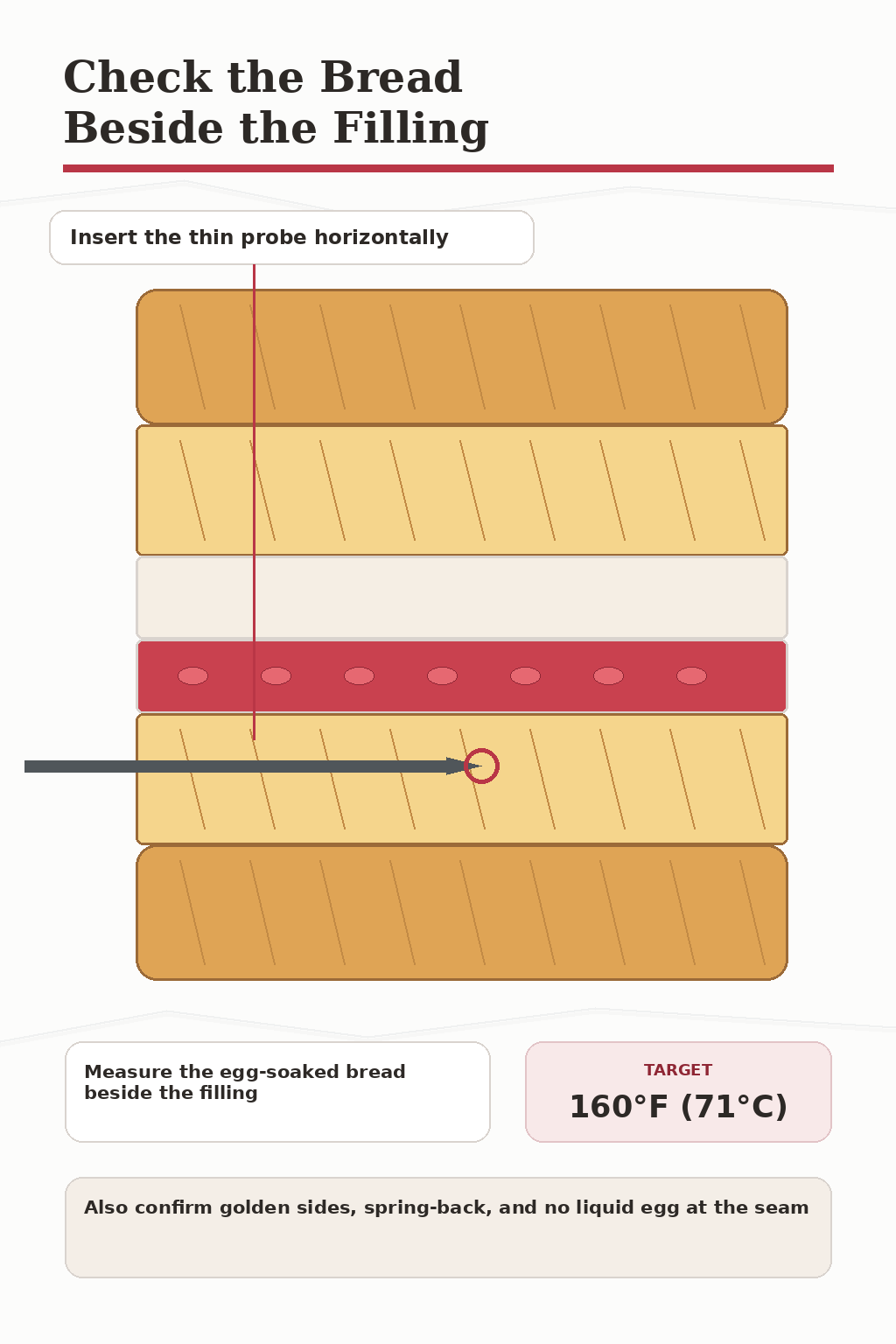
For the temperature check, insert a thin probe horizontally through an edge into the thickest egg-soaked bread immediately above or below the filling seam. The bread zone should reach 160°F or 71°C, the safe minimum temperature for egg dishes. Do not measure only the cream cheese and preserves.
Needs More Time
The sandwich is not ready if the exterior remains pale and damp, the center compresses without springing back, wet egg appears at the seam, the filling is still cold, or the egg-soaked bread reads below 160°F.
Return it to low heat and cover briefly, then uncover and recheck. Keep the heat gentle so the center can finish without adding unnecessary color to the surface.
Too Hot, Overcooked, or Rested Too Long
Nearly black butter or cinnamon, hard bread, boiling preserves, oily cream cheese, or very rapid deep browning all point to excessive heat. Lower the heat immediately and clean the pan before cooking the next sandwich.
A 2-minute rest lets the filling settle, but a long covered hold traps steam and softens the golden surfaces. Keep finished sandwiches separate and serve them within 10 minutes whenever possible.
Expert Tips for Golden Stuffed French Toast
Small temperature and handling decisions protect the center and surface at the same time. The most important lesson is to treat browning as one stage of cooking, not as proof that the center is already warm.
I learned why gentle heat matters after cooking stuffed French toast over too much heat. The brioche browned beautifully, but the filling was still cool. Now I lower the heat after the first side sets and cover the skillet briefly so the center can warm before the outside becomes too dark.
Soften Cream Cheese Without Melting It
Aim for 65 to 70°F, where brick cream cheese spreads smoothly but still forms soft ridges. Colder cheese can tear the brioche, while warm, oily, or melted cheese is more likely to shift during dipping and cooking.
If the filling was prepared ahead, let it sit only until it reaches this spreadable state. Do not microwave it into a loose texture.
Support the Whole Sandwich When Turning
Slide a wide thin spatula beneath the full sandwich before lifting. Turn in one controlled motion and use tongs only to steady an outer edge if necessary.
Do not press the center before or after turning. Pressure can force the measured filling toward the seam and compress the tender bread.
Refresh the Cooking Fat Between Batches
Butter solids, cinnamon, or a small drip of preserves can continue darkening after batch one leaves the pan. Wipe away dark residue, let the skillet recover over medium-low heat, and use the reserved fresh oil and butter for batch two.
Hold the first two sandwiches separately on a rack or warm plates. Stacking or tightly covering them traps steam and softens the surfaces before the second batch is ready.

Stuffed French Toast Mistakes and How to Fix Them
Most problems can be traced to the bread, filling thickness, dip time, or skillet heat. Use the visible symptom to find the likely cause, then choose the most practical fix or correct the next batch.
| Mistake | What Happens | Why It Happens | How to Prevent or Fix It |
|---|---|---|---|
| Using very fresh, soft bread | The sandwich bends or collapses during dipping | The surface absorbs too quickly and lacks handling strength | Surface-dry the slices and cool them completely before filling |
| Using slices that are too thin or too thick | Center timing no longer matches surface color | Thin bread collapses, while oversized bread heats too slowly | Keep eight slices near 340 g total and about 1/2 inch thick |
| Spreading filling to the edge | Cream cheese or preserves leak and burn | Turning pressure pushes filling beyond the seam | Keep a full 1/2-inch dry border and press only the perimeter |
| Using cold or melted cream cheese | Bread tears or the filling becomes unstable | The cheese is too firm to spread or too warm to hold | Use softened brick cream cheese at 65 to 70°F |
| Adding fresh berries inside | The filling shifts and creates wet areas | Fresh fruit adds free water and uneven thickness | Use thick preserves inside and fresh berries only for serving |
| Soaking longer than directed | The bread tastes wet or eggy and the seams weaken | Custard penetrates too deeply before the surface sets | Dip for 5 seconds per side and let the excess drip away |
| Cooking over high heat | The outside becomes dark while the center remains cold or wet | Surface browning outruns inward heat transfer | Use medium-low heat, then low covered heat after turning |
| Measuring the filling only | A warm reading may not verify the egg-soaked bread | The probe misses the egg-soaked bread | Insert it horizontally into bread beside the filling |
| Reusing dark pan residue | The second batch tastes bitter and looks blotchy | Butter solids, cinnamon, or leaked preserves scorch | Wipe the pan and add fresh oil and butter for the second batch |
| Stacking cooked sandwiches | The golden surfaces soften | Trapped steam condenses between the sandwiches | Hold them separately on a rack and serve within 10 minutes |

Stuffed French Toast Substitutions and Boundaries
A direct substitution must preserve the sandwich shape, filling thickness, and custard behavior. The substitutions below keep the same thickness, moisture level, and cooking behavior.
Challah Instead of Brioche
Use eight challah slices that weigh about 340 g total and remain close to 1/2 inch thick. Keep every other ingredient and step the same, and expect a slightly less buttery finished flavor.
Strawberry Jam Instead of Preserves
Use the same 1/4 cup or 80 g only when the seedless strawberry jam is thick and refrigerator-set. A smooth jam can create a less textured red layer, but a loose or warm jam may move toward the seam.
Using 2% Milk or Another Neutral Oil
You may replace the whole milk with the same 1/2 cup or 120 ml of 2% dairy milk. The custard will be slightly less rich, but its egg-to-liquid balance stays the same.
Canola, refined avocado, or another neutral high-heat oil can replace the listed neutral oil at the same volume. Keep the butter, because it contributes both flavor and browning.
Changes That Need a Different Recipe
Fresh or frozen berries inside, Nutella, banana, mascarpone, plant milk, gluten-free bread, egg substitutes, extra-thick Texas toast, and pocket-cut construction change the moisture level, thickness, or cooking time enough to require a different method. They are not one-to-one replacements in this recipe.
Whipped or tub-style cream cheese does not have the same dense structure as full-fat brick cream cheese. For reliable results, use full-fat brick cream cheese in this recipe.
Beautiful Ways to Serve Stuffed French Toast
Keep the finishes restrained so the golden brioche and layered cut face remain visible. Add sweetness at the table rather than soaking every sandwich before it reaches the plate.
Fresh Strawberries and a Light Sugar Dusting
Arrange a few thoroughly dried strawberry slices beside or over the diagonal halves, then sift on a light veil of confectioners’ sugar. The fresh fruit adds a bright contrast without introducing extra water inside the sandwich.

Maple Syrup Served on the Side
Offer maple syrup in a small pitcher at room temperature or gently warmed. Side service lets each person control sweetness and keeps the unsyruped surfaces lightly crisp for longer.
Add a Savory Brunch Counterpoint
Pair the rich sandwiches with simple eggs, crisp breakfast potatoes, or another unsweetened savory side. Coffee or tea also balances the sweet vanilla and strawberry flavors without crowding the plate.
If you would rather serve a soft, spoonable baked custard-and-bread dessert, choose this bread pudding recipe for a different occasion instead of changing the stuffed sandwich format.
How to Store, Make Ahead, and Reheat Stuffed French Toast
Prepare the filling and custard separately if brunch needs a head start, but assemble the sandwiches shortly before dipping. Once cooked, cool and refrigerate leftovers promptly, then reheat gently to protect the center and surface.
Prepare the Components Ahead
The cream-cheese mixture can be refrigerated in a sealed container for up to 2 days. Let it soften only until spreadable before assembly. The custard can be mixed, covered, and refrigerated for up to 1 day, then whisked again before use.
Surface-dry the brioche ahead if needed, but do not assemble the filled sandwiches overnight. Extended contact gives the preserves time to migrate into the bread before the brief custard dip.
Refrigerate and Reheat Leftovers Safely
Refrigerate cooled sandwiches in an airtight container within 2 hours, or within 1 hour when the surrounding temperature is above 90°F or 32°C. Keep the refrigerator at 40°F or 4°C or below and use the leftovers within 3 days. These handling limits align with FDA cold-storage guidance.
Reheat in a covered skillet over low heat for about 2 to 3 minutes per side, then uncover briefly, until the center reaches 165°F or 74°C. A microwave can reach a safe temperature, but the bread will be softer. Never save raw custard left after dipped sandwiches have touched it.

Why Freezing Is Not Recommended
Freezing is not recommended for the intended texture of this recipe. Cream cheese can become grainy after thawing, and the custard-softened bread can release moisture and lose its tender, contained structure.
For the best make-ahead result, prepare the separate components within their refrigerated limits or cook only the amount you expect to serve within 3 days.
Stuffed French Toast Questions, Answered
Here are quick answers to the questions that come up most often when making this recipe.
How Do You Keep Stuffed French Toast from Leaking?
Use full-fat brick cream cheese and thick preserves, measure the filling, and stop both layers 1/2 inch from every edge. Press only the perimeter, dip briefly, and support the full sandwich with a wide spatula when turning.
What Temperature Should Stuffed French Toast Reach?
The egg-soaked bread should reach 160°F or 71°C. Insert a thin probe horizontally into the bread beside the filling, because a reading taken only in the cream cheese and preserves does not verify the custard-coated bread.
Do I Need to Finish Stuffed French Toast in the Oven?
No. You can finish the sandwiches entirely in the skillet. After the first side browns, turn each sandwich, reduce the heat to low, cover for 3 minutes, then uncover for 1 to 2 minutes and check the temperature in the bread beside the filling.
Keep Exploring Breakfast Favorites
Choose another custard-soaked bread, a cozy brunch favorite, or a strawberry dessert for your next recipe.
More French Toast Ideas
Stay with custard-soaked bread while changing the shape, bread style, or cooking method.
- French Toast Casserole: choose a baked format for a larger table.
- French Toast Sticks: serve hand-held pieces with plenty of golden edges.
- Sourdough French Toast: bring a tangier bread flavor to the skillet.
- Crème Brûlée French Toast: make a richer caramelized brunch centerpiece.
Weekend Brunch Favorites
Move from filled toast to another warm breakfast with its own texture and serving style.
- Buttermilk Pancake Recipe: make a soft, tangy stack on the griddle.
- German Pancakes: bake a dramatic puffed breakfast for sharing.
- Crepe Recipe: cook delicate rounds with flexible serving options.
- Belgian Waffle Recipe: add crisp patterned edges and a light interior.
Strawberry Recipes to Try Next
Continue the strawberry theme in a dessert designed around fresh fruit, cake, pie, or a frozen finish.
- Strawberry Shortcake Recipe: layer fresh berries with tender cake and cream.
- Strawberry Poke Cake: bring berry flavor through a soft chilled cake.
- Strawberry Pie: make the fruit the clear centerpiece.
- Strawberry Ice Cream: turn the same fruit direction into a cold dessert.
Why This Stuffed French Toast Recipe Belongs in Your Recipe Box
This recipe turns simple brioche into a special brunch plate, while the measured filling and gentle skillet method make the sandwiches easier to cook through.
- Clear Center Check: Surface, seam, touch, and temperature work together to show when the sandwiches are ready.
- Neat Filling: Measured layers and a dry border create a colorful center while helping reduce leaks.
- Useful Heat Lesson: The covered low-heat stage teaches a practical way to warm a filled center.
- Flexible Finish: Strawberries, sugar, and syrup remain optional so sweetness can be adjusted at the table.
- Brunch-Ready Portions: Four individual sandwiches are easy to cut, plate, and serve as full portions.
- Repeatable Batch Flow: Fresh fat and unstacked holding protect the second batch and the serving window.
A Final Note on Stuffed French Toast
A filled breakfast benefits from more than an attractive golden surface. The dry border, short dip, and bread-zone temperature check reveal what is happening at the seam and center, where color alone cannot guide you.
Return to these warm brioche sandwiches when a weekend breakfast calls for something generous, individual, and easy to finish at the table with fresh strawberries or syrup.
The most useful recipes do more than give a cooking time. Once you know what ready looks and feels like, it becomes much easier to serve the sandwiches golden outside and fully set in the center.

Stuffed French Toast
Golden brioche French toast sandwiches filled with smooth vanilla cream cheese and strawberry preserves.
Ingredients
Vanilla Cream Cheese and Strawberry Filling
- 4 oz (113 g) full-fat brick cream cheese, softened to 65 to 70°F (18 to 21°C)
- 2 tablespoons (15 g) confectioners' sugar
- 1/2 teaspoon (2.5 ml) pure vanilla extract
- 1/8 teaspoon fine sea salt
- 1/4 cup (80 g) thick strawberry preserves
Brioche and Cinnamon-Vanilla Custard
- 8 slices brioche bread, about 12 oz (340 g) total, day-old or surface-dried and about 1/2 inch thick
- 3 large eggs, about 150 g without shells
- 1/2 cup (120 ml) whole milk
- 1 tablespoon (13 g) granulated sugar
- 1 teaspoon (5 ml) pure vanilla extract
- 1/2 teaspoon ground cinnamon
- 1/4 teaspoon fine sea salt
For Skillet Cooking
- 1 tablespoon (15 ml) neutral oil, divided
- 1 tablespoon (14 g) unsalted butter, divided
Optional for Serving
- 1 tablespoon (8 g) confectioners' sugar
- 1 cup (150 g) sliced fresh strawberries
- 1/4 cup (60 ml) pure maple syrup
Instructions
- Prepare the Bread and Skillet Setup
Arrange the eight brioche slices in one layer. Use them as-is if they are day-old and dry on the surface. If they are fresh and tacky, air-dry for 30 to 60 minutes, or bake at 275°F or 135°C for 8 to 10 minutes, turning once, then cool completely. Set a wire rack near the stove.What you should see: The surfaces feel dry rather than sticky, while the centers still bend slightly without cracking. - Make the Vanilla Cream Cheese Filling
In the small bowl, stir the softened cream cheese, 2 tablespoons confectioners' sugar, 1/2 teaspoon vanilla, and 1/8 teaspoon salt until smooth. Divide the mixture into four equal portions of about 32 to 33 g each.What you should see: The filling spreads without pulling the bread and holds soft ridges instead of flowing from the spatula. - Assemble Four Stuffed Sandwiches
Place four brioche slices on the work surface. Spread one cream-cheese portion over each, stopping 1/2 inch from every edge. Spoon 1 tablespoon or 20 g preserves into the center of each cream-cheese layer and spread it inside the same border. Add the remaining slices and press gently around the perimeter without compressing the center.What you should see: The top slices sit level, the edges meet cleanly, and no cream cheese or preserves are visible outside the sandwiches. - Mix the Cinnamon-Vanilla Custard
Whisk the eggs, granulated sugar, cinnamon, and 1/4 teaspoon salt until the whites and yolks are completely combined. Whisk in the milk and 1 teaspoon vanilla, then pour the custard into the shallow dish.What you should see: The custard is fluid and uniform with fine cinnamon specks, no dry spice clumps, and no ropes of egg white. - Preheat and Grease the First Batch
Heat the empty 12-inch skillet over medium-low for 3 minutes. Add 1 1/2 teaspoons oil and 1/2 tablespoon or 7 g butter, then swirl the skillet to coat the cooking area.What you should see: The butter foams gently and smells nutty-sweet without smoking or developing nearly black specks. - Dip Two Sandwiches
Place one sandwich flat in the custard for 5 seconds. Turn and coat the second broad side for 5 seconds, then hold it above the dish for about 5 seconds so the excess can drip away. Repeat with one more sandwich and move both directly to the skillet.What you should see: Both broad surfaces are evenly moistened, the bread lifts as one firm sandwich, and the seams remain closed. - Brown and Cook Through
Place the two dipped sandwiches in the skillet with space between them. Cook the first side for 3 to 4 minutes without pressing, until evenly golden. Turn with the wide spatula. Reduce the heat to low, cover, and cook for 3 minutes. Uncover and cook for 1 to 2 minutes more, until the second side is golden and the egg-soaked bread is set. If the first side softened beneath the lid, turn once more for 30 to 60 seconds. Insert a thin thermometer horizontally into the egg-soaked bread beside the filling and verify 160°F or 71°C.What you should see: Both sides are golden rather than dark brown, the center springs back gently, no liquid egg appears at the seam, and the filling is warm without bubbling out. - Repeat with the Second Batch
Transfer the first two sandwiches to the rack or separate warm plates without stacking. Wipe away dark butter solids or leaked preserves. Return the skillet to medium-low for 1 to 2 minutes, then add the remaining oil and butter. Dip and cook the final two sandwiches in the same sequence.What you should see: The fresh fat foams without smoking, and batch two develops color at a similar steady rate instead of darkening immediately. - Rest, Cut, and Serve
Rest each sandwich for 2 minutes. Cut diagonally with a sharp serrated knife, using light sawing strokes instead of downward pressure. Serve within 10 minutes with optional fresh strawberries, a light sugar dusting, and maple syrup on the side.What you should see: The cut face shows separate brioche, pale vanilla cream cheese, and red preserves, with soft filling that does not pour across the plate.
Notes
- Use eight sturdy brioche slices that weigh about 340 g total and are close to 1/2 inch thick. Day-old or surface-dried bread should feel dry on the surface but remain flexible inside.
- Use full-fat brick cream cheese softened only to 65 to 70°F or 18 to 21°C. Whipped, tub-style, melted, or oily cream cheese is not a direct substitute.
- Divide the cream-cheese mixture into four portions of about 32 to 33 g and use exactly 1 tablespoon or 20 g thick strawberry preserves per sandwich. Keep both layers inside a 1/2-inch border.
- Dip for only 5 seconds per side and let excess custard drip for about 5 seconds. Discard any raw custard left after the sandwiches have touched it.
- Doneness requires agreement between golden color, a springy center, no liquid egg at the seam, warm contained filling, and 160°F or 71°C in the egg-soaked bread beside the filling.
- Challah may replace brioche only when eight slices match the same approximately 340 g total weight and 1/2-inch geometry.
- Thick, refrigerator-set seedless strawberry jam may replace the preserves in the same 1/4 cup or 80 g amount. Loose or warm jam is not approved.
- Two-percent dairy milk may replace whole milk in the same 1/2 cup or 120 ml amount. Canola, refined avocado, or another neutral high-heat oil may replace the neutral oil at the same volume.
- Fresh or frozen berries inside the sandwich, Nutella, banana, mascarpone, plant milk, gluten-free bread, egg substitutes, very thick Texas toast, and pocket-cut construction need a different recipe.
- The cream-cheese mixture may be refrigerated in a sealed container for up to 2 days. The custard may be covered and refrigerated for up to 1 day. Rewhisk before use and assemble sandwiches shortly before dipping.
- Refrigerate cooled leftovers within 2 hours, or within 1 hour above 90°F or 32°C, and use within 3 days. Reheat in a covered skillet over low heat for 2 to 3 minutes per side, then uncover briefly, until the center reaches 165°F or 74°C.
- Freezing is not recommended because the cream cheese can become grainy and the custard-softened bread can release moisture after thawing.
- Automatic half or double scaling is not certified. For eight sandwiches, prepare two complete four-sandwich batches and preserve the same pan capacity, filling allocations, and temperature controls.
Storage
- Refrigerate cooled sandwiches in an airtight container within 2 hours, or within 1 hour above 90°F or 32°C.
- Keep at 40°F or 4°C or below and use within 3 days.
- Reheat in a covered skillet over low heat for 2 to 3 minutes per side, then uncover briefly, until the center reaches 165°F or 74°C.
- Freezing is not recommended for the intended texture.
Nutrition Information:
Yield: 4 Serving Size: 1 whole sandwichAmount Per Serving: Calories: 590Total Fat: 29gSaturated Fat: 13gCholesterol: 238mgSodium: 723mgCarbohydrates: 69gFiber: 3gSugar: 31gProtein: 15g
Nutrition information is provided as an estimate only and may vary based on specific ingredients, brands, and portion sizes used. This information should not be considered medical or nutritional advice.
12 Sweet Favourites — Yours, Free 🍰
Tiramisù, no-bake cheesecake, the perfect chocolate chip cookie & 9 more reader-loved desserts — gathered into one beautiful free recipe book. From my kitchen to yours.
No spam, just sweet things. Unsubscribe anytime.